Economics & Taxes Archives

Who Said This?

From a news article on the measures Greece is taking to deal with their financial crisis.

Among the most significant features of the plan, a Greek government official said, would be a measure making it easier for the government to lay off some of the many thousands of public sector workers, whose low levels of productivity and high wages are a big contributor to Greece’s debt problem. Until now, the government has not been able to lay off civil servants, whose employment rights are in effect constitutionally guaranteed.

Another reform high on the list is removing the state from the marketplace in crucial sectors like health care, transportation and energy and allowing private investment. Economists say that the liberalization of trucking routes — where a trucking license can cost up to $90,000 — and the health care industry would help bring down prices in these areas, which are among the highest in Europe.

What right-wing rag would point out how reducing government payrolls, and more privatization, including in the health care industry, would be useful parts of a plan to save money?

Answer below the fold.

Read the rest of this entry

Just how much money am I allowed to make?

“We’re not, we’re not trying to push financial reform because we begrudge success that’s fairly earned. I mean, I do think at a certain point you’ve made enough money.” – President Obama (HT: HotAir)

I guess telling other people where their paygrades end isn’t above the President’s paygrade.

"Tea Party Crashers" Fail Miserably

In telegraphing their intentions to infiltrate yesterday’s Tea Party protests, Jason Levin and his comrades gave Tea Party proponents a chance to prepare to disavow, not just folks from "Crash the Tea Party", but even nuts from within their own ranks.  Armed with signs helpfully supplied by Andrew Breibart’s "Big Government" web site, protesters could get in front of the media coverage curve and completely deflate attempts to push the perception of the movement out of the mainstream.

And it seems to have worked.  And some people brought their own signs to out the provocateurs

But given the history of Tea Party coverage on the broadcast news networks, this was required, and I’m guessing these signs will now become a staple at protests.  Well, at least at conservative-leaning protests.  The liberal side of the aisle hasn’t said much about the socialists that find common cause with them, but now that a precedent has been set, it’ll be interesting to see if they follow suit and let us know who does and doesn’t speak for them. 

But a big "thank you" should go out to Jason Levin for alerting the protestors and allowing them to prepare.  One wonders that if Jason really believes the Tea Partier are a bunch of racist, homophobic morons, why would they need any help looking that way?  Perhaps the premise is fatally flawed.  Consider this.

Health Care "Reform" Update

Yes, some folks weren’t paying attention and thought all this "free" health care was supposed to kick in the day after The Won(tm) signed it into law.  And now buyer’s remorse has hit.

Three weeks after Congress passed its new national health care plan, support for repeal of the measure has risen four points to 58%. That includes 50% of U.S. voters who strongly favor repeal.

The latest Rasmussen Reports telephone survey of likely voters nationwide finds 38% still oppose repeal, including 32% who strongly oppose it.

But while those folks may just not have been fully informed, our Congress folk should certainly have been caught off guard.  That’s what we pay them for!  And yet…

It is often said that the new health care law will affect almost every American in some way. And, perhaps fittingly if unintentionally, no one may be more affected than members of Congress themselves.

In a new report, the Congressional Research Service says the law may have significant unintended consequences for the “personal health insurance coverage” of senators, representatives and their staff members.

For example, it says, the law may “remove members of Congress and Congressional staff” from their current coverage, in the Federal Employees Health Benefits Program, before any alternatives are available.

The confusion raises the inevitable question: If they did not know exactly what they were doing to themselves, did lawmakers who wrote and passed the bill fully grasp the details of how it would influence the lives of other Americans?

To answer that question, we look to other news items.  A few weeks ago, Congress was shocked — SHOCKED — to find companies writing off millions and billions in losses over a federal prescription medicine that was going away.  Companies are, by law, required to honestly represent their revenues and liabilities, but Democrats will have none of that, if it reflects poorly on their pet project.  But now, a lot of other shoes are starting to drop.  At the SayAnything blog:

A starting revelation on the Scott Hennen Show today from Rod St. Aubyn, Director of Government Relations for Blue Cross Blue Shield of North Dakota.  St. Aubyn notes that under Obamacare, all polices offered in North Dakota must be approved by the Secretary of Health and Human Services and that this approval process will force BCBS to reduce its insurance offerings from over fifty different policies…to four.

(Audio at the site.)  And if you do get insurance, ObamaCare may be doing nothing about its cost.

Public outrage over double-digit rate hikes for health insurance may have helped push President Obama’s healthcare overhaul across the finish line, but the new law does not give regulators the power to block similar increases in the future.

And now, with some major companies already moving to boost premiums and others poised to follow suit, millions of Americans may feel an unexpected jolt in the pocketbook.

Advertisement

Although Democrats promised greater consumer protection, the overhaul does not give the federal government broad regulatory power to prevent increases.

And once you’ve paid for it, good luck finding a doctor.

Experts warn there won’t be enough doctors to treat the millions of people newly insured under the law. At current graduation and training rates, the nation could face a shortage of as many as 150,000 doctors in the next 15 years, according to the Association of American Medical Colleges.

That shortfall is predicted despite a push by teaching hospitals and medical schools to boost the number of U.S. doctors, which now totals about 954,000.

And if you do find a doctor, good luck finding a hospital.

The new health care overhaul law, which promised increased access and efficiency in health care, will prevent doctor-owned hospitals from adding more rooms and more beds, says a group that advocates physician involvement in every aspect of health care delivery.

Physician-owned hospitals are advertised as less bureaucratic and more focused on doctor-patient decision making. However, larger corporate hospitals say doctor-owned facilities discriminate in favor of high-income patients and refer business to themselves.

The new health care rules single out such hospitals, making new physician-owned projects ineligible to receive payments for Medicare and Medicaid patients.

Existing doctor-owned hospitals will be grandfathered in to get government funds for patients but must seek permission from the Department of Health and Human Services to expand.

All this and more (including increased taxes on those making less than $200,000) is summarized in a very informative Wall St. Journal op-ed.  Yeah, you can try to paint the WSJ as some right-wing editorial board, but they quote the NY Times, the LA Times; hardly bastions of conservatism. 

And so we go back to the question asked by the NY Times, "did lawmakers who wrote and passed the bill fully grasp the details of how it would influence the lives of other Americans?"  I think it’s pretty clear they didn’t. 

On Deadly Conflict

An interesting note from last nights reading. I had started reading American Rifle: A Biography. At the start of the book it notes that before the advent of the flintlock the American natives weren’t interested in firearms. But the flintlock change that, and the musket (later rifle) became a highly sought very expensive commodity item. Prior to that introduction, wars and conflicts between American native groups were based on enmity and for one 7 year conflict between two tribes resulted in 7 deaths. After the flintlock, conflicts were based not on enmity but on (economic) interest and became deadly. After 25 years, the number of combatants from one tribe dropped from 800 effectives to 300.

The point that enmity vs (economic) interest driving lethality is probably can be generalised and considered in the context of the popular opinion about European religious conflicts of the 15th-17th centuries.

A Brave New (Political) World

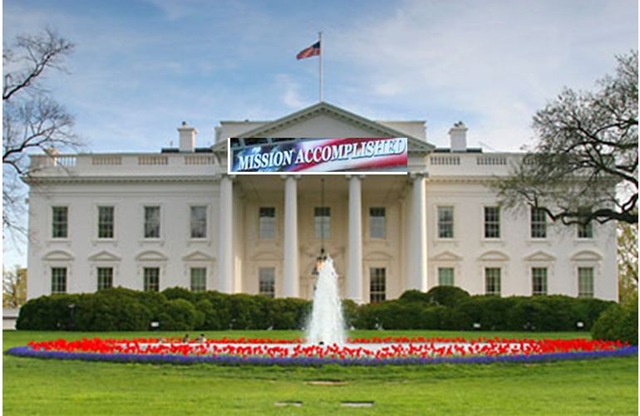
whiteHouse_missionAccomplished

(Fake photo credit:  Chris Jamison)

So the health care "reform" bill passed last night, complete with payoffs, abortion funding and fake projections of "savings" required to try to pass it via reconciliation.  And in an entirely "unipartisan" manner.  (Even the New Deal had bipartisan support.)

So what does this mean for American politics?  Glad you asked.

  • There is now a precedent for requiring Americans to buy something simply because they live here.  Automobile insurance is required in most states if you own a car.  Health insurance, however, is required, period.  Nice work if you can get it. 
  • The phrase "pro-life Democrat", at least (but not limited to) as it described Washington politicians, is now known to be an oxymoron.  The executive order Obama promised the Stupak group isn’t worth the paper it’s printed on.  (See here, here and here, please.)  An EO only applies to the executive branch, can be rescinded on a whim, and legislation always trumps it.  And in spite of whatever pro-life record they may have had in the past, the entire Stupak group sold its collective souls, principles and the lives of future generations for something they must know is less a fig leaf and more tissue paper.  (More on this from Betsy Newmark.  This is just unfathomable.)
  • Democrats can no longer legitimately complain about polarization or the lack of bipartisanship in Washington.  No doubt they will, mind you, but they’ve completely lost the moral authority on the issue.
  • Gaming the CBO system for political gain, though I’m sure it’s been done before, has, by virtue of this massive bill, been raised to a new level of legitimacy.  A former CBO head wrote on Saturday that the numbers were so manipulated that what is claimed will be a reduction in the deficit of $138 billion is really more like an increase in the neighborhood of $562 billion.  The foundation for using the reconciliation process to pass this bill was that it reduced the deficit.  So the method used to pass the bill was based on a lie.  And this is not even including a $371 billion dollar Medicare bill that’s coming down the pike. 

Everything about this legislation — above and beyond the usual sausage-making that is the political process — is absolutely awful, regardless of its actual contents.  And its actual contents, once we have it, no matter how awful it turns out to be, is now with us for good.  (Barring a repeal, which is very hard to get the political will to do in Washington.)  If it’s an abject failure, or even it if just keeps the status quo at the cost of billions every year to run in place, it will not go away.  We’re stuck with this ball and chain.

And a parting "shot", if you will, from Michael Ramirez.  (Click for a larger version.)


Bullet points

More Gaming the System for Health Care Reform

The CBO numbers for the final final health care reform bill may look good (depending on your definition of "good"), but, as I’ve noted before, the numbers are gamed.  And now, here’s more sleight of hand going on.

Democrats are planning to introduce legislation later this spring that would permanently repeal annual Medicare cuts to doctors, but are warning lawmakers not to talk about it for fear that it will complicate their push to pass comprehensive health reform. The plans undercut the party’s message that reform lowers the deficit, according to a memo obtained by POLITICO.

Democrats removed the so-called doc fix from the reform legislation last year because its $371-billion price tag would have made it impossible for Democrats to claim that their bill reduces the deficit. Republicans have argued for months that by stripping the doc fix from the bill, Democrats were playing a shell game.

Remember, the CBO estimate is, for all intents and purposes, a minimum price.  As with all other big government programs, it will increase dramatically.

Why I Oppose the HCR Bill: We’re Broke

Remember that “lock box” that Social Security money was in?  Well government, as government is wont to do, has already raided it over the years, treating Social Security funds as its own private slush fund and left IOUs in there.

This year, for the first time since the 1980s, when Congress last overhauled Social Security, the retirement program is projected to pay out more in benefits than it collects in taxes — nearly $29 billion more.

Sounds like a good time to start tapping the nest egg. Too bad the federal government already spent that money over the years on other programs, preferring to borrow from Social Security rather than foreign creditors. In return, the Treasury Department issued a stack of IOUs — in the form of Treasury bonds — which are kept in a nondescript office building just down the street from Parkersburg’s municipal offices.

Now the government will have to borrow even more money, much of it abroad, to start paying back the IOUs, and the timing couldn’t be worse. The government is projected to post a record $1.5 trillion budget deficit this year, followed by trillion dollar deficits for years to come.

The BigGovernment website, noting this, says there are 2 choices on how to raise this money; taxes and borrowing.  Those are the one mandated by law, but there is another option; change the law and renege on the promise.  (I didn’t say it was a good option.)  No one wants to do any of that, but the combination of a promise made, irresponsible spending on all sorts of “good” programs, and a down economy have combined to create this mess.  And now we’re broke, and our children are going to have to pay the price for our excesses.

All this is foreseeable with health care reform as well.  The creeping socialism of Europe has led it to insolvency as well.  Will somebody please learn from history.  Recent history?

And if you weren’t already realizing that the Democrats were gaming the numbers to make the costs look good, this report should (hopefully) jolt you into reality.

A new congressional report released Friday says the United States’ long-term fiscal woes are even worse than predicted by President Barack Obama’s grim budget submission last month.

The nonpartisan Congressional Budget Office predicts that Obama’s budget plans would generate deficits over the upcoming decade that would total $9.8 trillion. That’s $1.2 trillion more than predicted by the administration.

We’re broke, folks, and we’re issuing a credit card to our kids, and using it to fund our own out-of-control spending.  The money’s not there.  It’s gone.  It’s long past time to wake up to this fact before we follow Europe into the black hole.

Why I Oppose the HCR Bill: Cost Estimate is Really a Minimum

As events continue to unfold while the health insurance reform bill comes either to a vote or a train wreck (or both), I want to hit on a few main reasons why I’m against the Democrats’ idea of "reform".  Today, it’s the money.

Obama has said that whatever he signs must be either deficit-neutral or indeed reduce it, and the claims are that this bill will do just that.  In fact, it’s one of the reasons Democrats say that using reconciliation — typically used for deficit reduction — is appropriate.  They point to the CBO numbers for the bill as coming in under $1 trillion for the first 10 years, while generating savings that would go beyond that.

But here’s the thing. 

First of all, they’re gaming the CBO system.  By putting off any real serious spending for 4 years or so, while collecting taxes in anticipation of the spending, the real cost of the program is hidden.  To find the real estimates, click here to hear Democratic Senator Max Baucus give a better number for it; $2.5 trillion.  The difference?  In his words; if you start counting from the year 2014.  Knowing that the CBO rules only look 10 years out from bill passage, Democrats have crafted the timetable to favor a low CBO number, and they trumpet this fake number on the talk shows.  At least we have Senate video to show that they do know better, but they’re just hoping their constituents aren’t paying attention (which it looks like they aren’t).

Second of all, government programs virtually always cost more than original estimates, whether this is because the first estimates were faulty or gamed, or whether folks like the giveaways so much they ask for more, or whether politicians buy votes by increasing benefits.  The "experts" who were estimating the cost of Medicare back in 1966 — when it cost $3 billion — said that by 1990 it would cost $12 billion, allowing for inflation.  Instead they were off by almost 9 times; it was $107 billion.  And in 2007, it was costing us $431 billion.  For just 1 year.  Even after cost cutting measure like reducing payments to doctors, which then causes some doctors to leave the Medicare market.  (Follow the link for other medical cost underestimating.)

So in order to get this past the American people, Democrats are massaging the data to fit the narrative, while knowing full well (if they have any knowledge of history at all) that they are low-balling by an order of magnitude or more. 

It’s not just the cost estimates; it’s the disingenuousness and outright lying that is going on that should give any supporter pause as to what it is they’ve bought into.

Political Cartoon: Burning Through Debt

From MIchael Ramirez (click for a larger version):

Why does Obama think he can avoid the same fate while piling up the same kind of debt? 

Funding Failures, Suffocating Successes

In one of the McCain/Obama debates, candidate Obama promised this:

So there are some — some things that we’ve got to do structurally to make sure that we can compete in this global economy. We can’t shortchange those things. We’ve got to eliminate programs that don’t work, and we’ve got to make sure that the programs that we do have are more efficient and cost less.

OK then, how about the Head-Start program?  Does it work?  Not according to HHS.

“Head Start,” the flagship pre-kindergarten program introduced in 1965, has been a $166 billion failure. That’s the upshot of a sophisticated multi-year study just released by the Department of Health and Human Services.

An earlier iteration of the study, published in 2005, had found a few modest improvements in the language skills of participating students while they were enrolled in the program. But by the end of the first grade, even those few effects have disappeared, according to the follow-up released this month. Out of 44 separate cognitive tests given to former Head Start students at the end of the first grade, only two showed even marginally significant effects. The other 42 showed no statistically significant effect at all.

But even that overstates the case for Head Start. That’s because, on each of the 44 separate tests, there is a 1 in 10 chance of a false positive: a test result that appears to show a positive impact but is really just a random fluke. With so many test results, we’d expect to see at least a few false positives. Statisticians have ways to control for this problem, and when the authors themselves applied such a control, they found that the two apparently “significant” effects vanished.

What’s more, this applies to all the non-cognitive tests administered to students as well. After controlling for the likelihood of false positives, the study’s authors found no “socio-emotional” benefits and no “parenting practice” benefits either. No benefits to Head Start of any kind at the end of first grade. None.

Government education programs just give liberals the warm fuzzies, but we’ve spent half a century dumping money down this particular drain and no Democrat worth his NEA card would dare touch it.  Certainly President Obama won’t; he increased funding by more than a full one-third last year, and he shows no sign of stopping.

We’re not getting our money’s worth with Head Start, so how about funding another program that shows demonstrable results?

But President Obama and Congress have already had a golden opportunity to show that they will heed their own scientific evidence, supporting what works and what is efficient: the D.C. private school voucher program. The latest Department of Education study revealed that after attending private schools for three years, voucher-receiving students were reading more than two grade levels ahead of the randomized control group who had remained in public schools. What’s more, the average voucher value was a mere $6,600, compared to D.C. per-pupil education spending of over $28,000.

What did Congress do to the program that has proven itself dramatically more effective and many times more efficient than D.C.’s public system? They decided to sunset its funding, effectively killing it. What did President Obama do to save it? Nothing. He let it die despite having previously said that “if there was any argument for vouchers it was, ‘Let’s see if the experiment works.’ And if it does, whatever my preconception, you do what’s best for kids.”

Or not.

Don’t listen to what they say, watch what they do.  Democrats kill education programs that work and pour money into those that don’t.  The voucher program is a classic conservative, free-market approach to education, and it works.  We need more policies like it.

Defense Spending: Not As Much As You Might Think

What if I told you that we’re spending as much on defense now as we were when Jimmy Carter was President?  Yeah, I’d laugh, too.  But the Cato Institute notes that, as a percentage of the gross domestic product, defense spending is indeed at late-1970s levels.

What’s also interesting to see is that non-defense spending, by the same measure, having stayed at about the same percentage of GDP for 30 years or so, has skyrocketed under Obama.


(Click on the image for the accompanying article.)

Defense spending, a constitutional role of government, is really not the problem when it comes to our national debt.  Just an FYI.

Borrowing Our Way to Prosperity

Democrats carped over the big spending of the Bush administration.  (True conservatives did, too, by the way.)  But when they got the reins, both the White House and Congress, Democrats made Republican spending look positively thrifty.

When they have lots of money, Democrats spend money on all sorts of government programs.  And when we have less money, as in this recession, Democrats spend money on all sorts of government programs.

Rep. James Clyburn (D-S.C.), the House majority whip, said that trying to find greater savings in the budget, which was released by President Barack Obama this morning, wouldn’t help alleviate the recession.
“We’ve got to make some decisions here as to what’s in the best interests of our country going forward,” Clyburn said during an appearance on Fox News. “And I think the best interest is to invest in education, control these deficits, while at the same time trying to get people back to work.”

“We’re not going to save our way out of this recession,” the majority whip added. “We’ve got to spend our way out of this recession, and I think most economists know that.”

But Chuck Bentley, CEO of Crown Financial Ministries, has a different take on the issue.

The government is almost insolvent already because it borrows more money than it takes in. The government is trying to spend its way out of economic trouble.

Washington is not spending cash reserves, its spending borrowed money. We’re borrowing money to solve a problem caused by borrowing too much money. We’re borrowing from foreign sources. Spending is out of control. The only way to fund it is to raise taxes, borrow, or print money. None of those strategies will lead to economic health.

The Democrats are looking at the ends and forgetting all about the means they’re using to achieve them.  Indeed, Obama’s new budget spends a record $3.8 trillion dollars.

The spending blueprint for next year calls for tax cuts for workers and business and more aid for cash-starved state governments as well as the unemployed. The jobs initiative largely mirrors last year’s stimulus bill, but is about one-third its size. The president is asking for nearly $300 billion for recession relief and job stimulus.

The budget paints a remarkably dire picture of a federal government that will have to borrow one-third of what it spends next year as it runs a deficit that still would total some $1.3 trillion.

This from the guy who says he’s trying to reduce deficits.  

Please read all of Chuck Bentley’s article.  He goes over his 5 predicted trends for 2009 (which were all very much on the money, so to speak), and he goes over his 5 trend predictions for 2010.  It’s very likely we’re not out of the woods yet, and government isn’t really helping.

Chuck’s advice to Americans, and America’s government, is the same; get your financial house in order first.  Maxing out your credit cards when you’re already deeply in debt, on the assumption that things are going to get better, is a risky bet.  Just ask banks that bought those (now) toxic home mortgage securities.  Here’s his #5 trend prediction:

The mid-term elections will be a pivotal moment for the economic direction of our country. I don’t want to get into politics, but the problem is the U.S. is increasing its debt while people are trying to get out of debt. There are big differences in what people see as the solution. The population is trying to get its house in order while the government tries to spend its way out of trouble. The U.S. dollar has lost value because of government’s fiscal irresponsibility. The government can only get money by taxing, borrowing, and printing money. More programs mean more money is needed to fund them. That means government will print more money and further devalue the dollar. You can’t become prosperous through government spending. Elected officials from both parties treat the dollar as if it were Monopoly money. When taxing and borrowing isn’t bringing in enough money, government will print it. That will lower the value of the dollar, and devalue your savings. Our elected leaders are living foolishly. We should vote for those seeking office who pledge to be good stewards of the money the people supply the government through taxes. They should act as trustees that are committed to protect the people by making sure the government lives within its means. Work with all your power to get the government to live within its means. The mid-term elections will indicate the direction of the country. If we’re not successful in electing good stewards, a very painful correction is coming.

If that correction comes, be sure government will misread the reasons.  Just get educated yourself.

Could Heath Care Be the Enemy of Education?

That’s what writer Keith Baldrey is asking.

Is health care becoming the mortal enemy of our country’s education system?

I don’t pose this question facetiously. When we’re discussing public services, it’s important to remember that at the end of the day, everything comes down to money.

And it is obvious that health care is increasingly getting that money at the apparent expense of other public services – most notably education.

In fact, our health-care system’s voracious and unending appetite for tax dollars is crowding out spending in all sorts of other areas.

That’s a fair question.  We don’t yet have a system like Canada’s, for example, but we do have tax dollars that do go into heath care.  But is it really that bad?  Is there really that much of an issue of having to decide either health care or education?

We no, not really.  As James Taranto notes:

If only we had a single-payer system like Canada’s . . . Oh, wait! Baldrey’s article is about Canada’s system. It appears in the Surrey (British Columbia) Now.

And be thankful that it won’t be.

A Winning Economic Policy

Over my Christmas vacation, while I wasn’t blogging much, I was still watching the news and bookmarking articles to cover later on.  Today I’m using one of those bookmarks.  While the original story itself is a bit stale, the concept is what I want to focus on.

From “Investor’s Business Daily” on December 4th:

Chile is expected to win entry to OECD’s club of developed countries by Dec. 15 — a great affirmation for a once-poor nation that pulled itself up by trusting markets. One thing that stands out here is free trade.

(And they did, as this the OECD website notes.)  So how did they do it?

Chile is the first country in South America to win the honor, and in a symbolic way its OECD membership card seals its exit from the ranks of the Third World to the First.

For the rest of us, it’s a stunning example of how embracing free markets and free trade brings prosperity.

It’s not like Chile was born lucky. Only 30 years ago, it was an impoverished country with per capita GDP of $1,300. Its distant geography, irresponsible neighbors and tiny population were significant obstacles to investment and growth. And its economy, dominated by labor unions, wasn’t just closed, but sealed tight.

In the Cato Institute’s 1975 Economic Freedom of the World Report it ranked a wretched 71 out of 72 countries evaluated.

Today it’s a different country altogether. Embracing markets has made it one of the most open economies in the world, ranking third on Cato’s index, just behind Hong Kong and Singapore. Per capita GDP has soared to $15,000.

Besides its embrace of free trade, other reforms — including pension privatization, tax cuts, respect for property rights and cutting of red tape helped the country grow not only richer but more democratic, says Cato Institute trade expert Daniel Griswold.

But the main thing, Griswold says, is that the country didn’t shift course. “Chile’s economy is set apart from its neighbors, because they have pursued market policies consistently over a long period,” he said. “Free trade has been a central part of Chile’s success.”

Free trade and free markets.  Chile is on the economic rise, while Venezuela, deep into Hugo Chavez’s socialist experiment, has been left to rationing, lately of water and electricity.  It’s quite clear that capitalism is beating out socialism handily, and yet we in the US keep trying to move closer to the losing side of the ledger.

I think one of the reasons we’re doing this is because of the concept that the perfect is the enemy of the good.  Because things are not perfect, we try to make them that way, via government, rather than let the market (i.e. the people) work things out themselves.  In the US, those on the Left saw that people were not getting health care in some cases, so they decided that government must step in to do it.  Never mind that charitable organizations exist to handle much of this, and never mind existing laws that guarantee health care even to those who can’t pay; it wasn’t up to the par they expected, so, by their lights, government must step in.

When government keeps stepping in like this, you get Venezuela.  My concern, borne out by so many reports of sub-par health care in Canada and the UK, and evidenced by Canadians who come here for care when theirs fails them, is that our overall level of care in our country will fall while we give government more and more power over our lives.  While the poor in Venezuela may have marginally more social care given to them by the government, overall, the socialist approach to anything leads to what Churchill described as “shared misery”.

The result is further from perfect than the previous good was for the people as a whole.

Chile, however, has lifted itself up with free markets and free trade.  Congratulations to them.  I hope the world is watching.

 Page 13 of 23  « First  ... « 11  12  13  14  15 » ...  Last »