
Religion Archives

50 leaders of the evangelical generation: #13 J. I. Packer. Wise counselor.

[I am working on a project that may become a book on the most influential evangelicals leaders of our generation, since 1976, and the impact they’ve had on the church and their times. I will introduce them briefly on this blog from time to time. Who should be on this list?]

#13. J.I. Packer, Wise Counselor b. 1926
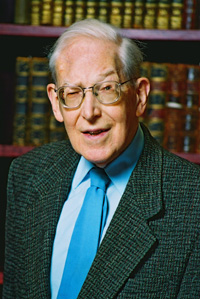
It is surprising to first meet J.I. Packer in his academic setting, an unassuming room at Regent College in awe-inspiring Vancouver. My first impression was “Mr. Rogers Goes to College.” But then, of course, Packer speaks and you begin sense the wisdom of the ages in one of Christendom’s wise and courageous thinkers.

The son of a clerk for Britain’s Great Western Railway, Packer won a scholarship to Oxford University, where as a student he first met C.S. Lewis, whose teachings would become a major influence in his life. In a meeting of the Oxford Inter-Collegiate Christian Union, Packer committed his life to Christ. Throughout the years Packer, like Lewis, taught and demonstrated that orthodoxy is the friend not the enemy of cross-cultural and cross-denominational engagement.

The Anglican scholar is one the most significant evangelical theologians of the last one hundred years and hHe has had a strong influence through his many book and lectures on many Christian renewal movements in the U.S. and worldwide. He has helped Christians in their pursuit of Knowing God, the title of his influential 1973 best seller, which taught the simple, deep truth that to know God is to love His Word..

A 2009 essay collection edited by Beeson professor Timothy George concludes that he “should be seen fundamentally as a “theologizer,” a “latter-day catechist,” a Reformed prophet standing in the tradition of Irenaeus, Augustine, Calvin, Baxter, and Owen.”

Packer has said “the numeric growth of evangelicals, which has been such a striking thing in our time, is likely never to become a real power, morally and spiritually, in the community that it ought to be if it does not embrace a God-centered way of thinking, an appreciation of his sovereignty, an appreciation of how radical the damage of sin is to the human condition and community, and with that, an appreciation of just how radical and transforming is the power of the Lord Jesus Christ in his saving grace.”

His collegial manner can mask what would otherwise be seen his conservative, even “right wing” beliefs. After being ordained in the Anglican church, Packer soon became recognized as a leader in the evangelical movement in the Church of England. In 1978, he signed the Chicago Statement on Biblical Inerrancy, which affirmed the conservative position on inerrancy.

In a 2009 discussion Mars Hill pastor Mark Driscoll found Packer to be “clear minded at age 82 and he remains incredibly conversant, insightful, and witty. Impressively, his words are impeccably precise.” During that visit, Packer explained his strong opposition to homosexuality on biblical grounds, and he said the teaching that Christians can remain practicing homosexuals is heresy because it denied the basic tenet of repentance.

Packer has also been engaged in some of the most important statements of evangelical engagement, including his decision to sign the Evangelicals and Catholics Together document in 1994. He is perhaps the most influential evangelical theologian to call for stronger ties between evangelicals and Roman Catholics, but he believes that unity should not come at the expense of orthodox doctrine. Nonetheless, his advocacy of this ecumenism has brought sharp criticism from some conservatives.

Packer served as general editor for the English Standard Version of the Bible (2001), an Evangelical revision of the Revised Standard Version of 1971. He is a frequent contributor to and an executive editor of Christianity Today.

[I am working on a project that may become a book on the most influential evangelicals leaders of our generation, since 1976, and the impact they’ve had on the church and their times. I will introduce them briefly on this blog from time to time. Who should be on this list?]


#39 Andy Miller. Happy Salvationist b.1923

Until a deck collapsed at a suburban Atlanta outing in 1995–injuring a number of Salvation Army leaders, including the man they still call Commissioner–Andrew S. Miller bounced with the exuberance and optimism of young man, belying his 80 plus years. Andy Miller is a renowned former leader of The Salvation Army in the U.S., a denomination best known for its quaint Christmastime bells and kettles, the sum of which—-together with other fundraising—-makes the “Army” among the nation’s largest and wealthiest charities. Its ubiquitous social services are highly respected in America and around the world and, while its tightly organized personnel live modestly and its use of funds is above board, the group raises more than $3 billion annually and has U.S. assets worth more than $10 billion, buoyed by its church buildings, community centers, and alcohol and drug rehabilitation centers.

Few people know that the Army is primarily and at its core an evangelical church in the holiness tradition, with 1,200 congregations (called corps) in the U.S. It is a deeply conservative expression of Methodism, begun by disaffected Methodist minister William Booth and his wife Catherine in 1865 as an evangelistic outreach to the down and out in English cities. Its uniformed leaders rarely rise to the level of public recognition because at every level, from most junior officer (minister) to the international general, its leaders are rotated every few years. It’s a discipline introduced by Booth to guard against complacency. U.S. leaders (called national commanders) are no different, but in the modern era one national commander, Miller, stands above others because of his effervescent personality and his uncanny ability to connect “Sallies” to the outside world.

Andy Miller’s two strongest contributions to the evangelical movement: He is part of the leadership that has pursued a seamless connection of the church’s evangelistic and social service heritage. And he bucked the separatist impulse of the most conservative churches and reached out to secular leaders–at the same time he stroked the hair and provided food and shelter for the poorest of the poor.

Miller, who held many positions during his 47-year career and served as the national commander from 1986-89, made it a priority to maintain the church’s historic connection of evangelism and social service. He resisted bifurcation of the church and insisted that its social ministry must be evangelistic and its evangelism must include a social service delivery system. “When we do it right,” Miller said, “you can’t tell the difference.”

This breadth was captured in The Salvation Army’s longtime slogan: “Soup, Soap, and Salvation. There is ongoing concern that the social will eclipse the spiritual, and today some in the church are concerned that the national command’s recent approval of the more secular slogan “Doing the Most Good,” may signal that slide. That worry is magnified because the social service effort is so large and the church body that meets in worship each week is relatively small in the U.S.

Although the The Salvation Army’s work can be found in nearly every region of the country and in communities large and small, its people—particularly its staff and clergy–are relatively insulated from both secular culture and the larger evangelical church. Salvationists have traditionally found their worship, social interaction, church conferences, even summer camping and recreation within the denomination, and adherents have traditionally found their marriage partners within the group. These trends have shifted in recent years and the U.S. membership is stagnant, even as giving has increased—bucking national trends.

In the midst of this insular subculture, Miller had an expansive tenure that introduced the church to the powerful and influential of his time. He had a commitment to bear witness about Christ with at least one person every day. After telling President Reagan about this in a meeting, Miller was called back to the White House several weeks later. The President wanted to tell the Salvationist leader that he had taken the opportunity to witness to Soviet President Mikhail Gorbachev in a face-to-face meeting. In private, Gorbachev told Reagan that his grandmother had him baptized as a young boy and that she had told him about Jesus.

Miller found ways to befriend powerful men as easily as others. He was an usher at Robert Kennedy’s funeral because he met and formed a friendship with the former U.S. Attorney General while jogging on the streets of New York City.

“He is a Salvation Army original,” his biography reads,” and at the same time a symbol of the Army, keeping the Army true to the Army, to its birthright and mission. His life story is the miracle of a bush that burned with fire and yet was not consumed.”

Priest Child Abuse Cases: Some Perspective

Jim Finnegan, writing in the Naples (Florida) News, was responding to some folks who had commented on his original article on the Catholic Church priest child abuse cases.  Apparently, some folks read his words and though he was saying something directly opposite to them.  In his follow-up, he first had to give the obligatory disclaimers that he’s not excusing anyone, but he quoted some information that puts this all in perspective.

Charol Shakeshaft, a researcher of a little remembered 2004 study for the U.S. Department of Eduction [sic] on the physical sexual abuse of students in schools, pointed out " the physical sexual abuse of students in schools, is likely more than 100 times the abuse of Priests." I am sure this is easy to Google for the entire study should you wish.

Shakeshaft also pointed out that "nearly 9.6% of students are targets of educator sexual misconduct sometimes durin [sic] their school career." Creditable accounts of Priestly abuse occured [sic] from but 1.7% of the total Priests in the U.S. Thankfully, Shakeshaft’s study is now being revisited by news commentators seeking to restore some sense of proportion to the media’s aggressive coverage of the Catholic Church.

While Priestly sex abuse can never be mitigated by these figures, they do point out the gross imbalance, and bring question to the motives of the news media that are pouring resources into digging up decades old dirt on the Church. Sadly,the nerative [sic] that has been constructed is often less about the protection of the young (for whom the Catholic Church is, by empirical measure now the safest environment for young people in America today

Aside from Finnegan’s need for a spell checker, this does point out a stark double standard in play, by both liberals and the media (apologies for the repetition).  Just going by numbers, you’d think there would be more coverage about abuse in schools, which (if you don’t homeschool) have a mandatory attendance requirement, vs. church, which is entirely voluntary.  Not to mention the fact that the school abuse continues while…

The facts show that Priestly sex abuse is a phenomenon that spiked in the mid 1960’s into the 1980’s. This at the time that the "anything goes" sexual revolution began. These are the old cases that the media has chosen to resurrect in their recent attacks on the Church.

Again, none of this should be construed as excusing anyone of these horrible deeds.  But a little perspective is in order, and the media, since it goes against "the narrative", is simply not providing it. 

God Observes “Everything is Mine Week”


AP Photo/Icelandi Coastguard

AP Photo/Icelandi Coastguard

Halldor Kolbeins/AFP/Getty Images


An Alternative Observation of Earth Day

As parts of the nation prepare to observe Earth Day, it has occurred to me that we may be observing The Earth is Mine Week.  With a well-placed volcanic eruption, God may be accomplishing three things:


 1.       In the face of slow action by humankind, God temporarily addresses global warming with volcanic ash that may lower worldwide temperatures for a time. 

2.       To provide an example of how people can slow down for a few days, God closes European airspace, dramatically reducing  consumption (and the burning of fossil fuel) and helping people observe the Sabbath.  

3.       Makes a dramatic statement:  The Earth is the Lord’s and everything in it” Psalm  24:1. 


J

Spring Break Catch-up

I was on Spring Break vacation with the family last week, so other than my post-dated blog posts, I didn’t write much … well, anything.  But I did surf the web and kept track of some articles I wanted to highlight when I came back.  Here they are, in mostly chronological order of when I found them.

Amnesty International decided that jihad was not antithetical to human rights so long as it’s "defensive". 

The bump in polling numbers after passing health care "reform" was supposed to go to Democrats.  Instead, while it’s just a measure of emotion at this point in time, you’d think that all the promises of the bill would give Democrats a few higher point.  Instead, they’re at an 18-year low.  It’s quite possible that people are only now understanding what they supported all along, because the "free" stuff isn’t materializing right now.

What was the point of the resurrection on Easter?  Don Sensing has (had) some thoughts.

The Tea Party’s ideas are much more mainstream than the MSM would like you to believe.  And Tea Partiers are much more diverse that the MSM realized.  Turns out, they did some actual journalism and found out the real story.  Imagine that.  Has the liberal slant of the press become a problem of corruption, especially with, first, the willful ignoring of the Tea Party story, and second, the willful misreporting of it?

Toyota cars have killed 52 people, and got a recall for it.  Gardasil, a cervical cancer vaccine, has had 49 "unexplained deaths" reported by the CDC and it’s still required in some states.

Changing the names to protect the guilty, the words "Islam" and "jihad" are now banned from the national security strategy document.  When the next terror attack Islamic jihadists happens, it’ll be interesting to find out how they describe it.

Cows have been exonerated of helping to cause global warming.  No, really.

Rep. Bart Stupak’s reversal of his principles is having the proper effect; he’s decided not to seek re-election.  Likely, he couldn’t get re-elected anyway, after betraying his constituents, but let this be a lesson about trusting "conservative" Democrats too much.

And finally, media scrutiny of church vs. state (click for a larger picture):

Media scrutiny

Oh, that liberal media.

[I am working on a project that may become a book on the most influential evangelicals leaders of our generation, since 1976, and the impact they’ve had on the church and their times. I will introduce them briefly on this blog from time to time. Who should be on this list?]

#5 Jimmy Carter. Born again President b. 1924

America had never had a presidential candidate, at least in the nation’s collective memory, utter the words: “I am a born-again Christian,” like the Georgia peanut farmer and Baptist Sunday school teacher Jimmy Carter did as he plied the towns of Iowa and the nation in an unlikely quest that resulted in his election as president. As a result of this bold declaration and public witness and the publication of Chuck Colson’s biographical account of his conversion, Born Again, Newsweek magazine declared 1976 the Year of the Evangelical.”

Jimmy Carter was different, and observers of his 1976 bid for the presidency readily recognized it. As a candidate, Carter spoke very openly and candidly about his faith, his commitment to Christ, his love for Scripture, and his desire to bring “a new spirit” to government. He quickly became a symbol of the rekindled religious and political vigor of American evangelicalism.

Carter said: “I’m a father and I’m a Christian; I’m a businessman and I’m a Christian; I’m a farmer and I’m a Christian; I’m a politician and I’m a Christian. The most important thing in my life beyond all else is Jesus Christ.”
Based on his Christian testimony and toothy optimism, I—like many other Christian belivers–supported Jimmy Carter in 1976 and delayed my final college work to become part of his Iowa campaign staff. I considered his election a harbinger of good will and healing for our nation, and marveled that such an outspoken Christian was sitting in the Oval Office.

As president, he continued to teach Sunday school, found occasions to share his faith with foreign leaders, readily admits in his post-presidential works that religion was an indispensable guide for his presidential behavior, and believes that Americans “have a responsibility to try to shape government so that it does exemplify the will of God.”

Regarding his frequent public displays of faith, church historian Martin Marty explained that Carter knows no other way to be. “Jimmy Carter is a public Christian…. It’s O.K. to be a private Christian in America, but he doesn’t know how to be a private Christian. Religion for him goes right to the streets, and he successfully relates his Sunday faith to his Monday world.”

My enthusiasm and optimism waned in the next four years, not because of any failure of presidential faith or moral fidelity, but because of a malaise that gripped the nation, Carter’s weakness during the Iran hostage crisis, and the fact that he never seemed to grasp the art of pulling the right levers of presidential power.

[After the campaign, the next time I was with Carter personally was during a Habitat for Humanity build in Chicago in the early 1990’s, when the odd couple of Democrat Jimmy Carter and Republican Chuck Colson swung hammers together to build homes for four poor but worthy Chicago families. On the first day of the build, Carter and Colson appeared together on the Today show in a live feed from the construction site. When Jane Pauley asked Colson what it was like to team up with Carter, Colson responded (with his remarkable ability to produce on the moment quips): “The last time I worked with a President I got one-to-three years [his prison sentence for Watergate]; this time I just got hard labor.”]

Although Carter failed to retain his early support of many evangelicals and was defeated by Ronald Reagan in 1980, the transparency of his Christian testimony—regardless of his politics—further emboldened evangelicals who were moving deliberately toward a greater role in public life and political action. Carter’s race for the nomination and his election to the presidency established for many the arrival of evangelicals as a new force on the American scene.

On Deadly Conflict

An interesting note from last nights reading. I had started reading American Rifle: A Biography. At the start of the book it notes that before the advent of the flintlock the American natives weren’t interested in firearms. But the flintlock change that, and the musket (later rifle) became a highly sought very expensive commodity item. Prior to that introduction, wars and conflicts between American native groups were based on enmity and for one 7 year conflict between two tribes resulted in 7 deaths. After the flintlock, conflicts were based not on enmity but on (economic) interest and became deadly. After 25 years, the number of combatants from one tribe dropped from 800 effectives to 300.

The point that enmity vs (economic) interest driving lethality is probably can be generalised and considered in the context of the popular opinion about European religious conflicts of the 15th-17th centuries.

Noetic Noah and the Fluffy Hermeneutic

This started as a reply about hermeneutic in the context of the flood on my personal blog. Do we take the flood literally or not. My interlocutor was exasperated exclaiming that to not take the text literally implies words have no meaning. This is exactly backwords. Here is my response to him.

Yes, you are exactly right. Words have meaning. There is this word hermeneutic, which I have used on more than one occasion used in this sentence. Yet, you gaily trounce in with replies like “Why start with the Bible at all? Why not just make up your own stories if that’s what you’re going to do anyway?” or other remarks along the “making it all up” line as if every religious person just takes their preconceptions and hammers the text until it fits. That is not what any honest theologian does (and I think the majority of people atheist or faithful are as honest as they can be). That word, hermeneutic means, “the method by which one extracts meaning from a text.” See that word there. Method. It is there for a reason. Read the rest of this entry

Child Abuse: Getting Some Perspective

From George Weigel at First Things:

The sexual and physical abuse of children and young people is a global plague; its manifestations run the gamut from fondling by teachers to rape by uncles to kidnapping-and-sex-trafficking. In the United States alone, there are reportedly some 39 million victims of childhood sexual abuse. Forty to sixty percent were abused by family members, including stepfathers and live-in boyfriends of a child’s mother—thus suggesting that abused children are the principal victims of the sexual revolution, the breakdown of marriage, and the hook-up culture. Hofstra University professor Charol Shakeshaft reports that 6-10 percent of public school students have been molested in recent years—some 290,000 between 1991 and 2000. According to other recent studies, 2 percent of sex abuse offenders were Catholic priests—a phenomenon that spiked between the mid-1960s and the mid-1980s but seems to have virtually disappeared (six credible cases of clerical sexual abuse in 2009 were reported in the U.S. bishops’ annual audit, in a Church of some 65,000,000 members).

Yet in a pattern exemplifying the dog’s behavior in Proverbs 26:11, the sexual abuse story in the global media is almost entirely a Catholic story, in which the Catholic Church is portrayed as the epicenter of the sexual abuse of the young, with hints of an ecclesiastical criminal conspiracy involving sexual predators whose predations continue today. That the vast majority of the abuse cases in the United States took place decades ago is of no consequence to this story line. For the narrative that has been constructed is often less about the protection of the young (for whom the Catholic Church is, by empirical measure, the safest environment for young people in America today) than it is about taking the Church down—and, eventually, out, both financially and as a credible voice in the public debate over public policy.

I guess one question would be, if the Pope’s fair game, why not the US Secretary of Education?  If not, why not?

Flipping Theodicy Sans Pangloss

Jim Anderson considers my turning the Theodicy question around. He suggests that this, in essence, means this is the “best of all possible worlds.” Now I suppose that could be a charge put to an omnipotent Good God, that is if this is not a Panglossian utopia … why not? But my claim in flipping theodicy was weaker than that. Let me try to isolate more abstractly (or succinctly) the question I had posed.

  1. God wishes the love of his creatures. Love cannot be coerced his creatures must be free willed.
  2. Following Kass’ arguments in The Beginning of Wisdom: Reading Genesis from Genesis 1, creation is (and should therefore be) reasonable, that its workings comprehensible to rational creatures.

So, we have a rationally understandable universe in which creatures within it can do evil things if they choose. The ‘trap’ here for your omnipotent God wanting to prevent evil is the brute force approach is unworkable. That is if somehow an evil person, say SW (Snidely Whiplash), is prevented by deus ex machina or Rube Goldbergian coincidence every time he attempts acts of gratuitous violence they fail that this will make it impossible for a rational person to reject God.

Mr Anderson brings 6 points to bear.

  1. His first point is one of imagination. He cannot imagine a rational universe with free willed actors without evil. He asks if his failure of imagination “imagine a world you can’t imagine” is a problem.
  2. A “rigorously logical attempt will be confounded by the Butterfly Effect” … is an objection I don’t understand.
  3. Point three (that there might be too much gratuitous evil in the world) argues that this is likely not the “best of all possible words”, a point I am not defending.
  4. Point four reflects on point 3.
  5. His fifth point is incomplete, considering that an “inversion of the Ontological Argument” might be necessary when considering the inversion of the Theodicy problem.
  6. Is a self-directed ad hominem. That is, the evil in the world reflects really really poorly on us men and if it is indeed necessary it is callous to think that men have been, perhaps, constructed so that we were more naturally nice fellows.

This last point offers perhaps a clue as to where we might find a better universe, that is one populated by men less inclined to do evil?

The comments in his post trend toward mathematical thinking and I’ll offer one mathematical comparison. A school of mathematics is not happy with the method of proof by contradiction. A proof by contradiction demonstrates a fact not by construction but by demonstrating that a thing is impossible without really pointing to exactly why, i.e., by demonstrating that implications of a thing lead to a contradiction.

This “turnaround” of theodicy is perhaps similar, in that it suggests that assuming the opposite that is that a better universe is possible leads to a problem, that is our constructions of better universes have inherent contradictions, i.e., SW is magically ineffective.

[I am working on a project that may become a book on the most influential evangelicals leaders of our generation, since 1976, and the impact they’ve had on the church and their times. I will introduce them briefly on this blog from time to time. Who should be on this list?]

#40.Russ Reid. Fundraiser b.1935

Follow the money. When you do in the evangelical sector over the last generation, following the money that it took to launch and support many of the great ministries and missions and projects of the time, the trail would take you to and through the offices of a fast-talking Californian with a sparkle in his eyes and many new ideas for funding mission: Russ Reid.

For many today, Russ Reid is the name of the firm, with little notice that it is also the man who launched the firm and remains a fascinating study. Russ Reid is the founder and leader of the first of the large fund development agencies that became partners with Christian organizations, using direct response fundraising to find support for their work. Russ said: “There is no shortage of money, only a shortage of well-articulated causes.”

Russ Reid has helped articulate a lot of causes.

Originally he had trained for the ministry, but finally realized that he was more of a marketing guy than a pastor. In the late 1950s he went to work for Word Publishing in Waco, Texas. There he learned all about direct response through book-of-the-month clubs and by marketing books through direct mail. Along the way, he noticed some wonderful organizations doing great work to help others, but they didn’t know how to tell their own stories, or how to raise money.

Russ had a vision—to start a company that would help nonprofit organizations make a bigger difference in the world. He founded the Russ Reid Company in 1964, and Word Publishing became his first client. Later he moved the company to Park Ridge, Illinois, and worked with small ministries as he got up and running. In 1966, Russ was able to get a project from World Vision. At that time, World Vision was conducting projects around the world on an annual budget of about $5 million (today they’re approaching $2 billion in annual revenue).

In 1972, as his work with World Vision increased, Russ decided to move from Chicago to Arcadia, California, near World Vision’s Monrovia headquarters. At that time, the way World Vision acquired sponsors was by speaking at churches and showing a film about the plight of children in the developing world.

Russ had an idea. He approached World Vision EVP Ted Engstrom and proposed that they film Art Linkletter traveling around the world and meeting these children in need, bring that film back, and instead of going from church to church, put it on television.

Ted Engstrom got approval from the board for this expensive, risky project, and reportedly said to Russ afterwards, “What will we do if this doesn’t work?” Russ laughed and said, “Ted, we’ll have the most expensive church film in history.”

It did work, beyond expectations, and the World Vision television specials were born–the first major television fundraising of their kind. Many of followed, and Russ Reid has been involved with many of them.

Over the last 40 years, Russ Reid’s little company has grown from one guy with an idea about helping people who help people, to what is now the largest agency in the world exclusively devoted to helping nonprofit organizations grow.

Russ says: “Giving life and health and hope to children in poverty, to the homeless, to people with cancer is significant work. It’s life-changing work. For me, it’s part of what gets me up in the morning, excited about coming to work.”

Theodicy Flipped

Theodicy is basically the question of how might a omnipotent good God permit bad things to happen to good or innocent people. This brings me to a question to which I have no good answer. Is there a better way of doing things than the sort of world in which we live? Qualities we consider the Trinitarian God posses include a notion that free loving relationships are of primary importance. God therefore loves us and desires us to love him. Love cannot be coerced but must be freely given. On the apologetics boundary, in discussions between those who believe and those who don’t, theodicy is pointed at as a discussion about whether or not God can exist or not given the existence of evil. But, this question can be turned another way. That is to ask given a God with certain properties does our world fit the expectations of the sort of world that God might create?

So, what properties do we think that a loving God who desires the free-willed love of his creation might possess? One might suggest that the following two qualities be present; that one might rationally choose to love Him and to rationally choose to not do so and that the creatures in that world be free to act against what He might wish. Furthermore observing that those creatures (us) that he has created are (nominally) rational, following Genesis 1 (and the Kass reading of the same) that it is good that the world in which we dwell be rational.

When one considers rape or murder of an innocent and natural disasters, those are typically the problems to which questions of theodicy are more clearly in evidence. These things occur in our world with regrettable regularity. So here’s the flip side theodicy question; that is, if you think theodicy inconsistent with the existence of a omnipotent loving Good God, how would creation differ if that was the case? Does a world in which natural disasters only strike the wicked allow for a person to rationally turn away from God? Does a world in which a rapist is halted by invisible forces allow that?

The claim is that theodicy is an intractable problem for the believer given the evil in the world. I think that this is not necessarily the case, but that those who object to the current state of affairs have failed to provide examples of a reasonable alternative world. Failing to do that means their theodicy objections lack force, that is they object to a state of affairs which may actually be exactly what is prescribed.

Clear The Stage

This song by Ross King was the special music last Sunday.  It asks some tough questions and points out some hard truths.  I knew I had to let folks know about it.

The words are below the fold, but they’re also displayed during the video.

"Clear the Stage", Ross King

Read the rest of this entry

Gnostics and Christian History

Dan Brown is just the famous and perhaps the least competent academically qualified person to link Gnosticism with Early Christian theology. The popular notion is that gnosticism is a Christian heresy, that was suppressed and/or attacked an ultimately eliminated in conflict, irenic and not so much, during the early church. In my recent class on the New Testament, we were taught about the ideas of one of the leading authorities on Gnosticism, Birger Pearson who argues something different. Gnosticism was not a Christian heresy. It was a completely separate religion which in fact predated Christianity.

Gnosticisms primary beliefs include:

  1. Belief in an overarching monadic God.
  2. Creation was not performed by the overarching deity but by a demiurge, a lesser (demonic) deity. Material creation, being ruled and controlled by mostly demonic entities is not good.
  3. The goal for the eternal mortal essences is to escape and transcend the material creation. The secret teaching and knowledge (gnosis) is how this is the method by which this is accomplished.

This is a different religion. Gnosticism was very syncretic. It brought in different and other religious traditions into their mythologies for their purposes.

Some striking differences between Christian stories. The archon (demiurge) creating and in charge of Earth was known as the “Child of Chaos”, the Fool, and/or the Blind God. Similarities between this and either the Hebrew unnamed God or the Christian Trinity are not slight. In the Garden of Eden story, in gnostic tradition, the villain of the piece was the God of the garden and the hero? Satan, the serpent.

Early Christian theologians contended against gnosticism, but not as a Christian heresy but as a competing but different religion.

50 Leaders of the Evangelical Generation: #29 Ron Sider. The Liberal

[I am working on a project that may become a book on the most influential evangelicals leaders of our generation, since 1976, and the impact they’ve had on the church and their times. I will introduce them briefly on this blog from time to time. Who should be on this list?]

Ron Sider. b. 1939

Since Ron Sider published Rich Christians in an Age of Hunger in 1977, he has provided direction and support for evangelicals focusing on poverty, social justice, pacifism, and the environment. Sider, both personally and through the small and lightly funded organizations he founded, has represented the northstar of the small group of evangelical liberals that from time to time prod the right-leaning community with a necessary nudge to include the last, least, and lost in the outreach of the church. One thing Sider has never done is deviate from both the core doctrines and the central cultural issues of the movement; he demonstrated this by signing the Manhattan Declaration in 2009. This was consistent with his lifelong pro-life stance. In fact, Sider’s Completely Pro-Life, published in the mid-1980s, calls on Christians to take a consistent stand opposing abortion, capital punishment, nuclear weapons, hunger, and other conditions that Sider sees as anti-life.

As Tim Stafford wrote in Christianity Today:

Ron Sider doesn’t seem the type to upset people. A short, balding seminary professor with a quick smile and thick glasses, he talks in a relaxed, low-voltage way. Professionally he is a hybrid, a historian who teaches theology and talks and writes about politics and economics. His academic credentials are exemplary: a Ph.D. in Reformation history Yale; articles published in prestigious journals. Theologically he is a heartland evangelical, deeply committed to an inspired Bible, to a passionate communication of the gospel and to a transforming personal faith. Politically he is mainstream Democratic party except for conservative stances on homosexuality and abortion. In short, Sider is no flaming radical. Yet it would be hard to think of another evangelical who has been more ardently criticized for being “radical.” In reality, Sider takes flak from both the Left and the Right, particularly when he upholds evangelical positions at ecumenical meetings. “I’ve been picketed twice,” he says, “by theonomists [who believe in applying Old Testament law today] in Australia, and in Minnesota by gay-rights [advocates].”

Sider has published over 22 books and has written over 100 articles in both religious and secular magazines on a variety of topics including the importance of caring for creation as part of biblical discipleship. Sider’s Rich Christians in an Age of Hunger was published In 1977. Hailed by Christianity Today as one of the one hundred most influential books in religion in the twentieth century, it went on to sell 350,000 copies. He is often identified by others with the Christian left, though he personally disclaims any political inclination. He is the founder of Evangelicals for Social Action, a think-tank which seeks to develop biblical solutions to social and economic problems.. He is also the Professor of Theology, Holistic Ministry and Public Policy at Palmer Theological Seminary in Wynnewood, Pennsylvania.

 Page 19 of 39  « First  ... « 17  18  19  20  21 » ...  Last »