
Archive for May 20th, 2010

Church in the Making: Valuable for ministry leaders, not just church planters

I’ve been handling publicity for a new book about church planting that I think should be of interest not only to those seeking to and thinking about planting a church, but also to anyone hoping to start something new to advance Christian mission.

Church in the Making by Ben Arment doesn’t mince any words, and it has the tone of a soldier who has fought the good fight and won, but at a high personal cost, with the sense that the battles could have been easier with better intelligence, and mourning the soldier-friends who he has seen fall around him.

I’ve never tried to start a church, but I knew even before reading this book that it is extremely difficult, with a high rate of failure. Arment demonstrates a passion for saving future church planters from heartache and failure; but in the process he writes some things that will undoubtedly rub church planting traditionalists the wrong way.

For instance, Arment writes:

“We have placed a dangerous label on church planting that puts tremendous pressure on planters to persevere through any and all difficulties. We call it faithfulness. But in many cases it should really be called stupidity.”

If you have plans to plant a new church, open a new campus, or help someone who is, you need to get and read Church in the Making. It is well written and an easy read. It’s worth your time.

But it is also valuable to people like me who are involved in starting and advancing Christian organizations, missions, and causes. I’ve seen a lot of the same mistakes that Ben describes in ministry start-ups of all kinds; and I’ve made a number of the mistakes myself. I wish I would have had Church in the Making to read several years ago.

I’ve marked nine different principles in the book that I’ve seen ignored by too many ministry leaders (myself included).

1. Plant in Fertile Soil

Arment: “Every community has an established degree of spiritual receptivity. When you plant a church on fertile soil, it springs to life out of the community’s readiness. When you plant a church on infertile soil, it chokes and gasps to survive. In this case, you have to stop planting and start cultivating.” (page 3)

2. Experience Produces Humility

Arment: “You can always tell a new, inexperienced church planter because he’s the only one who thinks he knows what he’s doing. The veterans show a humility that can only come from experience. It takes a year or two to knock the self-reliance out of the new guys.” (page 10)

3. A Dream and Hard Work are Not Enough
Arment: “Church planters are notorious for thinking that a great dream plus hard work equals a thriving church. But church planters fail all the time with this formula and have not idea why.” (page 46)

4. Build a Network First

Arment: “I’m convinced that when God calls a planter to start a church, he calls him either to start a social network first (which can take years) or simply to leverage the one he’s been building around him.” (page 81)

5. You Can’t Do It Alone

Arment: “When God creates a church in the making, he doesn’t just call one person to start it. He calls a whole network of people who have been growing pregnant with vision.” (page 137)

6. Properly Channeled Frustration is Good

Arment: “God uses frustration to shape a vision. This is what he did to Nehemiah. And this is what he did to me. If God doesn’t build up a tremendous amount of frustration within us, we’ll never have the passion to pursue his calling.” (page 158)

7. Don’t Let Cash be King

Arment: “The only thing worse than not pursuing your God-given vision is compromising your God-given vision for the sake of cash flow. Don’t let money do this to you.” (page 162)

8. Put a Good Staff to Work

Arment: “Senior pastors are notorious for under-estimating the potential of their staff, mostly because they overestimate their own potential. Creating systems in your church is a far better way to leave a legacy than building up yourself.” (page 191)

9. Many Tomorrows Do Not Include You

Arment: “The fruit of the gospel comes from building a church that can exist without you and beyond you. (page 193)

Grab this book. If you are in ministry work, whether or not you are a church planter, it’s likely there’s something in it that will shake your ministry world.

[See these reviews of Church in the Making at ChurchMarketingSucks, In My Head, and from Neil Tullos.]
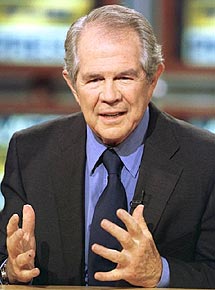
50 leaders of the evangelical generation. #9 Pat Robertson. Waves and airwaves

[I am working on a project that may become a book on the most influential evangelicals leaders of our generation, since 1976, and the impact they’ve had on the church and their times. I will introduce them briefly on this blog from time to time. Who should be on this list?]

#9 Pat Robertson. Waves and Airwaves b. 1930

Pat Robertson has always been full of surprises. Sometimes his surprise declarations play fairly well on the public stage: such as when he shocked the political establishment by not only running for president in 1988, but also placing second in the Republican primary in Iowa, which a decade earlier had been established as a viable first step for unlikely candidates when Jimmy Carter prevailed on its snow lined plains. Often his comments bring not acclaim but outrage, or at least as laugh lines on the late night shows. Sometimes his comments are careless and callous—such as his comments about Haiti’s pact with the devil, when tens of thousands of Haitians lay dead under earthquake rubble. At other times widespread mockery of Robertson is the result of broad exposure to earnest and widely accepted charismatic expression.

Like many other Christian leaders who brought faith to the nation’s largest stages during this generation, Robertson is a man of remarkable intellect and accomplishment. He built one of the nation’s largest media enterprises, and found personal fame and fortune as a result of his prowess.

“Pat” was born Marion Gordon Robertson to U.S. Senator A. Willis Robertson, a conservative Democrat from Virginia, and Gladys Churchill Robertson, a Southern belle and midlife convert to Christ. It was his mother who prodded and prayed for her son’s spiritual journey and she was instrumental in his conversion. He was raised as a Southern Baptist and later shifted to the charismatic movement.

While Robertson’s first and most significant corporate founding was the Christian Broadcasting Network (CBN), he also founded the American Center for Law and Justice (ACLJ), the Christian Coalition, Flying Hospital, International Family Entertainment Inc., Operation Blessing International Relief and Development Corporation, and Regent University. He has remained the host of The 700 Club since its founding (except for the several months when he stepped away to run for president).

His media and financial resources make him a recognized and influential voice for conservative Christianity. At the same time, the carelessness of some public statements have undercut his credibility and damaged the attractiveness internationally of the very faith he has sought to propagate.

After Robertson called for Hugo Chavez’s assassination, syndicated conservative talk show host Neal Boortz said to his evangelical listeners: “Do you realize how much damage Pat Robertson has done to evangelical influence in this country?” As Boortz pointed out, untoward statements by Robertson have not only been damaging on their face, but they have also provided ammunition to the opponents and critics of evangelicalism, including many media representatives.

Other controversies surrounding Robertson include his claim that some denominations harbor the spirit of the Antichrist and his widely misunderstood claims of having the power to deflect hurricanes through prayer. Using his broadcast pulpit, Robertson has also denounced Hinduism as “demonic” and Islam as “Satanic,” and called Israeli prime minister Ariel Sharon’s health crisis an act of God.

The week of September 11, 2001, Robertson discussed the terror attacks with Jerry Falwell, who said that “the ACLU has to take a lot of blame for this” in addition to “the pagans, and the abortionists, and the feminists, and the gays, and the lesbians [who have] helped [the terror attacks of September 11] happen.” Robertson replied, “I totally concur.” While Robertson and Falwell later issued apologies for their statements, the damage was done—particularly to Falwell‘s reputation and influence.

Less than two weeks after Hurricane Katrina killed 1,836 people, Pat Robertson again ventured to map out a divine hand, saying on The 700 Club that Hurricane Katrina was God’s punishment in response to America’s abortion policy. He also suggested that September 11 and the disaster in New Orleans “could… be connected in some way.”

Certainly, Robertson’s career cannot be characterized as a series of gaffes and misstatements. He is one of the most accomplished evangelicals of our time, and his multi-faceted empire has produced great good—often because of his drive and sometimes in-spite of it. CBN produces television programming in 80 languages to over 200 countries, and his Operation Blessing is the seventh largest private relief and development group in the world.

As one supporter, musician Charlie Daniels, said:

“Pat’s Operation Blessing plane is flown to back country third world locations loaded with doctors, dentists and other medical personnel who volunteer their time to bring free medical treatment to people who could never otherwise afford it. Imagine a child born with cleft palates and other disfiguring disabilities being shunned and teased for something they had absolutely no control over and no hope of ever having repaired. Then one day a big airplane lands with doctors who take them in and make them look normal. Or suppose you live in a village where you have to walk miles just to get a bucket of water and one day a crew shows up and with a drilling rig and drills a well right there in your village supplying the whole village with clean fresh water. Or suppose you’re hungry and someone feeds you or need clothes and somebody gives you some. Pat’s greatest accomplishment is all the lost souls he has helped find the salvation of Jesus Christ. He is a good man who serves his fellow man in a loving Christian way and some of his critics could learn some eternal lessons from him.”

Franklin Graham said at Robertson’s 80th birthday celebration: “I want to thank you for the integrity that you have brought to ministry, the standards that you have set of excellence.”

Things Heard: e119v4

Good morning.

  1. Spectacle and Art.
  2. The cross.
  3. Conservatism.
  4. And why do pundits so lack a clue? The tea party popularism is not a GOP movement, duh.
  5. The new theologian.
  6. Heh.
  7. Econ links.
  8. Our dysfunctional Senate.
  9. A site devoted to slamming the Grey Lady, defends it.
  10. Dissident or not?