
Political Cartoon: Who’s Running GM?
Tuesday, June 16th, 2009 at 1:45 pm
Comments Off on Political Cartoon: Who’s Running GM?
From Chuck Asay (click for a larger version):

No, really, nothing’s changed at all.
From Chuck Asay (click for a larger version):
No, really, nothing’s changed at all.
Some 32 years ago, a little typewritten paper was published which took 20 years for the consequences of that document to unfold. The US stood silent then. We stood silent 20 years earlier when tanks rolled into Hungary. It looks like some would ask us still to remain silent, yet again.
Clint Eastwood directed White Hunter, Black Heart some years back. In it there is a scene in which Eastwood’s character enters into a fight against a man who was, if memory serves really deserved it. Eastwood’s character (John Wilson modeled after John Huston and his filming of the African Queen) is soundly beaten. His companion wonders afterward if he thought he had any chance of winning. The reply was no … but some things one has to make a stand against. To disregard the consequences.
In Iran today people are wondering what to make of the Iranian election. Was it a modern miracle of non-automated clerical assiduous labor. Was it voter fraud or not?
Lots of people have been following this far more closely than I. Lots of people are more expert than I at the Iranian cultural and political situation.
What I would entreat is that we don’t do the “pragmatic” thing, or the politically expedient thing. We (the US and the world that is not-Iran for that matter) should stand up for what is right. Too often we have stood silent in the face of horror and evil.
Lest this be misunderstood. I’m not advocating war. I’m not saying we should have gone to war then. But there is a vast difference between standing in silence (tacit approval) and war.
Let us not be silent. If a some Iraqis publish their chapter 9, let it be heard in Arabic, in Kurdish, in English, and indeed in all the languages of the modern world.
Separation of church and state is as a necessary element for a free society is a fundamental block in the foundational grounding assumptions on which our country is based. Americans assume that this is necessary and that it leads to a much better and happier society. But … is it even true?
Supporters of this claim point to Eastern European post Reformation wars which were nominally religiously based, i.e., the Protestant/Protestant and Protestant/Catholic struggles. There certainly was a strong religious element to element to many of these conflicts although in many cases religious differences lay parallel to other important political, cultural, and economic fault lines and therefore religion was not the sole cause of many if not all of these struggles. However, the Eastern Roman history lies as a counter-example. Over one thousand years of unbroken church/state intermingling to which one cannot attest clearly that the lack of church state separation was harmful, in fact it may have been the reverse.
An important factor however distinguishes those governments in which church/state mingling “worked” and those in which it didn’t. In the ones which “work” the religion practiced in the state was almost completely uniform, that is one single religious tradition was unquestionably dominant to the point in which it did not need to suppress or put pressure on the others. This an important distinction.
So, consider the case in which one religious tradition exists within a state. In this case when that religion is not separated but can work closely with each other this can be beneficial for both. Religious traditions can stabilize the state and build trust in its institutional organs. On the other side, the state can recognize and validate in the state arena religious sacramental activity. One might suggest that if “pursuit of happiness” were the goal that indeed people would naturally be happiest in a state which is supported and supporting of their religious tradition.
Yet, we dwell in Babylon. There is not one religious tradition in American or perhaps in any country of the world. So the question might be posed, is there any way to reap the benefits of non-separation and at the same time the protections that we hold dear that are derived from separation? Here is one suggestion. By allowing the smallest parts of government, the village, the precinct or the rural whistle-stop to incorporate and use religion and soften the church/state boundary, we retain the global protections of separation but may at the personal level reap some of the advantages of non-separation.
The logic of this is as follows.
Objections? Comments?
Out of one side of his mouth:
WASHINGTON, June 9 (Reuters) – President Barack Obama sought on Tuesday to show he was serious about improving the U.S. budget picture as he called on Congress to pass new limits on tax cuts and spending programs to avoid adding to deficits.
Obama urged passage of "pay-as-you-go" legislation that would require any new tax cut or automatic spending program to be paid for within the budget.
"The ‘pay as you go’ principle is very simple. Congress can only spend a dollar if it saves a dollar elsewhere," Obama said in a speech at the White House attended by several Democratic members of Congress.
Out of the other side:
WASHINGTON (AP) — President Barack Obama on Tuesday proposed budget rules that would allow Congress to borrow tens of billions of dollars and put the nation deeper in debt to jump-start the administration’s emerging health care overhaul.
The "pay-as-you-go" budget formula plan is significantly weaker than a proposal Obama issued with little fanfare last month.
It would carve out about $2.5 trillion worth of exemptions for Obama’s priorities over the next decade. His health care reform plan also would get a green light to run big deficits in its early years. But over a decade, Congress would have to come up with money to cover those early year deficits.
Congress (under either party) is extremely adept at spending up front, promising to make up for it later, and then subsequently forgetting those promises.
And Obama knows this full well.
"Buyer’s remorse" is a phenomenon where, once a purchaser gets a product home and uses it, they decide it’s not living up to its potential, the advertising hype, or their expectations (realistic or otherwise). According to Rasmussen, looks like America is getting a case of "Voter’s remorse".
Voters now trust Republicans more than Democrats on six out of 10 key issues, including the top issue of the economy.
The latest Rasmussen Reports national telephone survey finds that 45% now trust the GOP more to handle economic issues, while 39% trust Democrats more.
This is the first time in over two years of polling that the GOP has held the advantage on this issue. The parties were close in May, with the Democrats holding a modest 44% to 43% edge. The latest survey was taken just after General Motors announced it was going into bankruptcy as part of a deal brokered by the Obama administration that gives the government majority ownership of the failing automaker.
Voters not affiliated with either party now trust the GOP more to handle economic issues by a two-to-one margin.
If voters didn’t realize that a President and a Congress in the hands of Democrats was going to be a big-spending perfect storm, they were just reading the advertising hype before casting their ballots. Republicans certainly tarnished their "fiscal conservative" image in the last 8 years, no doubt about it. But claims of "It would be worse with Democrats" is ringing true right on cue.
And how about that "culture of corruption" that the Democratic party has tried hard to pin on Republicans?
Republicans also now hold a six-point lead on the issue of government ethics and corruption, the second most important issue to all voters and the top issue among unaffiliated voters. That shows a large shift from May, when Democrats held an 11-point lead on the issue.
There are others, and it’s worth reading. Again I will say that most polls (or as fellow Stone Mark refers to them as, "cricket races") are simply a measure of emotion, and it’s also true in this case. Polls that ask whether or not the economy is getting better measure what people think is happening. What is really happening may be completely opposite to that. The general public, myself included, don’t know enough about economics to make the answer anything but a hunch. But this poll is asking who people trust, which they, in fact, are experts on. If the winds blow a different way tomorrow, these numbers could in fact change again. However, the trend right now is that folks see where we’re heading, and they don’t like it.
Neither do the folks in Europe, where EU Parliamentary elections finished up recently. This election, following the global financial crisis, shows which way the world leans when the find themselves in an economic pickle; to the Right. The love affair with the Left and the Socialists has grown cold — more voter’s remorse — especially in France, which started a move to the Right with Sarkozy and continued with a crushing defeat for the Socialists, losing almost 20% of its French seats. They may cheer Obama on the Left, but then they go home and vote Right when the chips are down.
Politics often disgusts me. President Obama gave a pretty speech at Ohama beach recently. In it we find these remarks:
We live in a world of competing beliefs and claims about what is true. It’s a world of varied religions and cultures and forms of government. In such a world, it’s all too rare for a struggle to emerge that speaks to something universal about humanity.
The Second World War did that. No man who shed blood or lost a brother would say that war is good. But all know that this war was essential. For what we faced in Nazi totalitarianism was not just a battle of competing interests. It was a competing vision of humanity. Nazi ideology sought to subjugate and humiliate and exterminate. It perpetrated murder on a massive scale, fueled by a hatred of those who were deemed different and therefore inferior. It was evil.
We don’t celebrate VE day, and rightfully so. We didn’t win the war in Europe. If the Soviet regime had not been a totalitarian state, but instead another liberal democracy … D-Day may never have come about. D-Day is an achievement. It is a moment to remember for the American and the West, the struggle and the sacrifice. We fought hard on D-Day and at Guadalcanal and in the Pacific. But, for myself, I wonder if we would have the will to persevere at a Stalingrad (where nearly 2 million died in a six month long battle). Our country (at least the left) balked today at 3,000 military deaths over more than a four year period.
And yes Nazi Germany was one of the glaring unlearned lessons from the 20th century, Soviet Russia which bore most of the burden of defeating that Nazi threat was the other. And alas, the misconceptions underpinning the reasons which brought those things he notes as “It was evil” into the light of day are shared and still maintained in the hopes and dreams of the left. Hope. Change. The utopian dream than man and society can be perfected coupled with a rejection of the dignity of man was lie at the core of all three visions. That same is the dream on which Nazi Germany was founded as well. It was evil in outcome then … it will likely be so again. Mr Obama’s administration began with the motto “never let a good crises go to waste.” And if you don’t have the means to effect that change … just find a new crises. And if no crises can be found? Hmmm. Three choices. Give up, make a crises, or manufacture an enemy.
(This in part is the thesis that I’ve been exploring in Chantal Delsol’s essay … which oddly enough has passed unremarked.)
The claim that the current Administration and their supporters trend to ‘socialism’. My co-blogger at Stones Cry Out wonders if this is an appropriate phrase and as well if the term is being abused to the point of being meaningless. Freydrich Hayek’s The Road to Serfdom might be read as a clarion call not specifically warning against socialism itself but a more general tendency highlighted in Chapter 2 of Chantal Delsol’s The Unlearned Lessons Of the Twentieth Century essay which I’m in the process of blogging my way through. Many of the tendencies and hopes (for change?) that the movement which propelled Mr Obama to the White House are in fact identified by Ms Delsol in her essay (and Ms Delsol being first of all a French national, a philosopher, and writing an essay that pre-dates Mr Obama’s run to the Presidency should be noted). Utopian dreams and the totalitarian consequences is the real danger. It should also be noted that many themes in this chapter resonate well this week as the abortion ethical question returns to the surface propelled by the killing of Mr Tiller.
A recurring theme of Ms Delsol’s is that the crux of the unlearned lessons lie in the continued acceptence of the fatal flawed that lie as the basis of the 20th century utopian totalitarian projects which were so very costly in human life and dignity. While we reject specifics of those projects we accept very many of their premises and therefore lie likely (easy?) prey for finding new ways to explore life in a totalitarian dystopia.
Ms Delsol begins chapter two, which is entitled The insularity of the human species.
Totalitarianism, of whatever persuasion, emerges when we get caught up in the belief that “everything is possible.” It might be worth recalling just how difficult it was to have this idea accepted, or, for instance, to remember how reluctantly the thought of Hannah Arendt was received in France. To deny that “everything is possible,” to make the postulate of unlimited possibility the cornerstone of the errors of the twentieth century, was, it was said, to equate terror and utopia, or to liken the perversities of man’s annihilation to ideals about reshaping human nature. To do this was unthinkable as long as ideological dreams were still persuasive.
Several decades of perseverant reflection, however, finally made it possible to state openly that the idea of that “everything is possible” represents the birth of the twentieth century. This little phrase, which was to reveal itself to be so terrible, essentially means two things. “Everything is possible” is a way of determining who is human: one can then arbitrarily set a boundary here or there between humans and “subhumans” and declare a particular category to be nonhuman, which is what Nazism did. “Everything is possible” is also a way of determining what it is to be human: one can then arbitrarily decree that humans can or should live without authority, without personal secrets, without family, or without gods, which is what communism did. In fact, communism ended up adding the first consequence of “everything is possible” to the second and denied the humanity of those who made no effort to become other than they were.
The essential defense against “everything is possible” is the axiomatic ontological insistence on the irreducible dignity of the human being, which must be and remain a foundational certainty. Human dignity in this context implies two important things. First that man may not be treated as a thing. This contitutes a ontological distinction between man and the rest of nature. Second, that there is therefore an essential bond between all men.
The modern secular (and many liberal deist) thought continues the project of defining man by his attributes and denying his essential axiomatic dignity. Discoveries (and the rise of scientism … see the quote excerpted Sunday), have blurred the biological and neurological differences between man and the animal world. Medical and biological capabilities have expanded our understanding of man’s development and our ability to affect this.
The Kantian was hoped would deflect the necessity of ontological axiomatic dignity. Kant argued persuasively that man deserves respect by virtue of being endowed with moral autonomy. This results however in the tempting substitution replacing “It is not man who has dignity, but man insofar as he is autonomous. [emphasis mine]” One characteristic is not sufficient to defend man. Thus the newborn, the dying, the handicapped become less than human. As our abilities at genetic screening expand, the fine tuning of our exclusion from the ‘truly human’ can narrow.
At the beginning of the twentieth century it was felt that the rise of reason and our understanding of the physical world would do away with the need for religion. But, especially inasmuch as religion provides a framework in which to base the necessary axiomatic irreducible dignity of man the reverse is true. The necessity and place for religion, instead of being done away with, is ever more needed and required as a bastion holding a multitude of totalitarian dystopias at bay.
A final note which may connect to the currently vogue resurgence of the abortion question in the light of current events.
Prudential wisdom consists precisely in acting within shadowy areas, where bearings have a tendency to disappear. but prudence is not a form of pragmatism; it is a virtue. It may dispense with overly strict principles on the condition that its eyes remain fixed upon points of reference that lie above those principles: there is an immense difference between allowing someone to die and decreeing that all the dying who have reached a certain point are no longer persons.
Dying and fetus I’d offer might be exchanged in the above.
From Larry Wright:

(Click for a larger image.) All this promise of rescuing GM and Chrysler, and yet, as of this morning, both are in Chapter 11 bankruptcy protection.
"The General Motors board of directors authorized the filing of a Chapter 11 case with regret that this path proved necessary despite the best efforts of so many," GM Chairman Kent Kresa said in a written statement. "Today marks a new beginning for General Motors. … The board is confident that this New GM can operate successfully in the intensely competitive U.S. market and around the world."
Please note 2 things: First, a government handout failed to both avoid bankruptcy and produce an automaker that could compete. Second, if this is what bankruptcy will do for GM, this should have been the first option.
A bankruptcy that comes post-bailout, however, creates a GM that looks something like this:

(Click for a larger image.) As you’ll notice, the government is in the driver’s seat.
The plan is for the federal government to take a 60 percent ownership stake in the new GM. The Canadian government would take 12.5 percent, with the United Auto Workers getting a 17.5 percent share and unsecured bondholders receiving 10 percent. Existing GM shareholders are expected to be wiped out.
Emphasis mine. There’s a word for when the government owns a controlling interest in (what was) a private company, but it’s not coming to me at the moment.
Late last week, the news was that a Bible study in San Diego county was trying to be shut down by county officials; holding a religious assembly without a permit.
Apparently after some notoriety, the county backed down.
Sweeping issues of religious freedom and governmental regulation are swirling around Pastor David Jones’ house in rural Bonita, attracting attention from as far away as China and New Zealand.
He says it all started with $220 in car damage.
Jones and his wife, Mary, hold a weekly Bible study at their home that sometimes attracts more than 20 people, with occasional parking issues. Once, a car belonging to a neighbor’s visitor got dinged.
David Jones paid for the damage, but he thinks the incident spurred a complaint to the county.
A code enforcement officer warned the couple in April for holding a “religious assembly” without a permit. The action became an international incident when it was reported last week on the Web site worldnetdaily.com.
The Joneses assert that the county’s action violates their rights under the First Amendment to the U.S. Constitution, which guarantees freedom of religion. Their story was picked up by conservative Web sites for days, then made it to CNN yesterday.
Barraged by hundreds of complaints, San Diego County officials backed down yesterday from their enforcement.
The whole story about this originally being just an issue with traffic control seems at odds with the initial treatment the pastor got when visited by the county. Sounds more like a cover story to paper over a little overzealousness.
Dean Broyles, president of the Western Center for Law & Policy, a nonprofit organization in Escondido that supports religious liberty, is representing the Joneses. He said traffic issues were not raised when the code enforcement officer first visited the Joneses in response to the complaint. The warning itself does not mention traffic or parking problems.
“Even though the county is saying it’s about traffic and parking, it’s a fake issue. It’s a fabricated issue,” Broyles said.
According to Broyles, the code enforcement officer asked a series of pointed questions during her visit with the Joneses – questions such as, “Do you sing?” “Do you say ‘amen?’ ” “Do you say ‘praise the Lord?’ ”
Wallar said the county is investigating what questions were asked and in what context. She said a code enforcement officer does have to ask questions about how a place is being used to determine what land-use codes are applicable.
“Our county simply does not tolerate our employee straying outside what the appropriate questions are,” Wallar said.
Including not asking questions about the actual issue at hand? Indeed.
Anyway, just some good news to start your week.
From Chuck Asay:

What’s that definition of “insanity”, again? Ah yes, doing the same thing over again and expecting different results.
Hugo Chavez would be proud.
A report Friday said federal officials are pressuring Bank of America Corp. to revamp its board and bring in directors with more banking experience.
The story in The Wall Street Journal called the regulators’ move "unusual" as the government does not own a stake in the company, and most of the bank’s problems are the result of its purchase of Merrill Lynch & Co., which was advised by regulators.
Bank of America said last week it was looking for new directors, but gave little detail. The announcement came as the government, after completing its stress test of the bank and 18 other financial companies, said Bank of America needed to raise nearly $34 billion. The bank has received $45 billion in government funds as part of the Treasury Department’s $700 billion financial rescue package.
The government is pulling the strings to change the makeup of the board, but it doesn’t even own any part of the company. There’s nothing wrong with a bank having more experience on its board. The question is, should the government be exerting pressure to do so?
President Barack Obama, calling current deficit spending “unsustainable,” warned of skyrocketing interest rates for consumers if the U.S. continues to finance government by borrowing from other countries.
“We can’t keep on just borrowing from China,” Obama said at a town-hall meeting in Rio Rancho, New Mexico, outside Albuquerque. “We have to pay interest on that debt, and that means we are mortgaging our children’s future with more and more debt.”
Holders of U.S. debt will eventually “get tired” of buying it, causing interest rates on everything from auto loans to home mortgages to increase, Obama said. “It will have a dampening effect on our economy.”
How someone can first create quadruple the deficit of his immediate predecessor, and then say this is beyond me.
Back in January, the Obama administration put out a prediction of what would happen if the stimulus bill was passed and if it wasn’t. It was called "The Job Impact of the American Recovery and Reinvestment Plan". In it, they predicted that, while unemployment figures would ultimately recover from this recession, the stimulus bill would flatten out the peak they would otherwise reach. They even put in a graph to demonstrate their prediction.
Geoff, one of the many writers at the Innocent Bystanders blog, noted in April, and again last week when the April numbers were official, that the unemployment figures are precisely following the Obama administration’s graph of what would happen … without the recovery plan.
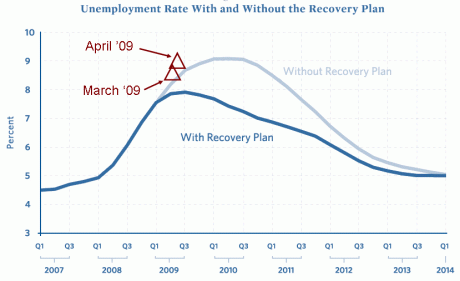
So we’re spending 3/4ths of a trillion dollars, and according to Obama’s own economic experts, the job impact of the American Recovery and Reinvestment Plan was nothing. But this is government, and no matter how poor the results, they’ll keep on doing the same thing; printing money, spending unlike any other time in history, and telling us that they know what they’re doing.
Oh yeah, and they’ll tell us to live within our means. We need an irony graph.
For a very modest definition of the word "trim". This administration has said it would be more fiscally responsible than the last, and then proceeded to put us into debt in a way never before seen. Well then, it made a promise about cutting the budget. So how’s that going?
President Obama has said for weeks that his staff is scouring the federal budget, "line by line," for savings. Today, they will release the results: a plan to trim 121 programs by $17 billion, a tiny fraction of next year’s $3.4 trillion budget.
About 1/2 of 1%. Well, one might say, that’s probably better than what Bush did. And one might be wrong.
The plan is less ambitious than the hit list former president George W. Bush produced last year, targeting 151 programs for $34 billion in savings. And like most of the cuts Bush sought, congressional sources and independent budget analysts yesterday predicted that Obama’s, too, would be a tough sell.
With a much smaller budget, Dubya found double the cuts he wanted.
But just because the President wants a cut, no matter his party, that isn’t the end of the story.
"Even if you got all of those things, it would be saving pennies, not dollars. And you’re not going to begin to get all of them," said Isabel Sawhill, a Brookings Institution economist who waged her own battles with Congress as a senior official in the Clinton White House budget office. "This is a good government exercise without much prospect of putting a significant dent in spending."
The problem is that our federal government is simply too big. So much responsibility has been given up voluntarily by, or taken by force from, states and the private sector, and once it goes to Washington, it virtually always stays there, where it grows and costs more money while becoming less and less efficient and nimble. Whatever the good intention, the more Washington does for us, the more it costs and the less anybody wants their piece of the pie slimmed. Consolidation of this power means lobbyists only have to convince a few Washington Senators and Representatives to keep their money flowing rather than legislatures in 50 states.
This is the result; a budget where only the most microscopic pieces can ever hope to be trimmed.
Jeremy Pierce at Parableman offers (I think for the Christian Carnival tomorrow) an interesting short essay on the establishment clause regarding education, creationism, and the Establishment Clause and the associated Free Exercise Clause, err, Phrase. I think his argument makes sense, but likely ignores much of the the larger part of Constitutional lore that lawyers depend on, which is the larger body of prior rulings, i.e., stare decisis. Specifically two cases are mentioned, Lemon and Lynch … but I’m willing to bet the cases cited in precedent number in hundreds or perhaps thousands.
However, us lay members (see Pelikan: Interpreting the Bible and the Constitution) of the US with respect to the body of law have little but (note Mr Pierce does refer to several SCOTUS cases) the text of the Constitution from which to judge whether a ruling or act is Constitutional. In some sense that might actually be a good thing.
Creationism is one of the “standard” issues regarding church/state separation that comes up in conversation and in blog essays. However a decidedly more radical one is one I’d offer. I think it can be argued, along similar lines as the argument presented in the linked essay noted above that the following is in fact Constitutional. Would it be Constitutional for a State to establish the death penalty and restrict its application to those who profess faith and believe in an effective soteriology. Or in plainer English, only those who believe in the afterlife might be put to death by the state.
I think the fundamental problem with Supreme Court doctrine on this sort of issue is that none of this has much to do with what the Constitution actually says. The First Amendment’s Establishment Clause reads, “”Congress shall make no law respecting an establishment of religion”. Together with the misnamed Free-Exercise Clause (which is a phrase, not a clause, which adds “or prohibiting the free exercise thereof” we have the entirety of the Constitution’s pronouncements on religion. The founders were preventing the establishment of a church state, such as Great Britain’s Church of England. Congress is prevented from making a law respecting the establishment of religion.
So. Examine for a moment Mr Pierces discussion about what “respect to” or “giving respect to” might mean.
The term ‘respecting’ could mean either “with respect to” or “giving respect to”. I tend to think it means the former, which is a broader prohibition. Congress can’t make any laws about the setting up of religions. Religions are free to do as they choose in setting themselves up, without laws prohibiting their free expression. But even in the more restricted second reading, Congress is only preventing from making laws that show respect for a religion. In that case, it still doesn’t mean that government employees can’t show respect for a religion (never mind show disrespect). This is about laws prohibiting certain religious conduct or establishing a state religion.
The question that I find no ready answer for, is how is that sense of “respecting” religion betrayed by failing to execute men (and women) who don’t believe they are assured of an afterlife. If you take a persons deeply seated beliefs seriously, a Christian for example, should not fear death, for it has no sting. An atheist on the other hand has plenty of reason to fear the ending of his days, for that is the end of him … there is more there. Basically the statement is saying, the state will only execute people who are in an essential way, OK with being killed. That seems to me ultimately respectful of religions and in a real sense cognizent of the role of religion regarding soteriology.