Government Archives

Justification for the Vigilante

This is an attempt to examine the question:

Vigilantism is justified when the government has failed to enforce the law.

In the following, two aspects of this question will be examined. One is to examine a famous example of the social custom of vigilantism in a very libertarian society in our American historical past. The second will attempt to touch on some of the foundational political aspects of this question, i.e., to look at authority and society and where force fits into that picture. Please find bulk of the essay “below the fold”. Read the rest of this entry

"Faith"-Based Initiatives

I wasn’t a big fan of Dubya’s faith-based initiatives.  Well, I was at first, but I was later convinced that, since whoever pays the bills makes the rules, that having government pay the bills was a bad  idea for churches.  It opened them up to having to do things their faith told them not to in order to keep the money coming in.

Of course, there’s another more general reason to avoid new government programs; they expand to fill whatever void the government finds; real or perceived.  And President Obama is busy looking for voids.

President Barack Obama on Thursday signed an order establishing a White House office of faith-based initiatives with a broader mission than the one overseen by his predecessor, Republican George W. Bush.

Obama said the office would reach out to organizations that provide help "no matter their religious or political beliefs."

Obama is calling his program the Office of Faith-Based and Neighborhood Partnerships.

(I would have put this in another ChangeWatch entry, more of the same alleged "theocracy" that Bush was supposedly foisting on us, yet continued and expanded under Obama, but thought it could use its own post.)

I wasn’t aware of a doctrinal test for Bush’s faith-based initiative, but Obama is claiming credit for expanding the reach.  Nifty sleight of hand there.

But the most notable expansion of the program is the addition of the word "Neighborhood".  The partnerships are "faith-based and neighborhood", not "faith-based neighborhood", meaning the neighborhood partnerships don’t have to be faith-based.  This turns the program into an untargeted channel for any and all grassroots groups.  As Warner Todd Hudson notes, sounds like yet another vector for funds to ACORN. 

Hudson also wondered (last Saturday, when he wrote his piece) whether the Left, and the Kos krowd in particular, will give Obama a pass on this, unlike the screams of "church and state!" they gave Bush when he created it.  Well, as of today, if you search Daily Kos back two weeks for the phrase "faith-based", you get exactly one hit, and that article still raps the GOP for it.  Yeah, still OK if their guy does it.  It’s still all about politics.  Such blind partisanship.

Considering the Stimulus and the Response

Economists are by no means exclusively Keynesian (or more properly append a “neo” to be hip to that term), however our beltway denizens are almost to a man Keynesian. Climate scientists are not “settled” by any means on anthropomorphic causes for global warming but, again, politicians are. Why is this? It think the answer boils down to a logical fallacy hinging on simple psychology.

When your child has the flu the desire is to actively do something to combat the illness. After all, your kid is (gasp) sick and hurting. Some, but certainly not all, pediatricians will cater to this desire of the parent and prescribe antibiotics. Antibiotics have no effect on viral infections. But it gives the appearance of action. After all antibiotics fight diseases and your child has a disease. So, therefore there is some notion that the pill or potion is helpful. The real active palliative measures that should be taken in the case of flu is to provide rest and fluids, i.e., basically do nothing. That is a moral equivalent to “do nothing” for rest and fluids are the response taken in the case of any illness, be it bacterial (in which case antibiotics will help), or cancer, or other.

Similarly Keynesian economics offers to the government the notion that specific actions in the times of economic change are helpful. Do “X” in inflationary times, during recession provide “stimulus”. During economic expansion, act to curb growth (that one I really really don’t get). The point is these actions have two effects. They cater to two strong impulses that governments are vulnerable. The first is the above, it gives justification for action in the face of crises. It provides an explanation for why antibiotics might help the virus infected patient. The second is more pernicious. All governments for a variety of reasons find growth necessary and good. All of these actions provide reasons for larger and a more active central government. Keynesian economics thereby provides an excuse for central/federal expansion in the face of economic crises of any flavor. Read the rest of this entry

Doomed to Repeat It

History only repeats itself when people don’t learn from it.  Even recent history.

Japan’s rural areas have been paved over and filled in with roads, dams and other big infrastructure projects, the legacy of trillions of dollars spent to lift the economy from a severe downturn caused by the bursting of a real estate bubble in the late 1980s. During those nearly two decades, Japan accumulated the largest public debt in the developed world — totaling 180 percent of its $5.5 trillion economy — while failing to generate a convincing recovery.

Yes, some still think that such spending can indeed create a recovery (notably, in the article, tax scofflaw Timothy Geithner), but it’s all theoretical, much like Japan’s attempt at stimulus.  In fact, Japan bailed out its banks as well, and the cure, at least according to the people living there (as opposed to those watching from an ivory tower) was far worse than the disease.

In the end, say economists, it was not public works but an expensive cleanup of the debt-ridden banking system, combined with growing exports to China and the United States, that brought a close to Japan’s Lost Decade. This has led many to conclude that spending did little more than sink Japan deeply into debt, leaving an enormous tax burden for future generations.

In the United States, it has also led to calls in Congress, particularly by Republicans, not to repeat the errors of Japan’s failed economic stimulus. They argue that it makes more sense to cut taxes, and let people decide how to spend their own money, than for the government to decide how to invest public funds. Japan put more emphasis on increased spending than tax cuts during its slump, but ultimately did reduce consumption taxes to encourage consumer spending as well.

Economists tend to divide into two camps on the question of Japan’s infrastructure spending: those, many of them Americans like Mr. Geithner, who think it did not go far enough; and those, many of them Japanese, who think it was a colossal waste.

Learn from history, or we may in for our own Lost Decade.

Geithner Must Go

National Review’s Larry Kudlow says it’s time for Treasury Secretary Timothy Geithner to resign:

For all of Mr. Geithner’s apparent skills and knowledge and other professional qualifications, he still has a tremendous ethical problem. Pres. Obama has made much of the need for a new era of responsibility and ethics. Obama is right. But Mr. Geithner is wrong. He should follow Daschle and Killefer by submitting his resignation.

This is a matter of personal character and accountability. It is a matter of honesty. Too many of our leaders suffer big deficits in these areas.

As Kudlow points out, the fact that President Obama has made ethics a central part of his administration makes the Geithner problem more acute. In addition, with the focus of the administration’s energies on the economy, it is going to be difficult for Geithner to be the face of economic policy for the administration. In a separate post, Kudlow made this point:

Treasury Secretary Timothy Geithner stood alongside President Obama in a White House press briefing yesterday. Obama talked about bank compensation limits and Geithner spoke about the need for trust, confidence, and faith in our leaders to get the job done. Only a day earlier, Pres. Obama said there should be no double standard when it comes to paying taxes.

However, Mr. Geithner is guilty of a double standard. He dodged his taxes. We know that. The only reason he eventually paid his taxes is because he was nominated to the Treasury. He has never gotten honest about his tax dodge. He never answered the key question of whether he would have paid his back-taxes had he not been nominated to the Treasury. And the result is that Mr. Geithner has lost the trust and confidence of the American people.

It’s time for Mr. Geithner to go.

The Accountability Factor

A growing list of "honest mistakes" by Democrats is leading this op-ed author to ask, "What does it take to disqualify Democrats from public service?"  If tax evasion, suborning forgery and using campaign funds for personal expenses ain’t enough, what is?  As commenter "socrates" writes:

Failure to pay $150K in taxes normally gets one in front of a Tax Court judge with the IRS burning your house down.

If you’re a Democrat it gets you a Cabinet position.

Both sides have corruption in their ranks, make no mistake about it.  But as I’ve said multiple times in the past, it’s not about corruption; it’s about accountability.  On the whole, Republicans tend to remove those involved with corruption, while Democrats, when they do anything, pass a motion and continue with the business of the day.  Read those links for a number of examples.

Nominating them for cabinet positions, right "socrates"?

Man is sinful; that’s just the way it is.  But if he’s not held accountable for his actions when he breaks the law, do we expect that we’ll have less law-breaking?

Rendition is Still an Option

Ed Morrissey notes that…

For the last seven years, the Left has screeched hysterically over the CIA practice of rendition, in which agents turn detainees over to authorities in their home country for interrogation.  Never mind that the practice started in the Clinton administration, and never mind that the other options were Guantanamo Bay, release, or two caps in the back of the head; they pilloried Bush over renditions as if he’d thought them up himself.  Hollywood even made a movie about how awful the process is, apparently matched in awfulness only by the film’s box office.

Obama has signed an executive order to remedy some things he finds wrong with the Bush administration policy, but some things remain as they are.

The CIA’s secret prisons are being shuttered. Harsh interrogation techniques are off-limits. And Guantanamo Bay will eventually go back to being a wind-swept naval base on the southeastern corner of Cuba.

But even while dismantling these programs, President Obama left intact an equally controversial counter-terrorism tool.

Under executive orders issued by Obama recently, the CIA still has authority to carry out what are known as renditions, secret abductions and transfers of prisoners to countries that cooperate with the United States.

Current and former U.S. intelligence officials said that the rendition program might be poised to play an expanded role going forward because it was the main remaining mechanism — aside from Predator missile strikes — for taking suspected terrorists off the street.

The anti-war Left is surprisingly silent.

The decision to preserve the program did not draw major protests, even among human rights groups. Leaders of such organizations attribute that to a sense that nations need certain tools to combat terrorism.

"Under limited circumstances, there is a legitimate place" for renditions, said Tom Malinowski, the Washington advocacy director for Human Rights Watch. "What I heard loud and clear from the president’s order was that they want to design a system that doesn’t result in people being sent to foreign dungeons to be tortured — but that designing that system is going to take some time."

But as Moe Lane notes, Human Rights Watch was playing quite a different tune up until a Democrat made it to the Oval Office.  Their web site says, in an article from April 7, 2008:

The US government should:

·Repudiate the use of rendition to torture as a counterterrorism tactic and permanently discontinue the CIA’s rendition program;

That was then.  This is now.  Now, it has "a legitimate place".  Funny how some Bush policies look oh-so-different through the Obama prism.

The New Deal Didn’t Work (And Won’t Work Again)

President Barack Obama has made no secret of the fact that he considers Franklin D. Roosevelt as one of his role models. President Obama’s economic plans are very similar to those of FDR: increased government spending and intervention in markets to try to spur economic growth. Amity Shales, author of the excellent book The Forgotten Man, offers a terrific summary of why the New Deal didn’t work. (hat tip: Nota Bennett)

The fundamental problem with President Obama’s economic policies is the underlying assumption that government action can solve problems that can be more effectively and efficiently dealt with by market forces. The only guarantee with the President’s proposals is that the economy will be no better off and in fact probably be in much worse shape no matter how much new spending is dressed up as “stimulus”.

If the President’s program actually helps the economy recover it will be the first time that increased government spending has spurred economic growth. History (and particularly the New Deal) suggest that the President’s stimulus is doomed to fail.

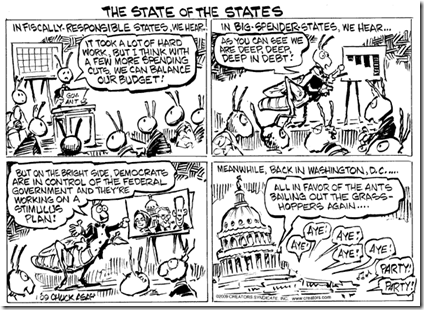
Political Cartoon: Bailing Out the States

From Chuck Asay.  (Click for a larger version.)

image

We punish the fiscally responsible by making them pay for the irresponsible.  Do you think this will bring about more responsibility or less?  Hmmm.

Stimulus Bill Not All That Stimulating

Ben Stein is not impressed.

I love this. The new kind of politics of hope. Eight hours of debate in the HR to pass a bill spending $820 billion, or roughly $102 billion per hour of debate.

Only ten per cent of the "stimulus" to be spent on 2009.

Close to half goes to entities that sponsor or employ or both members of the Service Employees International Union, federal, state, and municipal employee unions, or other Democrat-controlled unions.

This bill is sent to Congress after Obama has been in office for seven days. It is 680 pages long. According to my calculations, not one member of Congress read the entire bill before this vote. Obviously, it would have been impossible, given his schedule, for President Obama to have read the entire bill.

For the amount spent we could have given every unemployed person in the United States roughly $75,000.

We could give every person who had lost a job and is now passing through long-term unemployment of six months or longer roughly $300,000.

There has been pork barrel politics since there has been politics. The scale of this pork is beyond what had ever been imagined before — and no one can be sure it will actually do much stimulation.

Especially considering Stein’s note that only 10% of this even gets spent in 2009, and that most recessions don’t last more than a year, this is simply a way to push the pork and pretend to "do something".  And then, when the recession ends you can take credit and garner votes for you and your party.

All the House Republicans voted against this.  If you’re a fiscal conservative, you should be glad they listen to Rush Limbaugh.  And if you’re not a fiscal conservative, then perhaps the Senate version of the "economic stimulus" bill might make you one.  What’s in it?  Here’s a sampling:

•    $20 million “for the removal of small- to medium-sized fish passage barriers.” (Pg. 45 of Senate Appropriations Committee report: “20,000,000 for the removal of small- to medium-sized fish passage barriers)

•    $400 million for STD prevention (Pg. 60 of Senate Appropriations Committee report: “CDC estimates that a proximately 19 million new STD infections occur annually in the United States …The Committee has included $400,000,000 for testing and prevention of these conditions.”)

•    $25 million to rehabilitate off-roading (ATV) trails (Pg. 45 of Senate Appropriations Committee report: “$25,000,000 is for recreation maintenance, especially for rehabilitation of off-road vehicle routes, and $20,000,000 is for trail maintenance and restoration”)

•    $34 million to remodel the Department of Commerce HQ (Pg. 15 of Senate Appropriations Committee report:  $34,000,000 for the Department of Commerce renovation and modernization”)

•    $70 million to “Support Supercomputing Activities” for climate research (Pgs. 14-15 of Senate Appropriations Committee Report: $70,000,000 is directed to specifically support supercomputing activities, especially as they relate to climate research)

•    $150 million for honey bee insurance (Pg. 102 of Senate Appropriations Committee report: “The Secretary shall use up to $ 50,000,000 per year, and $150,000,000 in the case of 2009, from the Trust Fund to provide emergency relief to eligible producers of livestock, honey bees, and farm-raised fish to aid in the reduction of losses due to disease, adverse weather, or other conditions, such as blizzards and wildfires, as determined by the Secretary”)

The critical infrastructure spending is well within the purview of the federal government, and frankly is long overdue.  But there’s a huge amount of pork coming out of this that the Democrats seek to sweep under the rug hoping you won’t notice.  It’s apparently too imminent a problem to bother, y’know, debating the bill for too much longer.  This pork, er, stimulus must be passed now.

ChangeWatch

Some more of "change" in the Obama administration that I’ve been saving up for a few weeks.

"Capturing or killing Osama bin Laden" used to be "a critical aspect of stamping out al Qaeda".  Now he just needs to be "pinned down" or just kept "on the run".  Some of this "change" Obama speaks of apparently means change from his campaign rhetoric.  (H/T Don Sensing.)

Two years ago, Obama called the expansion of coal-fired electricity his "worst nightmare".  Two weeks ago, Obama’s choices for both the EPA and the Energy Department described the industry as "vital" and coal as a "great natural resource".  The environmentalists are not happy at this "change".

In spite of Obama’s promise to severely reduce or eliminate the influence of lobbyists in Washington, Harry Reid said that Obama would be meeting with lobbyists and him, where the president would be doing business with them.  Reid said, "And there’s nothing wrong with that."  I happen to agree with Reid (petitioning the government is a right, though it can, like anything, be misused), but Obama’s promises like this keep falling by the wayside.  (H/T Q & O.)

Hmm, wonder if I should rename this feature "StillTheSameWatch"…

Respect for the Office

Ronald Reagan never went into the Oval Office without a suit jacket and tie, and that was his rule for everyone who entered.  He did it out of respect for the position.  We know (unfortunately) how much respect Bill Clinton gave the office.  President Bush also had that dress code as well.  But Obama?  Naah.

Now you can say this is making something out of nothing (as some on the Left have), and admittedly it’s just clothing.  But it exposes an underlying attitude that I think speaks to how Obama treats the position of President of the United States.  I honestly hope he doesn’t take it as casually as he appears to, but his outward appearance says otherwise.

At the same time, I’ll bet he (rightly) expects people to respect his position, but he won’t treat it with the same deference.  A tad hypocritical.

"I Won."

Obama listened to the GOP’s criticisms of, and suggestions for, his economic stimulus plan, and included the title of this post as one of his rebuttals.  The Kos Krowd krows about it, but Moe Lane at Redstate takes Obama up on that offer.

So, it’s all yours. Your responsibility, your obligation, your reputation on the line. Not ours: yours.

Because, after all, you won.

Indeed, Obama won, and he can have it any way he wants.  Elections, as the GOP noted during its time, mean things.  But this quip, just days after being seated in the Oval Office, makes it sound like that vaunted bipartisanship that Democrats always say they want is not so highly valued by the Democratic President. 

I know he’ll take credit where credit is due, but will he take the blame where it’s due?  All the blame?  Hey, he won.

Justice Delayed

President Obama has suspended war crime trials for the Gitmo detainees.  Is this his start to his phase of the War on Terror (or, as Scott Ott hilariously suggests, "The Case Against Terror")?  He’s already peeved family members of 9/11 victims with this first step in the closing of Gitmo, and he has no actual "exit strategy" for the detainees themselves.

How about the European Union, that bloc of countries so against Gitmo?

Across Europe, President Barack Obama’s decision to shut the Guantanamo Bay prison has raised an awkward question: Which EU states that railed against the camp will offer new lives to released prisoners?

The U.S. Defense Department says about 50 of the 245 prisoners awaiting freedom cannot go home again on security or political grounds, raising the need to find an alternative place to send them. But European Union members long critical of Guantanamo shied away on Friday from any firm commitments to help.

Ireland has joined Portugal, France, Germany and Switzerland in saying it probably would participate in an EU-organized plan that might take shape at a summit of foreign ministers starting Monday in Brussels.

But it already appears likely that Europe will leave some of Guantanamo’s inmates in limbo behind a policy of: No terrorists please.

Lots of talk, but little action from those who protested the loudest.  Classic.

And letting them go free is fraught with its own dangers.

A Saudi national released from U.S. detention at Guantanamo Bay, Cuba, in September 2007 is believed to be a key leader in al Qaeda’s operations in Yemen, according to a U.S. counterterrorism official.

The Defense Department recently estimated that more than 60 terrorists released from Guantanamo may have returned to the battlefield.

According to the counterterrorism official, freed detainee Ali al-Shiri traveled to Yemen after being released to Saudi Arabia and may have been involved in recent al Qaeda attacks in Yemen, including a car bombing outside the U.S. Embassy in Sanaa last year that killed nearly a dozen people.

"He is one of a handful of al Qaeda deputies in Yemen," the official said. "He is one of the top terrorists."

No, they’re not being railroaded through tribunals.  If anything, we’re apparently giving them quite a lot of benefit of the doubt. 

Not the way to start an administration.

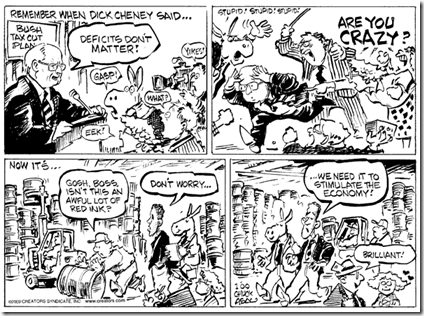
Political Cartoon: Spending, Then and Now

From Chuck Asay:

image

For the record, I disagreed with Cheney’s remark, and I disagree with Obama’s solution.  Putting the country in massive debt now and kicking the can down the road is completely wrong.

 Page 33 of 42  « First  ... « 31  32  33  34  35 » ...  Last »