
Politics Archives

Jason Kuznicki has some remarks spinning from a previous post of mine on Jim Anderson extended blog-based discussions on the ethics of vigilante activity. Here is Mr Kuznicki’s post. Here’s the post of Mr Anderson’s to which he refers and the original proposition and … for completeness my first post on this matter.

Mr Kuznicki offers:

To the extent that there must be laws (and only to that extent), the laws should be clearly expressed and regularly enforced. Laws that are unclear in their expression or irregular in their enforcement allow the legislators and law enforcement agents too much leeway. They give the state too much power. They also sap private initiative, because it’s important for private actors to have some reasonable expectations of how the state will behave in the future.

What this leaves out, and what one might have expected to have been the case in part in the Western folkway, is what is the case (even in the idealized “paradise” situation) in which the state has laws which it expects citizens to enforce. Consider the example of personal assaults in an idealization of the Western folkway. In the first case, of personal assaults such as battery or rape, the statutes and penalties against such things were minimal. A likely reason for this is that it was expected that individuals and their families would “take care” of such insults themselves. Now this led on occasion of course to the much celebrated mountain feuds between Western folkway clans in which the insult to one family matter would be “handed” in a way that the original injured party found excessive and responded in kind … leading to a never ending chain of responses. However, my guess would be, not having studied the matter, that feuds of that type were the exception not the rule. That most of the time the culture/society had a shared understanding within the society of a reasonable response and meeting that was the norm. Read the rest of this entry
D.A.R.E. – Democrats Against Rewarding Education

Democrats are poised to kill an educational program that has shown results for those who otherwise couldn’t afford to take their kids out of failing public schools.  The Washington Post editorializes:

Last week, the Democrat-controlled House passed a spending bill that spells the end, after the 2009-10 school year, of the federally funded program that enables poor students to attend private schools with scholarships of up to $7,500. A statement signed by [Rep. David] Obey as Appropriations Committee chairman that accompanied the $410 billion spending package directs D.C. Schools Chancellor Michelle A. Rhee to "promptly take steps to minimize potential disruption and ensure smooth transition" for students forced back into the public schools.

We would like Mr. Obey and his colleagues to talk about possible "disruption" with Deborah Parker, mother of two children who attend Sidwell Friends School because of the D.C. Opportunity Scholarship Program. "The mere thought of returning to public school frightens me," Ms. Parker told us as she related the opportunities — such as a trip to China for her son — made possible by the program. Tell her, as critics claim, that vouchers don’t work, and she’ll list her children’s improved test scores, feeling of safety and improved motivation.

As I said 9  years ago, while keeping money in people’s pockets is the best way to deal with school choice, vouchers are a good fall-back position.  (The moment money touches the hands of the government, the use of it on religious schools becomes an issue.  I don’t think it should be, but that’s the way it currently is.)  But why would Washington Democrats not even want this proven program removed?  The Post continues.

But the debate unfolding on Capitol Hill isn’t about facts. It’s about politics and the stranglehold the teachers unions have on the Democratic Party. Why else has so much time and effort gone into trying to kill off what, in the grand scheme of government spending, is a tiny program? Why wouldn’t Congress want to get the results of a carefully calibrated scientific study before pulling the plug on a program that has proved to be enormously popular? Could the real fear be that school vouchers might actually be shown to be effective in leveling the academic playing field?

Why must the government be the be-all, end-all solution to these guys?  They proclaim that they care about the poor and about education, and then then kill a popular and successful education program for the poor.  Which are we to believe; their words or their actions?

And if public schools can’t handle the competition, they should be the ones feeling the pinch, not the private schools.

Looking at the New Deal with Amity Shlaes

One of the most fascinating books I have read over the last few months is The Forgotten Man: A New History of the Great Depression. Actually, in reading the book I was amazed at how much President Barack Obama’s economic policies are like that of FDR. Needless to say, that was not comforting.

Recently I had the opportunity to talk with Amity Shlaes, author of the book. Click here to read more about our conversation and what she had to say about the current economic crisis.

ChangeWatch

It’s been a few weeks since we had one of these, and boy are things changing…or not.

"Extraordinary Rendition"?  Keeping the Bush administration policy.

Holding "enemy combatants" without trial?  Obama’s nominee for Solicitor General, Harvard Law Dean Elena Kagan, says yes we can!  (And Obama & Holder second that motion.)

Make Guantanamo Geneva-Convention-compliant?  It already is.

Wiretapping international calls related to terrorists?  The Obama administration continues to protect it.

Continuity we can believe in!

And Nicholas Guariglia says that we should have seen this coming.

Man, Society, and Science

Carl Olson of the Insight Scoop notes an article noting a term which he predicts will be in our future, scientific authoritarianism. The cited article notes:

Scientific authoritarianism, as I am using it here, holds that political decisions should be compelled by the political preferences of scientists. It is a very strong form of the ‘linear model’ of science and decision-making that I discuss in my book, The Honest Broker. Hansen believes that the advice of experts, and specifically his advice alone, should compel certain political outcomes.

There are just a few matters that need to take into account in this matter.

  • First off, it is my experience that there are two features found in many of the first rank scientists in our midst. First off, the best and brightest scientists in various fields don’t have the slightest interest in giving advice to politicians and in fact when they do offer political advice they offer very bad advice. I might add that theologians and religious leaders as well, for the most part, also are very horrible when they enter into the political world. There are some good reasons for this. Skills are involved in politics. The ability to read people, judge motivations and to have an estimate of the possible and so on are political skills. To become talented and to rise to the top of a scientific discipline requires three things: talent or genius, a love for inquiry, and a concentration on that field virtually to the exclusion of all else in life. Those people who are at the first rank usually have no talent, or frankly, desire to spend any time with exercising any authority. For them, their life is wholly given to the chase for the truths hidden by and in nature. To make an analogy with popular culture from cinema, while we might hope for our scientific authority to rise from the Mozarts in our midst, we’re going to get the Salieri’s who are the ones who will sully themselves with such matters.
  • Second, those scientists who are not blinded by the possibility of exercise of political authority, i.e., those who are honest with themselves, are aware of the vast gulf between what we know and what is out there to be known. To put it baldly, any scientist who assures you that we “know” the best policy is a liar or a fool. We “know” so very little about ourselves, our universe, and how it is put together.
  • Michael Polanyi in Personal Knowledge offers for us a glimpse at how much we deceive ourselves regarding about the epistemological certainties in science. I cannot recommend this book enough (although I’ll ruefully admit I really do need carve out the time to finish it).

A joke which is part of the culture of Physics and the pursuit of knowledge in that discipline.

A policeman encounters a drunk one night, who is on his hands and knees searching for something in the night beneath a street light. The policeman asks him, “What are you looking for?”
The drunk replies, “My keys.”
“Where did you drop them?” asks the bobby.
“Over there,” the drunk points down the block.
“Why are you looking here then?”
“I can’t see over there, because the light is here,” replies the drunk.

Our search for the mysteries of the universe and ourselves are a lot like that. We search under the light. Our keys … our understanding is to be found, so often, elsewhere down the road … in the dark.

So much of physics and our physical understanding of the universe assumes linearity. The mathematical behaviour and our understanding of linear PDEs and non-linear ones are much like comparing oranges to not-oranges. We look at and search for understanding under the light of just a few lamps. Gradually we uncover and begin to use a few more. But, we are just beginning. To pretend otherwise is foolishness. My advice would be to spurn those offering to give us scientific authority are who are assured in their results and their knowledge and don’t first show evidence of humility and uncertainty and demonstrate they posses a firm grasp of the magnitude of our ignorance.

A New Wind is Blowing

And it’s blowing away the rage that Democrats would have had if Bush had done this.

The economic stimulus signed by President Barack Obama will spread billions of dollars across the country to spruce up aging roads and bridges. But there’s not a dime specifically dedicated to fixing leftover damage from Hurricane Katrina.

And there’s no outrage about it.

Democrats who routinely criticized President George W. Bush for not sending more money to the Gulf Coast appear to be giving Obama the benefit of the doubt in his first major spending initiative. Even the Gulf’s fiercest advocates say they’re happy with the stimulus package, and their states have enough money for now to address their needs.

What a difference an administration makes.

It’s a significant change in tone from the Bush years, when any perceived slight of Katrina victims was met with charges that the Republican president who bungled the initial response to the disaster continued to callously ignore the Gulf’s needs years later.

Just last summer, Democrats accused Bush of putting Iraq before New Orleans when he sought to block Gulf Coast reconstruction money from a $162 billion war spending bill. Bush was pilloried for not mentioning the disaster in back-to-back State of the Union addresses.

Bush couldn’t miss mentioning Katrina let alone sending more money there.  But Obama doesn’t spend a dime in a 3/4 of a trillion dollar spending spree and cue the crickets.

What, does Obama hate black people?  That’s preposterous now, and it was preposterous then.

Obama’s Mortgage Plan: More Harm Than Good?

The Wall Street Journal takes a look at President Obama’s proposed mortgage rescue plan and finds that it could create far more problems than it solves:

President Obama yesterday announced his plan to prevent home foreclosures, saying he wanted to be “very clear about what this plan will not do: It will not rescue the unscrupulous or irresponsible by throwing good taxpayer money after bad loans . . . And it will not reward folks who bought homes they knew from the beginning they would never be able to afford.”

We really do wish he were right. In fact, the details released yesterday suggest the President’s plan will do all of the above. The plan will help some struggling homeowners. But by investing in failure, the Administration will also prolong the housing downturn and make financing a home purchase more difficult for future borrowers. Meanwhile, the plan isn’t likely to slow the continuing decline in housing prices.

The President’s plan is predicated on the false belief that everyone deserves to own a home. The fact is that not everyone can afford to own a home. The efforts of Fannie Mae and Freddie Mac to make it easier for people to buy homes they could not afford are at the heart of the current financial crisis. Unfortunately, the President’s plan does nothing to address this fundamental issue and instead just prolongs the crisis and leaving taxpayers on the hook.

As CNBC’s Rick Santelli correctly points out in this clip, this is an example of government rewarding bad behavior. Unfortunately it’s the 92% of honest, hardworking Americans he refers to that will pay the price.

On the Stimulus

Apparently on the so-called stimulus bill all that remains is for Mr Obama to sign it. It remains to see if he will put the bill for public examination for five days before signing as he promised in his campaign. The democrats controlling Congress certainly didn’t give much time for reflection after it was assembled in order to vote. I doubt it was humanly possible for anyone to even skim through it before a vote needed to be cast. Read the rest of this entry

Taxation Without Representation, Union-Style

Another interesting story that came out about California’s Proposition 8 banning same-sex marriage, and the effort to make public the names of donors who supported it, was this article from NPR showing how the Teacher’s Union and its own teachers were on different sides of the question.

As California’s legal and cultural conflict over same-sex marriage played out this fall, the state’s teachers union put up $1.25 million to advocate against the gay marriage ban.

But at the same time, individual public school teachers in the state were giving more money to enact the ban than to defeat it, according to an NPR analysis of Proposition 8 contribution data recently released by the California secretary of state.

Teachers, aides and counselors in California public school systems gave about $2 to support the marriage ban for every $1 they gave to oppose it. The educators gave some $450,000 in individual contributions to advocates supporting the ban and about $210,000 to those opposing it, according to the NPR analysis.

So the union went against the very people it purports to represent, and spent the dues money teachers are obligated to pay in a political cause that the majority of dues-payers opposed.  What a scam!  If you want to educate our upcoming generation, you must donate to political causes that you disagree with.  No wonder liberals love unions; it’s a cash cow for their pet causes.

Never mind the fact that an organization who’s purpose is to supposedly look out for the rights of teachers is giving money to a political cause completely unrelated to their charter.  Not only are teachers forced to underwrite this, it has nothing at all to do with their welfare as teachers. 

I say again; what a scam.

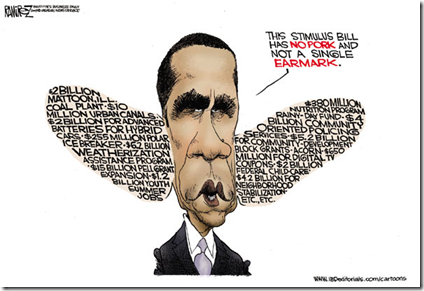
Political Cartoon: When "Pork" Becomes "Stimulus"

From Michael Ramirez (click for a larger version):

This stimulus bill has no pork and not a single earmark.

Henceforth, should any Congressman tack on anything to any bill ever, he or she can just say, “Hey, it’s economic stimulus for my district!”  Obama and the Democrats have redefined the word “earmark” into oblivion.

"Faith"-Based Initiatives

I wasn’t a big fan of Dubya’s faith-based initiatives.  Well, I was at first, but I was later convinced that, since whoever pays the bills makes the rules, that having government pay the bills was a bad  idea for churches.  It opened them up to having to do things their faith told them not to in order to keep the money coming in.

Of course, there’s another more general reason to avoid new government programs; they expand to fill whatever void the government finds; real or perceived.  And President Obama is busy looking for voids.

President Barack Obama on Thursday signed an order establishing a White House office of faith-based initiatives with a broader mission than the one overseen by his predecessor, Republican George W. Bush.

Obama said the office would reach out to organizations that provide help "no matter their religious or political beliefs."

Obama is calling his program the Office of Faith-Based and Neighborhood Partnerships.

(I would have put this in another ChangeWatch entry, more of the same alleged "theocracy" that Bush was supposedly foisting on us, yet continued and expanded under Obama, but thought it could use its own post.)

I wasn’t aware of a doctrinal test for Bush’s faith-based initiative, but Obama is claiming credit for expanding the reach.  Nifty sleight of hand there.

But the most notable expansion of the program is the addition of the word "Neighborhood".  The partnerships are "faith-based and neighborhood", not "faith-based neighborhood", meaning the neighborhood partnerships don’t have to be faith-based.  This turns the program into an untargeted channel for any and all grassroots groups.  As Warner Todd Hudson notes, sounds like yet another vector for funds to ACORN. 

Hudson also wondered (last Saturday, when he wrote his piece) whether the Left, and the Kos krowd in particular, will give Obama a pass on this, unlike the screams of "church and state!" they gave Bush when he created it.  Well, as of today, if you search Daily Kos back two weeks for the phrase "faith-based", you get exactly one hit, and that article still raps the GOP for it.  Yeah, still OK if their guy does it.  It’s still all about politics.  Such blind partisanship.

Geithner Must Go

National Review’s Larry Kudlow says it’s time for Treasury Secretary Timothy Geithner to resign:

For all of Mr. Geithner’s apparent skills and knowledge and other professional qualifications, he still has a tremendous ethical problem. Pres. Obama has made much of the need for a new era of responsibility and ethics. Obama is right. But Mr. Geithner is wrong. He should follow Daschle and Killefer by submitting his resignation.

This is a matter of personal character and accountability. It is a matter of honesty. Too many of our leaders suffer big deficits in these areas.

As Kudlow points out, the fact that President Obama has made ethics a central part of his administration makes the Geithner problem more acute. In addition, with the focus of the administration’s energies on the economy, it is going to be difficult for Geithner to be the face of economic policy for the administration. In a separate post, Kudlow made this point:

Treasury Secretary Timothy Geithner stood alongside President Obama in a White House press briefing yesterday. Obama talked about bank compensation limits and Geithner spoke about the need for trust, confidence, and faith in our leaders to get the job done. Only a day earlier, Pres. Obama said there should be no double standard when it comes to paying taxes.

However, Mr. Geithner is guilty of a double standard. He dodged his taxes. We know that. The only reason he eventually paid his taxes is because he was nominated to the Treasury. He has never gotten honest about his tax dodge. He never answered the key question of whether he would have paid his back-taxes had he not been nominated to the Treasury. And the result is that Mr. Geithner has lost the trust and confidence of the American people.

It’s time for Mr. Geithner to go.

The Accountability Factor

A growing list of "honest mistakes" by Democrats is leading this op-ed author to ask, "What does it take to disqualify Democrats from public service?"  If tax evasion, suborning forgery and using campaign funds for personal expenses ain’t enough, what is?  As commenter "socrates" writes:

Failure to pay $150K in taxes normally gets one in front of a Tax Court judge with the IRS burning your house down.

If you’re a Democrat it gets you a Cabinet position.

Both sides have corruption in their ranks, make no mistake about it.  But as I’ve said multiple times in the past, it’s not about corruption; it’s about accountability.  On the whole, Republicans tend to remove those involved with corruption, while Democrats, when they do anything, pass a motion and continue with the business of the day.  Read those links for a number of examples.

Nominating them for cabinet positions, right "socrates"?

Man is sinful; that’s just the way it is.  But if he’s not held accountable for his actions when he breaks the law, do we expect that we’ll have less law-breaking?

The New Deal Didn’t Work (And Won’t Work Again)

President Barack Obama has made no secret of the fact that he considers Franklin D. Roosevelt as one of his role models. President Obama’s economic plans are very similar to those of FDR: increased government spending and intervention in markets to try to spur economic growth. Amity Shales, author of the excellent book The Forgotten Man, offers a terrific summary of why the New Deal didn’t work. (hat tip: Nota Bennett)

The fundamental problem with President Obama’s economic policies is the underlying assumption that government action can solve problems that can be more effectively and efficiently dealt with by market forces. The only guarantee with the President’s proposals is that the economy will be no better off and in fact probably be in much worse shape no matter how much new spending is dressed up as “stimulus”.

If the President’s program actually helps the economy recover it will be the first time that increased government spending has spurred economic growth. History (and particularly the New Deal) suggest that the President’s stimulus is doomed to fail.

Stimulus Bill Not All That Stimulating

Ben Stein is not impressed.

I love this. The new kind of politics of hope. Eight hours of debate in the HR to pass a bill spending $820 billion, or roughly $102 billion per hour of debate.

Only ten per cent of the "stimulus" to be spent on 2009.

Close to half goes to entities that sponsor or employ or both members of the Service Employees International Union, federal, state, and municipal employee unions, or other Democrat-controlled unions.

This bill is sent to Congress after Obama has been in office for seven days. It is 680 pages long. According to my calculations, not one member of Congress read the entire bill before this vote. Obviously, it would have been impossible, given his schedule, for President Obama to have read the entire bill.

For the amount spent we could have given every unemployed person in the United States roughly $75,000.

We could give every person who had lost a job and is now passing through long-term unemployment of six months or longer roughly $300,000.

There has been pork barrel politics since there has been politics. The scale of this pork is beyond what had ever been imagined before — and no one can be sure it will actually do much stimulation.

Especially considering Stein’s note that only 10% of this even gets spent in 2009, and that most recessions don’t last more than a year, this is simply a way to push the pork and pretend to "do something".  And then, when the recession ends you can take credit and garner votes for you and your party.

All the House Republicans voted against this.  If you’re a fiscal conservative, you should be glad they listen to Rush Limbaugh.  And if you’re not a fiscal conservative, then perhaps the Senate version of the "economic stimulus" bill might make you one.  What’s in it?  Here’s a sampling:

•    $20 million “for the removal of small- to medium-sized fish passage barriers.” (Pg. 45 of Senate Appropriations Committee report: “20,000,000 for the removal of small- to medium-sized fish passage barriers)

•    $400 million for STD prevention (Pg. 60 of Senate Appropriations Committee report: “CDC estimates that a proximately 19 million new STD infections occur annually in the United States …The Committee has included $400,000,000 for testing and prevention of these conditions.”)

•    $25 million to rehabilitate off-roading (ATV) trails (Pg. 45 of Senate Appropriations Committee report: “$25,000,000 is for recreation maintenance, especially for rehabilitation of off-road vehicle routes, and $20,000,000 is for trail maintenance and restoration”)

•    $34 million to remodel the Department of Commerce HQ (Pg. 15 of Senate Appropriations Committee report:  $34,000,000 for the Department of Commerce renovation and modernization”)

•    $70 million to “Support Supercomputing Activities” for climate research (Pgs. 14-15 of Senate Appropriations Committee Report: $70,000,000 is directed to specifically support supercomputing activities, especially as they relate to climate research)

•    $150 million for honey bee insurance (Pg. 102 of Senate Appropriations Committee report: “The Secretary shall use up to $ 50,000,000 per year, and $150,000,000 in the case of 2009, from the Trust Fund to provide emergency relief to eligible producers of livestock, honey bees, and farm-raised fish to aid in the reduction of losses due to disease, adverse weather, or other conditions, such as blizzards and wildfires, as determined by the Secretary”)

The critical infrastructure spending is well within the purview of the federal government, and frankly is long overdue.  But there’s a huge amount of pork coming out of this that the Democrats seek to sweep under the rug hoping you won’t notice.  It’s apparently too imminent a problem to bother, y’know, debating the bill for too much longer.  This pork, er, stimulus must be passed now.

 Page 19 of 37  « First  ... « 17  18  19  20  21 » ...  Last »