
Ethics & Morality Archives

Science In Its "Rightful Place": Another Stem Cell Alternative

After President Obama’s inaugural speech, when he said, "We will restore science to its rightful place", I wondered aloud (as did others, see that post’s comments) if this had anything to do with his stance on embryonic stem cell research.  Well, it looks like we’ll find out soon enough.

A new way has been found to create stem cells like embryonic ones.

Scientists have developed what appears to be a safer way to create a promising alternative to embryonic stem cells, boosting hopes that such cells could sidestep the moral and political quagmire that has hindered the development of a new generation of cures.

The researchers produced the cells by using strands of genetic material, instead of potentially dangerous genetically engineered viruses, to coax skin cells into a state that appears biologically identical to embryonic stem cells.

"It’s a leap forward in the safe application of these cells," said Andras Nagy of Mount Sinai Hospital in Toronto, who helped lead the international team of researchers that described the work in two papers being published online today by the journal Nature. "We expect this to have a massive impact on this field."

Click here to see all the posts just from us on this issue, and how many alternatives to embryonic stem cells there are (include the hundreds of successful uses for adult stem cells).  All of these methods sidestep completely the ethical question surrounding the use of embryos.  You’d get no hollering from religious conservatives over the possible use of embryonic stem cells as an incentive for, or at least a slight guilt relief from, having an abortion.  That question goes right out the window.

But the scientific and the religious communities hold their breath.

In addition to the scientific implications, the work comes at a politically sensitive moment. Scientists are anxiously waiting for President Obama to follow through on his promise to lift restrictions on federal funding for research on human embryonic stem cells. Critics of such a move immediately pointed to the work as the latest evidence that the alternative cells make such research unnecessary.

"Stem cell research that requires destroying embryos is going the way of the Model T," Richard M. Doerflinger of the U.S. Conference of Catholic Bishops said. "No administration that values science and medical progress over politics will want to divert funds now toward that increasingly obsolete and needlessly divisive approach."

We will see soon enough where Obama thinks that science’s rightful place is.
Are Democrats Really Against Following Your Conscience?

Last December, the Bush administration granted protection to health care workers who refused to perform certain procedures on moral grounds.  If a hospital, health plan or clinic didn’t accommodate the consciences of their employees, they’d lose federal funding.  Abortion rights activists proceeded to take the low road.

But women’s health advocates, family planning proponents, abortion rights activists and some members of Congress condemned the regulation, saying it will be a major obstacle to providing many health services, including abortion, family planning, infertility treatment, and end-of-life care, as well as possibly a wide range of scientific research.

Never mind moral issues, and never mind that plenty of people who have no problem with performing these procedures exist, there must not even be the slightest impediment to these procedures.  Guess we know where their priorities lie.

As well as the priorities of some Democrats in Congress.

Sen. Patty Murray (D-Wash.), who with Sen. Hillary Rodham Clinton (D-N.Y.) introduced a bill last month to repeal the rule, said: "We will not allow this rule to stand. It threatens the health and well-being of women and the rights of patients across the country." Similar legislation is pending in the House.

No, it does not threaten anyone’s health or well-being.  Allowing an employee to follow their conscience simply means finding someone who’s ethics aren’t similarly bothered.

In spite of these overwrought pronouncements, the rule was put in place.

That was then, this is now.

Taking another step into the abortion debate, the Obama administration Friday will move to rescind a controversial rule that allows health-care workers to deny abortion counseling or other family-planning services if doing so would violate their moral beliefs, according to administration officials.

The rollback of the "conscience rule" comes just two months after the Bush administration announced it last year in one of its final policy initiatives.

This rule is important, mostly to protect health care workers from losing their jobs over their personal beliefs.  They weren’t supposed to be able to lose it, but that didn’t stop the health care industry.

For more than 30 years, federal law has allowed doctors and nurses to decline to provide abortion services as a matter of conscience, a protection that is not subject to rulemaking.

In promulgating the new rule last year, Health and Human Services Secretary Mike Leavitt said it was necessary to address discrimination in the medical field.

He criticized "an environment in the health-care field that is intolerant of individual conscience, certain religious beliefs, ethnic and cultural traditions and moral convictions."

Doctors have been successfully sued for not performing procedures they objected to, so the rule is necessary to give this same protection to other, non-abortion-related procedures. 

The Obama administration claims:

Officials said the administration will consider drafting a new rule to clarify what health-care workers can reasonably refuse for patients.

How about we find out what the administration considers "reasonable" before doing away with this valuable protection?  Or is conscience not that big a deal to Barack Obama?  It doesn’t sound like it.

The Moral Lessons of the Economic Stimulus

Kevin Schmiesing of the Acton Institute considers the bill from another angle.

The ARRA [American Recovery and Reinvestment Act] makes clear that we have not learned one great moral lesson: You can’t have something for nothing. Or, among economists, there’s no such thing as a free lunch.

I’m not even sure that anybody is seriously arguing that most of the items contained in this bill constitute “stimulus.” Congress can genuinely stimulate the economy in two ways: decreasing taxes and decreasing regulation. In other words, by putting fewer hindrances in the way of those who wish to produce and consume. Everything else is smoke and mirrors. Government puts money into one person’s hands only by taking it out of someone else’s; or by creating it ex nihilo, which amounts to the same thing (moralists have been condemning the debasement of currency at least since the Late Scholastics).

If the bill has any positive impact, it will be psychological, making people believe that the economy will improve and therefore generating positive economic activity. This possibility seems doubtful at this point. It appears instead that the measure’s most significant effect will be to increase the cynicism with which the American people view their government. I’m undecided yet as to whether that is a favorable development.

Keep an eye on the Acton Institute PowerBlog.  This is a great group and their take on religion and economics are invaluable.  (More PowerBlog entries on this specific topic are found linked from this post.)

Justification for the Vigilante

This is an attempt to examine the question:

Vigilantism is justified when the government has failed to enforce the law.

In the following, two aspects of this question will be examined. One is to examine a famous example of the social custom of vigilantism in a very libertarian society in our American historical past. The second will attempt to touch on some of the foundational political aspects of this question, i.e., to look at authority and society and where force fits into that picture. Please find bulk of the essay “below the fold”. Read the rest of this entry

The Unintended Consequences of Single Parenthood

There is no way that we could possibly eliminate single parenthood.  It’s not an ideal environment to raise a child, but sometimes it simply can’t be helped. 

However, single parenthood by choice — mostly single motherhood — is certainly something we ought to discourage.  Dan Quayle got castigated by Hollywood when he pointed to the TV character Murphy Brown, who chose single motherhood, as a bad example.  He was right.  Obviously so to those of us who understand how important it is to be raised by a mother and a father, but not so much for those that think everything’s cool.

It took a long time to see some of the effects, but in Britain, it’s revealing itself.

A deputy head who sat on a Government taskforce aimed at improving behaviour in schools yesterday condemned a generation of modern parents as ‘uber-chavs’.

Ralph Surman said the parents of today’s pupils were themselves the children of the ‘first big generation of single mothers’ from the 1980s.

He claimed they – and in turn their children – have been left with no social skills or work ethic and may be impossible to educate.

Mr Surman spoke out in response to figures unearthed by the Conservative Party, which show that the number of 16 to 24-year-olds who are not in education, employment or training – known as NEETs – is rising across Britain.

‘We must talk about a class of uber-chavs,’ he said.

‘They are not doing anything productive and are costing taxpayers a fortune.

When everything is provided to you at other’s cost, you have no appreciation for it.  Government wanted to show it cared by providing care for these children and their mothers.  It took much of the worry out of being a single mother by choice, and it took much of the guilt away from men who abandoned their children ("Hey, they’ll be taken care of by the nanny state."). 

Yes, the Bible tells us to take care of the widows and orphans, but personally.  When we abrogate that function to the impersonal government, don’t be surprise when people start to take it for granted and expect it.  And the results, it seems, are worse for those who give and those who receive.

Geithner Must Go

National Review’s Larry Kudlow says it’s time for Treasury Secretary Timothy Geithner to resign:

For all of Mr. Geithner’s apparent skills and knowledge and other professional qualifications, he still has a tremendous ethical problem. Pres. Obama has made much of the need for a new era of responsibility and ethics. Obama is right. But Mr. Geithner is wrong. He should follow Daschle and Killefer by submitting his resignation.

This is a matter of personal character and accountability. It is a matter of honesty. Too many of our leaders suffer big deficits in these areas.

As Kudlow points out, the fact that President Obama has made ethics a central part of his administration makes the Geithner problem more acute. In addition, with the focus of the administration’s energies on the economy, it is going to be difficult for Geithner to be the face of economic policy for the administration. In a separate post, Kudlow made this point:

Treasury Secretary Timothy Geithner stood alongside President Obama in a White House press briefing yesterday. Obama talked about bank compensation limits and Geithner spoke about the need for trust, confidence, and faith in our leaders to get the job done. Only a day earlier, Pres. Obama said there should be no double standard when it comes to paying taxes.

However, Mr. Geithner is guilty of a double standard. He dodged his taxes. We know that. The only reason he eventually paid his taxes is because he was nominated to the Treasury. He has never gotten honest about his tax dodge. He never answered the key question of whether he would have paid his back-taxes had he not been nominated to the Treasury. And the result is that Mr. Geithner has lost the trust and confidence of the American people.

It’s time for Mr. Geithner to go.

On Celibacy

Celibacy. A word used with fear and trepidation in our sex-drenched society. A common notion amongst (perhaps liberal or is it also Protestant?) some Christians is that celibacy is a calling. And that it is but few that are called. Parenthetically, the remark might be added that is is confusing to myself as to why the calling has evaporated in modernity and in the Protestant West … but not elsewhere. However, that is not the main point that I’m going to make tonight. Celibacy is not a “calling for the few” for the Christian. It is a universal calling. All Christians are called during times of their life to celibacy. From puberty until marriage … we are called to be celibate. When we travel apart for work or otherwise … we are called to be celibate.

Jesus remarks at one point when his disciples fail to cast out a demon, “that sort of demon can only be removed through prayer and fasting” … St. Paul counsels that married couples should fast from sexual activity (in a manner of speaking) only when they mutually agree. This seems to imply strongly as well that such celibate periods within marriage are beneficial to spiritual growth. The larger church accepted this idea quite universally, East and West, and this held until a few centuries ago but has dissolved in the modern era.

So … my question is the following. Where is there a defense of the notion that celibacy is a calling for the few? Where is defense of the abandonment of monasticism and single celibacy as a calling?

The Accountability Factor

A growing list of "honest mistakes" by Democrats is leading this op-ed author to ask, "What does it take to disqualify Democrats from public service?"  If tax evasion, suborning forgery and using campaign funds for personal expenses ain’t enough, what is?  As commenter "socrates" writes:

Failure to pay $150K in taxes normally gets one in front of a Tax Court judge with the IRS burning your house down.

If you’re a Democrat it gets you a Cabinet position.

Both sides have corruption in their ranks, make no mistake about it.  But as I’ve said multiple times in the past, it’s not about corruption; it’s about accountability.  On the whole, Republicans tend to remove those involved with corruption, while Democrats, when they do anything, pass a motion and continue with the business of the day.  Read those links for a number of examples.

Nominating them for cabinet positions, right "socrates"?

Man is sinful; that’s just the way it is.  But if he’s not held accountable for his actions when he breaks the law, do we expect that we’ll have less law-breaking?

Indvidual Choice and the Church

Pro-choice, the Madison avenue euphemization for by the pro-abortion crowd is on some reflection an odd choice of terminology. The word “heresy” comes from the Greek hairesis (haireomai, “choose”), and means either a choice of beliefs or a faction of dissident believers. Pro-heresy might be an interesting alternative phrasing. Relabeling is in vogue these days, where it is common for those with the bully pulpit to recast the opponents and terms to favor their cause, which perhaps is why Mr Obama is trying to identify Mr Limbaugh as a conservative leader. If turnabout is fair play, perhaps recasting pro-choice as pro-heresy might help the pro-life cause within the liberal Christian community.

When making arguments one must consider one’s audience. When convincing a secular audience that one should rely on secular arguments, which is the primary place in which these arguments are taking place these days. If on the other hand, one is speaking to a Christian community, then Christian argument and theology should be used. Rarely however it seems to me does the pro-heresy community attempt to cast their arguments for abortion in the light of Christian tradition and theology. And for good reason … because Christian tradition and theology has stood against abortion for almost 2 millenia. Read the rest of this entry

"Restoring Science"

President Obama took a jab at former President Bush with this phrase from his inaugural speech; "We will restore science to its rightful place….".  This implies that science has been taken down off of some pillar that it should reside on.

Science is important in the betterment of humankind, but science must be tempered by morality (as must all things).  Dubya, for example, kept federal funding for embryonic stem cell research for those cell lines already existing at the time, but his moral concerns over the issue prevented his allowing it unhindered.  (Private funding is still available and, indeed, the research is continuing.)  Is Obama suggesting he’ll place science above morality?  Is submitting science to the scrutiny of morality robbing the former of it’s "rightful place"?  Is this his worldview?

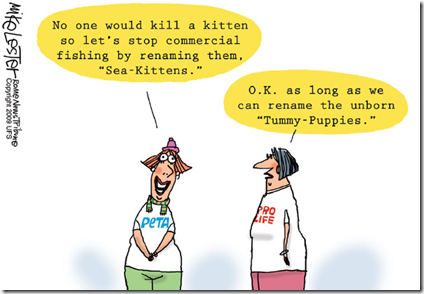
Political Cartoon: Words Mean Things

From Mike Lester:

image

Is PETA still being taken seriously by anybody?

Toward a Notion of Christian Ethics

With this warning echoing on the web against amateur philosophizing. But that being noted, I will forge ahead nonetheless. Meta-ethics is that branch of ethics not describing normative ethics (how we act) but instead the means by which we do ethics. Two popular branches of ethical methodologies are deontology and consequentialism (of the latter, utilitiarianism is a particular example). It is my sense that virtue ethics via Aristotle and later supporters, while put forth some ancient Greeks, is less in favor today. Deontology, roughly speaking, is rule based ethics. Some time ago, I suggested that Christian ethics are neither of these. Christian ethics, described meta-ethically, I suggest are pneumatological.

Christian ethics is not deontological. Jesus time and time again speaks out against deontological Phariseeism, rejecting rigid, or perhaps even non-so-rigid, following of laws described and set down by man.

Christian ethics is not consequentialist. We don’t do our actions in order to “store up pennies in heaven” as it were. Salvation is not garnered via works of men.

What does this mean? In theology, pneumatology relates to the Holy Spirit. That is the Spirit, in the Trinitarian sense, is the center of Christian ethics. Why might we think of ethics for the Christian as pneumatological. As a Christian, to borrow a phrase from R.R. Reno, we are called to be “transparent” to Christ, that is to perform his will through us as if we were transparent. This is effected in the world, via the Spirit to inspire us as to how to do His will.

How might Pneumatological ethics work in practice? How does one discern the will of the Spirit. What has been said and laid out in Scripture and in our Tradition is one source for seeking guidance in this matter. But, for example, bio-ethics today is consistently throwing up questions and issues which are new to this age. How does one act in those cases. I’d suggest, prayer, fasting, being open to inspiration, and seeking advice from those who have more spiritual insight seem all likely possibilities.

Thoughts?

Consider Pledging

Many bloggers have noted the “failure” of abstinence programs and chastity pledges to “work.” It seems to me that a lot of bad conclusions are drawn from this data. In fact the oddest thing about the studies into these programs is that people find the results worth noting. That is to say, the notion that superficial statements about changing one’s life or setting its course do not actually often change or set the course of that life unless one really changes the course of your life in non-superficial ways.

Consider the alcoholic or habitual drug user who (time after time) states, they are “quitting”, only to fall again and again “off the wagon.” You cannot stop drug use without changing all or at least most/many of the habits which accompany one’s life. Consider the convert to Christianity, who professes his or her faith yet changes other outward (or inward) modes and manner of thought. Failure to regularly attend liturgy, engage in daily prayer, and perhaps repentance and fasting … that conversion will likely be temporary and superficial.
Read the rest of this entry

Intentions and Actions, Redux

Well, I can’t leave comments at Positive Liberty for some reason or other, however a brief response to Mr Kuznicki seems in order.

Mr Kuznicki is up in arms about conservatives daring to “defend” a Rick Warren/Martin Ssempa connection. He finds a movement toward abstinence inappropriate as well as Mr Ssempa’s anti-gay rhetoric. Now, I’m not going to defend the latter. However, a little googling shows that the Saddleback church (Rick Warren’s “purpose driven” mega-church) has embraced an AIDS ministry. The concentration of this ministry accoriding to their web site concentrates confronting AIDS in particular because of the stigma associated with the disease. And additionally, they’ve chosen to focus their aid on orphans and children with AIDS. In spreading their assistance from the States to Africa apparently Mr Ssempa has aided their particular mission.

Mr Kuznicki asks how those particular things which bother him about Mr Ssempa:

–Agitated successfully to remove all mention of condoms from Uganda’s anti-HIV campaign.
–Burned condoms in public and otherwise condemned them. For Jesus.
–Recommended that gays be imprisoned.
–Expressed a belief that witches were making people sick.

He wonders how this could be worse?

Well, obviously it could. African AIDS is not a homosexual phenomena, unlike in the States. That epidemic is apparently driven by rampant widespread adultery. One might Imagine burning condoms were part of a movement to stem this tide and promote the notion of fidelity to one’s spouse. Imagine that, the horror! Why might a conservative support such a clearly silly notion.

It was Mr Kuznicki’s last bullet point that inspired my initial remarks regarding intentions and deeds. If one takes the two notions that Mr Ssempa has been allowing and facilitatting the Saddleback church in getting aid medical, food, and support to orphans and children with HIV/AIDS and at the same time Dr Ssempa thinks that witchcraft and the supernatural impacts the spread of disease. Well, we have an effect, i.e., aid to orphans. We have a belief, witchcraft. The question I posed, and Mr Kuznicki has failed to address, is to ask is why he discounts aid to HIV infected orphans because Mr Ssempa has a belief in witchcraft, i.e., if one’s beliefs (intentions) aren’t pure … does that discount one’s deeds, i.e., facilitating aid to orphans?

Apparently, in Mr Kuznicki’s world … it does.

One final remarks, I don’t know the extent or basis of Mr Ssempa’s political influence in Uganda. However, it is my impression that in sub-Saharan Africa in general there are generically very strong anti-gay biases in the populus. That a politician personally on occaision panders to this to garner support is no indication of their personal feeling and may in fact just be a requirement to get support to garner the political capital to do other things, such as for example try to turn the culture toward monagamy and to aid orphans.

Consider Hatred

I have to admit, I don’t grok the whole “hate-of-group” thing that so many people to seem get infected with.

But during National Brotherhood Week
National Brotherhood Week
New Yorkers love the Puerto Ricans
‘Cause it’s very chic
Step up and shake the hand
Of someone you can’t stand
You can tolerate him if you try

Oh, the Protestants hate the Catholics
And the Catholics hate the Protestants
And the Hindus hate the Moslems
And everybody hates the Jews

But during National Brotherhood Week
National Brotherhood Week
It’s National Everyone-Smile-At-
One-Another-hood Week
Be nice to people who
Are inferior to you
It’s only for a week, so have no fear
Be grateful that it doesn’t last all year!

Does anybody out there understand it? I don’t think the I have any conscious awareness of hatred for any particular group, except perhaps a particular peccadillo I observe (in others) which bugs me. That is I get unreasonably irked when I see able bodied people using handicapped spots. But that’s not the same as the prejudices and hatreds which seem to abound.

If you hate someone, why do you do it? If you hate or despise a particular group of people, why? How do you justify that?

 Page 7 of 12  « First  ... « 5  6  7  8  9 » ...  Last »