Economics & Taxes Archives

Is this responsible; saddling future generations with mountains of debt so that we don’t have to suffer ourselves?  Is this moral?

The federal government faces exploding deficits and mounting debt over the next decade, White House officials predicted Tuesday in a fiscal assessment far bleaker than what the Obama administration had estimated just a few months ago.

Figures released by the White House budget office foresee a cumulative $9 trillion deficit from 2010-2019, $2 trillion more than the administration estimated in May. Moreover, the figures show the public debt doubling by 2019 and reaching three-quarters the size of the entire national economy.

Obama economic adviser Christina Romer predicted unemployment could reach 10 percent this year and begin a slow decline next year. Still, she said, the average unemployment will be 9.3 in 2009 and 9.8 percent in 2010.

"This recession was simply worse than the information that we and other forecasters had back in last fall and early this winter," Romer said.

Fine, the recession may have been worse than your experts predicted, but you can’t possibly escape the fact that the "exploding deficits" and "mounting debt" are directly attributable to the administrations own programs, Ms. Romer.  You didn’t inherit TARP.  "Cash for Clunkers" is not a Bush administration program.  And it’s not entirely clear whether or not all this indebtedness has been a remedy.

Our current indebtedness is making foreign investors skittish, even if we do come out of the recession fairly early.  We have to pay this money back at some point, but Obama is going to foist it off on whoever’s President after him.

If this was a private citizen doing this, Dave Ramsey would be having an intervention.  Millions of (otherwise) fiscally responsible Christians would, too, but this crisis has turn some of them on their heads.

Here’s an article from March by Tony Campolo, where he says that he is repenting from being the "older brother" in the story of the Prodigal Son by complaining how irresponsible others were with (in this case) the money taken from him in taxes.

That, I am sad to say, is much the same attitude that I, along with most of my conservative evangelical brothers and sisters, have had in reaction to President Obama’s announcement that taxpayers’ dollars, earned by hard-working, responsible citizens, would be given to help those irresponsible Americans who bought houses that they couldn’t afford, while embracing a lifestyle that was beyond their means. With resentment, I, along with most of my rugged individualistic Christian friends, now sound like that older brother in Jesus’ story, and call for those irresponsible spenders to get what they deserve. With an air of self-righteous indignation, we declare, “They didn’t do what’s right and now we’re being asked to rescue them from the financial mess they’ve created for themselves!”

The gospel is about grace and we all know that grace is about us receiving from God blessings that we don’t deserve. But now, I, having received grace, find that my voice is blending in with a host of other older brother types who are reluctant to grant grace to those desperate home-buyers who were seduced into lavish living they could ill afford.

I’ve got some repenting to do. I doubt, however, that those who have wedded Christianity with laissez-faire capitalism will see things this way. I can just hear them saying, “Am I my brother’s keeper?”

I have no idea what conservative Christians you’ve been talking to, or perhaps imagining, Tony.  I am my brother’s keeper.  I am, not my government.  And my neighbor is not my brother’s keeper either, so forcing them via taxes to pay for my brother is wrong.  When God is separating the sheep from the goats, the Bible does not say He’ll ask me if I voted to make sure others paid to help the poor, He’ll ask if I fed the hungry, clothed the naked and visited the prisoner. 

Charity money I give directly, or through the organization of my choice, is grace.  Forcing me, with threat of incarceration, to pay for anything, no matter how well-intentioned, is most decidedly not charity or grace.  Campolo seems to suggest that God’s grace consists of always letting us keep the fruits of our foolishness and bad decisions. 

But in the story that he references, the younger son, while welcomed back into the family, does not get a windfall or a bailout.  He’s forgetting one of the last lines of the story, where the father says to the older brother, "’My son,’ the father said, ‘you are always with me, and everything I have is yours.’"  Yes, the younger brother came back and, instead of being a servant, was restored to his place as a member of the family.  Yes, he had a party thrown in his honor.  But, as Jesus points out through the words of the father, he no longer is entitled to half of the inheritance anymore.  That ship has sailed.  If he did have even that restored to him — if there were no consequence for his actions — the temptation later on to repeat the same mistake would be very great. 

As in that story, rewarding poor choices is not something we should have our government in the business of doing.  The father did take the younger son back into the family, which means he gets his 3 square meals a day and other benefits, and we, with our charity dollars (as opposed to forcibly taxed dollars), should be helping out those who made poor choices, or who find themselves in circumstances not of their own making.  Absolutely true, and I’d wonder where Mr. Campolo is finding Christians saying otherwise.  Certainly not in the disagreeing comments to his post.  They’re worth reading as much as the article itself.

Part of the issue with toxic mortgages is something Campolo alludes to; the government contributed to this problem by relaxing the rules on who could qualify for a mortgage.  This action was urged by liberals likely with the same mindset as now, who thought that encouraging home ownership, regardless of the ability to pay the debt, was also gracious.  Never mind the hindsight we now have, just the idea that doing anything and everything for the poor without thought for the potential consequences is irresponsible.  What we wound up with was a program to allegedly help the poor, that encouraged irresponsibility, funded by taxpayers, which, when it foundered, was then bailed out by taxpayers.  This, I believe, is the source of the frustration that Mr. Campolo is hearing; the same mindset that helped cause the problem claims that it can now solve the problem.

So the question from a Christian perspective is not whether we are our brother’s keeper, as Mr. Campolo’s straw man insists.  That’s a cheap shot at best.  I think the question is; what is the proper role of government in dispensing grace?  Jesus didn’t speak to the Roman government, nor did he speak to the local civic leaders (though He did have some strong words for the local religious leader).  He spoke to individuals.  To those outside the church, He said to repent.  That’s it.  To those inside the church, however, He had many things to say, including how to treat the poor.  Our civil government does not speak or act for the church, so it is not the job of the government to carry out the instructions to the church.  And given that churches and church-goers are, generally, the most giving and charitable people, I don’t see a rebuke of Mr. Campolo’s type is in order; simply an admonishment to continue to do more.

(This is not to say that we shouldn’t want the government to act morally in its proper spheres.  This is a question of what those spheres should be or how extensively it should penetrate those spheres that it is in.)

I grew up in the Salvation Army, and when giving out food to the poor, there was sometimes a concern that such giveaways might be scammed.  Perhaps a father comes in and gets groceries for a family of 3, and then later the mother comes in to do the same.  Is it moral to question whether or not the food program is being properly administered to avoid this?  Is it fair to the family in need who comes to our door only to be turned away because their bag of groceries went to a family that double-dipped, or didn’t really need it?  And so, wouldn’t it valid for those who give money to the Salvation Army, in hopes of helping the needy, to be frustrated if they find that the program needs more money because it was improperly handled in the first place?  And if it’s OK for the Salvation Army, how much more so for a government dealing out billions and trillions of dollars!

Don’t we expect good stewardship?  Or if the intent is good, should we ignore all the problems with a program and instead force our neighbors and future generations to pay for it?  How in the world is that moral or responsible or, if you will, sustainable?

For Perspective: Spending

For those that continue to say, "Well, Bush spent a lot during his presidency!", a little perspective from Greg Mankiw:

Before you read this story, here is one number you need to know: the U.S. federal government’s debt is now about $7.4 trillion. That is the accumulation from past budget deficits.

With that number firmly in mind, here is a story from the Washington Post about the path of future fiscal policy:

The nation would be forced to borrow more than $9 trillion over the next decade under President Obama’s policies, the White House acknowledged late Friday, bringing their long-term budget forecast in line with independent estimates.

The projection is that in 10 years we’ll more than double the debt our country has accumulated up to this point.  Dubya and the Republicans continues to look more and more like coupon-clipping penny-pinchers compared to Obama and the Democrats. 

Or, if you prefer automobile analogies:

Forget the DMV analogy, it’s the Post Office that Obamacare will model

And here we have Obama attempting to salvage a concern about the track record the government has with regards to mis-managing just about anything it lays its hands on. In his own words, “It’s the Post Office that’s always having problems” (emphasis added).

One thing is becoming increasingly evident, as more of Obama’s impromptu exchanges surface – he has a most difficult time presenting himself in a coherent manner. Perhaps the Left was correct in their concerns about Sarah Palin’s lack of experience, because we’re certainly seeing Obama demonstrate his.

The 1% and the 95%

In the late 1980s, the top 1% of taxpayers — the richest 1% of the country — paid 25% of the total income taxes paid.  This seems reasonable, as those folks make a lot more money than, say, the bottom 95%.  In fact, in the 80s, the bottom 95% paid about 55% of the total taxes. 

But things have changed quite a bit.

The Club for Growth is noting that IRS tax information just released information that the top 1% is now paying more total taxes than all of the bottom 95%, if you can believe that.  CFG highlights a graph of the data to show the continuous track we’ve taken to soak the rich.  Their observation:

This begs the question: At what higher rate do liberals want to tax "the rich" in order to make the tax code, in their eyes, more fair?

Indeed, liberals won’t define the term "fair tax code", other than to say that it’s taking more from the rich than they’re taking now. 

Bruce McQuain over at Q&O, in addition to wondering about the definition of "fair", also wonders about the Left’s definition of "greed".  Who, one might ask, is more greedy than the person who want to pay less and less for more and more government services paid for by other people?  And ye we hear from them cries of "greedy Wall Street" and "greedy corporations".  Pot, meet kettle.  Kettle, this is pot.

I also think it begs another question: How much money does the Left think it can suck out of the rich for things like universal health care?  Are they but a money tree, ripe for the picking?

Sweden Doing a 180

From a post at Redstate comes word that a liberal go-to guy for examples of a utopian society is now backing away from, what turned out not to be, the perfect world.  Quoting the Redstate writer "Skanderbeg":

Having run the “progressive experiment” for a few decades, the Swedes have figured out that it’s a dead end that does not work – and they want out.

What are they doing?  Cutting taxes, capping spending and privatizing health care.  What are we doing?  Raising taxes (or coming up with new ones), uncorking spending, and "publicizing" health care.  We’re meeting Sweden on the road going the opposite direction, and they’re telling us to turn back.  Will we listen?

I guess the first question is will they listen.  My underlying issue with public health care is that people will believe, at some point, that they are entitled to it, hence the term used for so many welfare programs; "entitlements".  But a poor choice of terms it is, because it engenders a sort of "right" that doesn’t really exist; your right to my money.  Living in that culture for 30 years, will Swedes let go of class warfare and "soaking the rich" to embrace financial independence?  We can only hope.

I linked only to the Redstate article, because it covers another topic as well, worth reading.  The link to the original article is in there, though.

Political Chuckle of the Week

The old phrase goes, "What if they gave a war and nobody came?"  Well, here’s another:  What if they gave a universal health care support rally

Local MoveOn.org members had penciled in on today’s schedule a protest in front of Senator John Cornyn’s Spring Valley Road office, during which they had hoped to pressure the senator to support President Barack Obama’s public health care legislation.

…and a tax protest broke out?  (I know, not as catchy.)

But when Paula Anderson, a MoveOn.org member and spokeswoman, showed up at 11:30 a.m., she found another contingent had beat her to the proverbial punch: A large number of Dallas Tea Party members were already set up, voicing their opposition to the proposal.

Anderson was stunned: "We really did not expect them to show up." She estimated the crowd at about 130. "From our perspective we took names of everyone there, and we had about 30 people," she told Unfair Park. "And I would assume they maybe had 100."

The Tea Party movement ain’t going away so easily.

It’s Been Tried. It Failed.

If good intentions were dollars, TennCare would be turning a profit instead of failing in its financial and moral responsibilities to the people of Tennessee.

And so begins an article dealing with the financial problems of a universal health care insurance program that has failed, and of a government that hid the fact that it was failing.

Now I’m sure that there are plenty of folks who would come forth and say that this time, with ObamaCare, it would be done right. 

The article lists a number of people and groups to blame for the failure, but I find this to be the foundation of it all, and why a little government intervention inevitably leads to a lot.

Then blame the entitlement industry that has grown up around TennCare like weeds choking a garden. These strident advocates believe they have the right to reach into our pockets and take as much money as they need to turn TennCare into what they want it to be — universal insurance — instead of what it is supposed to be — a safety net.

That is precisely what happens when a new entitlement comes into play, and why Ronald Reagan said that the closest thing to eternal life this side of heaven was a government program.  Promoting this entitlement to the federal government will, make no mistake about it, get larger than even its proponents dare to believe.  And ultimately it won’t be as good as what we have now.

Just ask all the Canadians that come over the border.

Sustainable Debt

One thousand words, meet picture:

And according to the article, we may dip even below all other estimates.

The federal deficit has topped $1 trillion for the first time ever and could grow to nearly $2 trillion by this fall, intensifying fears about higher interest rates, inflation and the strength of the dollar.

Neither the Congressional Budget Office nor the White House estimated those kind of numbers.  As I’ve said before, complain all you want about how Republicans overspent (and I did), Obama and the Democrats make Bush and the Republicans look like amateurs.  Nobody who complained during the Bush administration should be shouting for joy at all this new government spending on new government programs.  But most Democrats are.

Oh, by the way, this is not counting the Obamacare bill.

That has many Republicans and deficit hawks worried that the U.S. could be setting itself up for more financial pain down the road if interest rates and inflation surge. They also are raising alarms about additional spending the administration is proposing, including its plan to reform health care.

Look your children and grandchildren in the eye and tell them this is for their own good.

We’re out of money, so… we need to spend more of it

From current Vice President Joe Biden,

“And folks look, AARP knows and the people with me here today know, the president knows, and I know, that the status quo is simply not acceptable,” Biden said at the event on Thursday in Alexandria, Va. “It’s totally unacceptable. And it’s completely unsustainable. Even if we wanted to keep it the way we have it now. It can’t do it financially.”

“We’re going to go bankrupt as a nation,” Biden said.

“Now, people when I say that look at me and say, ‘What are you talking about, Joe? You’re telling me we have to go spend money to keep from going bankrupt?’” Biden said. “The answer is yes, that’s what I’m telling you.”

Now, the essential liberal complaint against Sarah Palin is that she is simply too ignorantly stupid to be our Vice President, much less President.

Remind me again… how is Joe Biden a better choice?

Update: watch for yourself. I’m reminded of when Orange County, California went bankrupt, in 1990s, and the proposed “solution” was to levy a special tax. You see, this is the way liberal socialists think… government will solve the problem if they have enough money.

Restructuring the Economy; What Do You Call It?

TigerHawk has an eye-opening blog post about how much of the economy the Obama administration wants to restructure. 

Perhaps a number will help: 35%. That is the aggregate percentage of United States GDP produced by the three industries that the Democrats hope to restructure from the top down: Health care (17% of GDP), energy (9.8% of GDP), and financial services (8% of GDP). Think about that.

And it has to be done now, now, now!  Don’t read the bills, and don’t let the public scrutinize them; just vote on them!

And if you act now, we’ll throw in the automotive sector (4% of GDP)!  (Sorry, channeling Billy Mays for a second there.)

So then, if the government gets to get its hands into more than 1/3rd of the economy, with a controlling interest never before given to it, would you still call that capitalism? 

A "Jobs Bill"?

Front-page Daily Kos writer SusanG is exuberant about the energy bill that recently passed in the House.

In an unprecedented move, the White House retracted yesterday the embargoed text for the president’s usual weekly address, which it generally sends to news outlets the evening before the official Saturday remarks are posted on the White House website. The first address sent was focused on health care reform; the replacement discussed—and praised to the heavens—the energy bill that passed the House yesterday afternoon.

Clearly, the measure’s passage prompted a nimble switch in presidential priorities for the address, which President Obama often uses as the first salvo in setting messaging for the coming week—and for putting friend and foe alike on notice about what’s on the administration’s upcoming agenda. In fact, he’s so adamant about pushing his slant on the energy bill that today’s weekly address is mostly a reprise of a speech he gave earlier in the day yesterday, with a framing he clearly wants to drive home:

It’s all about the jobs, baby.

In the very first sentence, in fact, the President doesn’t just refer to the measure as an energy bill—it’s a piece of legislation that "will open the door to a clean energy economy." In fact, this is—make no mistake, he says—a jobs bill.

Yup, he talked about jobs.  He called it a "jobs bill".  And merely saying that makes things all golden.

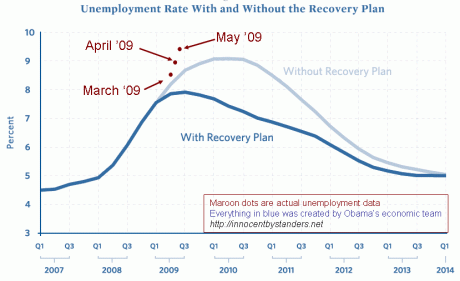
‘Cept he said the same thing about the stimulus package, and we all know how that turned out.  A reminder:

Stimulus-vs-unemployment-may

Yeah, the President called the energy bill "a jobs bill".  After the last "jobs bill", unemployment rose to a point higher that he said we’d hit if we did nothing

But hey, he said this would be a "jobs bill".  For the Left, it appears that’s all that really matters.  Results?  Meh.  Intentions are everything.

The "Expiration Date" on Political Promises

Remember when candidate Barak Obama said that he wouldn’t raise taxes on anyone making less than $250,000 a year?  That promise may not last 6 months into President Obama’s tenure.  George Stephanopoulos reports:

White House senior adviser David Axelrod said the president won’t rule out a health care reform bill that includes a middle-class tax hike.

"The president had said in the past that he  doesn’t believe taxing health care benefits at any level is necessarily the best way to go here.  He still believes that," Axelrod told me on This Week, "But there are a number of formulations and we’ll wait and see.  The important thing at this point is to keep the process moving, to keep people at the table, to the keep the discussions going. We’ve gotten a long way down the road and we want to finish that journey."

I pressed Axelrod on whether Obama will draw a line in the sand and veto any bill that funds health care reform with tax hikes for people making under $250,000 a year — despite a pledge Barack Obama made during the 2008 presidential campaign not to raise taxes on the poor and middle-class.

"One of the problems we’ve had in this town is that people draw lines in the sand and they stop talking to each other.  And you don’t get anything done.  That’s not the way the president approaches us.  He is very cognizant of protecting people — middle class people, hard-working people who are trying to get along in a very difficult economy.  And he will continue to represent them in these talks," Axelrod said.

So if you expect Obama to keep his promises, you’re just a stick-in-the-mud.  According to Axelrod, any line drawn stops the talks, and thus everything is negotiable. 

Well, at least we know where the administration stands now.  All the tough talk and "yes we can" talk were all just suggestions.  Hope for change, and such.

An Econ Question

I’ve a short question on economics, as I’ve never really studied the subject. Descriptions of economic activity seem that they must fundamentally be non-linear in nature. However all the equations and descriptions I’ve seen seem to be linear. Is that really the case? Are economists all playing with linear descriptions, which may actually be the case near equilibrium. But how often are economies near equilibrium? And when they are not, doesn’t that mean that in those times many if not most rules of thumb developed in times of equilibrium no longer hold true?

Who is saying things like this? What “school” of economics would or does admit to this sort of description?

Political Cartoon: Who’s Running GM?

From Chuck Asay (click for a larger version):

Chuck Asay cartoon

No, really, nothing’s changed at all.

Link Catch-up

I haven’t posted as much recently.  I thought summer would slow things down, but apparently not so much around our house.  I’ve been collecting things to write on, but they’re starting to get stale, so before they’re completely irrelevant, here are a few quick hits to start the week.

Economy: Never mind whether or not you got TARP funds, the Obama administration may be looking to cap your executive’s pay.

Gene Sperling, a top counselor to Treasury Secretary Timothy Geithner, conceded to a congressional committee that imposing compensation caps on companies could lead to a flight of talent.

“I can say with certainty that nobody in the Obama administration is proposing such a thing,” he said.

Yet, at the same time, he and officials with the Federal Reserve and the Securities and Exchange Commission laid out a case for how payment structures rewarded short-term gains at the expense of long-term performance and contributed to the nation’s financial crisis.

The administration plans to seek legislation that would try to rein in compensation at publicly traded companies through nonbinding shareholder votes and by decreasing management influence on pay decisions.

No mention of how incentivizing the giving loans to people who couldn’t afford them contributed to the nation’s financial crisis, nor any talk of reining that in.

Abortion: Warner Todd Hudson asks and answers, “Why is Killing Abortionists Wrong? Because it is Un-Christian, That’s Why!” He uses logic and scripture to back up his position.  The key paragraphs:

The final word here is that a Christian ethic posits that men are subject to man’s laws and willfully violating them is not a Christian thing to do — but for extreme cases, and then in a more passive manner than not. Additionally man’s duly constituted law is the sword of punishment and punishment should not be carried out by the individual going off on his own hook. Christians do not take the law into their own hands.

So, in answer to Jacob Sullum’s tough question, killing abortionists IS wrong. It is also quite in keeping with Christian practice to suffer under pro-abortion laws without taking the law into one’s own hands to end the life of a doctor committing abortions. The law says that abortion is legal, only the law may impose the sentence of death, and the individual is bound by those facts under a Christian worldview.

Definitely worth a read.

Health Care: So will all those saving we’re supposed to come from health care reform going to come after the trillion dollar cost is recouped?

Health-care overhaul legislation being drafted by House Democrats will include $600 billion in tax increases and $400 billion in cuts to Medicare and Medicaid, Ways and Means Committee Chairman Charles Rangel said.

Democrats will work on the bill’s details next week as they struggle through “what kind of heartburn” it will cause to agree on how to pay for revamping the health-care system, Rangel, a New York Democrat, said today. The measure’s cost is reaching well beyond the $634 billion President Barack Obama proposed in his budget request to Congress as a 10-year down payment for the policy changes.

Asked whether the cost of a health-care overhaul would be more than $1 trillion over a decade, Rangel said, “the answer is yes.” Some Senate Republicans, including Senator Orrin Hatch of Utah, say the costs will likely exceed $1.5 trillion.

And, as we all know, government estimates of the cost of a government program are a low end guess.  Somehow, I think that net tax decrease that Obama promised was never going to materialize anyway.

 Page 15 of 23  « First  ... « 13  14  15  16  17 » ...  Last »