“And folks look, AARP knows and the people with me here today know, the president knows, and I know, that the status quo is simply not acceptable,” Biden said at the event on Thursday in Alexandria, Va. “It’s totally unacceptable. And it’s completely unsustainable. Even if we wanted to keep it the way we have it now. It can’t do it financially.”
“We’re going to go bankrupt as a nation,” Biden said.
“Now, people when I say that look at me and say, ‘What are you talking about, Joe? You’re telling me we have to go spend money to keep from going bankrupt?’” Biden said. “The answer is yes, that’s what I’m telling you.”
Now, the essential liberal complaint against Sarah Palin is that she is simply too ignorantly stupid to be our Vice President, much less President.
Remind me again… how is Joe Biden a better choice?
Update: watch for yourself. I’m reminded of when Orange County, California went bankrupt, in 1990s, and the proposed “solution” was to levy a special tax. You see, this is the way liberal socialists think… government will solve the problem if they have enough money.
I was driving through West Virginia and Kentucky last weekend and saw a number of signs advertising that some particular road improvement project was being funded by the American Recovery and Reinvestment Act otherwise known as the “stimulus plan” or by its more derisive name Porkulus.
About half the projects I saw on the road appeared to have already been completed. The other half were in various states of progress.
But I couldn’t help wonder about the money spent on the signs. Turns out I’m not the only one. Frankly, I can’t see why the money was spent on the signs. But then again, this is the federal government and, as usual, nothing they do makes sense.
Perhaps the better thing to have done was to forgo buying the signs and spend more money fixing the roads.
Comments Off on Restructuring the Economy; What Do You Call It?
TigerHawk has an eye-opening blog post about how much of the economy the Obama administration wants to restructure.
Perhaps a number will help: 35%. That is the aggregate percentage of United States GDP produced by the three industries that the Democrats hope to restructure from the top down: Health care (17% of GDP), energy (9.8% of GDP), and financial services (8% of GDP). Think about that.
And it has to be done now, now, now! Don’t read the bills, and don’t let the public scrutinize them; just vote on them!
And if you act now, we’ll throw in the automotive sector (4% of GDP)! (Sorry, channeling Billy Mays for a second there.)
So then, if the government gets to get its hands into more than 1/3rd of the economy, with a controlling interest never before given to it, would you still call that capitalism?
John Stossel has a nice takedown of your most recent article on universal health care. No, it’s not better in France, and it’s going to cost way more than any estimate.
It’s short, so you can indeed Read the Whole Thing(tm).
It seems progressives have it ingrained that private healthcare insurance are not healthcare services or products that I’ve purchased. This is a lie. It is the essential lie that is wrecking the current debate on healthcare. From Tuesday’s comments here are to remarks to this assertion which I take as typical:
Actually you’ve ‘paid for’ a bet. You’ve betted that you will require certain expensive healthcare over the term of your policy. Your insurance company has bet that you will not. If it wins, they keep your premiums and make a profit. If you win, they pay for your healthcare.
and
As Boonton points out, you haven’t purchased healthcare per se, but healthcare coverage. And I’m not sure who “on the left” “forget” that.
Let me start with a little analogy.
Two men are neighbours. Their families both regularly have a Saturday evening barbecue at which sometimes they chat. One day they both start remarking on a very large boulder uphill of their properties. The way it is propped up it looks like it could hit one or the other of their houses. One of them suggests that every Saturday each one will put $20 a kitty. When (and if) erosion or other processes loosen the huge rock to crack into one of their houses … thy guy whose house is hit gets whatever was in the pot.
Imagine that rock was above a town … and the town agreed to a similar deal … and that contributions were fixed, contributors were voluntary, and that only contributors would be splitting the funds collected funds when the rock released. And that the funds getting large enough needed to hire an accountant to manage those funds … and that some rules needed to be established to apportion that sum in a equitable manner when rock caused damage to various houses in differing degrees. And voila … one has established an insurance company (not healthcare … but that is a distinction without difference).
This essentially the “bet” in the first quoted remark above or the “coverage” vs “product” in the second. What is the status of that money. When the person who’s house is struck has to pay for repairs … is that paid for with his money? It seems obvious that the answer to that is yes, he is paying with his money.
Healthcare coverage today is quite expensive. I don’t have the figures [note: I might ask at my employer for a rough estimate of what our companies healthcare costs per month run.] but I’m guessing offhand that $6k to $12k per year easily is being put to my healthcare insurance for my family of four. The first objection insists that this is a “bet” (which is an odd way to put actuarial calculations). Actuarial evolution is the means by which insurance companies make money. But the amount above the co-pay for medical services and medicines that are purchased on my families behalf is money from the “kitty” above. It is mine. It comes from my participation in the pool. The quantity that must be put in is related directly to mathematical statistical models of our population and our behaviour. Yet it is my money in exactly the same way that the money that money belonged the gentleman above with the damaged house. The movement from the two men to the town is pretty clear. When the money is spent is it still money belonging to and deriving directly from the people benefiting. That there is a “bet” involved is an unimportant detail. That this is “coverage” vs “payment” is a syntactic dodge.
Calling the health insurance that a person earns and receives as on of the means of remuneration for services rendered to an employer not a thing for which he has bought and paid is rhetorical thievery. The left will tell you today that these actuarial services are stealing from you. They will also deny that the private insurance company benefits are your money. And furthermore, that replacing these with greater government efficiencies will save incredible amounts. One wonders at the naivete at that sort of thinking. Greater. Government. Efficiencies. From what planet do these people originate? Medicare is a public healthcare program. There are private companies that exist solely for the purpose of navigating the arcane and Kafkan intricacies of Medicare paperwork on your behalf. Yep. More efficient indeed. Savings indeed. Mr Obama is indeed a great politician, that is if the term ‘great’ is a measure of the size and frequency of the the lies you tell.
Like the Bush administration, the Obama administration argues that the legal basis for indefinite detention of aliens it considers dangerous is separate from war-crimes prosecutions. Officials say that the laws of war allow indefinite detention to prevent aliens from committing warlike acts in future, while prosecution by military commission aims to punish them for war crimes committed in the past.
On national security, Obama has pretty much held the Bush line. But hey, he gave great speeches about Change, so it’s OK.
Comments Off on An Upside to Mr Obama’s Healthcare Plan
So Mr Obama wants a national healthcare plan. The right opposes this and the left is doing it’s best to shut down debate and shunt discussion aside, because the objections are strong and many. However, the right might be using the wrong tactic. Perhaps the best tactic is to embrace the dark-side.
Mr Obama points out that with a National Healthcare plan that people like himself, i.e., the wealthy, would as he did for his grandmother still be able to pay for the care of their loved ones directly out of their pocket. Yet this is very problematic for his vision of nationalized healthcare. For it provides the essential loophole the rest of us need.
The rest of us, that is the normal working stiffs while on the first glance don’t have the wherewithall to have the ready cash to pay for emergency healthcare do in fact have the same. For, we are currently paying for all of our healthcare. The solution goes something like this:
An enterprising group of ordinary middle class people, who realize they can’t pay for emergency medical care which isn’t or is poorly covered by government coverage (or for example to skip to the head of the queue like the wealthy will be doing) will do what free people have done from the start. They’ll organize (an activity oddly enough Contitutionally protected).
By organizing in groups, collectively people can, uhm, spread their risk. Each will make monthly contributions to a collective pool, managed financially by a small number of administrators, who will figure costs, apportion and manage benefits, and invest funds. In fact there is a word for such organizations, they were formerly known and health care insurance companies. You might even find employers adding supplemental health care as a benefit to attract qualified, skilled, and attentive labor. I’d even go so far as to suggest that health care companies currently in place might jump at this market.
Mr Obama suggested that you can keep your current insurance. But this is not in fact what will occur. Your current insurance will magically transmute itself tobe just supplemental insurance. If Mr Obama and the left decides this is dirty pool, it will become black market dirty pool, and I for one see know reasonable argument for why a person could not participate in such a market. If Mr Obama can use his ready cash … any schmoe should be able to join a risk pool to effectively do the same.
There is in fact a big fat plus to this plan. Supplemental insurance of this sort and in this market is completely (so far as I know) unregulated. It’s new unplowed ground. Unregulated health care markets are in fact exactly what Mr Obama thinks his plan is avoiding and also (not?) oddly enough exactly what I happen to think the health care market needs. Health care needs wild wooly unregulated markets to spur innovation. The unanticipated unregualted supplemental insurance market might provide at least a small sampling of this very thing.
Thus perhaps the best thing for the right to do is cede the healthcare proposal but fight for realistic cost controls and appraisals. That the taxes for this boondogle will not get out of hand, which will in turn cause the government insurance to cover and provide for in actuallity very little in the way of health care in the absence of supplemental income. This is actually what the right argues for, very minimal bare coverage for all and abillity to pay provides the caps on health care for the rest.
So the only stumbling block for this argument is one I don’t see as of yet. Is there any argument that would prevent supplemental insurance from springing up? Realistically I don’t see any difference between Mr Obama paying for his grandmother’s care and a group of people, in free association, collecting to provide the same and spreading the risk.
I did have a quick remark, which may or may not spur discussion. It seems to me Congress is becoming less and less influential? But is that because the Federal government in general is gaining power and that Congress is not doing so as quickly as the other branches so it only appears to be losing in influence? Rome as we all know had its Legislative body subsumed by the Executive. Why do we think that will not happen here?
Front-page Daily Kos writer SusanG is exuberant about the energy bill that recently passed in the House.
In an unprecedented move, the White House retracted yesterday the embargoed text for the president’s usual weekly address, which it generally sends to news outlets the evening before the official Saturday remarks are posted on the White House website. The first address sent was focused on health care reform; the replacement discussed—and praised to the heavens—the energy bill that passed the House yesterday afternoon.
Clearly, the measure’s passage prompted a nimble switch in presidential priorities for the address, which President Obama often uses as the first salvo in setting messaging for the coming week—and for putting friend and foe alike on notice about what’s on the administration’s upcoming agenda. In fact, he’s so adamant about pushing his slant on the energy bill that today’s weekly address is mostly a reprise of a speech he gave earlier in the day yesterday, with a framing he clearly wants to drive home:
It’s all about the jobs, baby.
In the very first sentence, in fact, the President doesn’t just refer to the measure as an energy bill—it’s a piece of legislation that "will open the door to a clean energy economy." In fact, this is—make no mistake, he says—a jobs bill.
Yup, he talked about jobs. He called it a "jobs bill". And merely saying that makes things all golden.
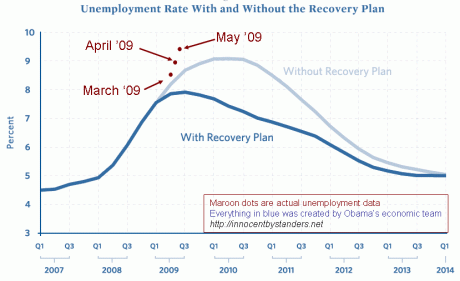
‘Cept he said the same thing about the stimulus package, and we all know how that turned out. A reminder:
Yeah, the President called the energy bill "a jobs bill". After the last "jobs bill", unemployment rose to a point higher that he said we’d hit if we did nothing.
But hey, he said this would be a "jobs bill". For the Left, it appears that’s all that really matters. Results? Meh. Intentions are everything.
Comments Off on The "Expiration Date" on Political Promises
Remember when candidate Barak Obama said that he wouldn’t raise taxes on anyone making less than $250,000 a year? That promise may not last 6 months into President Obama’s tenure. George Stephanopoulos reports:
White House senior adviser David Axelrod said the president won’t rule out a health care reform bill that includes a middle-class tax hike.
"The president had said in the past that he doesn’t believe taxing health care benefits at any level is necessarily the best way to go here. He still believes that," Axelrod told me on This Week, "But there are a number of formulations and we’ll wait and see. The important thing at this point is to keep the process moving, to keep people at the table, to the keep the discussions going. We’ve gotten a long way down the road and we want to finish that journey."
I pressed Axelrod on whether Obama will draw a line in the sand and veto any bill that funds health care reform with tax hikes for people making under $250,000 a year — despite a pledge Barack Obama made during the 2008 presidential campaign not to raise taxes on the poor and middle-class.
"One of the problems we’ve had in this town is that people draw lines in the sand and they stop talking to each other. And you don’t get anything done. That’s not the way the president approaches us. He is very cognizant of protecting people — middle class people, hard-working people who are trying to get along in a very difficult economy. And he will continue to represent them in these talks," Axelrod said.
So if you expect Obama to keep his promises, you’re just a stick-in-the-mud. According to Axelrod, any line drawn stops the talks, and thus everything is negotiable.
Well, at least we know where the administration stands now. All the tough talk and "yes we can" talk were all just suggestions. Hope for change, and such.
Don’t you just hate it when it’s the insurance company making your healthcare decisions rather than you or your doctor? Well, when it’s the government insuring you, this is what you can expect.
President Obama suggested at a town hall event Wednesday night that one way to shave medical costs is to stop expensive and ultimately futile procedures performed on people who are about to die and don’t stand to gain from the extra care.
In a nationally televised event at the White House, Obama said families need better information so they don’t unthinkingly approve "additional tests or additional drugs that the evidence shows is not necessarily going to improve care."
He added: "Maybe you’re better off not having the surgery, but taking the painkiller."
Obama advertises that you’ll be able to choose your own doctor, but if neither of you have a say in your healthcare that’s just a bunch of misdirection. Indeed, sometimes that happens even now, but if you think that the government option will somehow be fundamentally different, you’re gravely mistaken.
And after the trillions spent on providing this, the desire to cut costs will be great.
Mr Westmoreland-White here offers an “explanation” for why the GOP reacts differently to scandal than the Democrats. One wonders if he knows any conservatives or republicans. He could, you know, ask one or two what their reason for caring about scandal, unlike the Democrats who apparently don’t. The point is, I’m a conservative. The reason I’ve given and heard from other conservatives why personal scandal matters for politicians is the same every time. And it’s not the reason he gives, to whit:
It seems to me that the difference is the hypocrisy factor. The Democratic Party in the U.S. has not tried to set itself up as the “morality police.” Democrats sometimes campaign as “strong family people,” but this is seldom the center of the campaign. They don’t claim to be morally superior. They don’t try to claim that voting for them is the only way to save the American family. Republicans do make such claims–usually by implication, but sometimes in almost those very words. Further, Republican politicians loudly call for Democratic politicians to resign if they get caught in sex scandals–and claim that voting for them is a way to restore the moral fabric of the nation.
This is uncharitable. It is not any reason that he, I suspect, or I have ever heard given. So that liberals and progressives get this straight, here is why the GOP (in office and out) call for Democrats caught in sex and other scandals to resign from public office.
Conservatives believe that private dishonest is reflective of personality. That a person who is dishonest in his personal affairs will also be dishonest in public and is not worthy of public trust. Cheating on a spouse affects a number of people, the wife, the children, and the social community in which the person resides. It is at the core, a breaking of trust. Conservatives believe that a person who is dishonest in these things will cannot be trusted in other things. That dishonesty of this sort disqualifies one from public office where great trust over money and power is given to a person for whom integrity is important.
The question then redounds to the liberal side. Why do they for their part feel that a person who lacks personal integrity is worthy of public office? I might suggest reasons why I might think that liberals like Mr Westmoreland-White might feel that personal integrity is unimportant to those in public office, but unlike him I fear that any reason I might sugggest would be uncharitable. So … I’ll await suggestions from him and from other liberal/progressive readers to answer that question defending the notion that personal integrity is unimportant.
British homeschoolers may no longer be able to teach independently. Children’s Secretary of Britain accepted a report in full last week that could change the face of homeschooling in Britain indefinitely. In the report, the author, Graham Badman, Chair of the British Educational Communications and Technology Agency (BECTA), argues for an end to homeschool freedom.
"While it’s disgraceful that the British government would even entertain this report it’s particularly troubling for American parents because the United Nations Convention on the Rights of the Child (UNCRC) was used as the justification for this action," said Michael Farris, Chairman of HSLDA and President of ParentalRights.org.
The Badman report uses Articles 12 and 29 of the UNCRC to justify registering the estimated 80,000 homeschooling families in Britain, forcing them to provide annual reports regarding their homeschool, granting government officials the right to enter the home and interview the children alone as well as reserving the choice of curriculum to the state.
HSLDA has been warning that the UNCRC could bring an end to homeschool freedom in the U.S., if the treaty was ever ratified by the U.S. Senate because Article VI of the U.S. Constitution says that treaties become the supreme law of the land.
OK, first I have to admit that I snickered a bit when I read the phrase "The Badman report". But getting beyond that…
I’m wondering if the UNCRC says or implies that children can be used as witnesses against their parents without a lawyer present. I mean, why would any government official be granted exclusive access to a homeschool child other than to find out what’s really going on? Somehow, without all this invasiveness, homeschool children are, on the whole, doing better academically than their public-schooled peers. Part of the reason people homeschool is precisely to avoid the problem with government-chosen one-size-fits-all curriculum.
Do people misuse the opportunity? Indeed they do, but it is such a small minority that this is akin to burning down the forest to kill the mosquitoes. Parents, on the whole, are doing just fine thankyouverymuch educating their own children. (One wonders how we learned anything prior to the 19th century.)
It occurs to me that Iran may have committed a horrible strategic error. I’ve not seen this suggested anywhere, but bear with me a moment.
During the Iraq kerfuffle Iran has established munitions pipelines and connections between Shia in Iraq and Iran.
There are signs that civil uprising and large scale violence in Iran is on the horizon.
The West (and Israel) would welcome regime change in Iran, yet the West cannot be directly involved for there is little public trust or like in Iran for the West (especially the US).
However the US now has ties in places has close relations with Iraqi Shia … and through them likely the Iranian Shia as well.
Those ties could be used to funnel support to the nascent Iranian insurgency in Iran through the Iraq pipelines.
Thus the Iranian involvement in Iraq by the current regime may be weak point that can be now used to attack that same said regime.