Religion Archives

Friday Link Wrap-Up

I may start doing this more often.  I collect links during the week, some I comment on here, and some just languish in Google Bookmarks.  But instead of a daily report of links like my co-blogger Mark, I’m going to save it all until the end of the week.  This installment will be a bit longer than others since I’ve got some aging links here that really want to see the light of day.  So here they are, usually, but not always, in reverse chronological order:

Coattails?  What coattails? “Some Democrats on the campaign trail have hit upon a winning campaign tactic: Run against President Obama and his agenda — especially the health care overhaul.”

Seeking asylum in the US for … homeschooling persecution? “A German Christian family received asylum in Tennessee after being severely penalized for illegally homeschooling their children in Germany.”  I’ve covered this particular situation before; here, here, here, here, here and here.

California, parts of which are boycotting Arizona for it’s new immigration law, which just enforce existing federal law, should take a look at it’s own lawbooks first.  They might find something familiar.

The economic meltdown in Greece should be a wake-up call to politicians of both parties in the US.  Otherwise, it may turn out to be, rather, a coming attraction.

ObamaCare(tm) is predicted to increase the crowding in our hospitals’ emergency rooms.  “Some Democrats agree with this assessment. Rep. Jim McDermott (D-Wash.) suspects the fallout that occurred in Massachusetts’ emergency rooms could happen nationwide after health reform kicks in.”  But he still voted for this snake oil anyway.

“Economic Woes Threaten Chavez’s Socialist Vision” Only on NPR would this be news.  For the rest of this, it’s a redundancy.

Comedy Central stands on the bedrock of free speech and will mock anyone, just as long as there’s no chance of getting beheaded for it.  “The show in development, “JC,” is a half-hour about Christ wanting to escape the shadow of his “powerful but apathetic father” and live a regular life in New York.”

Green energy falling by the wayside in Europe.  Seems the massive subsidies for this alleged cost-saving energy are too much for governments going through financial troubles.  Should we (will we) take note?

50 leaders of the evangelical generation: #11 Rick Warren. Generational bridge

[I am working on a project that may become a book on the most influential evangelicals leaders of our generation, since 1976, and the impact they’ve had on the church and their times. I will introduce them briefly on this blog from time to time. Who should be on this list?]

#11 Rick Warren. Generational bridge b.1954

If forced to choose, by most measures megachurch pastor and best-selling author Rick Warren is now the most influential evangelical in America. He has his evangelical critics, but most mute their criticism when he presents the Gospel in places such as Fox News Channel and prays boldly at the Presidential Inauguration.

Warren has worked to shift the evangelical movement away from an exclusive focus on traditional evangelical social issues such as abortion and same-sex marriage (regarding the latter, he called divorce a greater threat to the American family), to broader social action. Warren’s five-point plan for global action, the P.E.A.C.E. Plan , calls for church-led efforts to tackle global poverty and disease, including the spread of HIV/AIDS, and to support literacy and education efforts around the world. In February 2006, he signed a the Evangelical Climate Initiative, a controversial evangelical statement backing action to combat global warming. As the director of the ECI campaign, I saw firsthand how Warren’s signature drew media attention and provided the campaign with a gravitas that it otherwise lacked, making it impossible to ignore. In this and numerous other efforts Warren has been parting ways with other conservative, high-profile evangelical leaders.

Warren’s softer tone on political issues central to U.S. evangelicals and his concern for issues more commonly associated with the political left have resulted in the characterization of Warren as one of a “new breed of evangelical leaders.” But it has also been misunderstood by much of media as indicating a shift in the position of the “new breed” on traditional evangelical issues.

Warren has been married to Elizabeth K. Warren (Kay) for 31 years in 2010. They have three adult children (Amy, Josh, and Matthew) and four grandchildren. He considers Billy Graham, Peter Drucker, and his own father to be among his mentors. Due to enormous international book sales, in 2005 Warren returned his 25 years of salary to the church and discontinued taking a salary. He says he and his wife became “reverse “tithers,” giving away 90 percent of their income and living off 10 percent.

Warren is the founder and senior pastor of Saddleback Church in Lake Forest, California, currently the eighth-largest church in the United States. He is also a bestselling author of many Christian books, including his guide to church ministry and evangelism, The Purpose Driven Church, which has spawned a series of conferences on Christian ministry and evangelism. He is perhaps best known for the subsequent devotional, The Purpose Driven Life, which has sold over 30 million copies, making Warren one of the bestselling authors of all time.

Warren holds conservative theological views and traditional orthodox positions on social issues such as abortion, same-sex marriage, and stem-cell research. What distinguishes his public voice is his call on churches worldwide to also focus their efforts on fighting poverty and disease, expanding educational opportunities for the marginalized, and caring for the environment. During the 2008 United States presidential election, Warren hosted the Civil Forum on The Presidency at his church with both presidential candidates, John McCain and Barack Obama. Obama later sparked controversy when he asked Warren to give the invocation at the presidential inauguration in January 2009.

Warren’s chief contribution has been the forging of a new tone and a broader set of issues from the prominent position he earned through historic book sales, while maintaining strong and clear evangelical positions on major public issues and on spiritual priorities. Through these efforts, Warren may represent a bridge between the leaders who began ministry in the 1950’s and the young evangelicals yearning for a break from the more strident voice of recent leaders.

Church in the Making: Valuable for ministry leaders, not just church planters

I’ve been handling publicity for a new book about church planting that I think should be of interest not only to those seeking to and thinking about planting a church, but also to anyone hoping to start something new to advance Christian mission.

Church in the Making by Ben Arment doesn’t mince any words, and it has the tone of a soldier who has fought the good fight and won, but at a high personal cost, with the sense that the battles could have been easier with better intelligence, and mourning the soldier-friends who he has seen fall around him.

I’ve never tried to start a church, but I knew even before reading this book that it is extremely difficult, with a high rate of failure. Arment demonstrates a passion for saving future church planters from heartache and failure; but in the process he writes some things that will undoubtedly rub church planting traditionalists the wrong way.

For instance, Arment writes:

“We have placed a dangerous label on church planting that puts tremendous pressure on planters to persevere through any and all difficulties. We call it faithfulness. But in many cases it should really be called stupidity.”

If you have plans to plant a new church, open a new campus, or help someone who is, you need to get and read Church in the Making. It is well written and an easy read. It’s worth your time.

But it is also valuable to people like me who are involved in starting and advancing Christian organizations, missions, and causes. I’ve seen a lot of the same mistakes that Ben describes in ministry start-ups of all kinds; and I’ve made a number of the mistakes myself. I wish I would have had Church in the Making to read several years ago.

I’ve marked nine different principles in the book that I’ve seen ignored by too many ministry leaders (myself included).

1. Plant in Fertile Soil

Arment: “Every community has an established degree of spiritual receptivity. When you plant a church on fertile soil, it springs to life out of the community’s readiness. When you plant a church on infertile soil, it chokes and gasps to survive. In this case, you have to stop planting and start cultivating.” (page 3)

2. Experience Produces Humility

Arment: “You can always tell a new, inexperienced church planter because he’s the only one who thinks he knows what he’s doing. The veterans show a humility that can only come from experience. It takes a year or two to knock the self-reliance out of the new guys.” (page 10)

3. A Dream and Hard Work are Not Enough
Arment: “Church planters are notorious for thinking that a great dream plus hard work equals a thriving church. But church planters fail all the time with this formula and have not idea why.” (page 46)

4. Build a Network First

Arment: “I’m convinced that when God calls a planter to start a church, he calls him either to start a social network first (which can take years) or simply to leverage the one he’s been building around him.” (page 81)

5. You Can’t Do It Alone

Arment: “When God creates a church in the making, he doesn’t just call one person to start it. He calls a whole network of people who have been growing pregnant with vision.” (page 137)

6. Properly Channeled Frustration is Good

Arment: “God uses frustration to shape a vision. This is what he did to Nehemiah. And this is what he did to me. If God doesn’t build up a tremendous amount of frustration within us, we’ll never have the passion to pursue his calling.” (page 158)

7. Don’t Let Cash be King

Arment: “The only thing worse than not pursuing your God-given vision is compromising your God-given vision for the sake of cash flow. Don’t let money do this to you.” (page 162)

8. Put a Good Staff to Work

Arment: “Senior pastors are notorious for under-estimating the potential of their staff, mostly because they overestimate their own potential. Creating systems in your church is a far better way to leave a legacy than building up yourself.” (page 191)

9. Many Tomorrows Do Not Include You

Arment: “The fruit of the gospel comes from building a church that can exist without you and beyond you. (page 193)

Grab this book. If you are in ministry work, whether or not you are a church planter, it’s likely there’s something in it that will shake your ministry world.

[See these reviews of Church in the Making at ChurchMarketingSucks, In My Head, and from Neil Tullos.]

50 leaders of the evangelical generation. #9 Pat Robertson. Waves and airwaves

[I am working on a project that may become a book on the most influential evangelicals leaders of our generation, since 1976, and the impact they’ve had on the church and their times. I will introduce them briefly on this blog from time to time. Who should be on this list?]

#9 Pat Robertson. Waves and Airwaves b. 1930

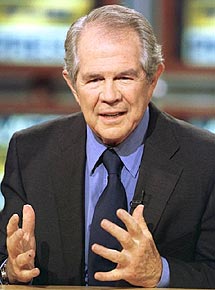
Pat Robertson has always been full of surprises. Sometimes his surprise declarations play fairly well on the public stage: such as when he shocked the political establishment by not only running for president in 1988, but also placing second in the Republican primary in Iowa, which a decade earlier had been established as a viable first step for unlikely candidates when Jimmy Carter prevailed on its snow lined plains. Often his comments bring not acclaim but outrage, or at least as laugh lines on the late night shows. Sometimes his comments are careless and callous—such as his comments about Haiti’s pact with the devil, when tens of thousands of Haitians lay dead under earthquake rubble. At other times widespread mockery of Robertson is the result of broad exposure to earnest and widely accepted charismatic expression.

Like many other Christian leaders who brought faith to the nation’s largest stages during this generation, Robertson is a man of remarkable intellect and accomplishment. He built one of the nation’s largest media enterprises, and found personal fame and fortune as a result of his prowess.

“Pat” was born Marion Gordon Robertson to U.S. Senator A. Willis Robertson, a conservative Democrat from Virginia, and Gladys Churchill Robertson, a Southern belle and midlife convert to Christ. It was his mother who prodded and prayed for her son’s spiritual journey and she was instrumental in his conversion. He was raised as a Southern Baptist and later shifted to the charismatic movement.

While Robertson’s first and most significant corporate founding was the Christian Broadcasting Network (CBN), he also founded the American Center for Law and Justice (ACLJ), the Christian Coalition, Flying Hospital, International Family Entertainment Inc., Operation Blessing International Relief and Development Corporation, and Regent University. He has remained the host of The 700 Club since its founding (except for the several months when he stepped away to run for president).

His media and financial resources make him a recognized and influential voice for conservative Christianity. At the same time, the carelessness of some public statements have undercut his credibility and damaged the attractiveness internationally of the very faith he has sought to propagate.

After Robertson called for Hugo Chavez’s assassination, syndicated conservative talk show host Neal Boortz said to his evangelical listeners: “Do you realize how much damage Pat Robertson has done to evangelical influence in this country?” As Boortz pointed out, untoward statements by Robertson have not only been damaging on their face, but they have also provided ammunition to the opponents and critics of evangelicalism, including many media representatives.

Other controversies surrounding Robertson include his claim that some denominations harbor the spirit of the Antichrist and his widely misunderstood claims of having the power to deflect hurricanes through prayer. Using his broadcast pulpit, Robertson has also denounced Hinduism as “demonic” and Islam as “Satanic,” and called Israeli prime minister Ariel Sharon’s health crisis an act of God.

The week of September 11, 2001, Robertson discussed the terror attacks with Jerry Falwell, who said that “the ACLU has to take a lot of blame for this” in addition to “the pagans, and the abortionists, and the feminists, and the gays, and the lesbians [who have] helped [the terror attacks of September 11] happen.” Robertson replied, “I totally concur.” While Robertson and Falwell later issued apologies for their statements, the damage was done—particularly to Falwell‘s reputation and influence.

Less than two weeks after Hurricane Katrina killed 1,836 people, Pat Robertson again ventured to map out a divine hand, saying on The 700 Club that Hurricane Katrina was God’s punishment in response to America’s abortion policy. He also suggested that September 11 and the disaster in New Orleans “could… be connected in some way.”

Certainly, Robertson’s career cannot be characterized as a series of gaffes and misstatements. He is one of the most accomplished evangelicals of our time, and his multi-faceted empire has produced great good—often because of his drive and sometimes in-spite of it. CBN produces television programming in 80 languages to over 200 countries, and his Operation Blessing is the seventh largest private relief and development group in the world.

As one supporter, musician Charlie Daniels, said:

“Pat’s Operation Blessing plane is flown to back country third world locations loaded with doctors, dentists and other medical personnel who volunteer their time to bring free medical treatment to people who could never otherwise afford it. Imagine a child born with cleft palates and other disfiguring disabilities being shunned and teased for something they had absolutely no control over and no hope of ever having repaired. Then one day a big airplane lands with doctors who take them in and make them look normal. Or suppose you live in a village where you have to walk miles just to get a bucket of water and one day a crew shows up and with a drilling rig and drills a well right there in your village supplying the whole village with clean fresh water. Or suppose you’re hungry and someone feeds you or need clothes and somebody gives you some. Pat’s greatest accomplishment is all the lost souls he has helped find the salvation of Jesus Christ. He is a good man who serves his fellow man in a loving Christian way and some of his critics could learn some eternal lessons from him.”

Franklin Graham said at Robertson’s 80th birthday celebration: “I want to thank you for the integrity that you have brought to ministry, the standards that you have set of excellence.”

50 Leaders of the Evangelical Generation: #3 Francis Schaeffer. Philosopher


[I am working on a project that may become a book on the most influential evangelicals leaders of our generation, since 1976, and the impact they’ve had on the church and their times. I will introduce them briefly on this blog from time to time. Who should be on this list?]

#3 Francis Schaeffer. Philosopher 1912-1984

When I was a collegian, which my kids believe may have been in the early days of the republic, if you wanted to look like a serious believer you had a book by Francis Schaeffer tucked under you arm—or at least displayed prominently in your bookcase (which may have been an orange crate in your dorm room).

Schaeffer was mysterious, thought-provoking, and a little ornery, and he seemed European. Whether or not we could understand what he was writing, we loved to have the appearance that we were contemplating his deep questions.

A theologian, philosopher, and Presbyterian pastor, Schaffer is best known for his writings and the establishment of the L’Abri community in Switzerland. Opposed to theological modernism, Schaeffer advanced traditional Protestant faith and a presuppositional approach to Christian apologetics, which he believed would answer the questions of the age. Schaeffer popularized a conservative Reformed perspective and many credit him with helping to spark a return to political activism among evangelicals in the late 1970s and early 1980s, especially in relation to the issue of abortion.

Today, roughly 25 years after his death, his teachings continue in the same informal setting at The Francis A. Schaeffer Foundation in Gryon, Switzerland. It is led by one of his daughters and sons-in-law as a small-scale alternative to the original L’Abri, which is still operating in nearby Huemoz-sur-Ollon and other places in the world. On the other hand, Schaeffer’s son Frank Schaeffer has bolted from the shadow of his father, distanced himself from many of his views, and converted to the Greek Orthodox Church.

Schaeffer’s views were most fully developed in two works: the book titled A Christian Manifesto published in 1981, and a film series, Whatever Happened to the Human Race?. The name A Christian Manifesto, is intended to position its thesis as a Christian answer to The Communist Manifesto of 1848 and the Humanist Manifesto documents of 1933 and 1973. Schaeffer’s diagnosis is that the decline of Western Civilization is due to society having become increasingly pluralistic, resulting in a shift “away from a world view that was at least vaguely Christian in people’s memory … toward something completely different”. Schaeffer argued that there is a philosophical struggle between the people of God and the secular humanists.

Schaeffer has also been embraced by the modern Christian environmental movement as a conservative champion of environmental protection, citing his 1970 book Pollution and the Death of Man.

He wrote in Pollution:

“…the hippies of the 1960s did understand something. They were right in fighting the plastic culture, and the church should have been fighting it too… More than this, they were right in the fact that the plastic culture – modern man, the mechanistic worldview in university textbooks and in practice, the total threat of the machine, the establishment technology, the bourgeois upper middle class – is poor in its sensitivity to nature… As a utopian group, the counterculture understands something very real, both as to the culture as a culture, but also as to the poverty of modern man’s concept of nature and the way the machine is eating up nature on every side.”

50 Leaders of the Evangelical Generation: #12 John Stott. Evangelical Pope

[I am working on a project that may become a book on the most influential evangelicals leaders of our generation, since 1976, and the impact they’ve had on the church and their times. I will introduce them briefly on this blog from time to time. Who should be on this list?]

#12 John Stott. Evangelical Pope b.1921


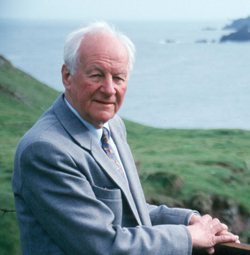
The most beloved of evangelical pastors and theologians in the last 30 years is probably John Stott, who although an Anglican from Great Britain has nonetheless been calming influence, a source of clarity and conviction, and a convening force for evangelicals in America and the world over.

Stott has written more than 50 books, including Basic Christianity, The Cross of Christ (of which J. I. Packer says: “No other treatment of this supreme subject says so much so truly and so well.”), and Evangelical Truth.

He has traveled regularly to the United States, and his prominence within North American evangelicalism was reflected in his role as Bible expositor on six occasions at Urbana, the triennial student missions convention arranged by InterVarsity Christian Fellowship.

New York Times columnist David Brooks wrote of Stott:

“This is why so many people are so misinformed about evangelical Christians. There is a world of difference between real-life people of faith and the made-for-TV, Elmer Gantry-style blowhards who are selected to represent them. Falwell and Pat Robertson are held up as spokesmen for evangelicals, which is ridiculous. Meanwhile people like John Stott, who are actually important, get ignored.

It could be that you have never heard of John Stott. I don’t blame you. As far as I can tell, Stott has never appeared on an important American news program. A computer search suggests that Stott’s name hasn’t appeared in this newspaper since April 10, 1956, and it’s never appeared in many other important publications.

Yet, as Michael Cromartie of the Ethics and Public Policy Center notes, if evangelicals could elect a pope, Stott is the person they would likely choose.”

In the words of his biographer, Timothy Dudley-Smith:

“John Stott has provided a model for international city-centre contemporary ministry now so widely accepted that few now realize its original innovative nature.” Central in this model were five criteria: the priority of prayer, expository preaching, regular evangelism, careful follow-up of enquirers and converts, and the systematic training of helpers and leaders.

One of Stott’s major contributions to world evangelization was through the 1974 International Congress on World Evangelization held at Lausanne, Switzerland. John Stott acted as chair of the drafting committee for the Lausanne Covenant, a significant milestone in the evangelical movement. As chair of the Lausanne Theology and Education Group from 1974 to 1981, he strengthened evangelical understanding of the relation between evangelism and social action. He was again chair of the drafting committee for the Manila Manifesto, a document produced by the second International Congress in 1989.

Although known for a gentle tone and for his embrace of dialogue among varied groups of Christians and with other faiths, Stott makes it clear that he does not believe truth is plural.

As Brooks writes:

“Stott does not believe in relativizing good and evil or that all faiths are independently valid, or that truth is something humans are working toward. Instead, Truth has been revealed. Stott writes: ‘It is not because we are ultra-conservative, or obscurantist, or reactionary or the other horrid things which we are sometimes said to be. It is rather because we love Jesus Christ, and because we are determined, God helping us, to bear witness to his unique glory and absolute sufficiency. In Christ and in the biblical witness to Christ God’s revelation is complete; to add any words of our own to his finished work is derogatory to Christ.’ ”

Stott has remained celibate his entire life. He says, “The gift of singleness is more a vocation than an empowerment, although to be sure God is faithful in supporting those He calls.”

Stott has publicly considered the idea of annihilationism, which is the belief that hell is incineration into non-existence rather than eternal conscious torment (the traditional evangelical view). This has led to some criticism and some support.

Despite his formal retirement from public engagements, he is still engaged in regular writing. In January 2010, at the age of 88, he launched of what would explicitly be his final book: The Radical Disciple.

The Many Worlds as Adiaphora

Two well known strands of Protestant theology are the Calvinist and Arminian. There are a number of differences between these two schools but one of them keys on soteriology (salvation). Calvinists would hold that once a person is saved, he is always saved. Arminians dispute this idea. Consider the following thought experiment:

  1. A person, we’ll call him John, is born and arrives in his twenties. He is a devoted and sincere Christian.
  2. Then, in his twenties a series of circumstances arise and he loses his faith. Through his mid-thirties he is a not-Christian.
  3. Finally late in life and to his death he returns to the faith of his birth and is again a devout and sincere Christian.

We add to this mix “device X.” Device X is trained on John and makes him into an human Schrödinger‘s Cat. If a particular nuclei is seen to decay … he dies. The state of this nuclei is tested at points 1 and 2 during his life. So we now consider if he dies at points 1,2, and 3 in his life and the soteriological implications of this.

My (limited and likely flawed) understanding of the Calvin/Arminius dispute is that an Arminian would say he was saved at points 1&3 and a Calvinist would say at point 2 that even though John was not a believer that he (John) is still one of those saved that He (God) would still call him saved because He (being omniscient) knows that John will live through to point 3 and will return to the fold.

This is where the Many-Worlds theory comes in. An Arminian could argue that each of points 1,2, and 3 the universe splits. In one universe he lives. In the other he dies. Therefore the Calvinist argument that God can know the result is impossible. Just before point 1, there is one universe. After point 3 there are three and in two of them John goes on to be saved and one in which he is not.  Therefore if Many Worlds is true God cannot say which John He is judging at point 1 … which is the Arminian statement on this question. Thus the Arminian view is compatible with Many Worlds while the Calvinist view is not.

If one take (the seemingly obvious and innocuous) view that belief or non-belief in the quantum theory known as the “many worlds hypothesis” is adiaphora. It is not essential to salvation whether you give the theory credence or not … and that given the dependence of this particular dispute between these two schools on this point … that therefore this point is thus also adiaphora and not dogma.

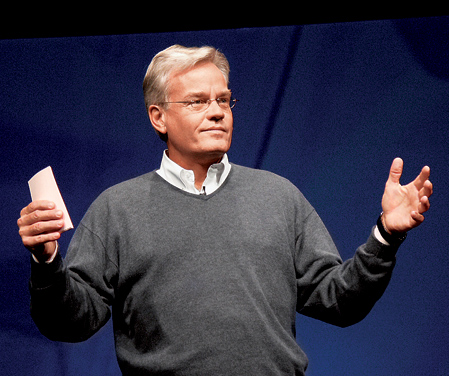
50 leaders of the evangelical generation: #19 Bill Hybels. Church changer

[I am working on a project that may become a book on the most influential evangelicals leaders of our generation, since 1976, and the impact they’ve had on the church and their times. I will introduce them briefly on this blog from time to time. Who should be on this list?]

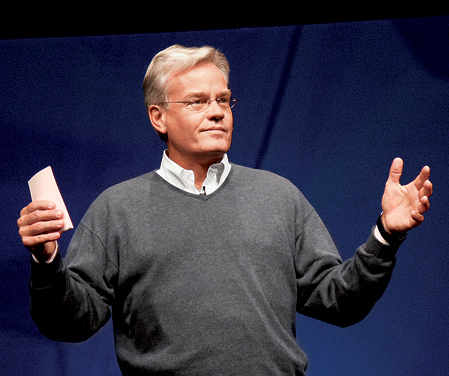
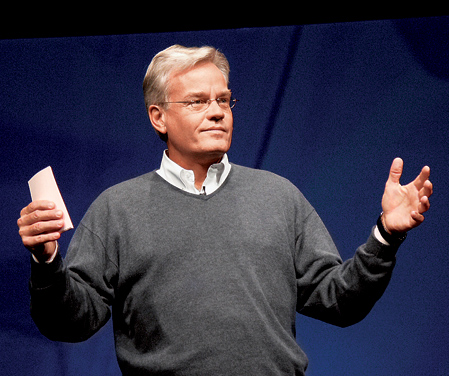
#19 Bill Hybels. Church changer b.1951

Walk into most evangelicals churches in America today, large and small, and you are likely to see the influences in worship style and service components of Bill Hybels and the Willow Creek church and association. It is particularly true in the megachurches, regardless of their evangelical flavor–from reformed to Wesleyan, charismatic or Baptist. Early, he was criticized for using marketing language to sell church and accused of smoothing the sharp corners off the Gospel to make it more “seeker-sensitive.” In recent years the Willowcreek team has been its own strongest critic, faulting its failure to adequately develop spiritual maturity while creating an enormous, active congregation.

Hybels’ South Barrington, Illinois, church is the third most attended in the country, with an average weekly attendance exceeding 23,000, and the nation’s most influential church for the last several years in a national poll of pastors. He is also the founder of the Willow Creek Association and creator of the Global Leadership Summit.

In 1971, as youth pastor at Park Ridge’s South Park Church, Hybels started a youth group with friend Dave Holmbo. With modern music, dramatic skits and multimedia combined with Bible studies in relevant language, the group grow from 25 to 1,200 in just three years.

After 300 youth waited in line to be led to Christ in a service in May 1974, Hybels and other leaders began dreaming of forming a new church. They surveyed the community to find out why people weren’t coming to church. Common answers included: “church is boring”, “they’re always asking for money”, or “I don’t like being preached down to.” These answers shaped the group’s approach to creating a new church, Willow Creek.

In October 1975 the group held their first service at Palatine’s Willow Creek Theater. 125 people attended the service. The rent and other costs were paid for with 1,200 baskets of tomatoes, sold door-to-door by 100 teenagers. Within two years the church had grown to 2,000 and in 1981 it moved to its current suburban location.
Willow Creek is the prototypical megachurch, with modern worship, drama and messages focused on the unchurched. Through its association, Willow has promoted a vision of church that is big, programmatic, and comprehensive.

Not long ago Willow released its findings from a multiple year qualitative study of its ministry. Willow Creek leadership wanted to know what programs and activities of the church were actually helping people mature spiritually and which were not.
The research revealed that “increasing levels of participation in these sets of activities does not predict whether someone’s becoming more of a disciple of Christ. It does not predict whether they love God more or they love people more.”

Speaking at his Leadership Summit, Hybels summarized the findings:

“Some of the stuff that we have put millions of dollars into thinking it would really help our people grow and develop spiritually, when the data actually came back, it wasn’t helping people that much. Other things that we didn’t put that much money into and didn’t put much staff against is stuff our people are crying out for.

We made a mistake. What we should have done when people crossed the line of faith and become Christians, we should have started telling people and teaching people that they have to take responsibility to become ‘self feeders.’ We should have gotten people, taught people, how to read their Bible between services, how to do the spiritual practices much more aggressively on their own.

Now, our dream is to fundamentally change the way we do church. That we take out a clean sheet of paper and we rethink all of our old assumptions. Replace it with new insights that are informed by research and rooted in Scripture. Our dream is really to discover what God is doing and how he’s asking us to transform this planet.”.

More than any other person of his generation, Bill Hybels developed a church ministry plan, found the blend of stability and innovation, and built a team that figured out how to involve modern, message-saturated Americans in church programs and services—in very large numbers for many years. But perhaps even more important, Hybels found an effective way to share that information with other church leaders, and then after painstaking measurement publicly admit mistakes—not in church building or evangelism, but in not more successfully leading believers to deeper levels of Christian maturity—and commit to correcting them.

Right-wing extremist, angry over Obamacare, arrested in NY bomb attempt

Or maybe not.

Via HotAir, NY mayor, and staunch anti-gun proponent, Michael Bloomberg recently speculated* that the bomber was someone upset about the healthcare [sic] bill. From the article,

Law enforcement officials don’t know who left the Nissan Pathfinder behind, but at this point the Mayor believes the suspect acted alone.

“If I had to guess, twenty five cents, this would be exactly that,” Bloomberg said. “Homegrown maybe a mentally deranged person or someone with a political agenda that doesn’t like the health care bill or something. It could be anything.”

Yet word comes in that Faisal Shahzad, a naturalized American citizen recently returned from a trip to Pakistan, has been arrested after he attempted to flee to Dubai.

No word yet on whether any Tea Partiers were involved.

* actually, “speculate” is too generous.

The Question of Augustine

One of the wonderful moments in St. Augustine’s Confessions returned to me in force from out of the blue. Now, I’ve not been a Christian for long in my adult life, having been raised within the fold of the Church, but having fallen away for 20 years of my adult life until fairly recently. The point of that observation is that regular and ordinary Christian culture is often new to me. The point of that observation is that I have questions about my experiences now as a Christian for which I lack the context and background of one who has been within the community for that missing time as an adult. This question in turn requires a little background or stage setting, which in turn can be found below the fold. Read the rest of this entry

Finally Looking at Secular Sexual Abuse

If you only read the newspapers and watched the TV news shows, you’d think that sexual abuse of children was limited to the Catholic church, and was worse now more than ever.  You’d be wrong, on both counts.  And The Anchoress notes something eye-opening.

In New York, Queens Assemblywoman Margaret Markey routinely presents a bill which seeks to open a year-long “window” into the statute of limitations on child sex-abuse cases, allowing victims whose cases may go back as far as 40 years to bring suit for damages.

Because the bill has -until now- always been limited by Markey to impact the churches, exclusively, it always either failed or been shelved. It is difficult to pass a bill that essentially finds some sexual abuse victims to be more worthy of redress than others.

Markey seems to have figured that out; her new bill includes suits against secular institutions, and the previously silent civil authorities, among others, are reeling.

Pointing fingers is so much easier than self-examination. But "credible allegations" of abuse dropped to 6 last year.  The public school system only wishes they had a record that good.

50 leaders of the evangelical generation: #50 Kurt Warner, sportsman


[I am working on a project that may become a book on the most influential evangelicals leaders of our generation, since 1976, and the impact they’ve had on the church and their times. I will introduce them briefly on this blog from time to time. Who should be on this list?]

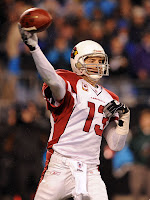
#50 Kurt Warner. Sportsman b. 1971

Arizona Cardinal quarterback Kurt Warner has many admirers, not only because of his stellar play, his sportsmanship, and his perseverance, but also because he’s so open about his Christian faith. He does not take the credit for his success without thanking God and praising Jesus Christ. There have been many stunning victories in Warner’s career, one of the most decorated post-season quarterbacks of all time. After each victory, the first words out of his mouth are recognition that his skills come from God and his life is in His hands.

There are many athletes today who use the limelight to shine light on their faith in God; it has become part of the sports landscape. Athletes congregate on the field after a game to pray; stars offer a sound bite honoring Jesus. It rarely makes the news. Warner is among the most prominent, consistent, and most effective. He understands a discussion with sports reporters about resurrections comes only in the context of career revivals and that tape recorders or cameras are often shut off when faith references start up.

During a visit to The Oprah Winfrey Show, Warner “basically had three sentences to say, so, in the middle one, I made sure I mentioned my faith, because how could they cut it out?” he said. “I went to watch the show on replay . . . and they cut it out!”

Warner is justified in wanting his faith to be part of his story, because it is dishonest and inaccurate to do otherwise. He is one of the NFL’s great success stories. In five years, he went from a 22-year-old stock boy at a Cedar Rapids, Iowa, Hy-Vee grocery store to Super Bowl MVP. Later, he has morphed again, from unemployed veteran to a record-setting starting quarterback with the Cardinals, taking them to the first Super Bowl in team history.

“I wasn’t always this way,” he told an Arizona sports writer. During his final season at the University of Northern Iowa in 1993, Warner went to a country-music dance bar called Wild E. Coyotes. He spotted Brenda Carney Meoni and asked her to dance. Her immediate reaction? “Get away. Get away.”

“Here’s this cute guy in a bar with an entourage of females, and I’m the last person that makes sense for him to go to,” said Brenda Warner. “I’m a divorced woman with two kids, one with special needs. And Kurt’s 21. Twenty-one.”

They danced, and the next day, Warner was knocking on her door with a rose.

“Again, I’m screaming in my head, ‘Go away!’ but I opened the door and said, ‘C’mon in,'” she said. “My 2 1/2-year-old grabs him by the hand and shows him every radio we own.” He fell in love with my kids before he fell in love with me. When we’d have a fight and were going to break up, he’d say, ‘Well I get the kids.’ I’m like, ‘But they’re my kids!’ ”

They stuck together, even when it appeared football wasn’t in Warner’s future. He signed with the Green Bay Packers as a free agent in 1994 but was cut before the season began. He returned to UNI to work as a graduate assistant football coach and spent nights stocking shelves at the local Hy-Vee grocery store. He moved in with Brenda, who was struggling financially and turned to food stamps for a while. They drove a car that died every time it turned left.

He landed with the Arena Football League’s Iowa Barnstormers in 1995 and three years later was signed by the St. Louis Rams, who allocated him to the NFL’s developmental league in Europe.

Around this time, Warner began challenging Brenda about her faith. She had become a devout Christian as a 12-year-old after seeing a Christian film called A Distant Thunder. Warner questioned her, suggesting she was picking and choosing her beliefs from the Bible at her convenience. During this exploration, he studied the Bible. “When I did, it was obvious what the truth was,” Warner said. He committed himself to Christ.

Before they married, he told Brenda they should follow the Bible faithfully, which meant, among other things, no premarital sex. Brenda: “I’m like, ‘Dude, we’ve got so many other things to work on. Why that one?’ ”

They married in 1997. In 1999, he took over as the Rams’ quarterback when starter Trent Green was injured. What followed was two Super Bowls, two MVP titles. He was both revered and scorned for his outspokenness about faith.

“I do try now to strategically figure out (during interviews) how I can get somebody to include a reference to my faith because it’s so important to who I am,” Warner said.

He always has the Bible in his hand when he does postgame interviews. He joins players in postgame group-prayer sessions on the field. He loves to engage in spiritual discussions with teammates, but says he tries not to be in-your-face about it. He wants the words of the Bible to guide his everyday life.

Warner is among many evangelical Christians who, over the last generation, have risen to prominence in professional sports and expressed their faith from this platform. These include former stars such as NFL defensive end Reggie White, Chicago Bears linebacker Mike Singletary, now head coach of the San Francisco 49ers; Philadelphia Eagles quarterback Randall Cunningham; San Diego Padres and San Francisco Giants pitcher Dave Dravecky; and Philadelphia Phillies and Boston Red Sox pitcher Curt Schilling. Also NFL coaches Tom Landry, Dan Reeves, Joe Gibbs, and Tony Dungy;and Florida State University’s longtime football coach Bobby Bowden.

Currently, outspoken Christians include Yankee finisher Mariano Rivera; Derek Fisher of the Los Angeles Lakers; Olympic sprinting medalist Allyson Felix; Indianapolis Colts punter Hunter Smith; Texas Rangers outfielder Josh Hamilton; Atlanta Falcons kicker Jason Elam; San Diego Padres pitcher Jake Peavy; former NASCAR driver and team owner Michael Waltrip; PGA golfer and Masters champ Zach Johnson; and most recently, University of Florida quarterback and Heisman Trophy winner Tim Tebow, who was selected in the first round of the 2010 NFL draft by the Denver Broncos.

Of course, not everyone welcomes this expression of Christian conviction from athletes who use their celebrity to good effect. At times, the complaint is more about the exclusivity of Jesus’ message itself. USA columnist Tom Krattenmaker called for a stop to Christian witness in a 2009 op-ed article. He wrote:

“I am impressed by the good that’s done by sports-world Christians. Jesus-professing athletes are among the best citizens in their sector, and they commit good deeds daily in communities across this country. These sports stars, like all Americans, have a right to express their faith. Evangelical players and ministry representatives in sports aren’t out to harm anyone, of course. On the contrary, they see themselves as fulfilling the Bible’s Great Commission (“Therefore go and make disciples of all nations, baptizing them in the name of the Father and of the Son and of the Holy Spirit,” Matthew 28:19). In this sense, their mission is pure altruism: They seek to share the gift of eternal life.

But there’s a shadow side to this. If their take on God and truth and life is the only right one — which their creed boldly states — everyone else is wrong….It’s not just non-Christians who might have a thing or two to say about this exclusive theology. According to a December 2008 survey by the Pew Forum on Religion in Public Life, 65% of American Christians believe that many religions can lead to eternal life. Our pluralism is a defining and positive reality of American life — but not one that is much valued by those who define the faith coursing through the veins of sports culture.”

Warner’s faith extends beyond the well-planned media interview. When he and his family dine on the road, they always buy dinner for another table in the restaurant, but they keep the purchase anonymous. The children choose the family. Brenda Warner said it’s their way of teaching their kids one of the Bible’s messages: It’s not your circumstances that define you but what you do with those circumstances.

Many teammates respect his choices: “Warner shouldn’t be categorized only one way,” said former European league teammate Jack Delhomme, now quarterback of the Carolina Panthers. “Football doesn’t define Kurt Warner, and I think that’s the biggest thing to me. It’s not who he is. Kurt Warner is a lot bigger.”

Added Cardinals defensive tackle Bertrand Berry: “To limit Kurt as a Super Bowl champion would do a disservice to him. I think his legacy will be that he’s just a great human being, and I think that’s the highest compliment that you can give anybody.”

He and his wife, Brenda, lead the First Things First Foundation, which provides a range of services for families in extreme need

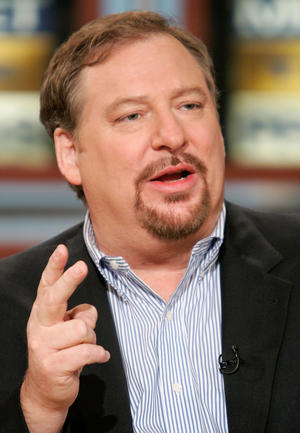

[I am working on a project that may become a book on the most influential evangelicals leaders of our generation, since 1976, and the impact they’ve had on the church and their times. I will introduce them briefly on this blog from time to time. Who should be on this list?]

#7 James Dobson. The Voice b. 1936

The rise and radio reach of former USC psychologist James Dobson made him one of the most heard, respected (and among those opposed to his conservative political and positions, despised) public figures of his generation. His Focus on the Family program, which he started in a storefront office in Arcadia, California, in 1977, provided enormous help to parents and spouses through a radio program that was one of the nation’s most popular in any genre. At Dobson’s zenith, there was not a more powerful figure in evangelicalism.

In his final years of work at Focus on the Family, it had become difficult to recall the early days of James Dobson’s radio program. Shuttered behind high security doors of an immense Colorado headquarters, Dobson’s public voice had become increasingly polemic and political. The family-doctor persona had developed an edge, and his ministry was losing the distinctiveness of the original family-focused brand.

 
As one Christian publishing executive told me: “Focus on the Family sees their organization and the message for families, which is more needed than ever, now marginalized not by people outside the community of faith where those impressions have been entrenched for quite some time, but inside the community of faith where perceptions among 20 -30 year olds is that Focus is 90% political and 10% about the family.”

With Dobson stepping more squarely into the political arena in the last decade, what was known at Focus as the organization’s “nurturing” side—the lifeblood of the ministry—had been overshadowed in the public eye.

I know and like James Dobson. I’ve spent time with him on many occasions, and I have admiration for what he has done to help families. His accomplishments are enormous, and Focus on the Family (which by the way is one of the great organization names, because the name states the mission) is a powerhouse advocate for the family. It is wrong to dismiss the contributions of James Dobson because he yielded to the seduction of political power, and it is short-sighted to focus on Dobson’s political involvement, which—while not without impact—was the least successful and important of his endeavors.

His impact on Christian radio and the extent of his help to parents over many decades cannot be overstated. The Focus on the Family daily radio program airs on more than 2,000 radio stations, and has some 1.5 million listeners a day—enormous by Christian radio standards.

Son of a Nazarene Preacher
James C. Dobson Jr. was born to Myrtle and James Dobson in Shreveport, Louisiana, and from his earliest childhood, Christian faith was a central part of his life. He once told a reporter that he learned to pray before he learned to talk. In fact, he says he gave his life to Jesus at the age of three, in response to an altar call by his father. He is the son, grandson, and great-grandson of Church of the Nazarene ministers. His father, James Dobson Sr. (1911–1977), never went to college, choosing instead the life of a traveling evangelist. Dobson’s father was well-known in the southwest, and he and Mrs. Dobson often took their young son along so that he could watch his father preach. Like most Nazarenes, they forbade dancing and going to movies, so young “Jimmie Lee” (as he was called) concentrated on his studies, and also excelled at tennis.

Dobson studied psychology, which in the 1950s and 1960s was not looked upon favorably by most evangelical Christians. He came to believe that he was being called to become a Christian counselor or perhaps a Christian psychologist.[ He decided to pursue a degree in psychology, and ultimately received his doctorate in that field in 1967 from the University of Southern California.

Dobson first became well-known with the publication of Dare to Discipline, which encouraged parents to practice firm and decisive discipline in rearing their children.

Dobson married his wife, Shirley, on August 26, 1960; they have two children, Danae and Ryan. Ryan Dobson, a graduate of Biola University, is a public speaker in his own right, speaking on issues relating to youth, the philosophical belief in ontological truth, and the pro-life movement. Ryan Dobson was adopted by the Dobsons and is an ardent supporter of adoption, especially adoption of troubled children. Ryan says he spent years rebelling against the expectation that he should follow in his father’s footsteps. But he eventually found a calling: preaching at youth events. He formed Kor Ministries.He is as opposed to abortion and homosexuality as his father, but his tone is edgier. Reviewing the first book he co-wrote, “Be Intolerant: Because Some Things are Just Stupid,” Publishers Weekly said it had “all the subtlety of a two-by-four to the side of the head.”

Transition out of Focus

James Dobson has been moving toward retirement for several years, relinquishing the chief executive role in 2003, and the position of chairman of the board in 2009. But the decision to step away from his role as the host of the daily Focus program was clearly the board’s, not Dobson’s, and many believe the board had decided to strike a less strident political posture.

Nonetheless, Dobson clearly wasn’t ready to hang up his microphone, and he announced that he will launch a nonprofit Christian group and host a new radio show with Ryan. His radio agency, Ambassador Advertising, promoted the new program–Family Talk with Dr. James Dobson–at the 2010 National Religious Broadcasters convention as “a voice you trust for the family you love, merging a fun and inviting tone with topics that families wrestle with every day.”

Of Noah and Culture

Does the particular anthropological differences between our individualistic/wealth driven culture and the Honor/Shame agricultural culture of the Middle East have in reading, for example, the story of Noah and the flood? This question was asked when last I discussed the flood in another context some weeks back.

Geneticists inform us that the genes which govern the particular patterns which direct the construction of our cornea show very little variation from individual to individual. Other features, even in the eye, which are not tightly constrained in the same way vary far much more from generation to generation and in fact show mutation and changes introduced much more freely between generations. The cornea and the eye are tricky enough that any structural mistake or change will likely lead to complete failure of the organ for its intended purpose, i.e., sight. Our genetic material pays attention to those things which it has found important. Read the rest of this entry

Franklin Graham Disinvited From Pentagon Prayer Service

For giving his opinion on some tenets of Islam, he’s apparently too intolerant for the Army.

The U.S. Army on Thursday withdrew an invitation to a Christian evangelist to speak at a Pentagon prayer service next month following an outcry over his references to Islam as a violent religion.

Franklin Graham, the son of famed evangelist Billy Graham, said in a statement he regretted the Army’s decision and would keep praying for U.S. troops.

The invitation prompted a harsh reaction, including from a prominent U.S. Muslim group that said Graham’s appearance before Pentagon personnel would send the wrong message as the United States fights wars in Muslim countries.

In an interview last year with CNN, Graham said "true Islam" was too violent to be practiced in the United States.

"You can’t beat your wife. You cannot murder your children if you think they’ve committed adultery or something like that, which they do practice in these other countries," he said.

"I don’t agree with the teachings of Islam and I find it to be a very violent religion."

The interview can be seen here

The Army said it did not invite Graham to the May 6 event organized through the Pentagon Chaplain’s office. The invitation was instead extended by the private, Colorado-based National Day of Prayer Task Force.

"Once the Army leadership became aware that Reverand Graham was speaking at this event, we immediately recognized it as problematic," said Colonel Tom Collins, an Army spokesman.

"The bottom line here is that his presence would be inappropriate. His past statements are not consistent with the multi-faith emphasis and inclusiveness of this event."

Graham acknowledged the decision, saying in a statement: "I will continue to pray that God will give them guidance, wisdom and protection as they serve this great country."

The National Day of Prayer Task Force called the Pentagon’s decision part of an "assault on religious freedom and people of faith" driven by groups including the government and media.

"The Pentagon, representing the most powerful military in the world, melted like butter and withdrew the invitation," it said, citing opposition by "a small group of naysayers."

 Page 18 of 39  « First  ... « 16  17  18  19  20 » ...  Last »