Christianity Archives

Attacks on Christians Escalating

Most notably in the middle east (Egypt, Iran), Christians are coming under an increasing number of attacks, and an increase in their brutality.  Also, when the Pope asked for religious tolerance in Pakistan, he was burned in effigy.

A Silent Hallelujah

A very clever rendition of the Hallelujah Chorus performed by The Silent Monks.

A Vision of Christ

Imagine seeing a vision of Jesus and hear Him calling your name.  Now imagine if you were Kamal Saleem, a Muslim, and that happened.


Hallelujah!

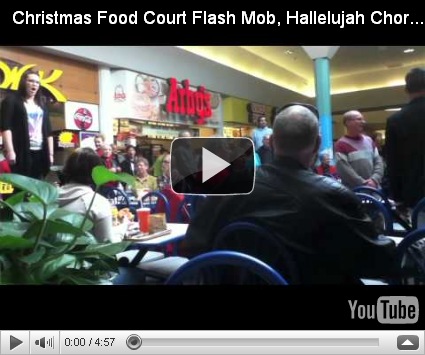
Imagine being at the mall food court, and the Hallelujah Chorus broke out.


It’s time for Communion: A bottle of red, or a bottle of white?

I recently got into a friendly discussion / debate with my pastor over the recent introduction of white grape juice, in place of red, when we celebrate communion. My concern regarding the change in practice had to do with the intentional exclusion of the dark colored “wine”, which I perceive as significant to the symbolism of Christ’s blood. I must say that my first inclination, as to the reason for the change in element, was that white grape juice was being sold for less than red, and that in time we’d return to the regular practice. Pragmatic frugality aside, the actual reason for the change was more disconcerting. It seems that after a recent refurbishing of the church sanctuary, which included a lighter colored upholstery on the pews, there was the concern that spilled red grape juice would stain the pews (and, I suppose, parishioner’s clothing). Complicating that subjective concern was the additional matter of the cost of removing the stain(s).

In discussing the topic of this ancient practice I was quickly reminded how fast rabbit trails emerge within the thickets of theology. One acquaintance stated, when presented with this issue, that if we were to follow the original practice, then we would be using wine and not grape juice. Others have brought up that the bread is not the same, the manner with which we partake of the meal itself is different, and that we don’t use a communal cup. I recently shared the following as a status on Facebook:

Using white grape juice instead of red, for communion, so as not to possibly stain anything, is like using peppermint leaves instead of bitter herbs, for Passover, so as not to possibly have pungent breath afterward.

In the comments that followed, I ran into the issue of using white wine and red grape juice, ostensibly to allow those who wish to partake of wine the opportunity, while allowing those who prefer grape juice that route, with the distinction being made easy to identify by… sight.* While all of these issues may be true, their veracity does not negate or vindicate my concern regarding the color of the wine used.

I’m not concerned with whether or not we practice communion exactly as was done in the upper room, by the early Christians, or by the Jews celebrating Passover. That the wine may be substituted with grape juice, coca-cola, or whatever, depending on the context of the situation, is irrelevant (to the context of my concern). Issues regarding whether or not we eat an entire meal, engage in the practice in unison or systematically in a queue, use wafers or loaves, etc., are all ancillary to the context of my question. That some of these ancillary issues may indeed be relevant to how we practice communion does not necessarily hinder or help the argument pertaining to my original question.

I try to approach issues in the simplest manner possible, while still addressing the intricacies involved – not always a task that is easy to accomplish. In looking at the color of the wine question I am attempting to ascertain the intent of not only the practice, but the means with which the practice is followed. I am of the opinion that God has, within his theology, intertwined abstract concepts with physical attributes – attributes which we perceive with our five senses. Consider that the Bible states that sacrifices brought a pleasing aroma to God. No doubt such events brought with them sights, sounds, and smells which would leave a lasting impression on those participating. It certainly should be of no surprise that the metaphorical meaning of the unleavened bread and bitter herbs of Passover was heightened through our sensory perception of their physical attributes. And the sense of taste and smell, particularly of the wine, would lend a certain memory imprint on any individual participating in communion. Is this not significant?

Therefore, I’m wondering if the same application could (or should) be made with something like the color of the communion wine. If it represents the blood of Christ is it happenstance that wine was chosen as the metaphorical symbol for the Passover meal? I don’t believe that God is surprised by anything or that he needs to have a “Plan B”, so it seems to me that his original intent was for the Passover meal to flow into the practice of communion. The wine, from the beginning, was to represent the blood of Christ. What are the physical attributes of blood? Crimson by sight, a distinctive rich taste (remember the taste in your mouth when you lost a tooth?), an equally distinctive aroma… Doesn’t wine mimic these attributes? It’s dark, red quality, a slightly burning and warm taste, and a rich aromatic quality.

I find it interesting that our 21st century Western culture, despite its technological prowess, seems to have lost touch with the history of the importance of meaning provided by our five senses. Visual and auditory stimulation, through means of movies, the internet, TV, video games, iPods, et. al,, while exciting, operates mainly as an ultimately unsatisfying, yet addictive, stimulant. The senses of taste and smell are catered to, by and large, through the gourmet world of microwavable-junk-food. Even though I am wary of much of what is happening in the emerging church, it is refreshing to see a desire to return to liturgies, accompanied with stained glass and incense, seeming to be a desire for sensory meaning amidst the muck of our techno-innovations.

So, if it could be argued that the attributes of the wine, while not necessary simply on their own for the practice are, nonetheless, important aspects of the metaphorical imagery being used, why would one avoid them? I understand the everyday concern about staining pews, carpet, clothing, etc., with spilled wine (interestingly enough, blood also stains). I simply don’t see that as a major concern. Is it really necessary to have stains from communion wine removed? Cleaned up, yes, but removed? It seems to me that such stains would be, in some sense, a badge of honor – that a church bears the evidence of the practice of communion being exercised so frequently. I recall a pastor deciding against replacing prayer benches because, once he realized that the “old” ones were stained from the tears of parishioners, he realized the testament he was about to remove.

Imagine a balance scale. On one side we have the choice of using red wine (or… dark grape juice) for communion. The minimum “weight” in favor of this choice is original intent, which brings with it all the metaphorical imagery surrounding the color of the blood of Christ. On the other side of the balance, we have the choice of using a clear liquid. The minimum “weight” on this side is, essentially, a desire not to stain the pews, carpet, or clothing – or perhaps another minimal reason.

It seems to me that the balance tips easily to one side…

* This practice seems, at first take, to be an attempt to address the stronger brother / weaker brother situation. I wonder if Paul ever ran into a church that had an after service time of fellowship with idol sacrificed pork grilling in one section and beef not sacrificed to an idol grilling in another section?

Friday Link Wrap-up

The deficit commission that President Obama convened agrees that most of ObamaCare should be kept.  Unfortunately, they believe in order to keep it fiscally sustainable is for it to include Death Panels.  They laughed at Sarah Palin for predicting this.  I don’t hear anyone laughing now.

Speaking of Sarah Palin, Richard Cohen (no conservative, he) just can stop reading about (and apparently, can’t stop writing about) the former Alaska governor.  And in writing about her and her beliefs, he includes this bit of honesty:

The left just doesn’t get America. I say this as a fellow-traveler of liberalism and as one who recognizes that many liberals fear the heartland. They see it as a dark place of primitive religions and too many guns. For such a person, Palin is the perfect personification of the unknown and feared Ugly American who will emerge from the heartland to seize Washington, turning off all the lights and casting America into darkness. The left does not merely disagree with the right; it fears it.

Hospitals closing or ridden with crime.  Doctors quitting the medical practice or leaving the country to find greener pastures in which to practice.  Shortages of medical supplies.  While these are predictions of what will come with ObamaCare, we have yet another example of where socialized medicine is failing.  Mr. Obama, call Mr. Chavez to find out how well it’s working in Venezuela.  (Hint:  It’s not.)

The Christmas song “Silver Bells” was inspired by the sound of Salvation Army bell-ringers outside department stores.  But apparently familiarity breeds contempt.

The character of Aslan in the Narnia series of books, as well established in “The Lion, the Witch and the Wardrobe”, is an allegory for Jesus Christ.  That was C. S. Lewis’ purpose.  But Liam Neeson, who provides the voice for Aslan in the movie series, has apparently been infected with the political correctness syndrome that pervades Hollywood.

Ahead of the release of The Voyage of the Dawn Treader next Thursday, Neeson said: ‘Aslan symbolises a Christ-like figure but he also symbolises for me Mohammed, Buddha and all the great spiritual leaders and prophets over the centuries.

‘That’s who Aslan stands for as well as a mentor figure for kids – that’s what he means for me.’

Mohammed and Buddha died for your sins?  Really?

Does Romans chapter 1 condemn homosexuality?  Some interpret it in such a way that it doesn’t, in spite of the words chosen.  John Stott takes apart such interpretations.

Bryan Longworth had an interesting tweet the other day.  “Comprehensive sex ed has been taught in schools 4 over 40 years. The results? Epedemic #STIs. How’s perversion working 4 U?”  Not so well, judging by the results.

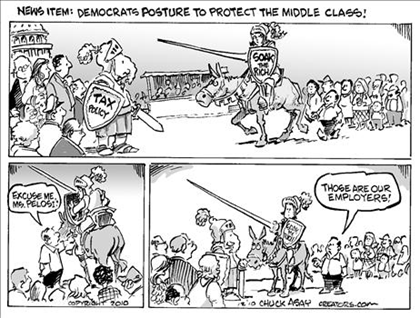
And finally, Chuck Asay has some words for Democrats who are ostensibly fighting for the workers.  (Click for a larger version.)

image

Scripture Is Not Magic

Catholicism and Protestants have as one of their primary disagreements the roles of Scripture and Tradition as authority in the Church. Metropolitan John Ziziolas writes in Lectures,

From the Reformation on, Western theologians asked whether divine revelation has one source or two. Protestants rejected the authority of tradition of the Church and introduced the principal of ‘sola scriptura‘, Scripture on its own, without the experience of all previous generations of the Church in expounding that Scripture. […] The West tends to regard Scripture and doctrine as two distinct sources and tries to arbitrate between what it understands as their rival claims.

There are two reasons why Western churches saw the relationship of Scripture and doctrine as a problem. The West tended to regard revelation as primarily rational or intellectual, and the Scriptures and the Church simply as repositories of truths, available as individual units of inert information. In the Orthodox tradition, however, Scripture and the Church are regarded as the testimonies of those prophets and people who have experience the truth of Christ. But truth is not a matter of objective, logical proposals, but of personal relationships between God, man, and the world.

St. Siluan was quoted as saying that if Scripture were lost, the Athonite monastics and the Church itself could and would recreate it without loss. Why and how? Because Scripture is a record of relationships between “God, man, and the world.” These relationships are not historical or accidental and frozen but living and vibrant in today’s world just as recorded in Scripture. 

I think as well that the misunderstanding of what mystery means is important here, where the Eastern view is that mystery is something that you experience but cannot put into words and the West regards it as a part of their belief/faith which cannot be understood and therefore must be kept at arms length. 

Where’s the Line To See Jesus?

A song inspired by a 4-year-old’s question, after seeing the line to see Santa.  From the website:

While at the mall a couple of years ago, my then four year old nephew, Spencer, saw kids lined up to see Santa Claus. Having been taught as a toddler that Christmas is the holiday that Christians celebrate the birth of Jesus, he asked his mom, "where’s the line to see Jesus"? My sister mentioned this to my dad, who immediately became inspired and jotted words down to a song in just a few minutes.

And thus began a year-long try to get someone in the music industry interested.  Failing that, Becky Kelley recorded it herself and the family created their own video for it

Since then, they’ve done the recording up better, with full instrumentation, and created a new video for it.

And now you can buy it in iTunes.  Wonderful song.

Stephen Meyer & William Dembski, tonight

For those in southern California, check out the Apologetics Conference at Calvary Chapel Costa Mesa, tonight at 6 p.m. On tap for the evening are Steve Collins, Stephen Meyer, and William Dembski. Best of all, the event is FREE!

Not in southern California? There is supposed to be a live stream of the conference at this link.

More Info:

Friday Link Wrap-up

I knew unions supported the Democrats, but really; getting fired for wearing a Bush hat and sweatshirt?  Even though it’s referring to the aircraft carrier the George H. W. Bush?  That your son serves on?  Really?  That’s a sign of rabid, unthinking support of the Democrats.

Andrew Fergusson, Head of Communications at Christian Medical Fellowship, writing in Christianity Today, lays out the big difference between embryonic stem cells and the adult variety.

Ron Futrell, writing at Big Journalism:

During the discussion where Williams said he gets “nervous” when he sees people on a plane in Muslim garb (that’s what got him fired).  Williams also warned O’Reilly against blaming all Muslims for “extremists,” saying Christians shouldn’t be blamed for Oklahoma City Bomber Timothy McVeigh.

Timothy McVeigh was not Christian. Love ya Juan, and sorry to hear about what happened with NPR, but Timothy McVeigh was not Christian. He was agnostic. He made the statement many times to newspapers. He also said “science is my religion.”

Political violence is an indictment against the cause that motivates it … except when Democrats do it.  If you just read liberal-leaning blogs, you haven’t heard the whole story about the Rand Paul supporter "stomping" on the MoveOn.org activist.

And finally, a scary Halloween story.  Click for a larger version.

Friday Link Wrap-up (Catch-up Edition)

More links this week since I didn’t get around to it last week.

What’s keeping this recession going for so long?  Ask James Madison. Yes, that James Madison.

The 6th Circuit judge that upheld the health care reform individual mandate to buy insurance has really redefined terms in order to make his ruling.

With that reasoning, Judge Steeh thoroughly unmoors the commerce clause from its concern with actual economic activity that Congress can regulate to a more amorphous realm of “economic decisions” which apparently include the decision to NOT enter into commerce at all.

A better example of an activist judge you’re not likely to find soon.

Roger Ebert, in reviewing “Waiting for Superman”, acknowledges that the private school highlighted does better than public school, proclaiming “Our schools do not work”.  His solution?  (Wait for it…)  More money for public schools, for the ones that don’t work instead of encouraging what does work and at typically a lower cost per student.  Liberal education policies are now just talking points rather than reasoned arguments.

Remembering a sociopathic mass murderer, who is extolled by liberal students T-shirts everywhere.  (No, not Charles Manson. I’m talking about Che Guevara.)

The Rise of the (Conservative, Christian) Woman in American politics.

Juan Williams responds to the NPR sacking.  Ah, the tolerant Left in action.

And to close it out, two cartoons to make up for missing a week.  I just love Chuck Asay.  (Click for larger versions.)

How can politics be more Christian?

As Christians, should we abandon the political parties that have moved to the left and right and establish a radical center? Calvin College professor Steve Monsma argues that we should, in a post at the fine new blog at Q Ideas. He has tired of the polarization of politics and finds much of it unchristian. He writes:

This leads me to plead for a radical Christian center.  Centrism may appear to be wishy-washy and undecided or so apathetic that one refuses to take sides.  But a radical Christian center is far from being either.  It is radical in that it goes to the root of today’s political issues, asking basic questions of purpose, value, and worth.  It puts the common good ahead of partisan advantage and narrow special interests.  If you don’t think that is radical, you haven’t been paying much attention to this fall’s partisan election campaigns

I’m not surprised that Dr. Monsma is exasperated. Generally, Christian academics don’t like partisan politics, for two good reasons. First, in the heat of political fights, there tends to be a suspension of godly character. Second, political campaigning is, for the most part, the repetition of simple messages.

While I personally sympathize with the need for more moderate positions on many issues and cringe at the tired rhetoric of political extremes, I don’t believe a move to the center is the answer. And to call centrist political positions “Christian” is as misguided as it is for progressives or conservatives to assume that there enlightenment is generated by the Light of world.

There is much for Christians and all people of good will to dislike about political campaigns and the methodology and practices of the major political parties, but it isn’t rigid political positions that make partisan politicking distasteful or less Christian.

It would be a shame for Christians to eschew partisanship, which is the sinew of our political process and has helped produce nearly 250 years of stability and peaceful transition of power. Instead we should call and work for three things in political argument– at all times, but especially in the most virulent campaign months:

Authentic passion

Flamboyant language, exaggerated charges, and the demonization and stereotyping of the opposition are particularly distasteful when they rely on borrowed passion. We roll our eyes at the repeated talking points that are foisted upon by an endless stream of political spokespersons or candidates who fail to do their own thinking. Our response is totally different when we hear the deep groans of an aggrieved soul, whether it is a partisan of the left or right. Authentic passion is the lubricant of healthy and vibrant political discourse.

Robust honesty

Nothing makes political argumentation more unChristian than dishonesty. We have to continue to insist on honesty from the left, the right, the center, or the uncommitted. We need to end not only bold lies, but the disguised lies the pervert understanding. Christians in the political process will not only tell the truth, but will refuse to tell a sideways truth that gives a false impression, or will lead the listener to a false conclusion.  We suffer from an avalanche of statements that—although not lies—routinely hide the truth. We are disgusted when politicians use statistics or characterizations that are true on the surface but impede genuine clarity. Robust honesty in the political process will restore confidence.

Uncommon civility

Just as damaging and unChristian is campaigning that tears apart people, disrespects opponents, and inflames the base obsessions of constituencies. Ad hominen attacks damage politics and keep good people from choosing to subject themselves to the character assassination of the political game. Candidates and campaign leaders often decry negative campaigning, then turn to the tactics if they fall behind. Poll numbers improve when candidate tear at the fabric of the opponent’s character, but they leave us all disgusted with partisan politics. As Christians, we should insist on uncommon civility from those who seek to represent us in government.

Those Chilean Miners’ Shirts

I saw the word "Jesus" on the sleeves of the shirts on the Chilean miners as they came up, one by one, in the capsule.  (Yeah, we had the streaming video going as I worked from home.  What a terrific event.)  But no news organization so much as mentioned the other writings on those shirts.

Thus the citizen investigative journalist kicks in where the major media won’t go.  The scripture verse on the back is Psalm 95:4.

In his hand are the depths of the earth,
       and the mountain peaks belong to him.

Yeah.  Wow.

And there’s more at the video below.  (Or view it on YouTube.)

Rusty Nails (SCO v. 16)

Global Warming – a scam? (HT: Ron’s Bloviating) From Harold Lewis, Emeritus Professor of Physics, University of California, Santa Barbara,

It [Global Warming] is the greatest and most successful pseudoscientific fraud I have seen in my long life as a physicist.

###

Yahoo! Yoga Mohler, Yoga, and Yahoo! together.

###

So… where’s Checkpoint Charlie? Rep. Loretta “The Vietnamese are trying to take away our seat!” Sanchez thinks a U.S. / Mexico border fence is the same as the Berlin Wall.

###

Hope (as in, “we can certainly hope this will happen”)

Christians practicing Yoga?: Al Mohler responds to criticisms he’s received

In Yahoo, Yoga, and Yours Truly, Albert Mohler has responded to criticisms of his original blog post questioning the contemporary practice of Christians participating in Yoga (see my post On a Christian Version of Yoga). Take the time to read his latest offering. One interesting excerpt,

I have received hundreds of emails and comments against my article from those identifying as Christians. Not one–not a single one–has addressed the theological and biblical issues. There is not even a single protest communication offering a theological argument.

Indeed.

 Page 10 of 33  « First  ... « 8  9  10  11  12 » ...  Last »