Politics Archives

Civility Watch

Let’s have some blood flowing in the streets, shall we?

Sometimes it’s necessary to get out on the streets and "get a little bloody," a Massachusetts Democrat said Tuesday in reference to labor battles in Wisconsin.

Rep. Michael Capuano (D-Mass.) fired up a group of union members in Boston with a speech urging them to work down in the trenches to fend off limits to workers’ rights like those proposed in Wisconsin.

"I’m proud to be here with people who understand that it’s more than just sending an email to get you going," Capuano said, according to the Dorchester Reporter. "Every once and awhile you need to get out on the streets and get a little bloody when necessary."

Really, do targets on a map even come close to this?

Watching Dominos Fall in the Middle East

I host an pretty-much-monthly podcast called Shire Network News, and if you’ve wondered what I sound like, you can find out here. It’s a right-of-center podcast that tries to use humor and satire to make its point. Much of the commentary in this episode is about the latest turmoil in the Middle East (well, more turmoil than is typical, at least). Show notes are at the link as well as ways to listen to the individual show or subscribe to the podcast itself.

This is now, that was then

Within hours, maybe minutes, of the shooting of Rep. Gabby Giffords, Liberal pundits began to point fingers at right wing extremists which, apparently, applied to Sarah Palin, the 2008 Republican candidate for Vice President. Of particular concern was the “cross-hairs” image, used by Palin to establish which Democrats to target in upcoming elections. Evidently and, coincidentally after-the-fact, such violent imagery and rhetoric was said to have led to the carnage in Tucson. The cross-hairs image was referenced by Barbara Walters (on The View) when she stated,

“…and certainly cross-hairs are very scary…”

I wonder how scary Ms. Walters thinks a depiction of the President getting assassinated is?

Back in 2006 I wrote a blog post, for RedBlueChristian.com, about a docudrama depiction of the assassination of President George W. Bush. Note that the TV movie was produced in the U.K. Per The London Standard,

Held up by a secret service bodyguard in his dying moments after being shot in the stomach, this is President Bush being assassinated.

Surrounded by a crowd of panicking onlookers, the American leader is pictured just seconds after being gunned down by a sniper following an anti-war demonstration.

Of course, this 2006 docudrama is just a drop in the bucket of violent left-wing rhetoric – rhetoric which typically goes unreported by the mainstream media.

Regardless of the political affiliation of our elected officials, let us remember to treat them all with the respect and dignity they deserve, especially when they are maligned by those who truly would hope to do them harm.

Obama and the “Is Really Smart Meme”

The discussion of whether or not Mr Obama is “smart” came up again in a conversation. I thought I’d lay out a few thoughts on that. Before I begin I want to emphasize that I don’t know whether or not he is smart or not. People say he is … and I think they have no real good way of knowing that. The reason I say I don’t know is that I don’t have the background or experience to judge whether or not largely because I really have no instincts or experience of lawyers who are or are not considered, in their field, smart.  Read the rest of this entry

Shire Network News #183

If you’ve ever wondered what I sound like, I host a political satire podcast that you may be interested in. Click here for the current show’s page, which also has links to subscribe to the podcast via iTunes or another podcatcher of your choice.

Thinking about Tuscon

Like a lot of folks, I’ve been watching a lot of news coverage of this past weekend’s shooting in Tuscon. My thoughts and prayers are with the victims and their families.

A couple of thoughts about the tragedy and its aftermath:

1. I never fail to be surprised at the lengths people will go to score political points from such a tragedy. I think most voters see such politicians for what they really are and they’ll get their just desserts the next time an election rolls around.

2. A Predictable Tragedy in Tuscon in today’s Wall Street Journal is a worthwhile read. And no, it doesn’t have anything to do with political speech. Instead, it focuses on one of the most underreported aspects of the story: the fact that the shooter, Jared Lee Loughner, had untreated mental illnesses. As long as we continue to ignore the problem of how we as a society deal with treatment of the mentally ill we’ll see these type of events continue to occur. All you have to do is look back at similar events and see how many of the perpetrators had a history of mental illness.

3. A related point to #2 above: Tuscon police missed the warning signs about Loughner’s behavior?

4. Another question that is begging to be asked and answered: why weren’t the police at Congresswoman Giffords’ event? If the political rhetoric is as dangerous as Sheriff Dupnik says then why didn’t he have any deputies there to provide security?

5. A natural response in the aftermath of a tragedy such as this is to talk about passing tougher gun control laws. But consider this quote:

Laws that forbid the carrying of arms… disarm only those who are neither inclined nor determined to commit crimes… Such laws make things worse for the assaulted and better for the assailants; they serve rather to encourage than to prevent homicides, for an unarmed man may be attacked with greater confidence than an armed man.” –Cesare Beccaria, On Crimes and Punishment, quoted by Thomas Jefferson in Commonplace Book

6. Leave it to Michael Ramirez to provide astute media analysis.

Friday Link Wrap-up

What Charlie Rangel did:

To summarize briefly, we have blatant and recurring Federal and State tax fraud, illegal use of four rent-controlled apartments in New York City, using his Congressional letterhead to illegally solicit funds for his private foundation from lobbyists for companies he was writing tax regs on, outrageous conflict of interest, failure to declare over $600,000 in income..the sort of stuff that would get you or I locked up for a long time.

What punishment he got:

Charlie Rangel’s penalty? He’ll be required to stand in the well before his colleagues in the House while a censure resolution is read, which will then become part of the Congressional Record. That’s it. Boo-freaking hoo.And he will stay in Congress.

Love that accountability.

Remember the movie "Erin Brockovich", telling of one woman’s crusade to get justice for the people of Hinckley, California from the eeevil corporation, Pacific Gas & Electric, for releasing a toxic plume of hexavalent chromium 6.  PG&E was sued for (what was going to be) a huge spike in cancer for the people.  No real scientific proof was offered, but this result was clearly going to happen.  Yeah, well, it didn’t.  Turned out John Stossel was right.  Again.  And Erin is back in Hinckley, pursuing the same thing.

Chuck Collins, senior scholar at the Institute for Policy Studies and writing for they Sojourners blog, decides that the moral measure of a tax plan. 

"Does it further concentrate wealth and power in the hands of a few? Or does it disperse concentrated wealth and power, and strengthen possibilities for a democratic society with greater equality, improved health and well-being, shared prosperity, and ecological sustainability?"

By this measure, it sounds like the "rich" should never have their taxes decreased.  Ever.  OK, so what’s his limit on that moral measure?  How much money should the "rich" be allowed to keep?  Can we just get that number out, so we know what the standard is?

Wonder what the Hollywood Left’s supporters of Hugo Chavez will think of his upcoming dictatorial powers?  Eh, probably sweep it under the rug.

Liu Xiaobo, newest recipient of the Nobel Peace Prize, also endorses the invasions of Iraq and Afghanistan, praised George W. Bush, and is strongly on Israel’s side in the Middle East conflict.  Just sayin’.

Post-natal abortions are all the rage.  Oh, please don’t be surprised.  It’s just the natural result of the culture of death mindset.

Death panels are getting ready to meet.  Really. 

Friday Link Wrap-up

The deficit commission that President Obama convened agrees that most of ObamaCare should be kept.  Unfortunately, they believe in order to keep it fiscally sustainable is for it to include Death Panels.  They laughed at Sarah Palin for predicting this.  I don’t hear anyone laughing now.

Speaking of Sarah Palin, Richard Cohen (no conservative, he) just can stop reading about (and apparently, can’t stop writing about) the former Alaska governor.  And in writing about her and her beliefs, he includes this bit of honesty:

The left just doesn’t get America. I say this as a fellow-traveler of liberalism and as one who recognizes that many liberals fear the heartland. They see it as a dark place of primitive religions and too many guns. For such a person, Palin is the perfect personification of the unknown and feared Ugly American who will emerge from the heartland to seize Washington, turning off all the lights and casting America into darkness. The left does not merely disagree with the right; it fears it.

Hospitals closing or ridden with crime.  Doctors quitting the medical practice or leaving the country to find greener pastures in which to practice.  Shortages of medical supplies.  While these are predictions of what will come with ObamaCare, we have yet another example of where socialized medicine is failing.  Mr. Obama, call Mr. Chavez to find out how well it’s working in Venezuela.  (Hint:  It’s not.)

The Christmas song “Silver Bells” was inspired by the sound of Salvation Army bell-ringers outside department stores.  But apparently familiarity breeds contempt.

The character of Aslan in the Narnia series of books, as well established in “The Lion, the Witch and the Wardrobe”, is an allegory for Jesus Christ.  That was C. S. Lewis’ purpose.  But Liam Neeson, who provides the voice for Aslan in the movie series, has apparently been infected with the political correctness syndrome that pervades Hollywood.

Ahead of the release of The Voyage of the Dawn Treader next Thursday, Neeson said: ‘Aslan symbolises a Christ-like figure but he also symbolises for me Mohammed, Buddha and all the great spiritual leaders and prophets over the centuries.

‘That’s who Aslan stands for as well as a mentor figure for kids – that’s what he means for me.’

Mohammed and Buddha died for your sins?  Really?

Does Romans chapter 1 condemn homosexuality?  Some interpret it in such a way that it doesn’t, in spite of the words chosen.  John Stott takes apart such interpretations.

Bryan Longworth had an interesting tweet the other day.  “Comprehensive sex ed has been taught in schools 4 over 40 years. The results? Epedemic #STIs. How’s perversion working 4 U?”  Not so well, judging by the results.

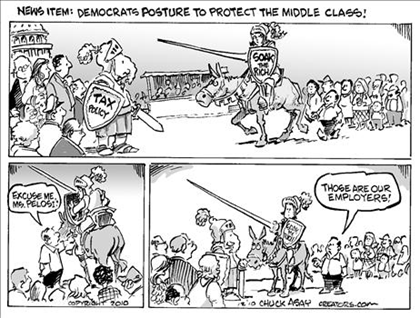
And finally, Chuck Asay has some words for Democrats who are ostensibly fighting for the workers.  (Click for a larger version.)

image

How Willing Are We To Really Cut Spending

As I noted earlier, if we stay on the same course, budget-wise, in just 5 years the interest on our national debt will approach what we spend to defend the country.  This must be dealt with.

Yesterday, a White House commission put together by President Obama released a draft proposal to do just that.

The leaders of a White House commission laid out a sweeping proposal to cut the federal budget deficit by hundreds of billions a year by targeting sacrosanct areas of U.S. tax and spending policy, such as Social Security benefits, middle-class tax breaks and defense spending.

The preliminary plan in its current form would end or cap a wide range of breaks relied on by the middle class—including the deduction for home-mortgage interest. It would tax capital gains and dividends at the higher rates now levied on wage income. To compensate, one version of the plan would dramatically lower and simplify individual rates, to 9%, 15% and 24%.

For businesses, the controversial plan would significantly lower the corporate tax rate—from a current top rate of 35% to as low as 26%—but also eliminate a number of deductions. It would make permanent the research and development tax credit.

There’s much more; cutting $100 billion from defense, raising gas taxes, raising the Social Security retirement age, cutting federal work force by 10%, and others.  It’s quite a sweeping proposal, and it’ll call on the government and the people alike to share the burden.

But what will it wind up doing?

Overall, the plan would hold down the growth of the federal debt by roughly $3.8 trillion by 2020, or about half of the $7.7 trillion by which the debt would have otherwise grown by that year, according to commission staff. The current national debt is about $13.7 trillion.

The budget deficit, or the amount by which federal expenditures exceed revenues each year, was about $1.3 trillion for fiscal year 2010, which ended on Sept. 30.

Even with all this, it’ll only cut the growth by half, with debt still rising by trillions every year.

This is where we find ourselves; overextended and really unable to do anything about it despite some Herculean efforts.  Our government has made so many promises that it can’t renege on, that the most we can hope for is "only" growing slower. Well, ya’ gotta’ start somewhere, and this is just a draft proposal.  But this is a good start.

Or is it?  How do other politicians see it?  (Warning: Easily anticipated reactions follow.)

Read the rest of this entry

Not So Much An Election As A Restraining Order

With apologies to P. J. O’Rouke for the title, last night was a historic night for the GOP, but I have a feeling this was more the voters saying "Stop!" to Obama than it was saying "Go!" to the Republicans.

Still, there were other things at work here than a Democratic smackdown.  Witness the shift of so many state governments to the Republicans. These folks weren’t the ones who bailed out banks, took over car companies or squirmed a health care bill through Congress.  And yet, for example, for the first time since Reconstruction, Georgia’s major state offices will all be held by Republicans.  While the wave last night certainly helped, this is a shift that has been going on for years.  The state legislature shift is, I think, the underreported story of the night (though Erick Erickson gives us a good view of it).  It’s important because in many cases it is so historic ("not since the 19th century" historic, in a few cases), and because reapportionment is happening this year due to the census.  This is big, and I think it’s more than just coattails.

But if you look at things like how well Democrats did who had voted for the health care reform bill, it’s clear that there was, indeed, a significant portion of the vote that was a referendum on Obama and the Democratic Congress.  Complaining from Democrats that the bill wasn’t explained enough, over the course of 6 months, is simply a refusal to face facts; the American people generally did not want this behemoth.  There was a price to pay for all the shenanigans done to get it passed.

Another big repudiation of the evening was of the media.  (Hmm, repudiation of Democrats and the media.  Why do these two groups keep getting mentioned together, I wonder?)  Uniquely labeling the Tea Party "extreme" by mainstream reporters and pundits alike, and spending so much press trying to make Christine O’Donnell the de facto face of the Tea Party, the voters have apparently decided for themselves what is or isn’t "extreme" and who’s endorsement (rather than the press’s) they’ll listen to (i.e. Sarah Palin’s picks are currently running more than 2 to 1 in the win column). 

Other interesting highlights:

No to recreational pot:  Californians voted No to make marijuana more available than it already is.  

Arizona governor re-elected: Jan Brewer got a vote of confidence from her state.  Apparently, enforcing laws that the feds refuse to enforce hasn’t been the economic meltdown her detractors claimed it would be.

I’ll close with some words from Don Surber, but read the whole thing.

This is not a normal midterm election in which the president’s party typically loses seats. In the last 10 midterms, a president’s party has averaged a loss of 12 House and two Senate seats.

That includes 1994’s tsunami, as then-Congressman Bob Wise put it.

President Carter lost 15 House and three Senate seats in his midterm.

Obama lost 59+ and 7+.

This was a big deal.

But I say to Republicans: Great, kids. Don’t get cocky.

The battle has just begun.

Friday Link Wrap-up

I knew unions supported the Democrats, but really; getting fired for wearing a Bush hat and sweatshirt?  Even though it’s referring to the aircraft carrier the George H. W. Bush?  That your son serves on?  Really?  That’s a sign of rabid, unthinking support of the Democrats.

Andrew Fergusson, Head of Communications at Christian Medical Fellowship, writing in Christianity Today, lays out the big difference between embryonic stem cells and the adult variety.

Ron Futrell, writing at Big Journalism:

During the discussion where Williams said he gets “nervous” when he sees people on a plane in Muslim garb (that’s what got him fired).  Williams also warned O’Reilly against blaming all Muslims for “extremists,” saying Christians shouldn’t be blamed for Oklahoma City Bomber Timothy McVeigh.

Timothy McVeigh was not Christian. Love ya Juan, and sorry to hear about what happened with NPR, but Timothy McVeigh was not Christian. He was agnostic. He made the statement many times to newspapers. He also said “science is my religion.”

Political violence is an indictment against the cause that motivates it … except when Democrats do it.  If you just read liberal-leaning blogs, you haven’t heard the whole story about the Rand Paul supporter "stomping" on the MoveOn.org activist.

And finally, a scary Halloween story.  Click for a larger version.

How can politics be more Christian?

As Christians, should we abandon the political parties that have moved to the left and right and establish a radical center? Calvin College professor Steve Monsma argues that we should, in a post at the fine new blog at Q Ideas. He has tired of the polarization of politics and finds much of it unchristian. He writes:

This leads me to plead for a radical Christian center.  Centrism may appear to be wishy-washy and undecided or so apathetic that one refuses to take sides.  But a radical Christian center is far from being either.  It is radical in that it goes to the root of today’s political issues, asking basic questions of purpose, value, and worth.  It puts the common good ahead of partisan advantage and narrow special interests.  If you don’t think that is radical, you haven’t been paying much attention to this fall’s partisan election campaigns

I’m not surprised that Dr. Monsma is exasperated. Generally, Christian academics don’t like partisan politics, for two good reasons. First, in the heat of political fights, there tends to be a suspension of godly character. Second, political campaigning is, for the most part, the repetition of simple messages.

While I personally sympathize with the need for more moderate positions on many issues and cringe at the tired rhetoric of political extremes, I don’t believe a move to the center is the answer. And to call centrist political positions “Christian” is as misguided as it is for progressives or conservatives to assume that there enlightenment is generated by the Light of world.

There is much for Christians and all people of good will to dislike about political campaigns and the methodology and practices of the major political parties, but it isn’t rigid political positions that make partisan politicking distasteful or less Christian.

It would be a shame for Christians to eschew partisanship, which is the sinew of our political process and has helped produce nearly 250 years of stability and peaceful transition of power. Instead we should call and work for three things in political argument– at all times, but especially in the most virulent campaign months:

Authentic passion

Flamboyant language, exaggerated charges, and the demonization and stereotyping of the opposition are particularly distasteful when they rely on borrowed passion. We roll our eyes at the repeated talking points that are foisted upon by an endless stream of political spokespersons or candidates who fail to do their own thinking. Our response is totally different when we hear the deep groans of an aggrieved soul, whether it is a partisan of the left or right. Authentic passion is the lubricant of healthy and vibrant political discourse.

Robust honesty

Nothing makes political argumentation more unChristian than dishonesty. We have to continue to insist on honesty from the left, the right, the center, or the uncommitted. We need to end not only bold lies, but the disguised lies the pervert understanding. Christians in the political process will not only tell the truth, but will refuse to tell a sideways truth that gives a false impression, or will lead the listener to a false conclusion.  We suffer from an avalanche of statements that—although not lies—routinely hide the truth. We are disgusted when politicians use statistics or characterizations that are true on the surface but impede genuine clarity. Robust honesty in the political process will restore confidence.

Uncommon civility

Just as damaging and unChristian is campaigning that tears apart people, disrespects opponents, and inflames the base obsessions of constituencies. Ad hominen attacks damage politics and keep good people from choosing to subject themselves to the character assassination of the political game. Candidates and campaign leaders often decry negative campaigning, then turn to the tactics if they fall behind. Poll numbers improve when candidate tear at the fabric of the opponent’s character, but they leave us all disgusted with partisan politics. As Christians, we should insist on uncommon civility from those who seek to represent us in government.

Rusty Nails (SCO v. 16)

Global Warming – a scam? (HT: Ron’s Bloviating) From Harold Lewis, Emeritus Professor of Physics, University of California, Santa Barbara,

It [Global Warming] is the greatest and most successful pseudoscientific fraud I have seen in my long life as a physicist.

###

Yahoo! Yoga Mohler, Yoga, and Yahoo! together.

###

So… where’s Checkpoint Charlie? Rep. Loretta “The Vietnamese are trying to take away our seat!” Sanchez thinks a U.S. / Mexico border fence is the same as the Berlin Wall.

###

Hope (as in, “we can certainly hope this will happen”)

Article V Convention: Is It A Good Idea?

As citizens struggle to figure out how to rein in a runaway federal government, some Constitutional scholars are taking a closer look at the pros and cons of an Article V Convention as a way to pass amendments that will help limit the size of government:

In August, Missouri became the latest state to rebel against the new national health care law when 71 percent of voters supported a ballot initiative rejecting the legislation’s requirement that individuals purchase government-approved insurance. Several other states will consider similar measures on the ballot this November.

However satisfying this backlash against ObamaCare may be to opponents of the law, these state-based efforts could all be for naught if the U.S. Supreme Court sides with Congress and rules that the legislation’s individual mandate is constitutional.

Such a decision would have far-reaching consequences, giving broad new power to the federal government over individuals and states. It would mean that the interstate Commerce Clause would have been interpreted so broadly as to allow the federal government to regulate the activities of people who choose not to engage in commerce, and within a health insurance market where businesses aren’t even allowed to sell their products across state lines. It would represent the culmination of decades in erosion of the concept of the separation of powers between federal and state governments, and the boldest example of congressional over-reach in the age of Obama.

In that scenario, short of repeal, the only remaining way to fight the law would be to amend the Constitution. Given how polarized the modern U.S. Senate is, it’s highly unlikely that a proposed amendment would garner the necessary 67 votes needed to amend the Constitution in the traditional manner. Yet the Founding Fathers left the states one last check on federal power.

Under Article V of the Constitution, “Congress… on the Application of the Legislatures of two thirds of the several States, shall call a Convention for proposing Amendments, which… shall be valid to all Intents and Purposes, as part of this Constitution, when ratified by the Legislatures of three fourths of the several States.”

The Constitution has never been amended through a convention of the states, and this route remains controversial, with many conservatives fearing that the meeting would turn into a circus in the modern media age, and open the door to a wholesale rewriting of the nation’s founding document. Yet a new body of research suggests that these fears are unwarranted, and that there are enough checks built into the system to prevent what scholars refer to as a “runaway convention.” With state legislators and grassroots activists searching for ways to limit the abuses of Congress, the possibility has begun to generate more chatter.

The article is lengthy but well worth reading as it closely examines the pros and cons of executing this Constitutional option.

Hat tip: The Volokh Conspiracy

Cap and Trade a Career Killer

So not only will proposed cap and trade legislation dramatically hike your utility rates, it’s also becoming something of a political career killer just like Obamacare:

Even as Speaker Nancy Pelosi twisted arms for the final votes to pass her climate bill in June 2009, Democrats feared they might be “BTU’d.” Many of them recalled how Al Gore had forced the House to vote in 1993 for an energy tax, a vote Democrats later blamed for helping their 1994 defeat.

The politics isn’t the same this time around. This time, it’s much, much worse.

Ask Rick Boucher, the coal-country Democrat who for nearly 30 years has represented southwest Virginia’s ninth district. The 64-year-old is among the most powerful House Democrats, an incumbent who hasn’t been seriously challenged since the early 1980s. Mr. Boucher has nonetheless worked himself onto this year’s list of vulnerable Democrats. He managed it with one vote: support for cap and trade.

Anger over the BTU tax was spread across the country in 1994; the tax hit everything, even nuclear and hydropower. And the anger was wrapped into general unhappiness with Clinton initiatives. Some Democrats who voted for BTU but otherwise distanced themselves from the White House were spared. Mr. Boucher, for instance.

Cap and trade is different. The bill is designed to crush certain industries, namely coal. As coal-state voters have realized this, the vote has become a jobs issue, and one that is explosive. It is no accident that Democrats face particularly tough terrain in such key electoral states as Ohio and Pennsylvania, as well as Kentucky, West Virginia and Indiana. They are being laser-targeted for their votes to kill home-state industries.

As the article goes on to point out, Mr. Boucher’s position on cap and trade (including his authorship of the legislation) may prove to be his undoing:

Mr. Boucher sensed danger earlier this year and has run right: He voted against ObamaCare and has a newfound love for Bush tax cuts. But he’s in a defensive crouch on the main issue, reduced to excuses for his cap-and-trade vote. A top one is the old chestnut that he got involved to make the bill better. He points to money he had inserted for “clean coal,” and has somehow spun his work into an ad claiming he “took on his own party” to “protect coal jobs” in the, ahem, “energy” bill.

Yet as the race has tightened, the Boucher campaign has looked more desperate. It nitpicked the Americans for Job Security ad and demanded TV stations pull it. The union bosses for United Mine Workers of America had to step up, inviting Mr. Boucher to keynote a picnic to try to shore up coal workers. He’s newly passionate about reining in an anti-coal EPA.

Mr. Boucher appears to still lead, but with a GOP wave building, no Democrat with an anti-job vote against his own constituents is safe. Virginia’s ninth has already delivered one of the lessons of 2010: Cap-and-trade policy is terrible. Cap-and-trade politics is deadly.

Hat tip: Powerline

 Page 10 of 37  « First  ... « 8  9  10  11  12 » ...  Last »