Politics Archives

YOU Want the Economy To Fail!

Yes YOU, if you opposed the auto maker bailout, want the economy to fail.  YOU are a reckless ideologue.  YOU don’t want to solve problems.  YOU want the US to suck up a Depression.  YOU are extraordinarily irresponsible.

So says Harry Reid and the Left side of the blogosphere.  If you want fiscal responsibility out of our government, you’re irresponsible. 

And in January, this line of thinking will hold even more sway in Washington, DC.  Hold on to your wallets, ladies and gentlemen.  It’s going to be a bumpy ride.

Bail? Fail.

Thanks to Senate Republicans, the auto bailout didn’t happen.  For now.  The UAW, et. al. may just be biding their time until there are more Democrats in the Senate (i.e. January).  More analysis (and specific credit to Sen. Bob Corker) from Francis Cianfrocca at RedState.

All the Blame, None of the Credit

When gas prices were quite a bit north of $4, Democrats blamed Bush’s policies.  Now that they’re down to $1.50, do they give him the credit?

Cue crickets.

Here’s another one; when the dollar was tanking against foreign currency, it was blamed on Bush.  But in the past 6 months, as Don Surber notes, the dollar has rallied against many currencies.  Credit where credit is due?

Keep the crickets handy.

In fact, neither of these events may be directly related to Bush policies, but if you’re going to blame him when things go bad, you should be at least intellectually honest when things go well. 

Unless everything is partisan, no matter what it is. 

On “Comprehensive Liberalism”

Well, I just started reading Mr Rawl’s Political Liberalism … just starting to break into the introduction. And so far, I’m unimpressed. His writing is sloppy and careless, not that I really should complain, but this is a book by an Academic philosopher who should be more careful than an amateur blogger. However, of interest (for tonight) is this following excerpt quoted as the beliefs belonging to “comprehensive” as opposed to “political” liberalism. Three tenents are given, the second of each is the “liberal” tenet.

Is the knowledge or awareness of how we are to act directly accessible only to some, or to a few (the clergy, say), or is it accessible to every person who is normally reasonable and conscientious?

Again, it the moral order required of us derived from an external source, say from an order of values in God’s intellect, or does it arise in some way from human nature itself (either from reason or feeling or from a union of both), together with the requirements of our living together in society?

Finally, must we be persuaded or compelled to bring ourselves in line with the requirements of our duties and obligations by some external motivation, say by divine sanctions or by those of the state; or are we to constituted that we have in our nature sufficient motives to lead us to act as we ought without the need of external threats inducements?

It seems, I am not a “comprehensive” liberal because I view the latter in all of cases as fatally flawed. Let’s consider this case by case.

  1. Is the upper floor of a house available to all or only to those who climb the stairs. Knowledge and awareness on a more than passing level is only available to those who practice and engage in self-examination and introspective thought on ethics and morals. That is not easy. It is not available to everyone for it is not reasonable to expect any more than a distinct minority to be conscientious. Thinking otherwise is hopelessly Utopian.
  2. Well, my answer to this is a little more confused. Our moral sense and the “moral order required of us” is derived from external source (God), but alas, God (and our connection to Him, e.g., “made in His image”) is in fact human nature.
  3. Well, as avidly and emphatically demonstrated by Charles Taylor in his book A Secular Age, one of the major pushes by Church, State, and Academia for the last 500 years has been to civilize and make polite society. 500 years ago, the medieval Emily Posts of the Europe were encouraging the masses not to take a dump in the living room. We’ve come a long way, baby … but it hasn’t been easy or a fast road. The idea that politeness and reasonableness is “in our nature” is to deny and ignore so so so much of our history (ancient and modern) it isn’t funny.

Political Cartoon: What Would We Do Without Experts?

From Chuck Asay.  Click for full-size version.

On major things like global warming and the economy, expert opinions are good to have, but if we jump to conclusions too soon we may not have the whole story.  And predicting the future has been notoriously difficult, even for the experts.

Political Cartoon: Good for the Goose (Gander, Not So Much)

From Chuck Asay.

Now They Tell Us, Part 2

CNN makes an astounding discovery.  Many people are comparing Barack Obama to famous presidents of the past, but the news organization is urging caution.

But will Obama be a great one? Even a good one?

The Americans who are comparing him to those remarkable predecessors are putting a lot of faith in a man they barely know.

In the words of Warner Todd Hudson (to whom the hat tip goes):

And why do we "barely know" Barack Obama, CNN? Is it perhaps because the American media never took the time to vet this man? Is it because all we’ve gotten is hero worship from the media?

The man’s been campaigning for 2 years; the media should have made sure we had more than just bare knowledge of the candidate, but his background, his associates, and even his middle name were considered taboo topics.  But now they tell us we don’t know enough about him.  Thanks.

Post-Vacation Catch-up Links

During my Thanksgiving vacation, I didn’t do any blogging but I did still read the news.  I’ll have long posts about some of the items later on, but just wanted to do a quick hit of some bits I found interesting:

* Tying up some loose ends, the state agency director that pried into Joe "the plumber" Wurzelbacher’s confidential information will be punished, if by "punished"  you mean "one month unpaid leave".  I think that qualifies more for "lightly tapped on the wrist". 

* The singles dating service eHarmony had chosen not to match same-sex couples.  The reason shouldn’t matter, as its a private business, but psychologist Neil Clark Warren, who started the site, had done his personality studies on heterosexual couples and didn’t think that, scientifically, he could extrapolate his findings to homosexual couples.  Disagree if you want, but it was his business and he can run it the way he wants to.

Well, perhaps not.  eHarmony has just caved to a lawsuit by a gay man, and now has a new site for same-sex matches.  Coming next; meat-eaters suing vegetarian restaurants.  So much for "tolerance".

* Archaeologists have found new evidence that they have indeed found King Herod’s tomb

* A funny little list that has made the rounds on why public schooling is better than homeshooling.

* Opposition parties gained ground in Venezuela against Chavez. 

* Academia’s assault on Thanksgiving is descending into self-parody, where a pair of public schools decided to stop a long-standing tradition of having kids from one school dress up as pilgrims and the other as American Indians and come together for Thanksgiving.  When opponents of this celebration of a very bright spot in our nation’s history protest it with signs saying "Don’t Celebrate Genocide", you know that either they are just full of anger or are simply products of the public education system.  Or both.

* Academia’s assault on Christmas is descending into self-parody (sensing a trend here?) with one school banning, not just Jesus, but even Santa.  When Jews and Wiccans are standing up for Christmas, you know you are light-years over the line.

* Salvation Army bell-ringers considered noise pollution?  Now, while I rang those bells as a kid growing up, and even in college, I just gotta’ say that this is serious over-sensitivity.  Bell ringers have been at malls for decades; it’s not all that loud.  If the bell-ringer can handle the "noise", the kiosk merchants should be able to.  And let’s not forget that the Christmas song "Silver Bells" was inspired by those bell-ringers.

A Preview

In reading this book, which I had intended to compare to Mr Rawls political ideas, the Pure Theory of Politics, I found another interesting idea for a short essay. This book at the outset tries to discuss some ideas of political theory which are less often discussed. Political theory, such as Rawls as well as Locke Hobbes and so on, typically discuss static ideas on politics. Rights or Justice and other such notions. Jouvenel instead wants to partially (or perhaps mostly) concentrate on the dynamic aspects of politics … the dynamics of getting and keeping political power and authority. To that end, he has an extended dialog, entitled “pseudo-Alcibiades” so named after the Alcibiades dialog by Plato featuring Socrates and Alcibiades. In the pseudo-Alcibiades, Jouvenel envisions a return dialog between Socrates and Alcibiades much later … in fact just before Alcibiades is to embark on his fateful trip to entreat the Athenian assembly to embark on their disastrous Syracuse adventure.

At any rate, I have not read the original dialog and only skimmed the latter. But … reading (and then discussing) both in detail is my intention to do so this week.

“Never Allow A Crisis To Go To Waste”

The top issue on President-Elect Barack Obama’s agenda on January 20 will no doubt be the economy. Over the weekend, Mr. Obama gave a hint of who he was looking for as a role model in an interview with CBS’ 60 Minutes:
 

(CBS) Kroft: Have you been reading anything about the Depression? Anything about FDR?
 
Mr. Obama: You know, I have actually. There’s a new book out about FDR’s first 100 days and what you see in FDR that I hope my team can–emulate, is not always getting it right, but projecting a sense of confidence, and a willingness to try things. And experiment in order to get people working again.

The problem is that such experimenting that Mr. Obama is referring to could very well be rehashing old liberal ideas. Ironically, FDR did the same thing according to Amity Shlaes:
 

The trouble with new financial crises is that they provide pretexts for implementing old social agendas. As the president-elect’s new chief of staff, Rahm Emanuel, said recently, “never allow a crisis to go to waste.”

Consider President Franklin Roosevelt’s New Deal, which President-elect Barack Obama invokes when he talks of “a defining moment.” Like Obama today, FDR was inaugurated into trouble. He wisely addressed the financial crisis through the steps that we learned about in school. He signed deposit insurance into law, reassuring savers. He created the Securities and Exchange Commission, making the stock market more transparent and consistent. He soothed our grandparents via his radio Fireside Chats. This was the FDR we love.

But FDR also used the crisis mood to push through an unprecedented program of reforms that progressives had been hoping to put in place for years. Sen. George Norris of Nebraska, for example, had for decades argued that utilities should be in the public, not the private, sector. As far back as the early ’20s, Norris wanted to build a big power project on Tennessee River. He wanted the government – and not the Ford Motor Company, which was drawing up such plans – to be in charge. FDR made Norris’ progressive dream a reality by creating the publicly owned Tennessee Valley Authority. Washington won out, but it wasn’t clear its power served the South down the decades.

Miss Shlaes goes on in the column to document other spectacular failures of experimentation in the New Deal including the NRA. The entire column is, of course, worth reading.
 
I’ve just started reading Miss Shlaes’ book The Forgotten Man: A New History of The Great Depression. Perhaps Mr. Obama would be well served to also read it before he takes office. While some of FDR’s experiments were huge successes, many were not. President-Elect Obama should be careful to not experiment with solutions simply for the sake of experimentation. Yes, voters asked for change but more importantly they want governmeent to deliver solutions and not create more problems. FDR’s legacy was one of creating as many economic problems as he did solutions. Perhaps Obama can avoid repeating that legacy.

Now They Tell Us

In what’s sure to be a common theme in the mainstream media in the coming months, the LA Times is just now really investigating Barack Obama’s background.  In this article, it notices that his resume is quite thin.

In his books, speeches and campaign commercials, Sen. Barack Obama has harked back to his days as a civil-rights attorney.

It is fundamental to his autobiography and was displayed on his campaign Web site and woven into his appeals for votes. In one of his television ads leading up to the South Carolina primary, Obama recalled "working as a civil-rights attorney to make sure that everybody’s vote counted."

Senior attorneys at the small firm where he worked say he was a strong writer and researcher, but was involved in relatively few cases before entering politics.

Hat tip: NewsBusters.

Of course, this information was available for the past 2 years, and yet only today does it get reported.  How…interesting.

How Obama Got Elected (.com)

This web site hosts a poll of Obama voters who were asked questions about the US government and the presidential candidates in particular.  The level of non- or mis-information is truly amazing.  There is an accompanying video of 12 of those respondents showing how little they knew about Obama or Biden, but how much they did know about negative reports on Sarah Palin (or mistook what Tina Fey said as a Palin quote). 

While the general lack of knowledge about who Barney Frank is, or who controls the US Congress, may indeed cross political boundaries, what I found interesting is that, of the Obama voters asked, 86% did know that the RNC paid $150,000 for Sarah Palin’s clothes, 93.8% knew she had a pregnant teenage daughter, but only 43.9% knew in who’s home Obama kicked off his political career.  Only 1 of the 12 highlighted in the video even knew the name Bill Ayers.  And yet we were told that the public had heard the Ayers/Weather Underground connection and, based on the continued Obama advantage in the polls, must have considered it uninteresting.

Well perhaps they never heard the information in the first place.  Watch the video and find out where these folks gets their news, and that’ll go a long way to answering that question.

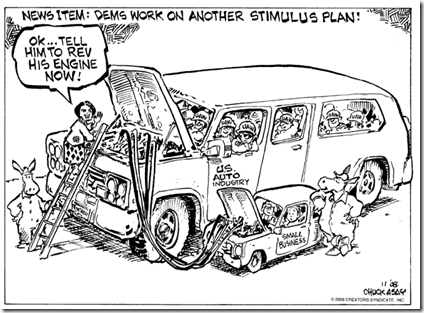
Political Cartoon: Jumpstarting the Economy

From Chuck Asay:

Chuck Asay cartoon

Prop 8 and a Scapegoat

Recently in a conversation on prop 8, it was suggested the religion of the Blacks which was why Black vote perhaps tipped prop 8 pass.

This seems an odd charge to make. Yes, time and time again we’ve heard how religion is the basis and foundation for so much anti-homosexual bigotry … but I don’t think that holds so much water. Yes, the “high atheists” do not hold fervent anti-gay positions. But … that’s not the whole of the matter. Look at two counter examples:

  1. Where did the big atheist 20th century Marxist horrors which were adamantly and ideologically atheist, such as China and the Soviet Union fall on the gay rights issues?
  2. Yes, the high atheists are not so anti-gay, but then again neither are the “high theists.” How about the six-pack or “low” atheists. What evidence do you have that they are more OK about gay rights than the bible belt/Wednesday night bingo crowd?

Try to compare apples and apples not apples and frogs.

How the Media Fared in the Campaign

Short answer:  Not very well, and it doesn’t appear they care.

Long answer:

The adulation given to Barack Obama was far more than can be accounted for by his historic run for the Presidency.  It got so bad before the election that Michael S. Malone, a tech journalist for ABC News, got to the point he was "deeply ashamed to be called a ‘journalist’".  Michael explained, back in late October:

For many years, spotting bias in reporting was a little parlor game of mine, watching TV news or reading a newspaper article and spotting how the reporter had inserted, often unconsciously, his or her own preconceptions.  But I always wrote it off as bad judgment, and lack of professionalism, rather than bad faith and conscious advocacy.  Sure, being a child of the ‘60s I saw a lot of subjective “New” Journalism, and did a fair amount of it myself, but that kind of writing, like columns and editorials, was supposed to be segregated from ‘real’ reporting, and at least in mainstream media, usually was.  The same was true for the emerging blogosphere, which by its very nature was opinionated and biased.

But my complacent faith in my peers first began to be shaken when some of the most admired journalists in the country were exposed as plagiarists, or worse, accused of making up stories from whole cloth.  I’d spent my entire professional career scrupulously pounding out endless dreary footnotes and double-checking sources to make sure that I never got accused of lying or stealing someone else’s work – not out any native honesty, but out of fear: I’d always been told to fake or steal a story was a firing offense . . .indeed, it meant being blackballed out of the profession.

[…]

But nothing, nothing I’ve seen has matched the media bias on display in the current Presidential campaign.  Republicans are justifiably foaming at the mouth over the sheer one-sidedness of the press coverage of the two candidates and their running mates.  But in the last few days, even Democrats, who have been gloating over the pass – no, make that shameless support – they’ve gotten from the press, are starting to get uncomfortable as they realize that no one wins in the long run when we don’t have a free and fair press.  I was one of the first people in the traditional media to call for the firing of Dan Rather – not because of his phony story, but because he refused to admit his mistake – but, bless him, even Gunga Dan thinks the media is one-sided in this election.

[…]

The absolute nadir (though I hate to commit to that, as we still have two weeks before the election) came with Joe the Plumber.  Middle America, even when they didn’t agree with Joe, looked on in horror as the press took apart the private life of an average person who had the temerity to ask a tough question of a Presidential candidate.  So much for the Standing Up for the Little Man, so much for Speaking Truth to Power, so much for Comforting the Afflicted and Afflicting the Comfortable, and all of those other catchphrases we journalists used to believe we lived by.

Read the whole thing(tm).  Malone is more certainly not against reporters digging for the dirt (he supported the "reportorial SWAT teams" sent to Alaska to see what they could find about Gov. Palin).  What he is aghast at, however, was how utterly unbalanced this hardball treatment was. 

Aside from the viciousness given mostly to Republicans and their supporters, the Pew Research Center found that McCain’s news coverage was incredibly lopsided.

Slightly fewer than a third of the stories about Obama were negative, whereas more than a third were positive and about the same number were neutral or mixed. More than half of the stories about McCain cast him in a negative light, whereas fewer than 2 in 10 were positive, according to Pew Research Center’s Project for Excellence in Journalism.

The study suggests that advancement in the polls does translate into more positive coverage, but with the polls so tight this season, bouncing around in the high 40s & low 50s for so long, that explanation doesn’t really fit.

The Washington Post ombudsman, Deborah Howell, also says that her paper tilted towards Obama and didn’t really cover the issues well.  The big question is, will this translate into better coverage?  With the media still in the tank for Democrats after decades of being that way, it doesn’t seem likely.

Just ask Chris Matthews:

CHRIS MATTHEWS: Yeah, well, you know what? I want to do everything I can to make this thing work, this new presidency work, and I think that —

JOE SCARBOROUGH: Is that your job? You just talked about being a journalist!

MATTHEWS: Yeah, it is my job. My job is to help this country.

The phrase "speaking the truth to power" is about to drop quickly out of fashion in national media circles.

 Page 21 of 37  « First  ... « 19  20  21  22  23 » ...  Last »