By Contributor Archives

"Stop Tinkering" Exhibit A

David Brooks:

During the first half of this year, German and American political leaders engaged in an epic debate. American leaders argued that the economic crisis was so bad, governments should borrow billions to stimulate growth. German leaders argued that a little short-term stimulus was sensible, but anything more was near-sighted. What was needed was not more debt, but measures to balance budgets and restore confidence.

The debate got pointed. American economists accused German policy makers of risking a long depression. The German finance minister, Wolfgang Schäuble, countered, "Governments should not become addicted to borrowing as a quick fix to stimulate demand."

The two countries followed different policy paths. According to Gary Becker of the University of Chicago, the Americans borrowed an amount equal to 6 percent of G.D.P. in an attempt to stimulate growth. The Germans spent about 1.5 percent of G.D.P. on their stimulus.

This divergence created a natural experiment. Who was right?

The early returns suggest the Germans were.

Indeed, Germany’s economy is growing at an amazing 9% annual rate and unemployment is back to what it was before the crisis.  Back home, Obama and company are considering a second stimulus.

Because the first one worked so well?

Perfectly Legal, But a Bad Idea

No, I’m not talking about the "Ground Zero Mosque".  I’m talking about the Dove World Outreach Center’s plan to burn Korans on September 11th.

There’s nothing unconstitutional about doing with your own property what you wish.  Insofar as there are any relevant ordinances, it’s a local issue.  But also, people are free to exercise their right to protest and express their displeasure at such a thing, and try to convince those who are doing it to reconsider their plans, as I am trying to do.

OK, now I’m talking about the "Ground Zero Mosque".  Or both.

Are liberal websites who criticize the Dove Center’s burning of Korans and mock them anti-Christian bigots?  Certainly this criticism, in and of itself, is not proof of any such bigotry.  They just feel it’s wrong and are expressing their opinion.  I would be building a straw man to suggest that they are motivated by hate of Christians.  Equally, appealing to the constitutionality of this would be ignoring the other, more substantive, points of their protest.

And yet when the tables are turned, out come their straw men and their baseless accusations.  Liberal talking heads speak of constitutionality of building the Mosque on private property and accuse opponents of Islamophobia.  A nutty and drunk cab passenger killing his Muslim cabbie is pointed to as an example of the alleged overall fear, even though the perp was for the Mosque and the Muslim victim against it. 

Why can’t we have a civil discussion about race, religion or any sort of sensitive subject in this country?  This is a big reason why. 

Things Heard: e136v2

Good morning.

  1. Of Beck and Obama.
  2. A man shot and consequence.
  3. Two Gulf disasters, two Presidents, and a cricket race.
  4. One post which clearly shows Mr Krugman and his ilk are non-serious about economy and politics.
  5. And lo and behold, he shows the origins of his fantasy.
  6. A big bubble?
  7. The continuation of the lying to Congress charge … one wonders how actual real-live you-can-tell-they’re-lying-because-their-lips-are-moving Congress-critters make such charges with straight faces.
  8. Appeasement.
  9. A challenge.
  10. Just get on your bike and ride, dude.
  11. Shotgun tracts.
  12. Contra smut.

On Park51 or the Cordoba House

I have not offered any opinion of mine own on the proposed Mosque site. I think a lot of odd things have been said about it, not the least of which was the GOP reaction to his expressing the mainstream conservative opinion on the matter, that they do in fact posses a Constitutional right to build but that it is a very bad idea. One has to remember an idea you support, when spoken by one on the other side of the aisle, remains a good idea (and recall that even a broken clock is right twice a day). Another silly thing touted is that this building is “two whole blocks away” and nowhere near the ‘Ground Zero’ location. The reason that notion is silly is that the Park51/Cordoba people have chosen this location is its proximity to the former World Trade site. It seems to me that the those who protest that this is too far away miss a crucial point. Neither the sponsors nor the objectors see that is correct. Doubtless one can point at countless other ideas fronted on this topic which are incoherent or silly. Read the rest of this entry

Church Services in the US Capitol

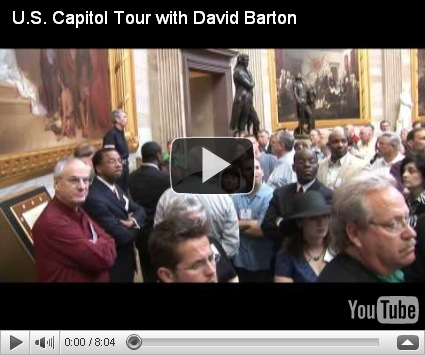
If you think the ACLU would have a conniption over that, imagine how they would have reacted had they been around for some of these other events in the video.  The "separation of church and state" doesn’t mean what they, and liberal judges, think it means.

US Capitol Tour with David Barton

Seven of the most interesting stories on Mon. morning: climate collapse, Moore on Beck, Jim Wallis apologizes, and more

1.    Crisis in the Environmental Community: The climate lobby has declined dramatically from its days of high confidence after the 2008 election and it is scrambling to determine the next steps:  

A year ago, these groups seemed to be at the peak of their influence, needing only the Senate’s approval for a landmark climate-change bill. But they lost that fight, done in by the sluggish economy and opposition from business and fossil-fuel interests.

2.    God, the Gospel, and Glenn Beck:  Southern Seminary’s Russ Moore writes about relying on populist God-and-country sloganeering and outrage-generating talking heads.

It’s taken us a long time to get here, in this plummet from Francis Schaeffer to Glenn Beck. In order to be this gullible, American Christians have had to endure years of vacuous talk about undefined “revival” and “turning America back to God” that was less about anything uniquely Christian than about, at best, a generically theistic civil religion and, at worst, some partisan political movement.

3.    Advertising Parasites: Ads that follow you from site to site.

“For days or weeks, every site I went to seemed to be showing me ads for those shoes,” said Ms. Matlin, a mother of two from Montreal. “It is a pretty clever marketing tool. But it’s a little creepy, especially if you don’t know what’s going on.”

4.    Jim Wallis Apologizes: Sojourners’ Jim Wallis apologizes to World’s Marvin Olasky.

“I was wrong, out of anger at the insinuation about the dependence on these foundations, I was wrong to imply that like Beck, Marvin lies for a living,” Wallis said. “Glenn Beck does lie for a living. Marvin Olasky doesn’t lie for a living; that’s not something I should say about a brother in Christ.”


5.    Crooked Afghan Partner?: Another Diem? Karazi fires his corruption fighter.

“What he was doing was very important,” State Department spokesman P.J. Crowley said of Mr. Faqiryar. “Those charged with pursuing corruption need to continue their work without political interference. It’s something we are watching to make sure the Afghan government lives up to the pledges it has made in battling corruption.”

6.    America’s Creativity Crisis?:  For the first time, research shows American creativity declining.

What’s driving the drop? According to Newsweek, technology and education are particularly nefarious culprits. At home, kids are spending more time watching television and playing video games; at school, our educational system is evaporating the creative juices. Neither of these criticisms is particularly new, but they are informative within the context of the creativity discussion.

7.    Baseball Replay Confirms Walk-off Homer:  For the first time, the limited replay rule is used on a play that ends game.

McCann capped a stunning comeback with a replay-assisted homer that gave Atlanta a 7-6 victory over the Marlins on Sunday – the first time a game ended on a call using video. Without it, McCann might have only gotten credit for a double and the game would have continued on. Instead, he was jumping into the arms of his teammates after the umps took a second look, taking advantage of a limited replay rule that went into effect two years earlier almost to the day – Aug. 28, 2008 – to make sure they got these sort of calls right.

Things Heard: e136v1

Good morning.

  1. Some with Nixie tubes
  2. The VP and those pesky details.
  3. Going up?
  4. Setting aside the (excessive) sarcasm, I think the question of how to treat differently talented kids in school to optimize goals is a valid question. And “making things equal” is not necessarily the best answer.
  5. Stupid liberal tricks … now bullets.
  6. That’s what we need more, bigger deficits.
  7. Extreme airport.
  8. Friendship.
  9. Mr Obama goes on the offensive against misinformation, with hyperbole and misinformation.
  10. Great photo anyhow.
  11. Reading on the Mosque
  12. 2-d time.
  13. Iraq.
  14. A photo.
  15. Norman and virtue.

Evangelical leaders of previous generations are in the process of passing the torch to younger leaders, for whom there are at least 10 fresh challenges. We’ve considered the challenge of Navigating Newfound Authority and Waging a New Bloodless Revolution; now a third challenge:

Overcoming Spiritual Superficiality

In the wake of megachurch-building success and a new ability to be culture-cool, the pews are filled with biblical illiterates who may be ill-equipped for the next personal or national crisis. In many cases spiritual depth has been sacrificed in the interest of growth and new church models are designed to multiply conversions but fall short in assuring spiritual growth and doctrinal understanding.”

The fear that theological lessons will bore and drive away new converts and a generation with a miniscule attention span, churches are not guiding their members through the fundamentals of the faith and the dangers of popular theological perversions such as:

  • universalism (that what God did for humans in Christ will redeem all humans, whether they are Hindus, Muslims, or atheists, all will eventually be saved),
  • pluralism (the belief that no religion offers superiority in the process of redemption; that all religions lead us to the same god and the same ends), and
  •  modalism (a denial of the Trinity which states that God is a single person who, throughout biblical history, has revealed Himself in three modes, or forms.  Thus, God is a single person who first manifested himself in the mode of the Father in Old Testament times.  At the incarnation, the mode was the Son.  After Jesus’ ascension, the mode is the Holy Spirit.)

Scot McKnight of North Park University and the Jesus Creed blog told Margaret Feinberg:

The biggest challenge facing American evangelicals is Christian universalism– the belief that everyone will eventually be saved because of what Christ has done….I think many young evangelical adults who have been reared in the church have imbibed pluralism and tolerance from their years in the public educational system.”

Norman Geisler, Christian apologist and president of Southern Evangelical Seminary said:

“The evangelical church in America is about 3,000 miles wide and an inch deep. Doctrinally, we are very shallow. We have enough religion to makes us susceptible, but not enough doctrine to make us discerning. You can’t recognize error until you can recognize the truth. I’m told that when government experts want to train people to recognize counterfeit currency, they study genuine currency. The same is true with doctrine.”

Some are recognizing the weaknesses. Bill Hybels, pastor of megachurch granddaddy Willowcreek, said after a study of the church’s ministry:

“We made a mistake. What we should have done when people crossed the line of faith and become Christians, we should have started telling people and teaching people that they have to take responsibility to become ‘self feeders.’ We should have gotten people, taught people, how to read their Bible between services, how to do the spiritual practices much more aggressively on their own.”

And that’s a key charge for the new evangelical generation: pair great growth, engaging entertainment, and compassionate service with the teaching of theological truth. Build strong and knowledgeable believers who will have the ability to dismiss error and to maintain their faith through difficult days.

Passing the evangelical torch: Waging a new bloodless revolution

Evangelical leaders of previous generations are in the process of passing the torch to younger leaders, for whom there are at least 10 fresh challenges.

We’ve considered the challenge of Navigating Newfound Authority; now a second challenge:

Waging a New Bloodless Revolution:

There is a divide in the evangelical church that is roughly along generational lines, although not entirely. The Evangelical Generation that began in the 70s has dedicated an enormous amount of its time, energies and resources to fighting the cultural corrosion of two values: First, the protection of human life from conception to natural death, threatened by the normalization of abortion-on-demand and the calls for euthanasia.  Second, the protection of heterosexual marriage, seen as under fire by increasingly ambitious homosexual activism. Those who have championed these protections have often done so at the exclusion of other valuable causes, and at the cost of public popularity.

The Emerging Generation and others have identified pressing issues that deserve the attention of the church and are biblical values and imperatives that cannot be left to secular interests. These include care for the poor, stopping human trafficking, protection of God’s creation or environmental stewardship; nuclear non-proliferation; the dreadful crises of the African people, including AIDS; and clean water crises around the world. These are vital (and popular) causes.

Through my work with many organizations over the years, I have been involved in nearly all of these causes, and I have seen and felt the passion of people who commit their lives to the important missions to which God has called them. The most discouraging aspect of the Church’s work in all of these areas is that its leaders rarely speak to the importance of the followers of Jesus addressing both the traditional concerns and newer concerns.

I see two major challenges for young Christian leaders in public engagement: 

  1. Avoid the division on issues that is expected in politics. Recognize that God’s people must transcend this and cheer and support ministries that battle for unborn life and that battle against climate change. New leaders must be as bold in speaking out for more liveable conditions for those in the inner city as they are in speaking out for better conditions for those who preach the gospel in hostile nations. Leaders must share the living water as they dig for clean water.  The bifurcation of Christian public engagement is wrong and harmful to the Kingdom. 
  2. It is dangerous to get comfortable with the notion that Christian advocates taking difficult and unpopular positions on public issues should back away from these issues and find warmer and fuzzier social causes. Instead, new leaders need to remain engaged, but with greater attention to tone and posture. We don’t need to be popular, but we cannot demonstrate unchristian characteristics as we do battle. A new generation cannot abandon the revolution of values; let’s just make it a bloodless revolution; a revolution where the ends do not justify means unbecoming to the followers of the prince of peace. 

To the barricades!  Just don’t break anything.

  1. Interfaith events almost always feature lukewarm and dumbed-down faith. This is true whether it’s a progressive event put together by Unitarians and barely religious theists or a conservative event put together by a god-and-country Mormon such as Glenn Beck.
  2. Interfaith is fine and good for patriotic events and to gain momentum on common causes, but Beck bills this as a time to help “heal your soul,” and I can promise you that the red-meat rhetoric that highlights most Beck events won’t heal anything.
  3. Evangelicals don’t look to Mormons for spiritual solace.
  4. While I am an active conservative, I do not appreciate Glenn Beck’s caustic and smirking approach to political dialogue. One evangelical leader is participating in the event because, he says, although Beck is a Mormon, he exhibits Christian “fruit.” “The fruit of the Spirit is love, joy, peace, patience, kindness, goodness, faithfulness, gentleness and self-control.” (Gal.2:22,23) I’m sorry, but that’s not a list of Beck traits. He exhibits a commitment to promoting many conservative political principles, but—in my view—by employing unchristian means.
  5. Let me give you some perspective. Most evenings during the 5 o’clock hour I’m on a treadmill at the local fitness club with a TV screen in front of me. Last night, rather than watch Glenn Beck I was watching the Little League World Series. The LLWS, really? That’s pathetic, I know, but it should tell you all you need to know about my appetite for Glenn Beck programming.
  6. I am a Republican and I think both Beck and this event are potentially harmful to improving Republican fortunes.
  7. I have a date with my wife.
  8. The Braves are in a pennant race and they’re on TV tonight (although that is trumped by #7 above).

I could come up with several more reasons, but thinking about Glenn Beck makes my head hurt.

Passing the torch: Who will lead the evangelicals?

Navigating Newfound Authority

During the last 50 years, neo-evangelicals have sought to break free from fundamentalist isolation and to give Christian orthodoxy a stronger voice than theological liberalism. They have gone far in achieving these goals, while also leaving the scars of the scorched earth strategy of the culture wars. A new generation of evangelicals will require the hand of God’s blessing to demonstrate the great wisdom, strength and grace that will needed to navigate current challenges and to be prepared to address the issues and crises that few of us can foresee or imagine. There are at least ten major challenges for young leaders; the first is identify these leaders.

We already know that there are many bright young leaders who can critique the church and analyze the actions of those who have preceded them. But can they lead? Will they be equipped to face fresh challenges?

Christian leaders for these times will need to be multi-dimensional and authentic; today there are few secrets and an alarming taste for exploitation of weaknesses. Leaders will need to be doctrinally sound, culturally relevant, publicly engaged, relationally winsome, attractively articulate, and morally consistent.

What young Christians may have what it takes to lead the church during the next generation and to be the face of American Christianity in the days ahead. I’m compiling a list of such potential leaders?

Here are three dozen on my list of candidates (with a hat tip to Brad Lomenick at Catalyst who has been thinking about these things). I’d like to hear for you: who do you think has the qualities and gifts to lead into the heart of the 21st century? Please let me know. 

  1. Jonathan Acuff, writer/blogger/consultant, creator of the Stuff Christians Like blog.
  2. Ben Arment,innovative author, trainer, church planter, creator of Story and the White Board Sessions.
  3. Leroy Barber, founder of Mission Year and author of New Neighbor, pastors in innercity Atlanta and guides young Christians into cross cultureal ministry in American cities.
  4. Mark Batterson author and pastor of National Community Church, which meets in theaters and coffee shops throughout the Washington, D.C. area.
  5. Francis Chan, popular speaker and author of Crazy Love: Overwhelmed by a Relentless God.
  6. Eugene Cho. pastor in Seattle of Quest Church. Also soon to launch a new organization focused on global poverty.
  7. Ryan Dobson, edgy son on Christian radio’s most famous name; founded Kor Ministries and now co-hosting new radio program with his Dad.  
  8. Mark Driscoll, author and pastor of Mars Hill church in Seattle and leader of The Resurgence.
  9. Joshua Dubois, executive director of the White House office of Faith Based and Neighborhood Partnerships

    Margaret Feinberg, author of Scouting the Divine


  • Margaret Feinberg, extremely gifted and poetic speaker and author of Scouting the Divine.
  • Cathleen Falsani, award winning Religion columnist for the Chicago Sun Times. Her recent book is  Sin Boldly
  • Jessica Flannery, co-founder of Kiva, a platform for micro-finance throughout the world.
  • Craig Groeschel, author and pastor of one of America’s largest and best churches, LifeChurchtv.
  • Chris Heuertz, international executive director of Word Made Flesh. Chris spends most of the year around the world serving the poorest of the poor.
  • Bethany Hoang, director of the International Justice Mission Institute, think tank for IJM, a human rights agency that secures justice for victims of slavery, sexual exploitation and other forms of violent oppression.
  • Rani Hong, founder of the Tronie Foundation, committed to fighting slavery and human trafficking through education and policy.
  • Skye Jethani,  managing editor of Leadership Journal and author of the recent book The Divine Commodity.
  • David Kinnaman, president of Barna Research Group and author of unChristian: What a New Generation Really Thinks About Christianity .
  • Shaun King, pastor of Courageous Church in Atlanta, and part of Hope Atlanta, an initiative dedicated to helping Atlanta flood victims.
  • Wendy Kopp, founder of Teach For America, an amazing organization that places recent college graduates as teachers in poor communities and underperforming schools across the country.
  • Kyle Korver, NBA player for the Utah Jazz, started a foundation to help inner-city kids, and also recently launched Seer Clothing.
  • Gabe Lyons, head of The Fermi Project, conducts the Q conference and projects for  new generation work towards long term, Gospel-centered cultural renewal.
  • Scott McClellan, editor of Collide Magazine, and also purveyor of the Collide blog.
  • Jonathan Merritt, a Southern Baptist insider who writes on culture and the church; he is  the founder of the Southern Baptist Climate and Environment Initiative and author of Green Like God.
  • Donald Miller, storyteller and author of the best-seller Blue Like Jazz.
  • Penny Young Nance, CEO of Concerned Women for America, the nation’s largest conservative women’s organization.
  • Jena Lee Nardella, executive director of Blood:Water Mission since she was 22.
  • Lindsay Orr Tarquinio, founder with husband Gavin of LUO, an initiative focused on setting children free from poverty, sickness, and slavery and.
  • Kevin Palau, EVP of the Luis Palau Association and the force behind Palau’s innovative street festivals.
  • Hannah Song, executive director of Link Global, which aims to raise awareness regarding the North Korea crisis and helping to meet needs.
  • Cameron Strang, founder and publisher of the popular Christian magazine on progressive culture, Relevant.
  • Tyler Wigg Stevenson, a pastor and writer who leads the Two Futures Project, a movement of Christians for nuclear threat reduction and the global abolition of nuclear weapons 

    Tyler Wigg Stevenson, head of the Two Futures Project.

  • Zach Williams, singer/songwriter/recording artist in New York City.
  • Pete Wilson, pastor of Cross Point Church in Nashville, uber blogger, and author of Plan B.
  • Danny Wuerffel, former Heisman Trophy winner and now Visionary Leader of Desire Street Ministries.
  • Brian Wurzell, pastor, worship leader, blogger extraordinaire, and creative guru. On staff with Cornerstone Church in Chandler, AZ.
  • Friday Link Wrap-up

    Yes, it’s that time of the week again, where I toss out a bunch of links that I was too lazy to do a full blog post on.

    Turns out the Iraq war didn’t break the bank.  It’s understandable that you might think that, but that only indicates a need to get your news from more sources.  The MSM loves to parrot DNC talking points.

    (Liberal) feminism is dead.  Long live (conservative) feminism!

    Jim Wallis said that Marvin Olasky (World magazine editor) “lies for a living” when Olasky noted that Wallis got $200,000 from George Soros.  When it was pointed out that he, in fact, did, then came the abject apology in sackcloth and ashes, “Well, it was so small I forgot.”  UPDATE: Wallis has issued a formal apology.

    Three months ago, James Cameron was ready to “call those deniers out into the street at high noon and shoot it out with those boneheads”, speaking of those who dispute anthropogenic global warming.  At the very last minute, after changing his demands over and over for how a debate was to be run, he cancelled.  Now that takes guts.  Or something.

    In England, teachers are dropping history lessons on the Holocaust and the Crusades, for fear of offending Muslims who are taught Holocaust denial and a different view of the Crusades at local mosques.  They’re afraid of challenging “anti-Semitic sentiment and Holocaust denial among some Muslim pupils”.  So much for academia being the standard bearer of truth and free speech.

    A back door repeal of the First Amendment by … social workers?  Well, when liberal ideologues get ahold of professional organizations, nuttiness does ensue.  Look at most unions.

    And finally, a US district judge put a temporary halt to embryonic stem cell research.  Some believe this will devastate scientific research, but  Steve Breen puts it in perspective.  (Click for a larger image.)

    Rusty Nails (SCO v. 9)

    So… where’s the oil now? Either Obama really is the Messiah he was portrayed as, and it was his mere presence alone that healed our earth; or, maybe, we aren’t quite up to predicting global effects of non-globally sized events? A couple of months ago, it wasn’t difficult to find commentaries declaring that we were were on the brink of planetary destruction, that the Gulf of Mexico would never recover, that oil spill was a foretaste of the effects of Global Warming Climate Change, that God was allowing this disaster as punishment for our sins on Mother Earth. Yet now we see that Obama really has the power to heal the Earth – scratch that – Yet now we see how inadequate we might be in our attempts at extrapolating data, on a global scale, over extended time periods – well – even short time periods. Common sense should tell us that our efforts would be better served by addressing known issues that we currently face, as opposed to potential issues we might face. (also see Joe Carter’s post)

    ###

    Illegal aliens allowed to get a New Mexico drivers license… so, why not allow them to purchase firearms as well (why should that “right” be infringed upon?). The argument for giving illegal aliens drivers licenses is that it provides for better enforcement of insurance, etc. If that were so, then why not allow illegal aliens to purchase firearms, thereby giving them direct access to the right of self defense?

    ###

    Well, at least they weren’t burning the books (but a pragmatist would have donated them to a local library). Or have a used-book sale or something to recoup some money?

    ###

    When in doubt, ask someone who has actually followed the rules. Gabriella, a naturalized U.S. citizen, educates a Tucson City Council member on why the City of Tucson should not sue the State of Arizona over SB1070.

    ###

    Two exo-solar planets transiting the same star… geekfest time.j

    ###

    The Ghosts of World War II. Have not confirmed the validity of these images but, if true, an interesting use of Photoshop linking the past with the present.

    Things Heard: e135v5

    Good morning.

    1. Church and state and Turkey.
    2. Market in Poland, a photo-essay.
    3. Vindictiveness and the Admin.
    4. On that hard pullout date and strategy.
    5. More on Park51.
    6. A conservative surprised at epistemic closure from the left.
    7. I have yet to see mention of this from the left. Odd that. And this is spot on … the concept of hate crimes are an outrage.
    8. Somebody somewhere didn’t like Wall-E.
    9. Fun with banks.
    10. 100 years, and some shared thoughts.
    11. Bike tech lust.
    12. Weight loss tips that beat licking raw eggs all hollow.

    Jim Wallis should take it back (and other thoughts on Christians and the Mosque)

    As Christians, should our response to the mosque controversy be different than others? As I’ve written, I believe the Muslims seeking to build the mosque should demonstrate American instincts by building it down the road. That aside, how should Christians respond?

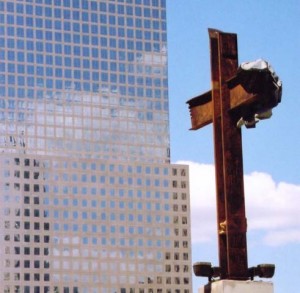
    Cross in the wreckage of Ground Zero

    I certainly believe that in dissent and argument Christians should demonstrate the fruit of the Spirit. Here are some thoughts in this case:

    Love (Your Enemies, Your Neighbors): We cannot hate Muslims because of their faith or even because of acts done in the name of Islam. We just can’t. Opposition to the placement of this mosque doesn’t mean we hate the individuals seeking the mosque or supporting it. Love for our neighbor does not mean we have to support everything they want to do. We’ve been down that road in other arguments.

    Blessed are the Peacemakers: We do need to be peacemakers. But part of keeping the peace is to avoid provocation. While the mosque shouldn’t be built in a grieving area, Christians also should not be burning Korans and putting up signs about Islam being of the devil.

    Kindness: Don’t portray these NYC neighbors worse than they may be. You don’t know them and I don’t either. Christians should not use hurtful language or false characterizations. There is enough ugliness in the media. Tone it down.

    Protect the Faith: There are plenty of efforts to restrict the religious liberty of Christians in America. Don’t give those who wish us ill any ammunition to use the next time a Christian church wants to express itself in the public square. I do find it interesting that the liberals who are so vocal about the religious liberty of those who are wanted to build this mosque are rarely seen in the defense of any Christian display, building, or expression.

    Jim Wallis Outrage

    Did you see the articles or appearances by Sojourners head Jim Wallis on this topic? He wrote that as Christian peacemakers, we should support our Muslim friends in their desire to build a house of worship near Ground Zero.

    While I don’t share Wallis’ politics, I share a Savior. But I’m troubled by what he wrote in his column. Not so much his arguments (although I disagree), but by his character assassination of his fellow Christians. He argues that peaceful Muslims should not judged because of the actions of Islamic 9/11 terrorists any more than he, as an evangelical Christian, should be “judged on the basis of fundamentalist Christians — some of whom have said and done terrible things.”

    Rev. Wallis, are you really equating the rhetoric of fundamentalist Christians with the actions of terrorists who murdered thousands of people?

    Over the years I have provided communications and public relations counsel and services to many Christian leaders (still do), both fundamentalists and (although not Wallis) evangelical liberals. I find this statement by Wallis as abhorrent as I did Jerry Falwell’s ill-timed assertion that Americans brought the 9/11 attacks upon themselves because of their sins.

    Wallis should retract this statement. And I’ll hear him out on the mosque issue and on reconciliation when he completes a Jerry Falwell statue at the Sojourners headquarters. To paraphrase Wallis: “What does it mean to love our enemies as Jesus instructed us? Wasn’t Jerry Falwell your brother and your neighbor?“

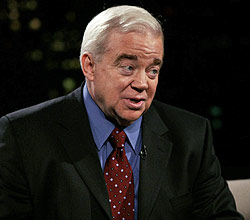
    Jim Wallis of Sojourners

     Page 102 of 241  « First  ... « 100  101  102  103  104 » ...  Last »