Archive for September, 2010

Passing the evangelical torch: Learning to communicate again

 Evangelical leaders of previous generations are in the process of passing the torch to younger leaders, for whom there are at least 10 fresh challenges. We’ve considered the challenges of Navigating Newfound AuthorityWaging a New Bloodless Revolution, Overcoming Spiritual Superficiality; Creating CultureReturning to Virtue, Bridging to Everyday Relevance, and Resisting the Seduction of the New Social Gospel. Now this challenge:

Learning to Communicate Again

John Maxwell tells the story, presumably true, about a denominational meeting on June 19, 1908, at which the following minutes were recorded:

Mr. Grueber introduced the following to be discussed: Nine reasons not to introduce the typewriter into our church.

1. The paper must be put into the machine and aligned properly, tabs must be set. This is not easy. When writing by hand, one simply begins, exactly where you want with no restrictions. 

2. With a typewriter, you have to constantly remember to capitalize and put in punctuation. It is easy to forget, and to go back and change things is hard. When writing by hand, such things are automatic. 

3. With the typewriter, you have to have been trained to find the proper keys. This takes time. We already know how to write. 

4. With the typewriter, you are limited to the size and spacing of the type. When writing by hand, you can use any size letters or style you want. 

5. With the typewriter, centering and setting margins is [sic] not easy; when writing, it is no problem. 

6. A typewriter breaks down and costs to be fixed. Writing does not. 

7. Correcting a mistake after something has been typed is a problem; when writing by hand, it is not. 

8. The church has gotten along for over 1900 years without a typewriter; why do we need this now? 

9. Instead of learning a machine with all the above drawbacks, time should be spent on penmanship (Maxwell, J. in Galloway, D. ed., 2001, p. 23-24) 

As one writer mused: “Debating the use of typewriters in 1908 proved just about as fruitful as the research devoted to perfecting the manufacture and sale of the buggy whip when the automobile was accelerating into the lifestyles of an increasingly mobile population in First World Countries. And no doubt future generations will derive a certain humorous pleasure in reviewing the record of our debates over technologies that will one day be deemed completely obsolete.”

The urgency of God’s message for our world has throughout history been a prime mover of communication and communications technologies. At times, people of faith have led the drive for new communications methods, and occasionally they have struggled to stay current with the available means of communications.

We take for granted the technologies and methods that have, one by one, been enormous contributors to the work of the church:

Printing:  The printing press revolutionized the Church, serving as a major catalyst for the Reformation. It was in 1450 that Johann Gutenberg developed a technique for commercial printing using movable type. The process became known as letterpress, and enabled Gutenberg to produce printed books of high quality. Most notable of these was the Gutenberg Bible of 1455. In a breathtakingly short period of time, roughly 50 years, more than eight million volumes had been printed, estimated to be more books than all the combined scribes of prior human history had produced. Throughout the years, Christian activists have tried to master the art of getting positive mention in newspapers and magazines, two media products that are heading (I fear) toward extinction.

Telephone: It was the manipulation of electrical current that created the first telegraph, opening the era of immediate long-distance communication. In 1837 British scientists Charles Wheatsone and William Cooke were inventing an electric telegraph system right at the same time as Samuel Morse, working with Alfred Vail, was also inventing a workable system. Just 39 years later Alexander Graham Bell invented the first practical telephone.

Until the invention of the telegraph, long-distance communication required people to move messages physically from place to place, a time-consuming activity involving travel by horse, boat, stagecoach, or other vehicle. Because of the difficulty of this type of one-way communication, messages were simple and utilitarian. The telegraph, and later the telephone, helped decrease the dependence of communication on transportation, making the space between people less important and their messages longer but often less consequential. Today the cell phone has made instantaneous long-distance communication portable. 

Radio: In 1915 a former telegraph operator by the name of David Sarnoff suggested to a Vice-President of the Marconi Wireless Telegraph Company of America that he had an idea to produce a “Radio Music Box” that would be capable of receiving radio signals on several different wave lengths. In a memo he wrote: “If only one million families thought well of the idea, it would…yield considerable revenue.” That idea was rejected and about a decade later Sarnoff’s company, RCA, was selling enough radio sets to establish it as a world leader among industrial firms.

In the early days of radio, some church leaders were wary of radio waves because they feared that it was a medium controlled by Satan, the “prince of the air.” An early radio preacher marveled when people came to Christ listening to a broadcast. “Unction can be transmitted,” he exclaimed.

Radio has been used mightily by the church for evangelism, preaching to the faithful, discussing Christian engagement, and broadcasting the music of the faith. This is true in this country, and it continues to be used for multiple purposes, especially in areas more difficult to reach with the Gospel through traditional means.

Television:  The television has had powerful influence on the church. Indeed, millions of viewers each week find their spiritual education, conviction, and nurture on the television. For huge numbers of people, both the infirmed and the healthy, their preacher is the television preacher. However, the use of television by evangelicals is mixed.  The evangelistic message of Billy Graham’s televised crusades is unmistakable, including the offer of counselors that can be reached by toll-free numbers on the telephone. But many of the “televangelists” have misused the medium. “Television evangelism,” Christian fundraising guru Russ Reid said, “is bad television and bad evangelism.”

The Internet:  Thomas Jefferson advanced the concept of the free library system in which information in printed form could be transferred and made accessible to large numbers of people. What would Mr. Jefferson think of the information superhighway available today on computers via the Internet? He’d probably love it and its power to equalize. The church is learning how to use the new media along with everyone else. With smart phones that access the Web, dynamic websites with flash graphics and webcam, churches have global access and reach, and the power to create a kind of digitally-based holiness for members and non-members alike.

Last week, a friend who pastors a Christian church in India, extended his visit to our area, which made it necessary for him to preach Sunday morning services in India from here in Atlanta.  He stood on the kitchen counter, preached vigorously into a Webcam on a laptop in the middle of the night (12 hour time difference), a broadcast to the church via Skype. Except for the relatively low cost of the laptop and a Skype fee, it was virtually free. That’s just amazing!

Christian churches, organizations, writers, and just about everyone else are learning along with the rest of the world how to establish and embellish an Internet presence. Church web sites and Internet blogs are increasingly being seen as opportunities to engage the culture with the message of Jesus Christ.

New Technologies

Today’s communication is a blur. How do you communicate spiritual depth in digital bytes or in 140 characters? We are moving from the immediacy of television and radio to the blinding speed of 4G and an almost completely mobile world.  Just how do you communicate the deep truths of faith and purpose in the constantly attention-compromised, distracted time bits afforded to you by a generation on the run?

That brings us to the challenges that will be faced by the Christian leaders of the rising generation. There seems to be a new device or communications system every day, and many of the next-generation technological developments are not yet on the horizon.

Here’s Forbes’ guess at the coolest communications devices of the future. They include:

  1. Empathetic Communication
  2. The Phone Glove
  3. Micromedia Paper: a book on one sheet
  4. $100 laptop
  5. Ubik Concept Mobile Phone
  6. Haptics: touchy-feely
  7. VOWI-FI:  hot spots become home phone lines
  8. 802.16 Phones: huge band width for phones
  9. VVT Finish Walking Bio Identification Phone
  10. Qualcomm IMOD Phone: revolution in screen lighting

Throughout the decades we have certainly learned that modernizations and technologies are spiritually inert and must be evaluated not simply by their modernity but by the impact they will have on individual character, communion with God, meaningful community, authentic communication of the Gospel, depth of knowledge, the quality of family and community life, and service to those in need.


Things Heard: e138v1

Good morning.

  1. Art and disability.
  2. Gaming rent control.
  3. Five years.
  4. Bulbs.
  5. Politics and history and the bear.
  6. No pull back from Mr Obama. Surprised, not?
  7. Heh.
  8. A Confessor.
  9. Bears of small brain?
  10. Mr Obama and the panthers.
  11. The “war as plunder/defence” argument neatly skewered.
  12. Muslims in Indonesia.

Burning Holy Books and the “Is Outrage” Response

When a small group led by a charismatic leader does something outrageous in this country to the average American this means little. This sort of thing happens all the time … bringing out examples is likely an exercise best left to the reader. A question that arises is why then does so much of the Islamic world rise up in anger when, say, a wacky pastor in South Florida burns a few books? The reason is in part a reflection of our different political cultures. 

In those countries which are rising up in anger, no such act would transpire without the express order and approval of a governmental (or organized anti-governmental organization, i.e., an insurgency). They are upset that this guy is going this because to them it means that Mr Obama and the US government has decided this is the right thing to do. Or at the very best, if he is doing it, then he has their explicit stamp of approval. It doesn’t matter that he says he thinks it is bad or that any number of us do the same. That is irrelevant because he is being allowed to do it means that their approval and sponsorship is a given. That they protest against his action but allow it is just a demonstration base deception. 

Those places in the world do not have freedom of speech and have never lived in such places or really (as is likely) considered the consequences of a society which defends such. Perhaps part of the problem is that our COIN apparatus (unlike as what pointed as “optimal” in the Petraeus manual) is almost exclusively military … which does in fact control its message and people in a way which our civilian life is not. This might be a big benefit of moving those COIN operations which are pointed as better done by non-military units to be done by actual non-military units. Perhaps the surge would have been best accompanied by 75k civilians in their unruly mess … so that part of the world might come to learn what freedom of speech looks like up close and personal. 

Remember

Image © 2010 A. R. Lopez

Rusty Nails, SCO (v. 11)

Oops From the setting yourself up department, a lesson in election politics in the New Mexico governor’s race.

###

Geek News of the week Amateur astronomers capture images of objects (comets or asteroids) impacting Jupiter. Beyond the geek-factor, however, Hugh Ross argues that Jupiter’s size and location, within our solar system, are no accident. Ross, president and founder of Reasons to Believe, notes that Jupiter’s gravitational tug is strong enough to result in errant bodies (e.g., comets and asteroids) slamming into its surface, reducing the chance of such bodies impacting the Earth while, at the same time, not being so strong as to corrupt Earth’s orbit, thereby making advanced life impossible. Is such precision in timing, size, location, etc., the result of chance or design?

###

Acrobat Security Hole This is why I use PDF Xchange or FoxIt.

###

Oops 2 The purpose of a gun holster is not to simply have a place to hold your gun. Holsters prevent you from placing your trigger finger directly onto the trigger when removing the gun from the holster. This is important because any time your finger is ON the trigger it is very likely that a bullet will exit the barrel. For those that choose to keep a gun in a pocket, the need for a pocket holster is even more significant. Or… you could be like the guy in the link.

###

Oops 3 While guns and holsters mix, guns and alcohol do not. However, I’ve got to admit the idea of using a finicky computer server as a target has a certain appeal.

###

Illegally in the U.S., and enrolled in college How broken is the immigration system when a person is allowed to be in the U.S. illegally, for over 15 years, not have a Social Security number, yet allowed to enroll in college?

Friday Link Wrap-up

Media Bias Dept.:  The Left got upset when Rupert Murdoch gave money to right-wing groups.  No mention, of course of the 88% of TV network donations go to Democrats.  And how much coverage did you hear about the BBC’s Director General admitting that the state-run news organization has had a “massive” left-wing bias?  Yeah, me neither.  Also, Patterico explains how the media has shaped the national discussion by selective coverage.

Market Watch:  The market is doing more for troubled homeowners than the government it.  CNN is, apparently, shocked to discover such a thing can happen.

“Recovery” Summer Dept.:  Germany’s recover has been fueled to a large extent by private sector consumption and growth, as opposed to the graph I posted earlier showing most of our jobs went to the government.  And irony of ironies, a French bureaucrat had to tell the US about cutting spending spurs growth.  Why can our own guys understand that?

ObamaCare Dept.:  After helping pass the health care bill, one Democratic Senator, using language he helped craft in the bill, is trying to use it to exempt his state from the individual mandate.  “Yeah, it’s a great idea … for everyone else but me.”  Also, reality is putting the lie to the promise that nothing was going to change for you if you like the health care you have.

Film Corner:  The trailer us up for “Blood Money”, an expose of the abortion industry.

Government (In)action Dept.:  The Justice Department is refusing to enforce voter fraud laws, and they’ve plainly said as much.  So one lawyer is using a provision of the law to file the lawsuits the Obama’s Justice won’t.  Our President respects the rule of law insofar as it furthers his own agenda.  No good can come of that.

Gossip Column:  Fidel Castro himself admits that the communist economic model doesn’t work.  It “works” only insofar as you get influxes of cash from, say, a beneficiary either internally (the “rich”) or externally (the USSR).  But on its own, it is an abject failure.  Would that the Left would hear this and stop trying to move us closer to it.

And finally, the last word on the “Ground Zero Mosque” and the burning of Korans, from Rick McKee.  (Click for a larger image.)

Things Heard: e137v4

Good morning.

  1. Contra fideism
  2. On the President’s “go after Bay-ner” strategy.
  3. Two posts on war, part one and part two.
  4. On becoming a monk.
  5. Greed.
  6. A tax increase plugged by a conservative.
  7. Obamacare in action, two notes here and here.
  8. On state secrets.
  9. Go ahead and burn those Bibles, but the Quran … not so much, eh?
  10. Ah, for those days when cookie meant cookie.

Jumping the Shark and the Marriage/State Discussion

From the rust belt, this statement was made (and apparently affirms at some level … of sophistry):

Justin and I both accepted a crucial premise that neither one of us bothered to support: that “marriage” should be a legal institution for any arrangement of people.

Well, there you go, jump that shark along with the Fonz. What might be some of the consequences of that notion:

  • Kiss the inheritance tax goodbye, after all just “marry” your beneficiaries for spouses don’t pay that tax. 
  • That will really help the power relationship between pimp and his flock now that he can “marry” them and really control their lives with legal machinery at his beck and call. 
  • I’d bet a clever lawyer might combine marriage and employment in ways that might be serve as a good union-buster. 
  • Or on the flip side, unions could “close shop” to only those in the family and get new ways to enhance their power.
  • For the controlling parent, “marry” your kids to enhance your hold on their life after age 18. 

When you try to make a blanket statement that marriage should be allowed for any random arrangement of people you need to step back and consider the sorts of things which marriage allows, merging of finances, relaxation of privacy between members, and a the option for a shared corporate presence for the state. There’s going to be lots of ramifications when you decide any group can don that cloak. 

In the early years after the framers finished the Constitution, they were quite taken aback and surprised that Mr Burr formed a electoral machine in New York and almost grabbed the Presidency. They hadn’t “figured” on the consequences of their laws. Likewise it pretty clear that a decision that the legal status of marriage assigned to “any arbitrary group” of people is going to be similarly used by people lacking the preconceptions-as-constraints under which your discussion labored. 


How come?

How come when a small group of Muslims kill innocent men, women, and children (e.g., 9/11, Bali, African embassies, Spanish train, British train, etc.), we’re reminded that Islam is a religion of peace, and that the murderous acts were those of fanatics; but when a small group of Christians decide to burn the Koran, there’s nary a word of Christianity being related to peace or that such a wacko group of self-proclaimed “christians” are fanatics?

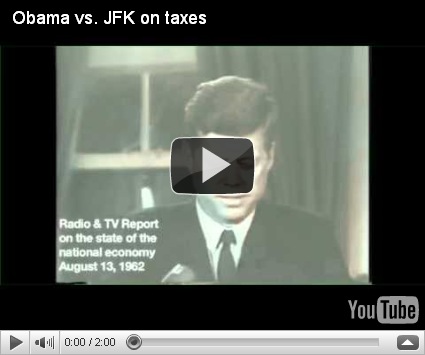
Tax Cuts: Obama v JFK

Great little comparison.

When JFK cut tax rates, IRS receipts went up.  Same for Reagan.

For Perspective

From a Facebook post by La Shawn Barber:

So much ink and hand-wringing over Koran-burning, yet so little over child killing. Strange, that.

If we could get Democrats this riled up over living beings, we’d have substantially fewer abortion tomorrow.  But they reserve their high dudgeon for … books. 

Well, holy books to be sure, but not all holy books.  See, it all depends on how the believers in said holy book might react.  La Shawn’s Facebook post links to her blog which adds this:

Burn an Islamic holy book, and Muslims kill in retaliation. Burn the Bible, and Christians pray for the one who lights the match and for the crowd cheering.

The planned Koran burnings are being highly, and rightly, criticized by the Left.  There are various reasons cited — Islamophobia, America’s reputation, insensitivity — but given the two different ways those believers react, it appears the Left only complains loudly when they might be hurt by those believers.  It’s more self-preservation than any pretense of religious tolerance. 

And children being killed in the name of convenience?  Well, that’s a right.

Passing the evangelical torch: Resisting the seduction of the new social gospel

Evangelical leaders of previous generations are in the process of passing the torch to younger leaders, for whom there are at least 10 fresh challenges. We’ve considered the challenges of Navigating Newfound AuthorityWaging a New Bloodless Revolution, Overcoming Spiritual Superficiality; Creating CultureReturning to Virtue, and Bridging to Everyday Relevance.  Now a seventh challenge:

Resisting the Seduction of a New Social Gospel

I have been in the vanguard of the evangelical effort to minister to the personal physical needs and societal injustices as part of our public ministry, and I remain convinced that ministries of compassion and justice are as clearly required by scripture as anything else we do. I have worked for and consulted with hundreds of organizations and Christian leaders over the last 30 years–some of whom wouldn’t pick up a shovel to plant crops for a hungry family if a gospel tract wasn’t handed out; many whom have demonstrated a refreshing, authentic blend of ministry to the whole person; and a few who have become so tied up in correcting systemic injustices that they’ve forgotten endemic spiritual depravity and the promise of redemption and transformation.

 Today, I am impressed with the creative and heartfelt work of so many young evangelicals in ministries to feed the hungry, limit the impact of AIDS, provide clean water, make urban neighborhood better places to live, stop global warming, and stop human trafficking. And so much more. I must caution, however, that a grave danger for the rising generation is yielding to the seduction of compassion—ministering to the body, but neglecting the hard work of dealing with the soul. The failure by many in the mid-20th century to blend social and spiritual ministry is what created the rift between fundamentalists and purveyors of the “social gospel.” The rising generation of evangelicals must take care not to remake history’s mistakes by thinking that they cannot also stray from the gospel of spiritual regeneration and find themselves meeting only physical needs rather than also physical needs. Check yourself; evaluate your, and don’t’ think this can’t happen to you! It is already occurring in too many ministries that began fully involved in holistic ministry but today have little evidence of evangelistic fervor in their programming.

Meeting physical needs and correcting societal injustices are important and satisfying. As Christian outreach, it is simply incomplete and insufficient.

Things Heard: e137v3

Good morning.

  1. Housing.
  2. The pencil.
  3. A list of books.
  4. Ice and that mythical industrial age 7k years ago.
  5. Germany and economic recovery.
  6. Remember that Discovery gunman nut? He was on the fringe of this current.
  7. My somewhat snarky comment aside, apparently nobody noticed that locations in which large amounts of raw materials get processed from the earth do not become vibrant and heavily populated.
  8. Can’t afford tax cuts for the rich” alas, the tax codes put most small business owners in the “rich” category. 
  9. On a prayer widely used.
  10. Health care and organ farming.
  11. Quran burning, here and here and here. For myself, talk of book burning reminds me of this The Master and Margarita.
  12. Defending Chesterton.
  13. Duh.
  14. And … our the stimulus that the Democrats hath wrought. The leeches did well.

Who Did the Stimulus Stimulate?

Not the folks that Obama would have you think.

http://www.nationalreview.com/corner/245828/government-job-john-derbyshire

All those promises and none of them came about.  Well, except for highly-unionized federal government workers.  And now there’s talk of a second stimulus.  You want a replay of this graph?  Really?

Things Heard: e137v2

Good morning.

  1. A painting.
  2. When you’re a generous billionaire that anti-Semitism isn’t noticed as much.
  3. Poverty and a photo-essay
  4. 9/11 and Muslim sensibility.
  5. And Park51 politics and financial shenanigans.
  6. Multi-tasking at its worst.
  7. The tightrope which the left will make sure no politician can every walk.
  8. Grist for the public education mill. It was recently remarked that all public education needs is to improve the student teacher ratio. This contradicts that and as well, I’ll note that at the meet-and-greet at my daughter’s High School last week the list of administrators to teachers was 4 pages to 8. For every two teachers there was one administrator … it seems to me that ratio needs to be worked on too if costs are to be contained. 
  9. And a teachers wish list.
  10. On faith and science.
 Page 3 of 4 « 1  2  3  4 »