Things Heard: e97v5

  1. Regime changes in the East recalled … and the anomaly considered.
  2. Inspecting desire.
  3. The neo-Keynsians.
  4. A rally.
  5. Skillz or just weird.
  6. Three year ban.
  7. Threats.
  8. An amateur trains with the team.
  9. Somebody was really really stupid, encryption is cheap.
  10. An Lenin wasn’t a Marxist.
  11. I’m guessing that’s not right, that the (few) supporters of the health care bill aren’t doing it to prevent “another Ronald Reagan.”
  12. On Mr Woods.

The Real Impetus Behind Copenhagen

Do you want to know the real reason behind all the meeting and agreements and doomsaying being done at the Copenhagen climate change confab?  Listen to the applause.

First, the warm-up act, so to speak, with hints of what was to come.

But before [Australian climate change minister Penny Wong] rose to speak the conference proceedings were interrupted by people with whistles and sirens chanting “stop green capitalism” – a sign of the anger in the developing world that the Danish host government is trying to wrest the process from the professional negotiators, who have failed to make any progress, and hand it to politicians, who might have some chance of achieving something before we all leave on Saturday.

And then the headlining act hit the stage.

Then President Chavez brought the house down.

When he said the process in Copenhagen was “not democratic, it is not inclusive, but isn’t that the reality of our world, the world is really and imperial dictatorship…down with imperial dictatorships” he got a rousing round of applause.

When he said there was a “silent and terrible ghost in the room” and that ghost was called capitalism, the applause was deafening.

But then he wound up to his grand conclusion – 20 minutes after his 5 minute speaking time was supposed to have ended and after quoting everyone from Karl Marx to Jesus Christ – “our revolution seeks to help all people…socialism, the other ghost that is probably wandering around this room, that’s the way to save the planet, capitalism is the road to hell….let’s fight against capitalism and make it obey us.”  He won a standing ovation.

Ladies and gentlemen, that is the primary purpose of the Copenhagen conference and those like it.  It’s the elites getting together to bring capitalism down and raise socialism up so that they can exert more power.  It’s a power grab, plain and simple and unashamed. 

You may have your reasons for wanting to see less carbon in the air, but those in politics and government clearly have their own agenda.  Is it yours?

Things Heard: e97v4

  1. Hmmm.
  2. A few favourite things noted.
  3. Some remarks at the passing of Oral Roberts.
  4. Controversy.
  5. A cracking good story … and a dissertation noted and described.
  6. Another passing noted.
  7. Racial politics.
  8. An essay contest for students and academics.
  9. A question.
  10. Data handling in the military.
  11. Of science and virtue.

The Cost of Health Insurance Reform

People generally quote the non-partisan CBO score when trying to figure out how much a bill will cost us.  But Michael Cannon of the Cato Institute notes that, since the CBO is quite transparent, showing how it calculates its scores, Congressional Democrats are gaming the system to make the Senate bill look far cheaper than it really would be.

For some time, I’ve suspected the answer is that congressional Democrats have very carefully tailored their individual and employer mandates to avoid CBO’s definition of what shall be counted in the federal budget. Democrats are still smarting over the CBO’s decision in 1994.  By revealing the full cost of the Clinton plan, the CBO helped to kill the bill.

Since then, keeping the cost of their private-sector mandates out of the federal budget has been Job One for Democratic health wonks.  While head of the CBO, Obama’s budget director Peter Orszag altered the CBO’s orientation to make it more open and collaborative.  One of the things about which the CBO has been more open is the criteria it uses to determine whether to include mandated private-sector spending in the federal budget.  The CBO even published a paper on the topic.  Read this profile of Orszag by Ezra Klein, and you’ll see that those criteria were also a likely area of collaboration with lawmakers.

The Medical Loss Ratios memo is the smoking gun.  It shows that indeed, Democrats have been submitting proposals to the CBO behind closed doors and tailoring their private-sector mandates to avoid having those costs appear in the federal budget.  Proposals that would result in a complete cost estimate — such as the proposal by Sen. Rockefeller discussed in the Medical Loss Ratios memo — are dropped.  Because we can’t let the public see how much this thing really costs.

Crafting the private-sector mandates such that they fall just a hair short of CBO’s criteria for inclusion in the federal budget does not reduce their cost, nor does it make those mandates any less binding.  But it dramatically reduces the apparent cost of the legislation.  It is the reason we’re all talking about an $848 billion Reid bill, rather than a $2.1 trillion Reid bill.

All the promises of reducing the total deficit or paying for the bill with Medicare cuts are as much smoke and mirrors (and outright lies) if the base cost of the bill is fudged.  You’re being led down the primrose path by folks who know full well you wouldn’t support it if you knew how much it was really going to cost.

Things Heard: e97v3

  1. Mr Lieberman … payback?
  2. Hmmm, cars still weigh upward of 1.5 to 2 tons and travel at 20-40 mph faster …
  3. Stopping power.
  4. Of science and belief.
  5. Legal and moral are not connected.
  6. Theology and Mr Tebow.
  7. Dreidel … Texas style.
  8. A book recommendation. I bit.
  9. Two more books.
  10. Google and Russia’s net.
  11. Mr Obama and voting blocs.
  12. Super-volcano? That could be, uhm, exciting.
  13. Somebody should point out to the unfortunate Mr Gore that plants like warmer weather and higher levels of CO2.
  14. Heh.

Things Heard: e97v2

  1. Of climate, fools and scoundrels.
  2. A patron saint of entrepreneurs for the Orthodox.
  3. Noting the passing of an economist.
  4. Hmmm.
  5. Bang bang tech.
  6. Beggars and pretend begging.
  7. On the Afghan conflict.
  8. The UK financial situation considered, in brief.
  9. Can’t imagine why.
  10. Culture notes.
  11. Not caring about who wins?
  12. Giant rats? As pets?
  13. Of evil and eternity.

Pelagius, Free Will, and the East

Frank Turk, cf this post, is down on wiggly ecumenism. And in this he is right. But it also seems out that he’s throwing the baby out with the bathwater. For there’s an important, and very difficult, first step toward ecumenism that he is not doing very well, especially regarding the East. Different traditions, as part of their growing apart, develop their own terminology. Even where they use the same words, they don’t often have the same meaning. Thus the first step of any ecumenical discussion is to find a common language for communication. This is one thing that one would hope a platform like Evangel and god-blogging in general can accomplish. Read the rest of this entry

The Clock Is Ticking

…while the world sits on its collective hands and this continues unabated.

Confidential intelligence documents obtained by The Times show that Iran is working on testing a key final component of a nuclear bomb.

The notes, from Iran’s most sensitive military nuclear project, describe a four-year plan to test a neutron initiator, the component of a nuclear bomb that triggers an explosion. Foreign intelligence agencies date them to early 2007, four years after Iran was thought to have suspended its weapons programme.

An Asian intelligence source last week confirmed to The Times that his country also believed that weapons work was being carried out as recently as 2007 — specifically, work on a neutron initiator.

The technical document describes the use of a neutron source, uranium deuteride, which independent experts confirm has no possible civilian or military use other than in a nuclear weapon. Uranium deuteride is the material used in Pakistan’s bomb, from where Iran obtained its blueprint.

Can we really afford to have a government so clearly desiring to destroy another country (i.e. Israel) to have a nuclear bomb?  Even if they never use it, they’d be untouchable since the threat would always be there. 

Not to mention the inevitable Middle East arms race it would spawn.

But OK, perhaps the world isn’t really sitting on its hands.  The United Nations has written letters and gotten perturbed over all this.  So there’s that.

But not much else.

Things Heard: e97v1

  1. Comparing science and church.
  2. Payscales.
  3. A cookbook recommended.
  4. On becoming whole.
  5. Considering sexuality … in Pakistan.
  6. The highest good as peace … or not.
  7. Do you still trust the data?
  8. Five minutes at Guadalcanal.
  9. Ontology and the presbytery.
  10. On healthcare.
  11. A fragment of verse.
  12. In his own words.

All-Nations Christmas Festival

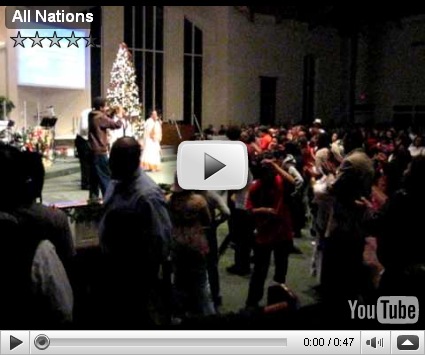
A video from my church’s All Nations Christmas Festival.  This group is from the Eretrean congregation.  It includes their pastor.

That night also included Christmas celebrations from our Spanish, Vietnamese, and Asian Indian congregations, as well as groups that were French African.  That was a great night.

Things Heard: e96v5

  1. Tech-splanations.
  2. Forgotten cities.
  3. Political motion.
  4. A quote … on becoming Orthodox.
  5. Of taxpayers and banks.
  6. Syncretism … religions insanity?
  7. Importing games shows … now from Russia not just the Beeb.
  8. What does “other” mean in that context?
  9. Sun and earth.
  10. Climate and the UK upper house.
  11. Hmm, that seems dated, talk should be replaced with something Obamoid platitude like “engagement.”
  12. Cranky?
  13. Looking for hypocrisy, go no further than Copenhagen?
  14. That doesn’t mesh with the history I’ve read.
  15. Somewhat critical of Mr Obama as orator.

Midterm Exams … on the Old Testament

Well, this class I’m taking has a mid-term exam. Next week I’m going to post my answers … the answers are due at midnight Saturday. We have to answer 2 of the 3 questions.

Question 1:

Write a short (3-5 pp., single spaced) presentation or sermon on the Genesis lection for the feast of the Birth of the Theotokos. Be sure to consult the text of the service in your attempt to understand the relation of the text of this reading to the celebration. You may also wish to draw from the larger context of the book of Genesis in formulating your answer.

The reading is from Genesis:

Now Jacob went out from Beersheba and went toward Haran. So he came to a certain place and stayed there all night, because the sun had set. And he took one of the stones of that place and put it at his head, and he lay down in that place to sleep. Then he dreamed, and behold, a ladder was set up on the earth, and its top reached to heaven; and there the angels of God were ascending and descending on it. And behold, the Lord stood above it and said: “I am the Lord God of Abraham your father and the God of Isaac; the land on which you lie I will give to you and your descendants. “Also your descendants shall be as the dust of the earth; you shall spread abroad to the west and the east, to the north and the south; and in you and in your seed all the families of the earth shall be blessed. “Behold, I am with you and will keep you wherever you go, and will bring you back to this land; for I will not leave you until I have done what I have spoken to you.” Then Jacob awoke from his sleep and said, “Surely the Lord is in this place, and I did not know it.” And he was afraid and said, “How awesome is this place! This is none other than the house of God, and this is the gate of heaven!”

Question 2:

Write a short (3-5 pp., single spaced) presentation or sermon on the Exodus lection for the feast of the Exaltation of the Cross. Be sure to consult the text of the service in your attempt to understand the relation of the text of this reading to the celebration. You may also wish to draw from the larger context of the book of Exodus in formulating your answer.

The reading is from Exodus:

So Moses brought Israel from the Red Sea; then they went out into the Wilderness of Shur. And they went three days in the wilderness and found no water. Now when they came to Marah, they could not drink the waters of Marah, for they were bitter. Therefore the name of it was called Marah. And the people complained against Moses, saying, “What shall we drink?” So he cried out to the Lord, and the Lord showed him a tree. When he cast it into the waters, the waters were made sweet. There He made a statute and an ordinance for them, and there He tested them, and said, “If you diligently heed the voice of the Lord your God and do what is right in His sight, give ear to His commandments and keep all His statutes, I will put none of the diseases on you which I have brought on the Egyptians. For I am the Lord who heals you. Then they came to Elim, where there were twelve wells of water and seventy palm trees; so they camped there by the waters. And they journeyed from Elim, and all the congregation of the children of Israel came to the Wilderness of Sin, which is between Elim and Sinai, on the fifteenth day of the second month after they departed from the land of Egypt.

Question 3:

Write a short (3-5 pp., single spaced) presentation or sermon on the 3 Kingdoms (1 Kings) lection for the feast of the Entry of the Theotokos in the Temple. Be sure to consult the text of the service in your attempt to understand the relation of the text of this reading to the celebration. You may also wish to draw from the larger context of the book of 3 Kingdoms (1 Kings) in formulating your answer.

The reading is from 3 Kings:

And it came to pass when Solomon had finished building the House of the Lord, he assembled all the elders of Israel in Zion, to bring the Ark of the Covenant of the Lord out of the City of David, which is Zion. And the priests took up the Ark of the Covenant of the Lord, the Tabernacle of the Testimony, and all the holy vessels that were in the Tabernacle of the Testimony.

And the King and all Israel went before the Ark. And the priests brought the Ark of the Covenant of the Lord to its place, into the Oracle of the Temple, into the Holy of Holies, under the wings of the cherubim. For the cherubim spread out their wings over the place of the Ark so that the cherubim made a covering above the Ark and its holy things above. There was nothing in the Ark except the two tablets of the Covenant which Moses put there at Horeb, when the Lord had made a Covenant.

And when the priests came out from the holy place, a cloud filled the house. And the priests were unable to stand to minister because of the cloud, for the glory of the Lord God Almighty filled the house.
Things Heard: e96v4

  1. Where or where was the werewolf (in Byzantium!)?
  2. Speaking of Byzantium … a blogger here talking about Christian influence on charity and welfare apparently doesn’t know about (Eastern) Rome and its history.
  3. A talk on the economy and banking.
  4. Contra diversity for diversities sake … followup here.
  5. Broken windows galore.
  6. Esteem and jobs … I wonder how Congressman compares to, say, pimp? … a not unrelated remark here.
  7. Slow recovery.
  8. Putting ice cores in context.
  9. Put some pockets on the back and it would make for better kit than “team Shack”, no?
  10. Heh.
  11. Consciousness considered.
  12. Numbers, polls and healthcare.
  13. A fascinating post on history, empire, and migration.
  14. Hmm.
  15. Looking at porn.

Of the LXX, MT, and Translations

Recently I noted textual differences between the MT and LXX text in Isaiah. One other difference noted in our reading recently was in 1 Chronicles (translated as Supplements in the LXX) 21. From the ESV (a MT based translation):

Now the angel of the Lord had commanded Gad to say to David that David should go up and raise an altar to the Lord on the threshing floor of Ornan the Jebusite. So David went up at Gad’s word, which he had spoken in the name of the Lord. Now Ornan was threshing wheat. He turned and saw the angel, and his four sons who were with him hid themselves. As David came to Ornan, Ornan looked and saw David and went out from the threshing floor and paid homage to David with his face to the ground. And David said to Ornan, “Give me the site of the threshing floor that I may build on it an altar to the Lord—give it to me at its full price—that the plague may be averted from the people.” Lord what is yours, nor offer burnt offerings that cost me nothing.” So David paid Ornan 600 shekels of gold by weight for the site.

From the NETS (a very recent LXX translation), which because of DRM imprinting I cannot excerpt here, but go to this link (pdf) and check out 1 Supplements 21:18-27. In the first Ornan also sees the theophany (angel) that David is witnessing. In the second … he is not.

A second feature found only in the LXX  is the interesting banter/exchange passing between David and Ornan in the purchase of the threshing floor. It seems likely that it was possibly traditional in a certain style of bargaining to offer a price, have the seller insist that he would just give it, and the buyer would then pay full price disregarding the formulaic refusal. However in the LXX this passage is altered. David offers a price (in silver). Ornan refuses. David then insists he will pay in silver (which is according to formula) … and then he pays in gold instead of silver, which contravenes what I perceive as the custom via an extravagant overpayment.

This raises two questions … What do we take as meaning of David’s theophany (David it might be noted had less evident and obvious theophanic experiences than his son Solomon). Is there any change to the story or meaning that you might extract if Ornan and his sons do not witness the angel? Is there a connection to the contravention of custom in the following bargain/purchase exchange?

Climategate vs. E-mail-theft-gate

It’s been interesting to see the diversionary approach, used by some, with regards to the recent news of pilfered e-mails regarding global warming of the doomsday variety research. Regardless of whether or not the e-mail theft was wrong (and, I think theft is wrong), these really are two separate issues. Rather than approach it as an either / or situation, we should address it in a both / and manner.

If there was theft, then those guilty should be prosecuted. If the data reveals inherent falsification of reported values, then it’s probably in our best interest not to spend countless amounts of money on addressing a problem that isn’t there.

Here’s an interesting read on the news at American Thinker (HT: Ron’s Bloviating).

 Page 139 of 245  « First  ... « 137  138  139  140  141 » ...  Last »