
An Uncomprehending Look at the Far Left

Mr Swartz is on the (far) left, which he thinks should be a larger plurality. In this post expressing that sentiment he writes:

It quickly became clear that I was the only person even remotely on the left. And it wasn’t simply that the others disagreed with me; they couldn’t even understand me. I remember us discussing a scene in Invisible Man where a factory worker brags he’s so indispensable that when he was out sick the boss drove to his house and begged him to come back, agreeing to put him in charge. When I suggested Ellison might be implying that labor, not management, ought to run workplaces, the other students (and the teacher) didn’t just disagree—they found the idea incomprehensible. How could you run a factory without managers?

And thereby it becomes clear why the left which Mr Swartz envisions is so small … it’s because the ideas he holds are so, well, wrong in a very obvious way.

Imagine as Mr Swartz suggests a “factory without managers.” How might that proceed. Well, consider that factory entirely consisting of managers. Somebody of course has to procure raw materials … and a good price would be nice. So one or more of the workers, depending on the size of the plant, isn’t on the plant floor, he’s making calls and finding suppliers. Somebody (or more people again depending on the plant size) has to manage the cash-flow: ingoing, outgoing, and arranging for lines of credit. People will have to locate buyers, find markets, locate new ways of the products produced at the factory to be used. Some people will need to tool up for new product, decide “build or buy” on new property for expansion and arrange for the, uhm, capital as is necessary.  Additionally some of those workers will need to arrange for the hiring of new workers, assist during health emergencies, and could even help plan retirement plans. Others will need to do engineering or basic science work to figure out new and better ways to manufacture whatever it is this factory produces. These roles, oddly enough, are indispensable. They all  in fact take quite a bit of hard work. Additionally many of these roles take more expertise and background training than an unskilled labourer requires, which cost that person time and money in order to acquire. A plant manufacturing “stuff” if it is real actually depends on these sorts of services. We have a name for those people in those roles, that name for people watching the supply chain, doing sales, managing capital and doing HR services are what we call management. Oddly enough the idea is in fact incomprehensible. It is in fact impossible to run a factory without managers in a actual real world situation.

So it seems this is the sort of leftist who finds it sad that factories which don’t actually sell their product, acquire raw materials, and so on … are not seen as realistic. Or to put it another way, I find it completely incomprehensible that Mr Swartz figures on running a factory without people performing the jobs and roles noted above. Who will do this? How and why? There must be a standard answer in his repertoire. What might that be?

My commenter JA scoffs at my idea that those the communist sympathizers and the sympathies held by the left in the mid to late 80s didn’t suddenly have an epiphany and decide that everything they believed was wrong. That they instead have softened their rhetoric and acquired camouflage. Part of his difficulty with that sort of notion is that Mr Obama is of this generation and himself being somewhat younger and one of the “non left lefties” that Mr Swartz complains realize that the socialist/communist dreams of the 80s left has not been inherited by the younger left.
Things Heard: e79v4

  1. Well, that setup ain’t for racing, but one can certainly see the appeal, the other could probably climb a tree … and break your legs going downhill.
  2. 2nd quarter shows no support for stimulus benefits.
  3. The sun and climate change, oh my.
  4. Hey, it’s not a ponzi scheme if you’re soaking the taxpayers, just ask Tweed and Tammany.
  5. Some thoughts on income inequality.
  6. Accusations that that opposition to Obamacare is “an insurance company plot” is demonstration that this Administration remains out of touch with reality. So say the cricket races.
  7. Very cute.
  8. A modal argument for the existence of God.
  9. Well, I for one have little but good things to offer from my switch to Linux on my laptop.
  10. 800 died, did you notice? I hadn’t.
  11. The 100 + 1000 + 23 million Mr Clinton missed.
  12. Alexandr.
  13. Some unfunded government insurance liabilities … so says the liberal, “Please, sir may I have another?”
  14. 3 down, 62 to go.
  15. Memory and tribute.
  16. Memory eternal.
  17. I occurred to me while reading this, in the arguments discussed on “harm give birth” I wonder how those arguments transpose to the benefits to suicide? Larry?

A Sixth-Month Assessment

Billy Hollis, writing at the Q&O blog, has a breakdown of Obama’s successes and failures in his first 6 months in office.  He comes away very unimpressed.  No President should be ultimately judged on his first 6 months only, but given how big a bite Obama has taken and the promises he led his supporters to believe, the trend is not looking good for him at all.

If you have said, "Obama is doing a great job", or substituted "good" or even "OK" instead of "great", you owe it to yourself to read this.

ChangeWatch: Immigration

Making promises that pander to a particular voting bloc is one thing.  Sitting in the Oval Office is, apparently, quite another.

After early pledges by President Obama that he would moderate the Bush administration’s tough policy on immigration enforcement, his administration is pursuing an aggressive strategy for an illegal-immigration crackdown that relies significantly on programs started by his predecessor.

A recent blitz of measures has antagonized immigrant groups and many of Mr. Obama’s Hispanic supporters, who have opened a national campaign against them, including small street protests in New York and Los Angeles last week.

The administration recently undertook audits of employee paperwork at hundreds of businesses, expanded a program to verify worker immigration status that has been widely criticized as flawed, bolstered a program of cooperation between federal and local law enforcement agencies, and rejected proposals for legally binding rules governing conditions in immigration detention centers.

“We are expanding enforcement, but I think in the right way,” Janet Napolitano, the homeland security secretary, said in an interview.

Translation: It’s the same policy but we’ve tweaked it just enough to give enough cover to still talk about the eeeevil Bush regime.  But even this has an ulterior motive.

Ms. Napolitano and other administration officials argue that no-nonsense immigration enforcement is necessary to persuade American voters to accept legislation that would give legal status to millions of illegal immigrants, a measure they say Mr. Obama still hopes to advance late this year or early next.

That approach brings Mr. Obama around to the position that his Republican rival, Senator John McCain of Arizona, espoused during last year’s presidential campaign, a stance Mr. Obama rejected then as too hard on Latino and immigrant communities. (Mr. McCain did not respond to requests for comment.) Now the enforcement strategy has opened a political rift with some immigrant advocacy and Hispanic groups whose voters were crucial to the Obama victory.

"Trust me, I’m on your side" is a mantra many have heard from Obama, only to be disappointed.  Ask anyone hoping for fiscal responsibility.

Considering Children

Pseudonymous Larry Niven at Rust Belt Philosophy has a short post in which the “right to avoid life” movement arises. Chantal Delsol points that this and similar movements are consequens of the rejection of taking the as axiomatic the ontological nature of human dignity in The Unlearned Lessons Of the Twentieth Century. I should note that a person “CM” is the author of these arguments and that in my reading of Mr Niven’s piece it is unclear what his stance is on this matter.

A relatively famous document begins:

We hold these truths to be self-evident, that all men are created equal, that they are endowed by their Creator with certain unalienable Rights, that among these are Life, Liberty and the pursuit of Happiness.

Here we find the founders noting that some truths are not ones for which a foundational argument needs to be waged, they are self-evident. That the continuance of the human species is both good and a salutatory (if not to say necessary) attitude for humans to take seems to be another such self-evident statement. If you are a shark or a mosquito one must necessarily as such argue that continued existence of the shark and the mosquito is also good.

Mr Niven for CM offers two arguments against human reproduction, a harm based and a rights based argument. The harm based argument is easily countered. He offers that:

Choosing to reproduce, CM says, is tantamount to “imposing a lifetime’s worth of negative experiences on someone else.” And while one might agree that “everybody has negative experiences,” everybody capable of having negative experiences also has positive experiences: are these, too, “imposed”?

The abortion rights individuals hate the counter to this argument. Merely quiz the living, “Would you have never been born?” and oddly enough nobody whom we would term sane answers in the affirmative to that question. This particular argument is not uncommonly seen in the pro-abortion rhetorical quiver. The “his/her life would be too filled with hardship” and therefore termination is required. Yet oddly enough people with hard lives rarely venture that their lot would have been better in non-existence or death, but that sort of notion only resides with those people whose life has been in the main very soft and full of ease. Furthermore virtually everyone in the pre-industrial age had, by today’s standards, a life far harder than the hard life imagined for the incipient child.

The second argument is as follows:

For CM, no person has “interests prior to existing. Hence, biological children are always used as means to an end,” which, together with “the fact that people are brought into existence without their consent,” consists of a violation of the rights

This has two problems. One is a common rhetorical ploy found in philosophical circles the “if P then Q” where there is no logical connection between the premise and the conclusion. All things are a interest or a means to an end is not true. There are “ends”, which are neither. For a child can be see as in intrinsic good in and of itself. A child is good in an of itself, therefore creation of a new child is abstractly a good which is not a means (but an end). The second problem is in his notion of rights. CM suggests that the lack of consent implies a violation of rights. This might be OK if human beings were created ex nihilo with full faculties at creation, but that is not how it works. We have, well, these constructions known as “children” who are in developmental stages for at least a decade and a half. Consent is not a right children possess naturally because they are not equipped to handle those responsibilities at that time.

Things Heard: e79v3

  1. Post tour flurry, and not even the traditional criterium circuits. Too much?
  2. Climate and flawed science?
  3. Somebody thinks that academia leans right? Hmm.
  4. An unelected official.
  5. Inflation and the debt.
  6. Roaches and riddance.
  7. The long wrong arm of the law.
  8. On Ms Robinson’s commendation and implications of how the White House views the world.
  9. All the news that’s fit to print, fits the agenda at least.
  10. More “for the children” arguments noted.
  11. Replying, it seems to me quite adequately, to Krugman.
  12. Where nature roams (and is written as Nature).
  13. Remember that “open” promise, fuhgetaboutit.
  14. Some quotes.
  15. Left and right, from my view (on the right) I have no clue as to what this is trying to say or imply or what it even means.
  16. Oh, it won’t happen here. Right.
  17. Right to healthcare. Right to jobs. Right to food. Someday someone will point to an exposition from the left what the heck they think rights are.
  18. Well, here’s the healthcare quote which the WH says is out of context but … refuses to provide the larger context to defend it.
  19. About that F-22.
  20. And on the oeuvre of Mr Kolakowski.

"Venting Your Spleen" Not Such a Bad Thing

Just when you think medical science has our bodies pretty much figured out, they get another glimpse at God’s design.

Scientists have discovered that the spleen, long consigned to the B-list of abdominal organs and known as much for its metaphoric as its physiological value, plays a more important role in the body’s defense system than anyone suspected.

Reporting in the current issue of the journal Science, researchers from Massachusetts General Hospital and Harvard Medical School describe studies showing that the spleen is a reservoir for huge numbers of immune cells called monocytes, and that in the event of a serious trauma to the body like a heart attack, gashing wound or microbial invasion, the spleen will disgorge those monocyte multitudes into the bloodstream to tackle the crisis.

“The parallel in military terms is a standing army,” said Matthias Nahrendorf, an author of the report. “You don’t want to have to recruit an entire fighting force from the ground up every time you need it.”

That researchers are only now discovering a major feature of a rather large organ they have been studying for at least 2,000 years demonstrates yet again that there is nothing so foreign as the place we call home.

It’s not like the ol’ spleen has been hiding away somewhere.  We’ve been keeping an eye on it for quite some time.

That researchers are only now discovering a major feature of a rather large organ they have been studying for at least 2,000 years demonstrates yet again that there is nothing so foreign as the place we call home.

“Often, if you come across something in the body that seems like a big deal, you think, ‘Why didn’t anybody check this before?’ ” Dr. Nahrendorf said. “But the more you learn, the more you realize that we’re just scratching on the surface of life. We don’t know the whole story about anything.”

Indeed we don’t.

Things Heard: e79v2

  1. For a light-hearted start.
  2. A cyclist unimpressed by the cash-for-clunkers program.
  3. Mr Sensing parses some numbers related to the above program and is unimpressed.
  4. A little zooom.
  5. An example of some of the better climate discussions to be found. Oh, and some Arctic sea ice data.
  6. Some truth hidden in that satire.
  7. Yahoo bites it.
  8. Jefferson on national debt.
  9. Mr Obama disagrees with himself.
  10. A TV series recommended. Perhaps a good choice for winter basement riding?
  11. Dragons and witches, oh my!
  12. Birther stuff keeps coming up, examples here, here (heh), and here.
  13. Reflections on marriage.
  14. Doping control and the (dehydrated) cyclist.
  15. How about they pass a law and exile any politician who utters the phrase (and variations), “It’s for the children.”
  16. Of theology (specifically Calvin’s) and politics in the US.
  17. Well, that’s exactly what our robust economy needs, a new tax. Duh.

Bringing Water To The Desert

A more liberal church, led around by a more liberal culture, soon became no church at all.  But that’s changing.

North Bennington, VT. – After three decades as a home to pigeons rather than parishioners, a 175-year-old stone church with Presbyterian roots is once again filled with song on a warm Sunday morning. This time around, however, the brand of faith carries a new tune, one that would be more familiar in Mississippi than Vermont.

Hallelujah religion is a-rising in Yankee country. As liberal congregations die in a secularizing region, conservative churches with roots outside New England are replacing them with a passionate brand of faith that emphasizes saving souls – even in a land where many think there’s nothing to be saved from.

A Christian Science Monitor article entitles "Evangelicals March North" details how conservative evangelicals from the south are filling in the gaps.  They’re doing this by doing what churches should do best; ministering to the community.

"Vermonters aren’t interested in a pie-in-the-sky, ‘I’m better than you’ kind of faith," says Terry Dorsett, the Southern Baptist Convention’s director of missions for Vermont. "But a roll-up-the-sleeves-and-help-my-community kind of faith? There are a lot of Vermonters interested in that."

New churches are building good- will by addressing needs outside their doors. Example: Last summer, during renovations of what is now Mettowee Valley Church in West Pawlet, Vt., locals joined with teams from North Carolina to rebuild an elderly neighbor’s collapsing porch. In Barre, Vt., members of five-year-old Faith Community Church regularly serve at the Open Door Soup Kitchen.

These are individuals, not inefficient government programs, going out and helping those in need.  And it’s working. 

In eight years, the Southern Baptist Convention (SBC) has more than doubled its Vermont church count, from 17 to 37.

Let’s pray it continues.

Things Heard: e79v1

  1. A film noted.
  2. Obama … the first six months, inexperienced? Hmm.
  3. Russian-US relations and trying to parse what Obama means by “a reset”.
  4. Cash for clunkers.
  5. Of skill and games.
  6. Life and the administration.
  7. Consequences of Mr Obama’s Israeli rhetoric? Different airplane sales noise here.
  8. A race report.
  9. Gates, Sotomayor and race.
  10. I think the whole “solving things” is the main reason that Keynesian interventionist economic theory is predominant in politically connected circles.
  11. A death noted.
  12. Ms Pelosi makes it clear, whatever the Democrats rhetoric on private medical insurance … they want it dead.
  13. On death.
  14. Heh.
  15. An interesting question for the liberal comic book reader.

On Foreign Affairs

Foreign policy in some measure is a game of judgement of the intentions of a foreign power. It does not do to assume that the other power is working toward similar goals as yours, even with the goalposts reversed. There is an additional problem, judging the other power takes time, attention, and care.

Coal miners in past centuries (and perhaps still) kept canaries in mines in cages. The reason for this is that during the mining process if the air supply was fouled or contaminated the canaries, being smaller and weaker than the miners would collapse or even die before the miners might notice. This would serve as a early warning.

There is in fact a similar situation in foreign policy. Russia, China, and other Middle Eastern countries are culturally very different from American and much of the West. It might be reasonably said that nobody outside of those countries really understand the day to day policy decisions, personalities, and events in those countries and the implications for foreign nations. Few pay attention to even the broad events and those actions must then be interpreted through the distortion of cultural division. We in the US for example have a hard enough time understanding the decisions and actions of those on the other side of a much smaller political divide between right and left not to speak of the far wider gulf of seeing events in their correct context where language, history and culture divide us.

Yet, canaries exist. Take Russia for example. The intentions and seriousness of Russian actions and motives might be best judged by reading commentary small states on her border such as the Baltic states&nbsp;&nbsp; … the smaller the state the better. Reading commentary and essays from those places is a better place to look than discussions or remarks about the same from any expert Western sources. Find a weak neighbor, a neighbor with the most to lose and there you fill find the most attentive watchers. And of course, like the Sudentdland of Hitler’s pre-WWII aggression, if the canary <i>dies</i> … then protestations of innocence on the part of the foreign power might be judged to be fallacious.

And yes, this is something that undoubtedly experts do right now. Yet, trusting the experts here is again a problem. They are themselves biased and have their own agendas. Canary watching however is something that ordinary people can do in this information age we live in. I blog. So, as an experiment I’m going to see if that particular medium is approachable to this sort of exercise. To whit, as an exercise, I’m going to try following through. In this exercise, the assumption is that reading and reviewing foreign blogs or smaller news sources with the canary model in mind is a better way of judging foreign intentions than by reading local expert opinion. In addition,&nbsp; the canary in the mineshaft model might also be an interesting way to judge one’s own country and how it is perceived&nbsp; from the other side. So … the next week’s I’m going to try adding a lot more foreign blogs to my reader list … which will likely ultimately be reflected in my weekday links posts.

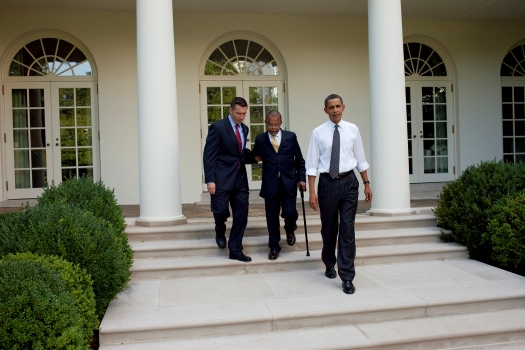
A tale of two Presidents

Interesting, to compare these two photos, one of President Obama, and the other of President Bush.

Further commentary at American Thinker (HT: Ron’s Bloviating),

I am stunned that the official White House Blog published this picture and that it is in the public domain. The body language is most revealing.

Sergeant Crowley, the sole class act in this trio, helps the handicapped Professor Gates down the stairs, while Barack Obama, heedless of the infirmities of his friend and fellow victim of self-defined racial profiling, strides ahead on his own. So who is compassionate? And who is so self-involved and arrogant that he is oblivious?

In my own dealings with the wealthy and powerful, I have always found that the way to quickly capture the moral essence of a person is to watch how they treat those who are less powerful. Do they understand that the others are also human beings with feelings? Especially when they think nobody is looking.

The 1% and the 95%

In the late 1980s, the top 1% of taxpayers — the richest 1% of the country — paid 25% of the total income taxes paid.  This seems reasonable, as those folks make a lot more money than, say, the bottom 95%.  In fact, in the 80s, the bottom 95% paid about 55% of the total taxes. 

But things have changed quite a bit.

The Club for Growth is noting that IRS tax information just released information that the top 1% is now paying more total taxes than all of the bottom 95%, if you can believe that.  CFG highlights a graph of the data to show the continuous track we’ve taken to soak the rich.  Their observation:

This begs the question: At what higher rate do liberals want to tax "the rich" in order to make the tax code, in their eyes, more fair?

Indeed, liberals won’t define the term "fair tax code", other than to say that it’s taking more from the rich than they’re taking now. 

Bruce McQuain over at Q&O, in addition to wondering about the definition of "fair", also wonders about the Left’s definition of "greed".  Who, one might ask, is more greedy than the person who want to pay less and less for more and more government services paid for by other people?  And ye we hear from them cries of "greedy Wall Street" and "greedy corporations".  Pot, meet kettle.  Kettle, this is pot.

I also think it begs another question: How much money does the Left think it can suck out of the rich for things like universal health care?  Are they but a money tree, ripe for the picking?

Things Heard: e78v5

  1. Well, if I had big bags of money lying around this would be very very tempting.
  2. Watching the tyrants … who try the delay gambit.
  3. Action and consequence, well admittedly consequence in this case is just a cricket race.
  4. 100 killed, good bad or indifferent?
  5. Training goes on in Iraq.
  6. What passes for hospitality.
  7. By that theory, Luke killed Paul.
  8. Canada where the liberals have sway … and what passes for judgement (HT: First Things).
  9. Life is not about ….
  10. Reflections on creation.
  11. On technology and church Mr Anderson asks, “Fundamentally, there is no reason why any local church should continue to listen to Pastor Bob drone on and on when they can get the video of John Piper instead.  What’s more, why simply have John Piper when you can alternate with Mark Driscoll?” Why not throw in Athanasius, Chrysostom, Augustine, et al.?
  12. Well, at least it isn’t on the right side of the aisle. The other side has a more complicated relationship with that notion.
  13. Tactics on the left.
  14. Very cool artwork.

Obamacare and The End of Life

Buried deep within the 1000+ page healthcare bill is a confusing and vague provision that mandates “advanced care planning consultations” for Medicare recipients. What exactly is intended by these consultations is open to interpretation.

The provision originated from an earlier bill
that was designed to encourage patients to consider hospice and pallative care as they near the end of their lives. But make no mistake, this is also about money. According to one estimate, Medicare spends $100 billion a year for care of patients in their last year of life.

Many critics are rightly concerned that the government will be dictating to patients what care they can and can’t receive. The Bioethics Defense Fund is going so far to suggest that this provision is government endorsement of euthanasia.

As a matter of fact, such arguments about the cost of caring for the eldery and infirm as an endorsement for euthanasia has been tried before:

This poster appeared in Nazi Germany during the 1930’s. The message reads: “60,000 Reich Marks. This is what this person suffering from hereditary defects costs the Community of Germans during his lifetime. Fellow Citizen, that is your money, too.”

The arguments being made for mandatory “advanced care planning consultations” seemed to be eerily similar to the poster above. Critics of the President’s health care plan have very legitimate reasons to be worried about what this provision means. Voters should be concerned also.

 Page 158 of 245  « First  ... « 156  157  158  159  160 » ...  Last »