By Contributor Archives

Sophmoric Homiletics: Tolerance (pre-draft)

When I asked Father Andrew (the priest of my parish) for suggestions for a homily or short talk on the New Testament he suggested talk on the theme of tolerance, which was a theme for articles in this months parish newsletter. For myself the following came to mind. (John 8)

Early in the morning he came again to the temple. All the people came to him, and he sat down and taught them. The scribes and the Pharisees brought a woman who had been caught in adultery, and placing her in the midst they said to him, “Teacher, this woman has been caught in the act of adultery. Now in the Law Moses commanded us to stone such women. So what do you say?”  This they said to test him, that they might have some charge to bring against him. Jesus bent down and wrote with his finger on the ground.  And as they continued to ask him, he stood up and said to them, “Let him who is without sin among you be the first to throw a stone at her.” And once more he bent down and wrote on the ground.  But when they heard it, they went away one by one, beginning with the older ones, and Jesus was left alone with the woman standing before him. Jesus stood up and said to her, “Woman, where are they? Has no one condemned you?” She said, “No one, Lord.” And Jesus said, “Neither do I condemn you; go, and from now on sin no more.”

A suggestion at Evangel as well was from Romans 14:

Who are you to pass judgment on the servant of another? It is before his own master that he stands or falls. And he will be upheld, for the Lord is able to make him stand.One person esteems one day as better than another, while another esteems all days alike. Each one should be fully convinced in his own mind. The one who observes the day, observes it in honor of the Lord. The one who eats, eats in honor of the Lord, since she gives thanks to God, while the one who abstains, abstains in honor of the Lord and gives thanks to God. For none of us lives to himself, and none of us dies to himself. For if we live, we live to the Lord, and if we die, we die to the Lord. So then, whether we live or whether we die, we are the Lord’s. For to this end Christ died and lived again, that he might be Lord both of the dead and of the living.

Others suggested Revelations 2, Romans 12: 17-21, and Mark 2:15-17 as well a general reference to Jesus commandment that we love each other.

As is often the case, I before I begin a draft … out comes the dread bullet list. Read the rest of this entry

Friday Link Wrap-up

Isn’t government supposed to enforce the laws it makes?   Well, it looks like the Obama administration has a bit more leeway.

How’s that Gitmo-closing promise coming along, 5 months after its due date?  “The House Armed Services Committee has dealt a blow to President Obama’s hopes to shutter the military prison at Guantánamo Bay, Cuba, by unanimously approving legislation that would prohibit creating a detention center inside the United States.”  Aren’t there one or two Democrats on that committee?

The Hollywood Left just loves their socialists.

American filmmaker Oliver Stone said Friday he deeply admires Hugo Chavez but suggested the Venezuelan president might consider talking a bit less on television.

Promoting his new documentary “South of the Border” in Caracas, Stone heaped praise on Chavez, saying he is leading a movement for “social transformation” in Latin American. The film features informal interviews by Stone with Chavez and six allied leftist presidents, from Bolivia’s Evo Morales to Cuba’s Raul Castro.

“I admire Hugo. I like him very much as a person. I can say one thing. … He shouldn’t be on television all the time,” Stone said at a news conference. “As a director I say you don’t want to be overpowering. And I think he is sometimes that way.”

(We’re not entirely sure whether Stone said “director” or “dictator” at th end there.  Either can be overpowering.)

When the director of the Congressional Budget Office directly refutes cost-saving claims of the President and his Budget Director, it’s worth noting.  Even the NY Times (finally) notices.

How’s that “smart diplomacy” workin’ for ya’?  Please remember; speeches are no substitute for sound policy.

Marry a Jew, lose your citizenship.  Can armbands with the Star of David be far behind?  Tell me again, who are the bad guys in the Middle East peace situation?

How did the pollsters do predicting the recent primary results?  About as good as expected, which isn’t saying much.  And the Daily Kos fired its official pollster, Research 2000.  Turns out they skewed left.  Now who would have thought that?  This time, however, it was downright embarrassing.

And finally, Chuck Asay on life, liberty, and the pursuit of happiness.  (Click for a larger image.)

Chuck Asay

Things Heard: e122v5

Good morning.

  1. A story of justice.
  2. This is not unrelated.
  3. Of Jews and genes.
  4. Drilling and scale.
  5. Perhaps a progressive defender of the President will explain how putting criminal charges (?) and fines on BP will help fix the problem faster (and not slower).
  6. In which diversity means nothing.
  7. Helen and Rod.
  8. Summer is on its way.
  9. Girls will be girls.
  10. Faster than a bear.
  11. Uhm, many (if not most) occupations require the acquisition and refinement of specialised skills
  12. A point of agreement with Mr Obama discovered.
  13. Those Iraqi WMD.
  14. Against the Obama’s Katrina meme.

The Iraqi WMD Question

The question of where Saddam Hussein’s WMDs went that the whole world believed were there has been knocked around since at least 2004, with the most popular answer being Syria.  There was some evidence of it, that the MSM cheerfully ignored, but it’s back in the news today because President Obama’s pick for replacement of the Director of National Intelligence believes this is true

Ryan Mauro of Pajamas Media has an article today about new satellite imagery that is lending new credence to this thought.  Worth a read.

Things Heard: e122v4

Top of the morning (and especially to the Blackhawk fans in the crowd).

  1. Of love and war.
  2. A Saint noted.
  3. And then came the hound.
  4. Such is Life  … get used to it.
  5. Central Europe.
  6. Yah think?
  7. Reuters remains … the question is why do they still have a market?
  8. Form and function.
  9. Bulbs.
  10. Eugenics? Bookstores? Seriously?
  11. A troubling parallel. Seriously, why the heck would we have refused any sort of assistance?
  12. On the alien thing.
  13. Middle east kabuki.
  14. The putative reset and questions thereof.

50 leaders of the evangelical generation: #31 Beverly LaHaye. Concerned woman

[I am working on a project that may become a book on the most influential evangelicals leaders of our generation, since 1976, and the impact they’ve had on the church and their times. I will introduce them briefly on this blog from time to time. Who should be on this list?]

#31  J. Beverly LaHaye. Concerned woman  b.1929 

It might be said that Beverly LaHaye was present at the birth of the religious right, starting Concerned Women for America in 1979, the same year as Jerry Falwell launched the Moral Majority. She has been one of many people who have made it their vocation to provide a conservative Christian perspective on the issues of each day and to lobby for policies acceptable to Christians of the political right. 

 Although she began CWA to counter the National Organization for Women, the organization has become one of several Christian conservative groups that are, in many ways, interchangeable in their activities to counter abortion, gay rights, and liberal thought and action. In that sense, LaHaye represents many conservative activists like her, such as Gary Bauer, Tony Perkins, Donald Wildmon, and Janet Parshall. She is the senior member of this group. 

 LaHaye was one of few women to emerge as public figures in the evangelical movement in this generation, although her prominence may be seen as a half-step in this regard because she emerged as part of a tandem with her husband Tim LaHaye, right-wing activist, then best-selling co-author of the phenomenally best-selling Left Behind book series.

LaHaye started the Beverly LaHaye Live daily radio program in 1988 “to influence women and men to take political action, build strong families and take leadership in their communities.” The program was awarded the National Religious Broadcasters’ “Talk Show of the Year Award” in 1993 and was on the ari until 2004.

”Christianity Today wrote in 1997: “LaHaye spent the early years of her 50-year marriage raising four children and supporting her husband. While very much a traditional woman in one sense, Beverly LaHaye now heads the largest politically active women’s organization in the country. LaHaye said her radio show ‘combats the fiery darts of immorality, the entertainment industry, and school curriculums.’”[1]

LaHaye’s legacy, like those who have shared the same mission and methodology, is hotly debated, not only on ideological grounds, but also in terms of the effectiveness of the frontal attacks on dreadful policies such as legalized abortion, and the ensuing harsh and hateful image that has been successfully cast by their opponents of these conservative Christians. Although one can question the efficacy of pastors and Christian leaders who turned from other areas of work to the political fight, there clearly needed to be a group of professionals who stood up for Christian values in the public realm, and did so as their day job. Beverly LaHaye took up the fight as a second career, after raising her kids, and she has spent her later years as one of the early and few women in the indelicate role as an evangelical storm trooper in the Washington.

LaHaye has been frequently recognized for her leadership in the political and Christian community. In 1984, she was named “Christian Woman of the Year.” In 1988, she was named “Church Woman of the Year.” In 1991, she received the Southern Baptist Convention’s “Religious Freedom Award.” The Values Action Team of the U.S. House of Representatives honored her in 1994 for her service to the country. In 1992, Liberty University awarded her an Honorary Doctorate of Humanities for her lifetime achievement in protecting the rights of the family. LaHaye currently serves on the boards of Liberty University, Childcare International, and the International Right to Life Federation. She and Tim LaHaye have four adult children, nine grandchildren and seven great grandchildren. They live in Southern California.


[1] http://www.christianitytoday.com/ct/1997/march3/7t3066.html?start=2

Things Heard: e122v3

Good morning, oh, and go Hawks!

  1. More on Ms Thomas (HT: HNN)
  2. A film noted.
  3. Considering new drug developments.
  4. Just a little off the deep end.
  5. Tyranny.
  6. Working towards the world’s dumbest fathers day gift. Try REI, Midway, or you know … something fun or interesting.
  7. Kiev in pictures.
  8. Hope for our political future and a turning back of the tide.
  9. The next big bubble and a look at real education.
  10. Remarks for Mr Singer.

50 leaders of the evangelical generation: #38 Doug Coe. Stealth networker.

[I am working on a project that may become a book on the most influential evangelicals leaders of our generation, since 1976, and the impact they’ve had on the church and their times. I will introduce them briefly on this blog from time to time. Who should be on this list?]

#38  Doug Coe. Stealth Networker  b.1928 
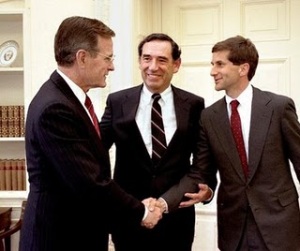
Doug Coe, center, introduces the president to a friend


 It is hilarious to read about attempts to weave a master plan by Christians to take over the government or create a shadow group to corner some part of the culture. It is clear that anyone who attempts this has very little experience within the Christian sub-culture. Religious groups have a difficult time agreeing on much of anything, and there are many jokes about how “if you have three Baptists (or fill in your denomination) in a room, there are four opinions.” 

Yet many have tried to find some nefarious motivation in the work of Doug Coe and his network, known by most as The Fellowship. Coe is perhaps the most effective networker in the evangelical world and he is likely the most invisible leader of a major Christian outreach. It is the secretive and silent nature of Coe and The Fellowship that has made them the target for conspiracy theories. Coe is reluctant to do public speaking, and he routinely denies requests for interviews and speeches to large audiences. Muckraking journalists have attempted to fill in the blanks left by Coe’s silence.

 Many praise the low-visibility approach. “It is a virtue to try to be anonymous in a town where self-promotion is so often the modus operandi of many who come to work among the powerful,” said Michael Cromartie, vice president of the Ethics and Public Policy Center.[1]

 The Fellowship’s most visible program (although you’ll never see Coe on the stage or hear the organization make a pitch) is the annual National Prayer Breakfast the first week in February in Washington, D.C. This event, which the President always attends, is officially conducted by the House and Senate prayer groups; but The Fellowship is the group that makes it happen each year. 

 Although Coe is revered by evangelicals for creating places and relationships around Christian faith, The Fellowship is not a place of theological purity and the spiritual content is frequently superficial. Theological specificity is sacrificed in the interest of pulling leaders in the U.S. and around the world into relationships based on Christianity.    

 Nonetheless, Coe has had an enormous impact on evangelical outreach among the most powerful people in the world, and on maintaining at least the vestiges of Christian protocol in the Nation’s Capital through the Prayer Breakfast and related groups. In a survey of 300 top evangelical politicians, one third told author D. Michael Lindsay that the Fellowship was one of the most influential Christian groups in Washington, more than any other group.  According to Lindsay, “there is no other organization like the Fellowship, especially among religious groups, in terms of its access or clout among the country’s leadership.”[2]

The extent of Coe’s influence in American politics is a subject of debate. Important figures have acknowledged his role on the national and international stage. Speaking at the 1990 National Prayer Breakfast, President George H.W. Bush praised Coe for his “quiet diplomacy, I wouldn’t say secret diplomacy”.[3] Coe was a behind-the-scenes spiritual mentor at the Camp David Accords in 1978, working with President Jimmy Carter to issue a worldwide call to prayer with Israeli Prime Minister Menachem Begin and Egyptian President Anwar Sadat.

One of Coe’s most publicized relationships is with Chuck Colson, founder of Prison Fellowship Ministries. Colson has described the key role the Fellowship and Doug Coe played in his conversion in his 1976 book Born Again (that’s why the word Fellowship is in the Prison Fellowship name).  Colson praises Coe’s work in his life as a young Christian, but he has been quietly critical of the lack of orthodoxy in the teaching and discipling work of The Fellowship. Colson has said he also has concerns about politicians using Fellowship events and relationships as a replacement for church. “A leading figure ought to belong to a church,” Colson said.[4]

However, despite significant efforts, no one has been able to find anything but the highest motives in Coe’s work. As former U.S. Senate Chaplain Richard Halverson put it in the eighties, Coe “became the godfather; but for good, not for bad.  He became the mentor of dozens of seekers of Christ who came, like Nicodemas came to Jesus quietly by night, to ask Faith questions.” [5]

A native of Oregon and a product of Young Life and The Navigators, Doug Coe was schooled in Bible memorization and study, mentoring, and discipling by Lorne Sanny and Jim Rayburn. He was also mentored for a time by a young Billy Graham.  In 1958, Coe was employed by Abraham Vereide at the International Christian Leadership, the parent of what has become known as The Fellowship.


[1] http://www.worldmag.com/articles/15778


[2] Lindsay, D. Michael. Evangelicals in the Halls of Power.

[3] Sharlet, Jeff (2008). The Family: Secret Fundamentalism at the Heart of American Power. Harper-Collins.

[4] http://www.worldmag.com/articles/15778

[5] http://www.worldmag.com/articles/15778

Things Heard: e122v2

Good morning.

  1. The recession.
  2. All that healthcare … will not help much it seems.
  3. Mr Obama’s crystal ball.
  4. And this is not unrelated.
  5. As Mr Obama and industrial backers make post legislation push to fix the opinion on his healthcare legislation … one wonders whether how the cognitive dissonance between that motion and his statements regarding corporate speech is resolved seeing as it seems that this sort of law doesn’t apply to messages with which he approves. 
  6. Considering marriage.
  7. A parable and one of the cultural chasms. 
  8. A (likely) much discussed study for today.
  9. On Ms Thomas, here and here.
  10. Wal-Mart and the unions.
  11. Hypocrisy in high office, not just a common practice for our Congress critters and the likes of Mr Obama.

Flotilla-palooza

Apparently, this story has legs like I never would have imagined.  Even after video comes out showing that the "peace" activists were armed with, among other things, knives, you’d think that folks would see through this little charade. 

Anyway, here are some relevant links from the past few days.

In preparation for sailing, a few harmless Jihad chants and hopes for martyrdom.  Then, after cheerfully ignoring warnings about the blockade, preparing for violent confrontation.  (The very first link also has a video of the attacks on the soldiers.)  The reason that the IDF soldiers were taken advantage of initially, I believe, is that they didn’t think "peace" activists would try to stab them to death. 

There are some photos, taken by the activists terrorists themselves showing downed IDF soldiers.  Reuters, in two different cases, decided that they should crop out the part of the picture that shows knives in the hands of those peaceful protestors.  Ruins the narrative.

Is the blockade against Gaza legal?  Why yes, yes it is.  And if you have more questions about the blockade in general or the flotilla in particular, this is a great resource.

Who Flunked Economics 101?

It turns out that how well you know your basic economics principles correlates pretty closely with your spot on the political spectrum.

Who is better informed about the policy choices facing the country—liberals, conservatives or libertarians? According to a Zogby International survey that I write about in the May issue of Econ Journal Watch, the answer is unequivocal: The left flunks Econ 101.

Zogby researcher Zeljka Buturovic and I considered the 4,835 respondents’ (all American adults) answers to eight survey questions about basic economics. We also asked the respondents about their political leanings: progressive/very liberal; liberal; moderate; conservative; very conservative; and libertarian.

They describe the specific questions as well as their methodology, which breaks things down by incorrect answers, and where "not sure" doesn’t count against you.  I can see one of the questions that I might disagree with what they considered the correct answer, but you had to be positively wrong (so to speak), not just unsure, to get marked off.  The results?

How did the six ideological groups do overall? Here they are, best to worst, with an average number of incorrect responses from 0 to 8: Very conservative, 1.30; Libertarian, 1.38; Conservative, 1.67; Moderate, 3.67; Liberal, 4.69; Progressive/very liberal, 5.26.

Ronald Reagan said, "The trouble with our liberal friends is not that they are ignorant, but that they know so much that isn’t so."  This shows how remarkably true that is. 

Stereotypes Last Only As Long As You Let Them

This woman and Penn Jillette might have a lot in common to talk about regarding how the Religious Right have been portrayed in our culture.

[Eve] Tushnet entered Yale in 1996 a happy lesbian, out since age 13 or 14 (she can’t quite remember). Her father, a nonobservant Jew, and her mother, a Unitarian, both belonged to progressive traditions, tolerant of her sexuality.

When, as a freshman, she attended a meeting of the Party of the Right, a conservative group affiliated with the Yale Political Union, it was “specifically to laugh at them, to see the zoo animals,” she says.

“But I was really impressed, not only by the weird arguments but the degree to which it was clear that the people making them lived as if what they were saying had actual consequences for their lives, that had required them to make sacrifices.”

In Ms. Tushnet’s time, as in mine — I was four years ahead of her at Yale — the Party of the Right had a benignantly cultish quality. “Have you read ‘The Secret History?’ ” she asks, referring to Donna Tartt’s 1992 novel about a secretive student clique obsessed with Greek literature. “It was like that.”

But she listened to them, sincerely, and came out with a far, far different view of them than the culture had led her to believe.

But she found the Party of the Right students compassionate, intellectual and not terribly exercised about her homosexuality. She was drawn to the Catholics among them, who corrected her misimpression that the existence of sin “means you are bad.” It means “precisely the opposite,” they taught her. “It means you have a chance to come back and repent and be saved,” she says. She began reading books like St. Anselm’s “Why God Became Man.” She began attending church. Her sophomore year, she was baptized.

“By the time it was real enough to be threatening,” she says of her conversion, “things had gone too far. I didn’t see it coming.”

So now she’s a fervent Catholic and against same-sex marriage, but isn’t trying to change her religion to fit her notions of right and wrong.  She really believes in it, and understands what that means for her life.

As the hundred or so daily readers of eve-tushnet.blogspot.com, and a larger audience for her magazine writing, know by now, Ms. Tushnet can seem a paradox: fervently Catholic, proudly gay, happily celibate. She does not see herself as disordered; she does not struggle to be straight, but she insists that her religion forbids her a sex life.

“The sacrifices you want to make aren’t always the only sacrifices God wants,” Ms. Tushnet wrote in a 2007 essay for Commonweal. While gay sex should not be criminalized, she said, gay men and lesbians should abstain. They might instead have passionate friendships, or sublimate their urges into other pursuits. “It turns out I happen to be very good at sublimating,” she says, while acknowledging that that is a lot to ask of others.

Marriage should be reserved for heterosexuals, whose “relationships can be either uniquely dangerous or uniquely fruitful,” she explained in an e-mail message. “Thus it makes sense to have an institution dedicated to structuring and channeling them.”

She has her problems with the ex-gay movement (see here for her very thoughtful NRO piece on the topic), but does understand what the Church teaches on the subject and, rather than practice the a la carte version of Christianity some do, she’s taken Jesus’ advice to count the cost, and decided to apply the teachings rather than ignore that which she holds true.  That’s dedication and commitment.

But she got there by actually listening and giving a fair hearing to what others considered religious nuts.  Don’t believe the press.  Well, in general, but specifically about the Religious Right(tm).  Find out for yourself.

Things Heard: e122v1

Good morning.

  1. Natural gas in Israel?
  2. Death of a poet.
  3. That statute is in the US
  4. Meta-linking and the high court.
  5. Asia and the NSS … and not even getting to the dog barking in the night, i.e., any mention at all of Taiwan is conspicuously absent.
  6. Uhm, sorry. That picture is now presently popular in China … as a symbol of government restraint.
  7. A new econ blogger noted (here).
  8. A great film-maker
  9. Turkey.
  10. Talking SSM, here and here.
  11. Eucharist.

Rusty Nails (SCO v. 2)

80 year-old man, with a gun, vs. an armed home invader: home invader loses. This happened in Chicago, where the current law forbids the ownership of pre-ban handguns. Do you think the intruder’s gun was registered?

###

Hiker, with a gun, vs. an unarmed grizzly bear: grizzly bear loses. However, this hiker was armed with a .45 caliber semiautomatic pistol… not the best choice if one happens to run into a grizzly bear. This hiker was very lucky.

###

Forget about the color of Obama’s skin… is it really that thin?

Barack Obama — a man who was as unprepared to be president as any man in our lifetime — has over the last 16 months shown that he is overmatched by events. His poll numbers continue to drop, his health care proposal is becoming less rather than more popular, the oil spill in the Gulf is badly eroding his image for leadership and competence, and his party has been battered in election after election since November. We have now reached the point where Democrats are running against Obama and his agenda in order to survive (witness Mark Critz in Pennsylvania).

50 leaders of the evangelical generation: #20 Al Mohler. Denominational whip.

 [I am working on a project that may become a book on the most influential evangelicals leaders of our generation, since 1976, and the impact they’ve had on the church and their times. I will introduce them briefly on this blog from time to time. Who should be on this list?]

#20 R. Albert Mohler, Jr. Denominational whip  b.1959 

Because it is the largest Protestant denomination in the world, actions by the Southern Baptist Convention (SBC) attract significant attention, and few people interested in matters of faith are neutral in their opinions of the SBC. With the current position of the SBC as a solidly conservative bastion within evangelicalism, it requires a 20-year journey to the early 1990’s to observe an interdenominational fight that almost thoroughly ousted leaders of the SBC who had begun to toy with more liberal theological positions.  Through the election of conservatives at the national level, Southern Baptists initiated a process to return the denomination to traditional teachings

 In that war for orthodoxy, R. Albert Mohler became a five-star general, leading first a cleansing of Southern Baptist Theological Seminary in Louisville, where he became president in 1993, and then joining like-minded conservatives to realign the denomination as a whole. Paige Patterson, former SBC president and also a seminary president, said that Mohler’s presidency at Southern—the denomination’s flagship institution—corrected theological leanings in the SBC. “Al Mohler has the brains of Erasmus and the courage of Luther,” Patterson said at the time.

Shortly after his term as president began, Mohler drafted a policy (which was ratified by the trustees) that the Seminary would only hire professors who agreed to sign an Abstract of (theological) Principles (many professors had moved away from the tradition of Biblical inerrancy). Those who refused to sign were dismissed or resigned, which was approximately 75 percent of the faculty. During the two-year period after this policy was implemented, more than 50 percent of the student body transferred out of Southern Seminary to other academic institutions.

The fall-off in enrollment was short-lived and by 2006 Southern Seminary saw the largest enrollment in its history, and the institution is now one of the most endowed and largest seminaries in the world.

Mohler was also instrumental in the mid-1990s restructuring of the Southern Baptist Convention, which saw an increase in the influence of conservatives. After the restructuring had occurred, Mohler and others sought to enforce these doctrinal changes through the adoption of a revised Baptist Faith and Message in 2000.

Today, Mohler– who Time magazine called the “reigning intellectual of the evangelical movement in the U.S.”.[1]—has the most powerful religious blog in the country, and he has a popular daily radio program syndicated by Salem Radio Network.

Mohler is in the middle of what may be his next theological battle: Southern seminary has become a Reformed hotbed, part of a trend in many of the leading evangelical seminaries. This surge of Reformed theology has divided Southern Baptist churches and raised questions about the doctrinal direction of the denomination. A LifeWay Research study released in 2009 reported about 10 percent of Southern Baptist pastors identified themselves as Calvinist, but that number is increasing. Twenty-nine percent of recent SBC seminary graduates espoused Calvinist doctrine.[2]

 Mohler writes, “Calvinism was the mainstream tradition in the Southern Baptist Convention until the turn of the century. The rise of modern notions of individual liberty and the general spirit of the age have led to an accommodation of historic doctrines in some circles.”[3]

With the majority of Southern Baptist pastors preaching Arminianism and the seminaries becoming more Reformed, it’s too early to tell who is going to prevail in this doctrinal split. But if Southern Baptists allowed any kind of gambling, the good money would be on Al Mohler’s team. 

Al Mohler  is a native of Lakeland, Florida. He attended received a B. A. from Samford University, a Baptist college in Birmingham, Alabama. His graduate degrees, a Master of Divinity and Ph.D. in “Systematic and Historical Theology,” were conferred by Southern Seminary.

In addition to his position as president, Mohler also serves as Professor of Christian Theology at Southern. His writings have been published throughout the United States and Europe. He has contributed to several books including Hell Under Fire: Modern Scholarship Reinvents Eternal Punishment, Here We Stand: A Call From Confessing Evangelicals and The Coming Evangelical Crisis. He served as General Editor of The Gods of the Age or the God of the Ages: Essays by Carl F. H. Henry and served from 1985 to 1993 as Associate Editor of Preaching, a journal for evangelical preachers. He currently serves as Editor-in-Chief of The Southern Baptist Journal of Theology.


[1][1] http://www.time.com/time/world/article/0,8599,443800,00.html


 [2] http://www.bpnews.net/bpnews.asp?id=27181&ref=BPNews-RSSFeed0111

[3] http://reformedbaptistfellowship.wordpress.com/2009/03/23/southern-baptists-and-calvinists-a-response-to-elmer-towns-part-1/

 Page 113 of 241  « First  ... « 111  112  113  114  115 » ...  Last »