By Contributor Archives

On Memorial Day

It’s Memorial Day. Keep in mind that, while we certainly should honor our veterans, Memorial Day is the day we remember those who have died in service to our country.

Whatever your choice of activities for today, whether it be picnic, barbecue, parade, beach, lake, or all of the above, take the time to remember those who, by virtue of their sacrifice, are unable to partake in today’s festivities. And… take the time to teach your children to respect the freedoms we remember today.

Enjoy!

Images: National Cemetery, Springfield, MO; American Flag, Cambria, CA © A. R. Lopez

Remembering a Soldier of the Greatest Generation

Memorial Day 2010
 
When I think of men and women of the armed forces who paid the ultimate price to fight for freedom and justice, I think of their peers and how they honor those who didn’t make it.   Those who remember soldiers who fought and died on the battlefields of  the last century are now bowed men in their seventies and eighties speaking hesitantly about their colleagues and their service a lifetime ago in the killing fields of Europe and Asia. We owe our nation to them, because of their moral strength, their youthful sacrifices, and their country-building ethic.
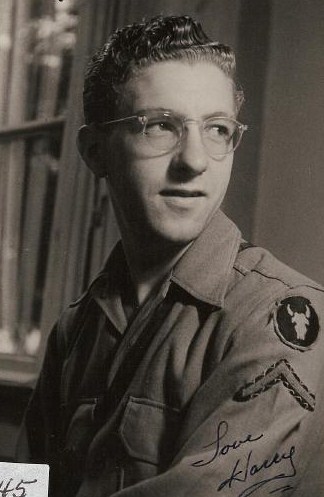
Harry Jewell, 1945 (5th Army, 34th Division, 135th Infantry)

Harry Jewell, 1945 (5th Army, 34th Division, 135th Infantry)

There has been much courage and dreadful sacrifice by veterans in the intervening years, but on Memorial Day and all days when we honor veterans, I think of  my favorite veteran, my father, who left us to be with the Lord he loved in January 2004 at the age of 79.

“They were better than we are,” said Tom Brokaw about the generation that saved the world from the last century’s Axis of Evil. The stark statement is true, we know. My father, Harry Jewell, was better than I am, I know.

Dad was a member of what they’ve called The Greatest Generation. He served his country mostly in Italy during World War II, and he was a hero of the American variety—putting his life on the line to save the world, and spending his life to serve his family, assuring their well-being in so many ways.

Dad told very few stories of the War, like most of his comrades in arms who saw their service as opportunities for duty, not celebrity; and didn’t relish the ugly memories. But from time to time we’d pull out a remarkable tale. Such as the time he was racing his jeep across an open field, with German artillery following him, but missing by just a few paces each time. Or the time he and others stepped inside a building, and their friend was obliterated by a shell on the front step they had just left. Death was always so close.

A sense of purpose prevailed and soldiers like Dad never asked why. Evil is evil, and men like Dad didn’t have any trouble recognizing it, as many seem to today.

A man of deep faith, my Dad demonstrated his peace with God in his final days and his homegoing. In life and at death he was an example to all of us.

Thanks to all who have served, then and now. And thanks Dad. I miss you.

Friday Link Wrap-Up

My blogging was rather light this week, but that doesn’t mean I wasn’t collecting links.

Sarah Palin got skewered for suggesting that ObamaCare(tm) would bring about what she called “Death Panels”.  Well, turns out that Obama’s pick for the guy to oversee government health care programs is all in favor of them.

Jobs saved and created … and created and created and created.  “Last week, one of the millions of workers hired by Census 2010 to parade around the country counting Americans blew the whistle on some statistical tricks. The worker, Naomi Cohn, told The Post that she was hired and fired a number of times by Census. Each time she was hired back, it seems, Census was able to report the creation of a new job to the Labor Department.”

“Unexpected” is the term the MSM uses to describe Obama’s economic failures.  We were promised it would work, and they’re shocked when it didn’t.  But’s that’s so last week.  Now the phrase is “little-noticed”, as in “a little-noticed provision of the health care bill is unexpectedly discovered.”  (Well, little-notice by the MSM.  Opponents mostly knew it already.)

And finally, some “smart” diplomacy, courtesy of Michael Ramirez (click for a larger image):

Michael Ramirez

Things Heard: e120v5

Good morning.

  1. Girls and fins.
  2. A missing point … that it is dangerous to be an illegal resident anywhere. This is not an argument for legalising aliens it is an argument not to be an illegal.
  3. Why ideological blinders matter. Everyone abuses history.
  4. North Korea and China.
  5. One report on the handling of the Gulf cleanup/reponse.
  6. The administration pulls a queue from two-bit dictatorships.
  7. Will the AZ outrage over immigration now move to MA? Or not so much cause it’s a Democratic stronghold?
  8. Heh heh.
  9. On anger.
  10. Obama’s version of “Its my responsibilty” … fire and forget. Just like his pleas of bipartisanship in the wake and during his own particular partisan attacks the buck stops here comes in in the wake of and during his own assignment of blame. His supporters somehow remain blind to this.
  11. A musical tribute to the Doctor.

Our Security Strategy ?!

My weekend homework for blogging. This post has piqued my interest and I think it will focus in on a number of points which are crucial. Of particular interest there is a 50+ page paper by the White House highlighting and stating to Congress our current National Security Strategy. The first link in the linked piece is to a downloadable document which of primary interest. In reading a statement like that one has to read it twice to avoid falling into the Satan’s Hermeneutic trap. One should read this first adopting and trying to fit in and understand within the context of the writer what points he is trying to make and his argument. In that reading when one encounters points which are troubling or incomplete … it an exercise for the reader to supply possible and likely solutions which perhaps were either overlooked or assumed. This is the part of reading which is only typically done by and between sympathetic parties. The second reading is adversarial and is aimed at finding and highlighting the essential flaws in the understanding or thesis of the writer. Many of these points are made already in the piece linked and are a key point in why this document might be interesting. Why?

  • One fundamental flaw pointed out is Mr Obama’s tendency to academic modes of practice. That is talking the correct talk, but lacking follow through and any serious commitment to the same.
  • Another flaw is Mr Obama’s (and his administration’s) lack of general expertise in executive positions. For example, in the linked piece note Mr Levy has noted an implicit (or even explicit) assumption of mercantilism as a working and useful economic model for today’s economy. Now it is highly likely that his economic team advising him on matters of national and international economic affairs wouldn’t make that sort of mistake. Apparently however, there is nobody who might easily catching those sorts of mistakes in the room when overall security strategies are being crafted. 
  • In Mr Obama’s numerous foreign addresses there seemed to be a number of flaws and defenders pointed out that an over-arching strategy was in play but never offered any suggestions what that strategy might be. Well, this document should give us that. Why for example, does is he so short with our allies. Why the verbal appeasement and praise for our putative enemies? This document should clear that up.

Anyhow, I’m not diving into flaws or other points yet. I haven’t read the paper … even once and I’m going to read it twice … and take notes. My discussion will follow at the tail end of the weekend.

This Just In: Penn Jillette Discovers Christians "Most Tolerant People"

Penn Jillette, magician, liberal, and critic of religion in general, has a program on Showtime where, among other things, he pokes fun and mocks all sorts of religions.  In an interview with George Lopez, he confessed that American Christians are "the most tolerant people worldwide", and admitted that he was shocked by that discovery.  (And this even when his attacks on said religion are riddled with falsehoods.)

Now why would that be?  Why would the perception of Christians be so far from the reality?  How would the word get out that Christians are such intolerant folks, if they’re not the ones doing it?

Oh, that liberal media!

Things Heard: e120v4

Good morning.

  1. The left likes to point out lingering effects of the cold war on attitudes on the right. A point returned.
  2. Some more thoughts on Mr Paul and the CRA.
  3. Economics, macro. Micro here.
  4. A prayer.
  5. Wise words.
  6. Sleeeeeep.
  7. Betcha he didn’t “read the bill” either. Such a dreary 10 pages.
  8. Hatred and blogs.
  9. Contra more (pension) bailouts.
  10. The engine controversy.
  11. Title suggestions?

The Latest News

If by "late" you mean "bordering on stale".  Walter Mead notes that the NY Times is singing long after the opera is over.

Climate Fears Turn To Doubts Among Britons,” blares the headline.

The story begins:

LONDON — Last month hundreds of environmental activists crammed into an auditorium here to ponder an anguished question: If the scientific consensus on climate change has not changed, why have so many people turned away from the idea that human activity is warming the planet?

Last month? The conference was last month and we are only hearing about it now, at the end of this month?

It turns out, however, that by Times standards a report on a conference from last month is a late breaking newsflash.  The main evidence that ace reporter Elizabeth Rosenthal has tracked down for her story about changing public sentiment comes from a BBC opinion poll from February.

The last I looked, we were approaching the end of May.  This is deliberative journalism at its best: only ninety swift days between a BBC poll and the time that the New York Times thinks you are ready to hear about it.

Rosenthal has tracked down some other elusive leads.  Concern about climate change, she reports, has also dropped dramatically among Germans — from 62 percent to 42 percent.  This time, the news dates only  from March.  Sixty days from simmer to serve: the head spins at the speed of information in this globalized world of ours.

And there’s nothing as thorough as a professional journalist hunting a good story; she’s also got another late breaking revelation.  As recently as January, a scant four months ago, a mere flick of the eyelid in geological time,  a survey of Conservative political candidates in the UK showed that stopping climate change rated as the lowest among 19 priorities for the new government.

Now six months after the rest of the world found out about it, Times readers are finally learning that Climategate and Glaciergate so seriously reduced public confidence in climate science in so many countries that there is little or no chance that serious global climate change legislation will be enacted.  At the time, the story did not merit much attention in the print pages of the Times; but sometimes a good story has to age like a fine wine.

"All the news that’s fit to print…eventually." 

50 leaders of the evangelical generation: #14 Ralph Winter. Missiologist


[I am working on a project that may become a book on the most influential evangelicals leaders of our generation, since 1976, and the impact they’ve had on the church and their times. I will introduce them briefly on this blog from time to time. Who should be on this list?]

#14 Ralph Winter. Missiologist. 1925-2009

The missionary task has changed dramatically in the last half century because of the accomplishments of missionaries past, the dramatic closing of nations and regions and the opening of others, and the changing perception of effective methods of recruiting and assigning missionaries and impacting “the field.”

At the center of this world of change was Ralph D. Winter, a 10-year Presbyterian missionary to Guatemala who founded the U.S. Center for World Mission and William Carey International University. He is widely regarded as one of the key factors behind the major shift of perspective in the mission movement — from going to countries and individuals to penetrating “unreached peoples,” or those who have been bypassed by traditional mission strategies. Winter introduced this new approach in what many consider a watershed moment for modern mission—his presentation the 1974 Congress for World Evangelization in Lausanne, Switzerland,an event organized by Billy Graham.

Winter argued that instead of targeting countries, mission agencies needed to target the thousands of people groups worldwide, over half of which have not been reached with the gospel message.

Graham said: “Ralph Winter has not only helped promote evangelism among many mission boards around the world, but by his research, training and publishing he has accelerated world evangelization.”

Golden Gate Seminary professor Ray Tallman, shortly after Winter’s death in 2009, described him as “perhaps the most influential person in missions of the last 50 years.”

Winter was a highly educated leader who received degrees at Caltech (B.S.), Columbia University (M.A.), Princeton Theological Seminary (B.Div), and Cornell (Ph.D). He also studied at Fuller Theological Seminary, where he would later teach.
After the 1974 Lausanne Congress, Winter and his wife Roberta felt there needed to be a place to tackle cultural and linguistic barriers hindering the sharing of the Gospel with all people. In 1976, he left his secure, tenured position at Fuller to focus on calling attention to the unreached peoples, founding the U.S. Center for World Missions.

Ralph Winter was the most influential missiologist in the last half century, with his work and thought creating a shift in Christian missions strategies in a changing modern world.

Things Heard: e120v3

Good morning.

  1. Logic meets the partisan, ships passing in the night.
  2. Marketing meets the satirist.
  3. Bohemian rhapsody and … now Bohemian rose.
  4. The pope’s words for Pentacost.
  5. A case in court.
  6. Slow news day? These type of vending machines have been common in airports for more than a year.
  7. Marya Bolkonsky.
  8. Fire and ice.
  9. Yet another bailout?
  10. Of Mr Rumsfeld and his legacy.
  11. Wave function and Eucharist.

Things Heard: e120v2

Good morning.

  1. Looking for a clue. I offer that if you cannot understand why a practice, custom, or institution is in place then you are not qualified to discuss removing it.
  2. Boredom.
  3. Our thoroughly modern world.
  4. Men’s rights.
  5. Concerning priests.
  6. Collaboration.
  7. So, does this guy want all the oil spills somewhere else in the world or does he think that there is a viable energy replacement?
  8. PC an Sex in the City.
  9. I missed one of the cues.
  10. The church and the man alone.
  11. The “new order.”
  12. One big jump.
  13. Big city gun control … and a facet of the argument likely not noted in the courts.
  14. The nuclear devices used in WWII get the big press, not this.

50 Leaders of the Evangelical Generation: #16 Luis Palau. Innovator


[I am working on a project that may become a book on the most influential evangelicals leaders of our generation, since 1976, and the impact they’ve had on the church and their times. I will introduce them briefly on this blog from time to time. Who should be on this list?]

#16 Luis Palau. Innovator. b.1934

Portland’s downtown waterfront on a summer afternoon in 2000 was ablaze with sound, action, and color; rock music screaming, skateboarders and BMX riders strutting their stuff, and the mostly young crowd in prime form, enjoying the sun drenched festival atmosphere. This was not a concert, sports event, or political rally, but a Luis Palau street festival drawing some 140,000 people; an updated version of an evangelistic crusade that brought new prominence to the longtime efforts of the Argentina-born evangelist.

It is unlikely that anyone in the crowd was saying: “This Palau guy seems like the next Billy Graham,” which is a relief to both the Palau and Graham organizations, neither of which was comfortable with this moniker that was heard from time to time early in Palau’s ministry. Now, it is the Graham organization and others who are playing catch-up to Palau’s dynamic outreach to the next generation through dynamic large-crowd street festivals.

In fact, as Franklin Graham began to pick up more speaking responsibilities from his aging father, he had the instinct to do something different but, using the same teams that at times seem robotically steeped in Graham’s 50-year old crusade methodology, the Franklin Graham Festivals were little different than Billy Graham’s events, except in name and the inclusion of some contemporary musicians on-stage.

Indeed, because of his openness to innovation, Palau has regenerated the mass evangelism genre and demonstrated that the methodology—while needing a generational facelift–is not quite ready to be retired.

While Palau’s street festivals have been a great success and put some distance between he and the Grahams, the two organizations do have the same succession plan: both Billy Graham and Luis Palau have knighted their sons (Franklin Graham and Kevin Palau) to take the reins of the organizations and assume the evangelistic speaking mantle from their fathers.

[Nepotism is alive and well within evangelical organizations headed by their entrepreneurial founders. Leadership is shifting to the sons at BGEA and LPEA; and when the board at Focus on the Family nixed the idea of a stronger role for Ryan Dobson at Focus on the Family, James Dobson left and started a new radio program with Ryan. Jerry Falwell was succeeded by his sons at his university and church; Pat Robertson’s likely successor is his son Gordon; Joel Osteen took over Lakewood church from his father. Some other father-to-son hand-offs that didn’t work out so well: Oral Roberts to Richard and Robert Schuller to Robert Jr .]

It was in the 1990s that Palau’s ministry focus moved toward the United States—the majority of his crusades had been overseas—and by the end of the decade he had refined the unique festival evangelism outreach. Embracing contemporary life and culture, these festivals combine popular Christian music artists, a massive skate park featuring top Christian athletes of action sports like skate boarding, BMX and motocross, and even Veggie Tales for the children. The central feature, though, remains an evangelistic message inviting an on-the-spot response to the Gospel.

It was Kevin Palau who realized that extreme sports greatly influence the youth culture and incorporated BMX riding and skateboarding demonstrations into the festivals. This has given the ministry an additional edge to its outreach to youth. Recently, Kevin and actor Stephen Baldwin co-produced Livin It, a 40-minute documentary that includes extraordinary sports action and compelling face-to-face, street-style evangelism.

Born and raised in a wealthy Argentinean family, Luis Palau became a Christian at an early age. He became successful in the family banking business before moving to Portland, where he attended Multnomah Biblical Seminary. While in Bible school he met his wife, Patricia, and after completing their studies, they began traveling as missionaries in Latin America. This led to involvement in evangelistic ministries, developing teams and helping evangelists.

Palau first heard Billy Graham on a radio broadcast while still living in Argentina in 1950, and he drew inspiration from him. He later worked for Graham as a Spanish translator and as an evangelist. In 1970, Graham contributed the seed money for Palau to start his own outreach, which he initially modeled after Graham’s. Doors continued to open through international invitations and by the early 1980s Palau was having a big impact in Western Europe and throughout the world.

Palau has authored 50 books and has preached in person to 25 million people in 70 nations. The organization says more than a billion people worldwide have heard Palau when you also account for radio, television, and the Internet. His radio program is heard in both English and Spanish in 42 countries. The Palau ministry employs 70 people in Beaverton, Oregon, and another 25 around the world.

A recent addition to the festival package came about when Portland Mayor Tom Potter approached Palau at a 2005 Portland appearance by First Lady Laura Bush and asked for Palau’s assistance in getting other evangelical leaders to address Portland’s homelessness problems. Palau contacted fellow evangelicals and cooperated with Potter and other area officials to include in the 2008 area festival a focus on volunteerism in support of the homeless, which he called the Season of Service.

Today, the Palau’s have four sons and 10 grandchildren and make their home near Portland.

50 Leaders of the Evangelical Generation: #43 Stu Epperson. Radio Transformer


[I am working on a project that may become a book on the most influential evangelicals leaders of our generation, since 1976, and the impact they’ve had on the church and their times. I will introduce them briefly on this blog from time to time. Who should be on this list?]

#43 Stuart W. Epperson. Radio transformer b.1935

Unless you live in the world of religious broadcasting it will be difficult to grasp how totally Stu Epperson and his Salem Communications have changed Christian radio throughout America. He did this by taking a new approach and pumping life into the expansive but often toothless religious radio industry. The new idea: acquire radio stations with high-powered signals on the commercial radio band spectrum, unlike most Christian broadcasters who tend to purchase many low-power translators.

Epperson started Salem Communications with his brother-in-law Ed Atsinger in 1972 and today Salem is the dominant player in the Christian radio industry (Epperson is the chairman; Atsinger the CEO). Today, Salem Communications, a for-profit corporation traded on NASDAQ, operates about 100 stations, 65 of which are in the top 25 markets.

Salem is the fifth largest U.S. radio station owner after Clear Channel, Cumulus, Citadel, and Entercom. Salem owns slightly more AM than FM stations, and covers one-third of the U.S population; the programming targets audiences interested in Christian and family-themed content and conservative values. Epperson, Atsinger, and other family members control about 85 percent of the company.

The innovation and product expansion have continued. On the radio side, Salem now operates stations that provide traditional Christian teaching and ministry programs, contemporary Christian music stations, country music, and talk radio stations that feature conservative (although not necessarily Christian) hosts. These include some of the most popular second-tier (if the first tier is Rush Limbaugh, Sean Hannity, and Glenn Beck) conservative talkers, including Michael Medved, Dennis Prager, Bill Bennett, Mike Gallagher, and Hugh Hewitt.

The company also produces and syndicates programming through the Salem Radio Network, which boasts about 2,000 affiliates that subscribe to religious programming, its twice-hourly news summaries, and other news programming—through a credible news operation, SRN News (part of what Columbia Journalism Review called “an alternative universe of faith-based news”).

In addition, Salem publishes books and magazines and operates the Salem Web Network, a provider of online Christian content that owns and manages more than 60 websites, including: Christianity.com, Crosswalk.com, OnePlace.com, SermonSearch.com, LightSource.com, ChristianJobs.com, ChurchStaffing.com, TheFish.com, Townhall.com, CrossDaily.com, Hotair.com, and many more.

As this generation has progressed, Epperson may be the most powerful unknown evangelical in America, with perhaps far more actual influence and decisive power than well-known figures such as Jerry Falwell, Pat Robertson, or James Kennedy.

Epperson attended Bob Jones University in Greenville, South Carolina, where he received a bachelor’s degree in radio/television broadcasting and a master’s degree in communications. In 1984 and 1986, Epperson was the Republican nominee for the fifth Congressional district of North Carolina. In both races, Epperson was defeated by the incumbent Democrat, Stephen L. Neal.

He is a member of the board of directors of the National Religious Broadcasters (NRB).

Friends say his real passion is helping the fatherless. He founded “One Kid at a Time”, a youth mentoring organization, now part of the Christian Association of Youth Mentoring, where Epperson serves as chairman of the board.

Epperson lives in Winston-Salem, North Carolina. His wife, Nancy, is on the board of international Christian broadcaster Trans World Radio (TWR). He has four children, daughters Kristy, Karen, and Kathy, and son Stuart Jr.

Things Heard: e120v1

Good morning.

  1. California as the world.
  2. California schools.
  3. The Southwestern US states are not the only ones with water issues.
  4. A word, Coming soon to the US care of your ever-growing government.
  5. The Democrats complained when their remarks during the Iraq fighting were cited as abetting the enemy. Hypocrites.
  6. A canned response for Mr Paul (HT: A Gentleman Ordinary).
  7. The future of iconography … is bright.
  8. A passing noted.
  9. Likely true.
  10. Seeking strategy.
  11. The future of US Medicine … a cash economy. 
  12. Those much touted Iran sanctions, kind of sieve like.
  13. Asking about Ms Clinton.

Friday Link Wrap-Up

I may start doing this more often.  I collect links during the week, some I comment on here, and some just languish in Google Bookmarks.  But instead of a daily report of links like my co-blogger Mark, I’m going to save it all until the end of the week.  This installment will be a bit longer than others since I’ve got some aging links here that really want to see the light of day.  So here they are, usually, but not always, in reverse chronological order:

Coattails?  What coattails? “Some Democrats on the campaign trail have hit upon a winning campaign tactic: Run against President Obama and his agenda — especially the health care overhaul.”

Seeking asylum in the US for … homeschooling persecution? “A German Christian family received asylum in Tennessee after being severely penalized for illegally homeschooling their children in Germany.”  I’ve covered this particular situation before; here, here, here, here, here and here.

California, parts of which are boycotting Arizona for it’s new immigration law, which just enforce existing federal law, should take a look at it’s own lawbooks first.  They might find something familiar.

The economic meltdown in Greece should be a wake-up call to politicians of both parties in the US.  Otherwise, it may turn out to be, rather, a coming attraction.

ObamaCare(tm) is predicted to increase the crowding in our hospitals’ emergency rooms.  “Some Democrats agree with this assessment. Rep. Jim McDermott (D-Wash.) suspects the fallout that occurred in Massachusetts’ emergency rooms could happen nationwide after health reform kicks in.”  But he still voted for this snake oil anyway.

“Economic Woes Threaten Chavez’s Socialist Vision” Only on NPR would this be news.  For the rest of this, it’s a redundancy.

Comedy Central stands on the bedrock of free speech and will mock anyone, just as long as there’s no chance of getting beheaded for it.  “The show in development, “JC,” is a half-hour about Christ wanting to escape the shadow of his “powerful but apathetic father” and live a regular life in New York.”

Green energy falling by the wayside in Europe.  Seems the massive subsidies for this alleged cost-saving energy are too much for governments going through financial troubles.  Should we (will we) take note?

 Page 115 of 241  « First  ... « 113  114  115  116  117 » ...  Last »