Monday, May 18th, 2009 at 9:16 am
I’ve begun reading John Behr’s (so far) two volume series (three are reported as planned) subtitled Formation of Christian Theology. The first volume, in soft cover from SVS Press, is entitled The Way to Nicaea. This books covers aspects of the formation of Christian theology, focusing on the development of the answer to Jesus query to the disciples, “Who do you say that I am?” Volume 2 is split into two books and covers in some detail the controversies surrounding the two councils which developed the Nicene creed.
The first chapter of this book begins with a look at how the Scriptural canon for the Christian church developed and was set. There were a lot of alternative canonical choices at the end of the second century when the canon was set. But the result, to summarize Behr, was that two key criteria were used to select what books and epistles were included in the New Testament canon. They are that the books chosen were “according the the Scriptures” and that the cross (the passion) was central. The phrase “according the the Scriptures” meant specifically that the acts and narrative account in the selected book connected these actions with the accounts and prophecies of the Old Testament. This meant that books like the Gospel of Thomas and other gnostic works were excluded. Behr defends his interpretation of this development of canon by examining the methods and arguments used by St. Irenaeus in discussing various heresies of his day at the close of the 2nd century.
David Schraub blogging at the Debate Link, dislikes the term “Judeo-Christian”. This term admittedly can be misused. The above historical notes demonstrate how this term is at the same time correct and how the traditions diverged. For certainly in the context of investigating first and second century theological currents and ideas that term is relevant. Throughout the first century the majority of Christians were Jews who felt that Jesus was in fact the awaited Messianic figure, the fulfillment of Scriptural promise. At the same time, there is here a key difference which will form the basis possibly for the contention that this term does not make sense. Christians over the centuries following embarked on a program to reinterpret the Jewish Scriptural canon through the “lens of the cross”, i.e., via the life and passion of Jesus. That is they re-examined and reinterpreted, often as “type”, events and prophecies of Scripture to be interpreted specifically in the context of Jesus message, and his crucifixion and resurrection. Christian theology at the end of the second century defined itself and its theological methods in the light of Jewish writing. At the same time however, it was beginning to highlight the differences by beginning a program of returning to and examining that same canon in a radically different way (although it might be noted that “different” way was himself a 1st century Jew).
Friday, May 15th, 2009 at 9:48 pm
Hugo Chavez would be proud.
A report Friday said federal officials are pressuring Bank of America Corp. to revamp its board and bring in directors with more banking experience.
The story in The Wall Street Journal called the regulators’ move "unusual" as the government does not own a stake in the company, and most of the bank’s problems are the result of its purchase of Merrill Lynch & Co., which was advised by regulators.
Bank of America said last week it was looking for new directors, but gave little detail. The announcement came as the government, after completing its stress test of the bank and 18 other financial companies, said Bank of America needed to raise nearly $34 billion. The bank has received $45 billion in government funds as part of the Treasury Department’s $700 billion financial rescue package.
The government is pulling the strings to change the makeup of the board, but it doesn’t even own any part of the company. There’s nothing wrong with a bank having more experience on its board. The question is, should the government be exerting pressure to do so?
Friday, May 15th, 2009 at 1:19 pm
For the first time since the Gallup organization has been polling this issue (1995), more Americans consider themselves pro-life than pro-choice, and the percentage of pro-life designations is the highest ever.

(Click on the picture for the source article.) Gallup calls this jump a "significant shift". Increases were found among the individual demographics Republicans, conservatives, moderates, Protestants, Catholics, men and women.
Thursday, May 14th, 2009 at 8:51 pm
Amazing.
President Barack Obama, calling current deficit spending “unsustainable,” warned of skyrocketing interest rates for consumers if the U.S. continues to finance government by borrowing from other countries.
“We can’t keep on just borrowing from China,” Obama said at a town-hall meeting in Rio Rancho, New Mexico, outside Albuquerque. “We have to pay interest on that debt, and that means we are mortgaging our children’s future with more and more debt.”
Holders of U.S. debt will eventually “get tired” of buying it, causing interest rates on everything from auto loans to home mortgages to increase, Obama said. “It will have a dampening effect on our economy.”
How someone can first create quadruple the deficit of his immediate predecessor, and then say this is beyond me.
Thursday, May 14th, 2009 at 9:00 am
Tuesday night I attended the choral concert at my daughter’s middle school. Stylistically speaking choral arrangements of 20-30 year old popular songs and show-tunes are not my cup of tea. Before the concert I began, at long last, reading Matt Ruff’s Bad Monkeys and am now about a 1/3 of the way into the book. “Bad Monkeys” we discover is the short-hand phrase for the place on the org chart of the secret “evil fighting” society of which Thiour main character was(is?) a member.
- The Department for Optimal Utilization of Resources and Personnel — Cost-Benefits
- The Department of Ubiquitous Intermittent Surveillance — Panopticon
- The Department for the Final Disposition of Irredeemable Persons — Bad Monkeys. Bad Monkey’s are the “assassins” who remove from circulation people who are, well, irredeemable. A common weapon used is an NC gun, NC stands for “Natural Causes,” this gun works at short range and has two settings, MI and CI which stand for myocardial and cerebral Infarction respectively.
- The Department of Organizational Counterintelligence — Catering
Our narrator is a young girl who is being interviewed by a doctor in a criminal psychiatric ward. She is recounting how she became a Bad Monkey and some of her exploits. Anyhow, judging from the cover the rest of the story is going to have its share of twists, turns and weirdness.
Wednesday, May 13th, 2009 at 9:02 pm
Let them brand themselves.
A member of the Republican National Committee told me Tuesday that when the RNC meets in an extraordinary special session next week, it will approve a resolution rebranding Democrats as the “Democrat Socialist Party.”
No, no, no, no, no. Let their actions speak for themselves, from purchasing interests in financial and auto companies, to ignoring bankruptcy law when dealing with those companies in order to pay off special interests, to spending billions (and taxing more) on universal health care, they can pretty much fill out the "Hello, my name is" badge themselves.
I’m with Michael Steele on this. All this will do is give the media and the Democrats a tool to hammer Republicans with. "They’re comparing him to Hugo Chavez" or something like that. While the truth is that they’re pulling us in that direction and not letting a crisis go to waste (as Mr. Emmanuel has declared), labeling them doesn’t change minds, or at least not for long. Pointing out why their policies are flawed will.
Wednesday, May 13th, 2009 at 12:17 pm
That’s the introduction from a Bible Quiz master in our denomination when he or she is about to quote someone’s words and is asking who spoke those words. So here’s a similar question for you; who said these words? One hint is that it’s from a category of people, not a single speaker. Another is that they’re talking about Arab extremists and our foreign policy towards them.
"Openness for the sake of openness makes the situation more complicated and sends the wrong message."
Appeasing extremists tells them, "that extremism is the most effective way to attract the U.S.’s attention, and to compel them to conduct dialogue."
When Pakistan was too soft on terrorists, the result was “more murders and torture of those opposed to the movement and more suffering for the people."
“Despite all [Obama’s conciliatory actions], violence has increased….None of these elements have changed their positions–despite everything Obama has done since assuming the presidency. Every step [Obama] takes towards [his foes] will only prompt them to challenge him."
So who said it? Neocons? The staff at National Review? Former Bush administration officials? A conservative think tank?
If you guessed any of them, the quiz master takes away 10 points for an error.
If you guessed moderate Arabs, you get 20 points. Barry Rubin has the details.
Tuesday, May 12th, 2009 at 2:22 pm
Via the Corner, Ed Whelan notes two instances in which President Obama previously said,
[W]hile adherence to legal precedent and rules of statutory or constitutional construction will dispose of 95 percent of the cases that come before a court, so that both a Scalia and a Ginsburg will arrive at the same place most of the time on those 95 percent of the cases — what matters on the Supreme Court is those 5 percent of cases that are truly difficult.
OK. What is that man talking about? A quick look at some, you know, actual statistics shows that the agreement is just a little less. Ms Ginsberg agreed with Mr Scalia less than 15% of the time and Mr Thomas less than 10%. A far cry from 95%.
So, remind me why is this man touted for his “high intelligence?” He’s either bright … and a bald faced liar … or he’s innumerate. Pick one.
Tuesday, May 12th, 2009 at 1:33 pm
Back in January, the Obama administration put out a prediction of what would happen if the stimulus bill was passed and if it wasn’t. It was called "The Job Impact of the American Recovery and Reinvestment Plan". In it, they predicted that, while unemployment figures would ultimately recover from this recession, the stimulus bill would flatten out the peak they would otherwise reach. They even put in a graph to demonstrate their prediction.
Geoff, one of the many writers at the Innocent Bystanders blog, noted in April, and again last week when the April numbers were official, that the unemployment figures are precisely following the Obama administration’s graph of what would happen … without the recovery plan.
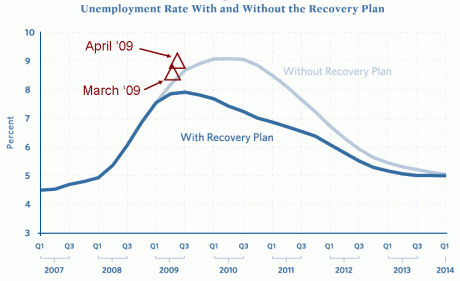
So we’re spending 3/4ths of a trillion dollars, and according to Obama’s own economic experts, the job impact of the American Recovery and Reinvestment Plan was nothing. But this is government, and no matter how poor the results, they’ll keep on doing the same thing; printing money, spending unlike any other time in history, and telling us that they know what they’re doing.
Oh yeah, and they’ll tell us to live within our means. We need an irony graph.
Tuesday, May 12th, 2009 at 8:53 am
One of the arguments that atheists often bring forth is that the Christian notion of God is logically inconsistent. 1+1+1=1 they will point out doesn’t logically make sense. Well, on the other hand a fundamental particle being simultaneously a mathematical point and and extended object is logically inconsistent as well. Yet the latter is presently our best understanding of how nature presents itself, quantum objects, leptons and quarks that is to say matter is in fact point-like and extended at the same time. The atheists failing is that they, when confronted with the first logical inconsistency insist is it fundamental and when confronted with the second, insist that the human mind and our learning will encompass and explain the paradox more fully. I would suggest that the latter confidence can equally be applied to the former and that if they cannot yet understand it, that is because they are not engaging their imagination and optimism in the same way for reasons which have little to do with the problem posed.
Yet at the same time, there is an accusation of lack of imagination which might be returned to the court of the Christian believer. Modern physics has deepened our understanding concerning space and time. Applying the Minkowoski metrics to a four dimensional Riemann manifold describing space time as governed by a dynamical equation by Einstein in his proposal of General Relativity is a powerful way of envisioning our Universe. Similarly, Yang-Mills gauge theories, either classical or quantized provide a beautiful geometrically motivated understanding of the forces and small scale structure of space time. Ernst Mach a physicist and philosopher, prior to Einstein considered abstract ideas regarding motion and inertia, with the idea suggested that a single object in space (in the absence of any other “things”) has no inertia. In fact motion can only be described as a relation between two things. Christian conceptions place God, or at least his essence if not His energies following St. Gregory Palamas, outside of time. Certainly God prior to creation and the eschaton are placed by theologian to be outside of time. Christians have, as far as I know, not connected either large-scale or small scale (Minkowski-Riemann space-time or Yang-Mills quantization of U(1)xSU(2)xSU(3) gauge theory) to the notion of what “out of time” means. For myself, while I’ve thought a little about this and have nothing useful to report as yet, this book by John Pokinghorne might spur some ideas, The God of Hope and the End of the World. it should be noted that Mr Polkinghorne was an accomplished theoretical physicist before he became a Anglican priest and theologian.
Humans endow the world with meaning. Semantic content flows from our every thought and our conversation finds expression and meaning in semantic intercourse with others. Yet, in a purely material world semanatic content is meaningless. A pattern of electro-chemical discharges invoking vibrational patterns in the air is devoid of meaning. Yet humans call that speech and embue it with semantic import in a way which can be translated to word, text, and image. Michael Polanyi in Personal Knowledge recounts that when reading his morning correspondence which arrives from friends and peers the world over is unaware during the act of reading the language in which the text he reads is transmitted (obviously he is very fluent in a number of different languages). When he wishes to share something, for example, with his son, who only knows English, he has to check to see if the letter or passage of interest is in English or not. He is not, in the act of reading, consciously aware of the langauge which he is reading. On this matter theists and atheists point the “lack of imagination” finger at the other, the latter insisting that the semantic boostrap from the material to the semantic is lacking in the imagination of the former and the former insisting that the latter cannot imagine how the semantic boostrap itself might be the essence of the soul.