By Contributor Archives

Things Heard: e56v2

  1. Race advice which is transferable to other avenues of life.
  2. Except, due to cholesterol, my dietitian informs me cheese is not a food … it’s a garnish.
  3. Iran slumping?
  4. Crime pays?
  5. Water and Spirit.
  6. Verse.
  7. Violation of law.
  8. In five short (long?) months … ta-daaa.
  9. On that scientific authority thing.
  10. Getting parenting very very wrong.
  11. F-22. Stimulus?
  12. A gigabyte now and then.
  13. Sssspiiin.
  14. We need some gridlock in the beltway faaast. Huh?
  15. On theodicy.
  16. Links … I thought the Krugman criticism cogent.
  17. Mornings.
  18. Loony ranting wackjobs haters. Whatever.
  19. Very cool art.
  20. Abduction.

Man, Society, and Science

Carl Olson of the Insight Scoop notes an article noting a term which he predicts will be in our future, scientific authoritarianism. The cited article notes:

Scientific authoritarianism, as I am using it here, holds that political decisions should be compelled by the political preferences of scientists. It is a very strong form of the ‘linear model’ of science and decision-making that I discuss in my book, The Honest Broker. Hansen believes that the advice of experts, and specifically his advice alone, should compel certain political outcomes.

There are just a few matters that need to take into account in this matter.

  • First off, it is my experience that there are two features found in many of the first rank scientists in our midst. First off, the best and brightest scientists in various fields don’t have the slightest interest in giving advice to politicians and in fact when they do offer political advice they offer very bad advice. I might add that theologians and religious leaders as well, for the most part, also are very horrible when they enter into the political world. There are some good reasons for this. Skills are involved in politics. The ability to read people, judge motivations and to have an estimate of the possible and so on are political skills. To become talented and to rise to the top of a scientific discipline requires three things: talent or genius, a love for inquiry, and a concentration on that field virtually to the exclusion of all else in life. Those people who are at the first rank usually have no talent, or frankly, desire to spend any time with exercising any authority. For them, their life is wholly given to the chase for the truths hidden by and in nature. To make an analogy with popular culture from cinema, while we might hope for our scientific authority to rise from the Mozarts in our midst, we’re going to get the Salieri’s who are the ones who will sully themselves with such matters.
  • Second, those scientists who are not blinded by the possibility of exercise of political authority, i.e., those who are honest with themselves, are aware of the vast gulf between what we know and what is out there to be known. To put it baldly, any scientist who assures you that we “know” the best policy is a liar or a fool. We “know” so very little about ourselves, our universe, and how it is put together.
  • Michael Polanyi in Personal Knowledge offers for us a glimpse at how much we deceive ourselves regarding about the epistemological certainties in science. I cannot recommend this book enough (although I’ll ruefully admit I really do need carve out the time to finish it).

A joke which is part of the culture of Physics and the pursuit of knowledge in that discipline.

A policeman encounters a drunk one night, who is on his hands and knees searching for something in the night beneath a street light. The policeman asks him, “What are you looking for?”
The drunk replies, “My keys.”
“Where did you drop them?” asks the bobby.
“Over there,” the drunk points down the block.
“Why are you looking here then?”
“I can’t see over there, because the light is here,” replies the drunk.

Our search for the mysteries of the universe and ourselves are a lot like that. We search under the light. Our keys … our understanding is to be found, so often, elsewhere down the road … in the dark.

So much of physics and our physical understanding of the universe assumes linearity. The mathematical behaviour and our understanding of linear PDEs and non-linear ones are much like comparing oranges to not-oranges. We look at and search for understanding under the light of just a few lamps. Gradually we uncover and begin to use a few more. But, we are just beginning. To pretend otherwise is foolishness. My advice would be to spurn those offering to give us scientific authority are who are assured in their results and their knowledge and don’t first show evidence of humility and uncertainty and demonstrate they posses a firm grasp of the magnitude of our ignorance.

Religious Environmentalism & Idolatry

Don Sensing has noted in the past how the environmental movement morphed from a Teddy Roosevelt conservation into Earth worship, to the detriment, in this case, of highly unemployed Latinos.  Rev. Sensing also observes that the increase in this idolatry seems to coincide with its economic decline.

God is not mocked. 

Things Heard: e56v1

  1. Penicillin and Lent.
  2. Induction and inference.
  3. That nasty brutish and short thing.
  4. Prayer request.
  5. Power and efficiency.
  6. Brand name and prestige.
  7. Winter.
  8. Offensive prayer.
  9. Ms Pelosi is perhaps the tip of the non-catholic catholic iceberg.
  10. 1st Corinthians in the modern world.
  11. damned lied … and statistics.
  12. That right to privacy.
  13. Is that a thing which is needed?
  14. Beowulfs.
  15. And a pony for everyone too?
  16. Putting his cards on the table.

A New Wind is Blowing

And it’s blowing away the rage that Democrats would have had if Bush had done this.

The economic stimulus signed by President Barack Obama will spread billions of dollars across the country to spruce up aging roads and bridges. But there’s not a dime specifically dedicated to fixing leftover damage from Hurricane Katrina.

And there’s no outrage about it.

Democrats who routinely criticized President George W. Bush for not sending more money to the Gulf Coast appear to be giving Obama the benefit of the doubt in his first major spending initiative. Even the Gulf’s fiercest advocates say they’re happy with the stimulus package, and their states have enough money for now to address their needs.

What a difference an administration makes.

It’s a significant change in tone from the Bush years, when any perceived slight of Katrina victims was met with charges that the Republican president who bungled the initial response to the disaster continued to callously ignore the Gulf’s needs years later.

Just last summer, Democrats accused Bush of putting Iraq before New Orleans when he sought to block Gulf Coast reconstruction money from a $162 billion war spending bill. Bush was pilloried for not mentioning the disaster in back-to-back State of the Union addresses.

Bush couldn’t miss mentioning Katrina let alone sending more money there.  But Obama doesn’t spend a dime in a 3/4 of a trillion dollar spending spree and cue the crickets.

What, does Obama hate black people?  That’s preposterous now, and it was preposterous then.

Obama’s Mortgage Plan: More Harm Than Good?

The Wall Street Journal takes a look at President Obama’s proposed mortgage rescue plan and finds that it could create far more problems than it solves:

President Obama yesterday announced his plan to prevent home foreclosures, saying he wanted to be “very clear about what this plan will not do: It will not rescue the unscrupulous or irresponsible by throwing good taxpayer money after bad loans . . . And it will not reward folks who bought homes they knew from the beginning they would never be able to afford.”

We really do wish he were right. In fact, the details released yesterday suggest the President’s plan will do all of the above. The plan will help some struggling homeowners. But by investing in failure, the Administration will also prolong the housing downturn and make financing a home purchase more difficult for future borrowers. Meanwhile, the plan isn’t likely to slow the continuing decline in housing prices.

The President’s plan is predicated on the false belief that everyone deserves to own a home. The fact is that not everyone can afford to own a home. The efforts of Fannie Mae and Freddie Mac to make it easier for people to buy homes they could not afford are at the heart of the current financial crisis. Unfortunately, the President’s plan does nothing to address this fundamental issue and instead just prolongs the crisis and leaving taxpayers on the hook.

As CNBC’s Rick Santelli correctly points out in this clip, this is an example of government rewarding bad behavior. Unfortunately it’s the 92% of honest, hardworking Americans he refers to that will pay the price.

Sometimes a Chimp is Just a Chimp

John Hinderaker on PowerLine:

If the President is a Republican, it’s fine to call him a "chimp." In fact, it’s morally superior. But if the President is a Democrat, you can’t call a chimpanzee a chimp lest someone think you might have been referring to the President.

It all makes perfect sense.

Indeed, for 8 years calling the President a chimp was so prevalent that there are hundreds if not thousands of images of him specifically morphed into or compared to a chimpanzee

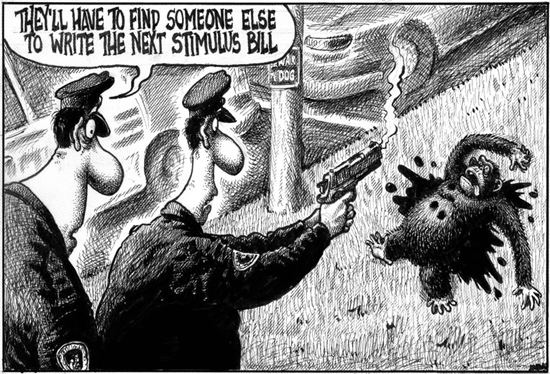
But today, here is the controversial chimp in question:

They'll have to find someone else to write the next stimulus bill.

This was referring to, not just the awful "stimulus" bill (written by Congressmen, not the President), but the chimpanzee that went on a rampage in Stamford, CT that was shot and killed by police.  Just like in the cartoon. 

But Al Sharpton and all manner of bloggers have now confirmed what many of us thought might happen when Obama was elected.  Any criticism of the President (or in this case, the Congress) that can be linked to racism, will. 

Paging Mr. Holder.  Maybe your observation that we’re "essentially a nation of cowards" on racism is because of this sort of reaction from the Left whenever race comes up.  Or, as in this case, even when it doesn’t come up.

Obama Taps Pornography Defender for DoJ

Al Mohler gives an introduction:

In contemporary America, pornography is both a public reality and big business.  Ambient pornography — sexually explicit advertising, entertainment, and merchandising — is all around us.  But pornography is also big business, producing sexually explicit materials in printed, video, and digital formats and making billions of dollars in the process.

The pornography industry has a big stake in defending itself against legal challenges and restrictive laws, and it has been stunningly successful in doing so.  One of the leading legal defenders of pornography has been David Ogden, a lawyer who can only be described as a First Amendment extremist, who has even argued against laws against child pornography.

President Barack Obama has nominated David Ogden as Deputy Attorney General of the United States.  This nomination is both ominous and dangerous.  Given David Ogden’s high visibility in defense of pornography, this nomination sends a clear and unmistakable message.  The pornography business will have a friend in high office in the Department of Justice.

Steven Groves of the Heritage Foundation has some other concerns about the Ogden nomination.

In the 2005 case Roper v. Simmons, Ogden succeeded in convincing a narrowly divided Supreme Court to declare the juvenile death penalty unconstitutional and spare the life of his client, who killed a woman in cold-blood nine months before he turned 18.

Groves says Ogden argued that the high court should look to laws, legal opinions, and decisions of foreign countries and international organizations regarding the death penalty. He notes that in particular, Ogden cited the United Nation’s Convention on the Rights of the Child (CRC) — a 1989 treaty that bars the execution of people who commit crimes while under the age of 18.

Ogden, says Groves, pointed out that the United States is one of only two countries in the world that has not signed onto that treaty.

"[He argued] that doesn’t mean that the U.S. doesn’t have to follow the treaty, [but that] it means the opposite — that the United States must follow the treaty that it has specifically decided not to join," says Groves. "Why? Because [Ogden argued] the rest of the world has joined it — and so therefore it’s some new customary, international norm and the United States must outlaw the juvenile death penalty."

So he wants the United States Supreme Court to use foreign laws for precedent, and to adhere to treaties we’ve never signed.  Regardless of your position on whether or not we should sign the CRC, Ogden wants our courts to decide cases based on laws we have no control over, and to unilaterally implement treaties that our legislature hasn’t agreed to or our President hasn’t signed.

Judicial activism, anyone?  Well, more like judicial usurpation.  And Obama wants this guy as our Deputy AG, fighting for the rights of pornographers to get their stuff in front of as many eyeballs as possible, never mind the age.  (He fought against porn filters in libraries, too.) 

Is this just your basic Democratic "family values" kinda’ guy?

Things Heard: e55v5

  1. Foreclosures … one solution.
  2. TARP and the difficulty of bucking markets.
  3. That cartoon two views allow and censure.
  4. Le Tour of February, in pictures.
  5. A suggestion for those “really smart fellows” in the Obama Admin.
  6. An economic rant.
  7. Of the default “evil men” of hollywood.
  8. Increased productivity … sources of same.
  9. Women and friction.
  10. Uh … no.
  11. The Administrations plans that will destroy the economy.
  12. Two martyrs.
  13. A for “effort” … or “accomplishment” and mastery?
  14. On American greatness.
  15. What goes into making/baking prosphora (the bread used in communion) for the Orthodox.
  16. Thinking about love, but which of the four loves ala Lewis (or the Greek lexicon) is meant here?
  17. Nailing down truth … or not.
  18. From the desert.
  19. On repentance.
  20. Oops. Faked climate data.
  21. And a interesting photo to wrap up.

"Hate" Speech

…for weaker and weaker definitions of "hate", notes Eugene Volokh.

From a UCLA Chicano Studies Research Center study titled Hate Speech on Commercial Talk Radio:

Types of Hate Speech

We identified four types of speech that, through negative statements, create a climate of hate and prejudice: (1) false facts [including "simple falsehoods, exaggerated statements, or decontextualized facts [that] rendered the statements misleading"], (2) flawed argumentation, (3) divisive language, and (4) dehumanizing metaphors (table 1).

What a definition!

The example they give should give you pause.  If "exaggerated statements" will get you thrown in jail, we’ll all be either imprisoned or silenced. 

And note that this particular study only looked at "Commercial Talk Radio".  Obama may have come out against the "Fairness Doctrine", but if we get a back-door version of that, this may be how it happens.

Obama Says, No "Fairness Doctrine"

Some good news from this administration:

President Obama opposes any move to bring back the so-called Fairness Doctrine, a spokesman told FOXNews.com Wednesday.

The statement is the first definitive stance the administration has taken since an aide told an industry publication last summer that Obama opposes the doctrine — a long-abolished policy that would require broadcasters to provide opposing viewpoints on controversial issues.

"As the president stated during the campaign, he does not believe the Fairness Doctrine should be reinstated," White House spokesman Ben LaBolt told FOXNews.com.

The "Fairness Doctrine" is really just targeted at radio, where conservative voices dominate.  You typically don’t hear those promoting it complaining that there’s too much liberal bias in this newspaper or that TV network; it’s always a complaint about conservative opinions and ideas.  So the idea that this is about "fairness" is just a smokescreen.

Blogger Dan Riehl is skeptical, though.

Instapundit posts word that Obama does not want the Fairness Doctrine back. Great.

That makes him look like quite the moderate. But the actual doctrine was always a stretch. Get back to me in 3-6 months after we see what his FCC does in terms of "localism."

That’s always been the play more likely to get done. Until I hear something from the FCC, the WH release is what I’m growing accustomed to with Obama: just words.

It is possible to have the effect of a "Fairness Doctrine" without the name, so indeed we’ll see.  But it is nice to get the word from the President.  We’ll hold you to that, sir.

Things Heard: e55v4

  1. Ms McArdle, a former(?) fan, on Geithner.
  2. One idea for Lent, stop breathing?
  3. The Pope to Vietnam?
  4. Two approaches to economic stress compared.
  5. As Mr Obama keeps stressing the “crises” we’re in … one wonders if Mr Emanuel’s remark of using a crises to seize power is part of this play.
  6. Demons replaced in metaphor.
  7. St. Polycarp? I think the significance of his martyrdom was he was the last alive at one degree.
  8. A book list.
  9. An oil deal.
  10. If it’s really a Ponzi or bubble, buyout/buy-in is not the solution, I think.
  11. The importance of being Earnest, err, stupid.
  12. His purpose.
  13. Fisking Krugman.
  14. Our irresponsible AG?
  15. Uncertainty.
  16. Emulating Mr Soprano.
  17. A quote.

The Light of Christ

One book, which is treasured today by the modern Orthodox community derives from the experiences of an extraordinary man who survived the gulag experience in Russia. This book, Father Arseny, 1893-1973: Priest, Prisoner, Spiritual Father : Being the Narratives Compiled by the Servant of God Alexander Concerning His Spiritual Father, I recently acquired. I’ve read about half of it, and I’d like to share a little from what I’ve read. The first part of the book are stories and fragments collected from prisoners who remembered Fr Arseny during their imprisonment. From a fragment entitled, O Mother of God! Do not Abandon Them! we find a recounting of a time in which Fr Arseny became very very ill. He was expected by all around him to die. During this time he recalled having out of body experience. At the first part of this, he recalled viewing the following:

As he prayed, he cried, begging God, the Mother of God, and all the Saints to have mercy on them all. But his prayer was wordless. And now the barracks and the entire camp appeared before his spiritual eyes in a very different way. He saw the whole camp with all its prisoners and its prison guards as if from inside. Each person carried within himself a soul which was now directly visible to Father Arseny. The souls of some were afire with faith which kindled the people around them; the souls of others, like Szikov and Avsenkov, burned with a smaller yet ever growing flame; others had only small sparks of faith and only needed the arrival of a shepherd to fan these sparks into a real flame. There were also people whose souls were dark and sad, without even a spark of Light. Now, looking into the souls of the people which God had allowed him to see, Father Arseny was extremely moved. “O, Lord! I lived among these people and did not even notice them. How much beauty they carry within them. So many are true ascetics in the faith. Although they are surrounded by such spiritual darkness and unbearable human suffering, they not only save themselves, but give their life and their love to the people around them, helping others by word and by dead.

“Lord! Where was I? I was blinded by pride and mistook my own small deeds for something grand.”

Father Arseny saw that the Light burned not only in the prisoners, but also in some of the guards and administrators, who, within the limits of what they could do, performed good deeds. For them this was extremely difficult, because it was very dangerous.

This image, of those around us, burning with varied lights some stronger some weaker and the need for us to encourage the sparks and growing or lessening flames of faith in those around us. This is a powerful metaphor, one which could spur us to find a way to put our faith in action. To listen, to love and to encourage that spark in our neighbor, in our family, and in all those with whom we come in contact. Even, or perhaps especially, those to whom, like the guards in Fr Arseny’s camp, we would normally see as those who are working against us.

Letter from Heaven; Good-bye to Millard Fuller

Yesterday I received a letter from heaven, and while it certainly seemed odd, it was the news that an old friend had died that shocked and saddened me.  I am grieving for the dear wife and family of a truly great man.

Millard Fuller, the founder of Habitat for Humanity and the Fuller Center for Housing, died Feb. 3 at the age of 74.  It appears it was a heart attack, which was a surprise for a razor thin man of drive and energy.   I didn’t see any news stories on his passing; perhaps you didn’t either. 

I had sent Millard a letter about the new ministry we’re involved in called Flourish, an effort to energize Christian churches around the right priorities of creation care.  He received my letter on January 27 and dictated a gracious response (remember when people routinely exchanged letters; how quaint).  His secretary transcribed the letter and mailed it to me on February 5, with the notation: “dictated by Mr. Fuller and transcribed after his death.”

Our firm, Rooftop MediaWorks, worked with Millard and Linda Fuller soon after a late-in-life crisis, when Millard was forced out of his position as the leader of Habitat, the organization he and Linda had begun, by the board he had chosen.  [When you spend much of your life in the public relations business, as I have, you often meet people at times of crisis.]

It was an ugly parting, and I first talked with Millard about it when I wrote a news piece for Christianity Today on the separation.  My research left me troubled by the board’s rough treatment of Millard, so when I saw that he and Linda were continuing the ministry of providing low cost housing through a new organization, the Fuller Center for Housing, we offered to provide public relations services—which we did for the next several months, introducing the new group to the world.

When I learned yesterday of Millard’s passing in this odd and unexpected way, my first thought was that when he was pushed out of Habitat at the age of 70 he should have stepped back and enjoyed his accomplishments and bounced some grandkids on his knee.  Maybe that would have prolonged his life.  But instead he chose to continue serving people who suffered because of substandard housing.  He believed in serving his God and his neighbors in this way, which he called the Theology of the Hammer.”

So Millard died, figuratively, with a hammer in his hand, and although his life could have been longer, I doubt that it could have been much richer. 

People like Millard Fuller are great not because they are flawless or all-wise.  Great people like Millard Fuller do great things by challenging themselves to do ever more, by motivating everyone in their path, and by trusting in a Greater God. 

We owe Millard much and we do well to emulate him.  At very least, in his honor we should pick up a hammer this year and help some folks who cannot help themselves. 

Unintended Consequences; Removing Morality from Sexuality

Melanie Phillips in the London Daily Mail observes:

The story of 13-year-old Alfie, who reportedly has become a father by 15-year-old Chantelle, is a fable for our tragically degraded times.

Most of the attention has focused upon Alfie, who looks about eight and doesn’t even understand the word ‘financial’. But while Alfie’s youth is exceptional, this situation is not.

Whether or not Alfie is the father of baby Maisie or whether that honour goes to one of Chantelle’s reputed other boyfriends, the fact is that the length and breadth of this country there are many Chantelles, having sex and often getting pregnant while under age.

Phillips points out what has long been a refrain in societies where liberal programs have taken hold; the unintended consequences of government intervention.

There has been a profound loss of the very notions of self-restraint and boundaries of behaviour, promoted from the top by narcissistic liberals and funded at the bottom by welfare benefits which cushion people from the consequences of their actions.

The liberal intelligentsia pushed the idea that the worst things in the world were stigma and shame. Illegitimacy was accordingly abolished, lone mothers provided with welfare benefits and any talk about the advantages to children from marriage and sexual continence was to be banned as ‘judgmental’.

With all constraints on behaviour vilified as ‘moralising’, sex became treated merely as a pleasurable pastime devoid of any spiritual dimension.

As parents careered through serial sexual partnerships, putting their own short-term desires first and effectively behaving like children, they no longer wanted to be bothered with taking responsibility for their own offspring and so started treating them as if they were grown-up.

This was massively reinforced by the approach to sex education and contraception by schools and public health professionals, who treated children as quasi-adults capable of making their own life choices.

What they actually needed, as all children do, was firm and consistent boundaries which taught them that sex was properly an adult activity.

Instead, they were taught to treat sex a bit like bungee-jumping or paragliding – to have fun doing it, but to take precautions to avoid getting hurt.

And, she notes, the only definition of "hurt" was "getting pregnant".  Never mind the emotional or psychological harm that might be involved.

Read the whole thing.  Seems the more sex education we have and the earlier it starts, the more stories like this that we get.  Phillips’ article is a strong argument for the teaching of responsibility and its consequences rather than covering the world in bubble wrap. 

 Page 178 of 241  « First  ... « 176  177  178  179  180 » ...  Last »