Archive for September, 2010

Guilty Pleasures

Well, this weekend the clever routines at Amazon suggested an interesting book, on which I bit and a problem of sorts arose. This book, in electronic form, was priced at that-which-must-be-obeyed level, that is to say $1. It was a “trilogy” of short books, fiction, in a genre I enjoy. Enjoy in the “guilty pleasure” sense of the title of this little essay. 

So. Do you like space opera? If so, check out the series by Mr Randolph Lalond (here’s a start in paper First Light Chronicles Omnibus or eInk First Light Chronicles Omnibus.

Thoroughly enjoyable. I’m into the continuation series … as time permits. The continuation books are a little more expensive in the eInk version … but only by a little. 


Rusty Nails (SCO v. 10)

Executive Order No. 62 or… How to, at a moment’s notice, turn otherwise law abiding citizens into criminals. In North Carolina, the governor signed the executive order, declaring a State of Emergency due to the approaching Hurricane Earl. While that may sound all well and good, when combined with North Carolina General Statute 14-288.7, things can become messy. The statute makes it unlawful for one to possess or transport off their own premises, a “dangerous weapon”, during a declared state of emergency. Hence, anyone engaged in lawful possession of a firearm off their premises (such as hunters or CCW permit holders), prior to a declared emergency, would automatically be breaking the law once an emergency is declared.

###

Korean shop owners had it figured out During the 1992 Los Angeles riots, Korean shop owners were left on their own to defend themselves, with whatever means they had. Lucky for them they were armed as looters roamed the streets looking for booty. Not surprisingly, after experiencing shots fired from pistols and AR-15 rifles, looters left the Korean shop owners alone. Funny how that works.

###

Laser-tag makes it to the Olympics Well, not quite. Laser guns will replace air guns at the Olympics, for the modern pentathlon, beginning in 2012. Billed as the “way of the future,” organizers say that safety will no longer be a concern, and that events could be held at parks or even shopping malls! I guess the safety issue of a laser beam in one’s eye is not a concern to officials. Rumor has it that other Olympic events will be restructured, in the name of safety: the javelin throw will be done via a Wii, and the hammer throw and discus will utilize nerf technology.

###

An offer he can’t refuse? If offered a 15% raise (on top of your $150,000 / year salary), 4 times the stock benefits, and a $500,000 bonus – just to stay a year more – would you refuse it, as well?

###

How did he become Mr. Unpopular? Because, I think, he finally showed his true colors (please, no racist intent was meant by the use of the word “colors”).

###

At first, complaints about his use of the teleprompter were laughed off by liberal comics… Now, even Matthews is tiring of Obama’s dependence on it.

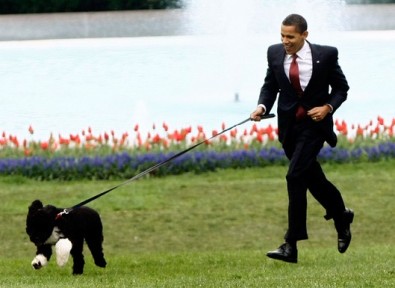
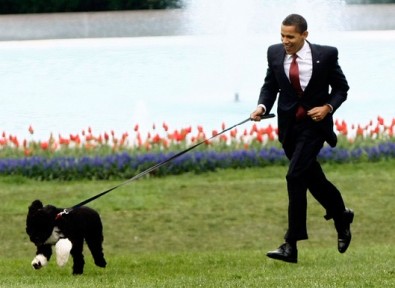
President Obama is not a dog. But he may need a friend

President Obama said in a political speech yesterday that his opponents talk about him as if he were a dog.  Well, I want to state here that I do not think the President should be treated like a dog. However, he should take counsel from the Harry Truman quote (which most now say Truman never said): “If you want a friend in Washington, get a dog.” Truman did have some dog issues, and probably should have had a dog.

The Obama’s do have a dog, who the President believes has star quality. Things are not going to get any friendlier in Washington the next two months; perhaps President Obama should get better acquainted with the dog, because he may need a friend. 

And as Lord Byron (not Truman) said in 1841: “Nobody need want a friend who can get a dog.”

Things Heard: e137v1

Good morning. I hope everyone had a nice Labor Day weekend.

  1. A new legal blog, a sample here.
  2. Worse than heroin? Hmmm, that’s an odd point of view to say the least.
  3. A word, oikophobia.
  4. More on the Beck gathering, here and here.
  5. That strikes me as less a problem of gender and more about manners.
  6. On the values gap.
  7. Freedom of speech and a martyr.
  8. Church and dress.
  9. A reply to Mr Krugman’s reading of WWII as stimulus
  10. Our government right now in a nutshell.
  11. One part of the financial picture.
  12. And an argument against expanding government influence in, say, healthcare or well just about anything.

Passing the evangelical torch: Bridging to everyday relevance

Evangelical leaders of previous generations are in the process of passing the torch to younger leaders, for whom there are at least 10 fresh challenges. We’ve considered the challenge of Navigating Newfound AuthorityWaging a New Bloodless Revolution, Overcoming Spiritual Superficiality; Creating Culture; and now a fifth challenge: and Returning to Virtue; now a sixth challenge:

Bridging to Everyday Relevance

As those of us who are Christians consider the needs of the world around us, we are wise and faithful to address first the deep spiritual needs of individuals, that they may be transformed by Christ. While the people we encounter will openly verbalize their concerns about external situations and crises—the ones that effect them personally and others that touch their hearts–the deep cry of the soul is often the most difficult to express.

But to be fully human and to identify with the humanity of our neighbors, we must address both the societal crises and conundrums and the spiritual hunger that seizes every human heart. Because of this dual responsibility we can meet physical and social needs as both urgent ministration and as a means to address spiritual needs. While this breadth of ministry has been common for the neo-evangelicals of the last generation, it is not as publicly known as their work fighting the culture wars. This is a serious identity challenge for young evangelicals as they engage in the issues that are of greatest concern to the rising generation. Often this will require bridging to issues of concern such as environmental degradation, nuclear proliferation, and persistent poverty.

Simply, to connect with those who are now coming of age, evangelicals need to overcome the blurred image of orthodox Christianity caused by controversial political involvement–by working alongside their contemporaries on often new issues of common concern.

Just what are those concerns?

Beyond the ongoing concerns of relationships and social connections, multiple polls about the most important current concerns and worries about the future surface two major issues for Americans ages 18-29:

  1. Will I have a job and be able to pay the bills in the near future, and will world and national economies be sound enough to provide stability throughout my life?
  2. Will our quest for energy and the damage it does to the world’s environment allow for a healthy and productive lifestyle today and in the distant future?

Typically, the environment and the economy figure prominently when Americans predict what the nation’s top problem will be 25 years from now. One of those two issues has been the most commonly mentioned in 7 of the 10 years Gallup has asked this question. Social Security topped the list in 2005 and 2006. In 2010 the top concerns about the future (for all Americans) were the economy, the federal deficit, and the environment. In other polls, terrorism, healthcare costs, war, and illegal immigration were also of great concern in 2010. 

A poll by Harvard’s Institute of Politics found that six out of 10 young adult Americans are financially anxious, worried that they cannot meet their educational, housing and health care needs. More than eight out of 10 said they expect difficulty finding a job after graduation. Fewer than half said they believe they would be better off than their parents when they reach their parents’ age.

In another survey of young adults, 24 percent of the respondents consider the breakdown of the family to be the most pressing issue facing their generation today, followed by violence in neighborhoods and communities, and then poverty and global warming. Personal finances and school ranked as high stressors

Jason Hayes wrote that in a Lifeway Research national poll almost 90 percent of unchurched 20–29 year olds said they would be willing to listen if someone wanted to tell them about Christianity. About 60 percent would be willing to study the Bible if a friend asked them to do so. However, while they agree that Christianity is a relevant and viable religion, they are harsh in their judgment that Christianity is more about organized religion than about loving God and people. In fact, only 17 percent (1 in 6) would first go to church if seeking spiritual guidance. They prefer going to trusted individuals.

That’s probably because someone who is going to sit down and talk with them is going to listen to their concerns and hear their emotion and spend the time finding commonality.

Things Heard: e136v5

Good morning.

  1. A book reviewed.
  2. VAT considered. The bigger problem with VAT is that the Congress critters considering VAT aren’t thinking of it as a replacement but an addition.
  3. A book list.
  4. Clunkers. A bad idea then, worse in retrospect.
  5. Oil in them thar hills.
  6. What airline I wonder?
  7. Beslan.
  8. Lies, damn lies, and statistics.
  9. Weather is not climate. Climate is not climate
  10. The Administration and yet-another-broken-promise.
  11. Another look at unemployment numbers
  12. Prayer as image.
  13. The Discovery nut as right winger meme.
  14. Statistics and schools. 

He Must Be a Right-Winger; He Used "Immigration" In a Sentence

He was a rabid environmentalist.  He considered babies "parasitic human infants", and wanted all "pro-birth" programs to push "stopping human birth".  He was extremely anti-war, and equated having more humans with more war.  He considered civilization "filth", and its religious roots "disgusting".

And ThinkProgress, an extremely popular liberal blog, calls out the Right over this guy, James Jay Lee, who took hostages at the Discovery Channel, because one of his eleven points refers to immigration. 

Really?  Is this what passes for intellectual honesty on the Left these days?  A guy who said Al Gore’s "An Inconvenient Truth" woke him up is a product of the Right?

None other than President of the United States Bill Clinton blamed conservative talk radio for Timothy McVeigh, and recently brought that back up in light of the Tea Party.  Conservatives against the "Ground Zero Mosque" were blamed for the stabbing of a Muslim cabbie (until it was found that it was a GZM supporter who stabbed the cabbie who was against the Mosque).  And Caleb Howe reminds us:

Lee acted irrationally. His environmental extremism was likely a function of his derangement, rather than the source of it. He latched on. He took it to the extreme, to say the least. Lee was not, by any measure that I would choose, a sane man. The story told by his brother-in-law – one of temper, erratic behavior, and irrational views – recalls Jerry Kane.

Jerry Kane, and his son Joe, killed two police officers and were killed themselves, in a shoot-out precipitated by a simple traffic stop. Jerry Kane, too, was an unstable man. His hometown mayor said of him that “You were always looking over your shoulder to make sure he wasn’t there. You never knew what he was going to do. I always thought he was an unstable individual.” Like Lee, the aftermath anecdotes painted a picture of paranoia and fear. But that didn’t stop liberal sites like Crooks and Liars from laying him at the feet of the conservative movement. Or Joseph Stack. Or Richard Poplawski. Or Byron Williams. It didn’t stop them from suggesting that Erick [Erickson] was responsible for a census worker slaying.

In fact, every time someone is shot in a lone gunman scenario, the right, and the tea parties and talk radio in particular, are virtually instantaneously blamed by the left at large for “violent” rhetoric and instigation.

Stop me, again, if you’ve heard THAT one before.

We never stop hearing from the MSNBC left how the Fox News right is stirring up violence. But when someone clearly basing his murderous intent on the idea that humans are going to destroy the world, and soon, acts on the dire prophecies of Al Gore … well suddenly you can’t blame rhetoric for crazy people.

Rachel Maddow, Keith Olbermann and Ed Schultz will simply not take responsibility for this guy.  I don’t think they should, but they should then not require the Right to take responsibility for the acts of other nuts.

But they will, as will Bill Clinton.  This is what passes for intellectual honesty on the Left.

When feelings take the place of thinking, God becomes our puppet

I’ve written previously on the false notion, in my opinion, of “felt-led” theology (see here and here). Felt-led theology, as coined by Greg Koukl at Stand to Reason, is a mindset among Christians, in which life decisions are based on whether or not one feels led – presumably of the Spirit – towards said decision. This experiential approach is heavily dependent on interpreting inner feelings and urges as potential messages from God. In a broad sense, such an approach is also used as a measure of one’s “connectedness” with God. In other words, your walk with God is determined by how well you decipher those inner nudges; the better you decipher, the more closely aligned you are with His Will.

Unfortunately, though pervasive within contemporary evangelical culture, felt-led theology has no scriptural foundation and, in my opinion, is tantamount to Christian superstition.

How many times have you encountered a fellow Christian who has made an important commitment decision or, worse, has left a previous commitment, mainly because they felt that God was leading them in such and such a direction? How many times have you encountered a fellow Christian, while contemplating a decision, state that they are “praying for direction”? It seems to me that the Bible makes it clear that we should pray for wisdom (and then use our own minds to make the decision).

Maybe it’s the introvert in me, as I deal with a decidedly extroverted Christian culture, but I tend to find the notion of relying on inner nudges and feelings, while we have access to God’s Word, to be a bit counter intuitive. Recently, I saw a discussion pertaining to how one should expect an answer from God, after prayerfully asking, especially when no answer seemed (felt) to be forthcoming. Some comments were (with my emphasis),

Yes, the waiting time can be very difficult. However, sometimes we have to ask ourselves if we are really listening or if we are really waiting for an answer.

Sometimes we’re so afraid of what the answer might or might not be that we’re not ready to listen to what he has to say.

He’ll only answer if you want him to.

While it’s sad to see such lame theology coming from other Christians, it’s even sadder to realize that such notions are commonly held beliefs within the evangelical community. One has to wonder if those who hold such beliefs have ever considered that God not only has the ability to deliver a message to us in any manner he chooses, regardless of whether or not we’re “listening” or whether or not we’re afraid of the answer, but that scripture does not support the notion that we have control over whether or not God speaks to us. Indeed, when one looks at scripture, one finds that God has no problem at all getting His message to whomever He chooses (ref. Saul on the road to Damascus); and that those who happen to feel that God is not answering them do not conclude that they aren’t listening hard enough, but understand the distinction of who they are and who God is (ref. David calling out to God).

Unfortunately, the message behind the idea that we can control whether or not answers from God get through is that we can conjure up God. That makes God our puppet – and that’s sending the wrong message to our fellow Christians.

For additional reference:
Just Do Something – Kevin DeYoung
Decision Making & the Will of God – Greg Koukl

Perhaps It’s a Double Standard Based On Science?

Steven Hawking is one of the most brilliant scientists of our time, and we’re lucky to have him.  In earlier days, his disability might have relegated him to being homebound, and he probably wouldn’t have lived nearly this long, robbing humanity of his intelligence.

However, he’s apparently branching out into a new area that he is not as well versed in; religion.

In his latest book, The Grand Design, an extract of which is published in Eureka magazine in The Times, Hawking said: “Because there is a law such as gravity, the Universe can and will create itself from nothing. Spontaneous creation is the reason there is something rather than nothing, why the Universe exists, why we exist.”

He added: “It is not necessary to invoke God to light the blue touch paper and set the Universe going.”

In A Brief History of Time, Prof Hawking’s most famous work, he did not dismiss the possibility that God had a hand in the creation of the world.

He wrote in the 1988 book: "If we discover a complete theory, it would be the ultimate triumph of human reason — for then we should know the mind of God.”

In his new book he rejects Sir Isaac Newton’s theory that the Universe did not spontaneously begin to form but was set in motion by God.

Scientists have a conniption when theologians delve into the scientific realm.  But apparently, that doesn’t work both ways in Prof. Hawking’s estimation.

Frankly, I think there can be spill over to each other.  The God of creation made us to be curious and made the order of the universe understandable to us.  I just would like scientists, who frown when a religious person appears to infringe on territory they claim exclusive rights to, would judge themselves by their own standards when moving the other direction. 

Things Heard: e136v4

Good morning. Well, I’m a little rushed this morning … shorter list than usual … work intrudes on life.

  1. Satan and cinema.
  2. Another view of the POTUS speech. I think the right was not his intended audience. I’m not sure who was.
  3. Thoughts on marriage, mostly from the left. I’d offer that if you’re considering marriage and want to pretend to live the self-examined life, this resource is indispensable (Wing to Wing, Oar to Oar).
  4. Ahhhhh
  5. Occupied territory.
  6. Why is this even a question
  7. Thought and sin.
  8. Liberal caricature.
  9. Comments of note.
  10. Of rest and restlessness.
  11. Noetic processes.

Passing the evangelical torch: Returning to virtue

Evangelical leaders of previous generations are in the process of passing the torch to younger leaders, for whom there are at least 10 fresh challenges. We’ve considered the challenge of Navigating Newfound AuthorityWaging a New Bloodless Revolution, Overcoming Spiritual Superficiality; Creating Culture; and now a fifth challenge:

Returning to Virtue. 

The new generation must deal with the crisis of basic character that overwhelms the nation and has also inflicted the church–with temptations of self-interest, immediate gratification, and moral laziness sapping the strength of its leaders and the witness of its people. All of us who are honest with ourselves will grieve our own failures to consistently demonstrate Christian character and to rise above our self-interest and harmful attitudes. There is less and less encouragement from our culture to demonstrate the basic virtues called for in not only the Christian tradition but in most traditions of Western civilization. Our Christian leaders must be known not primarily for their power, their persuasiveness, or their cultural conformity, but by their virtue.

These are not new concepts; they are ancient. Effective Christian witness will be seen from believers who can consistently demonstrate virtue.  Here’s one list of virtues:

 Purity

Abstaining from sexual conduct inappropriate for one’s state in life; the ability to refrain from being distracted and influenced by hostility, temptation,  or corruption.

 Restraint

Practicing self-control, moderation, and deferred gratification. Prudence to judge between actions with regard to appropriate actions at a given time. Proper moderation between self-interest, versus public-interest, and against the rights and needs of others.

Generosity 

Charity and self-sacrifice. Spending time, money, or labour, for others, without being rewarded in return.

Diligence

Decisive work ethic. Fortitude and the capability of not giving up. Budgeting one’s time; monitoring one’s own activities to guard against laziness. Upholding one’s convictions at all times, especially when no one else is watching; integrity.

 Patience   

Forbearance and endurance. Resolving conflicts and injustice peacefully, as opposed to resorting to violence. The ability to forgive; to show mercy to others. Creating a sense of peaceful stability and community, rather than engendering suffering, hostility,  and antagonism.

 Kindness  

Compassion and friendship for its own sake. Empathy and trust without prejudice or resentment. Unconditional love and voluntary kindness without bias or spite. Having positive outlook and cheerful demeanor; to inspire kindness in others.

 Humility    

Modest behavior, selflessness, and the giving of respect. The courage of the heart necessary to undertake tasks which are difficult, tedious or unglamorous, and to graciously accept the sacrifices involved. Reverence for those who have wisdom. Giving credit where credit is due; not unfairly glorifying one’s own self

That’s a good list for all of us. 

Bishop and New Testament scholar N.T. Wright makes a good case for believers to take seriously the formation of Christian character and the daily practice of virtues in his book After You Believe: Why Christian Character Matters.

This is an excerpt from the book:

“It is thus more or less impossible to speak of God with any conviction or effect if those who profess to follow Jesus are not exemplifying humility, charity, patience, and chastity. These are not optional extras for the especially keen, but the very clothes which the royal priesthood must ‘put on’ day by day. If the vocation of the royal priesthood is to reflect God to the world and the world back to God (the world, that is, as it was made to be and as, by God’s grace, it will be one day), that vocation must be sustained, and can only be sustained, by serious attention to ‘putting on’ these virtues, not for the sake of a self-centered holiness or pride in one’s own moral achievement, but for the sake of revealing to the world who its true God really is. The church has been divided between those who cultivate their own personal holiness but do nothing about working for justice in the world and those who are passionate for justice but regard personal holiness as an unnecessary distraction from that task. This division has been solidified by the church’s unfortunate habit of adopting from our surrounding culture the unhelpful packages of ‘left-wing’ and ‘right-wing’ prejudices, the former speaking of ‘justice’ and meaning ‘libertarianism’ and the latter speaking of ‘holiness’ and meaning ‘dualism.’ All this must be firmly pushed to one side. What we need is integration.

Wednesday Highlights

Good morning.

  1. Son of a great man.
  2. On the POTUS address.
  3. Verse.
  4. Huh, the average male has a GPS these days.
  5. France and the Roma.
  6. Hmm, in a search for a less substantial less vapid political post … this might be in the list. My wife lists here occupation on our 10-40 as “domestic goddess.” 
  7. Male midlife crisis … a temporary one.
  8. Mr Assange.
  9. About those free riders.
  10. I think that assessment is right, although I doubt my own ability to judge the motives of liberal/progressives.
 Page 4 of 4 « 1  2  3  4