Constraint and Awareness

In many cultures in the Middle East and elsewhere in the world there is a strikingly different approach to sexuality and the interactions between men and women. These cultures feature an emphasis on honor and shame as well as well as being on the other side of the individual/collective axis from those us in the modern West. If one takes a spectrum of human cultures and measured them by a metric which weighs their emphasis on individual vs group responsibility and sensibility one would find US and Western cultures today leaning toward the side of individuality and the individual whereas these Middle Eastern cultures were would be found at the other end, in which a person does not weigh his own advantage before that of his particular group (in this instance the primary group was the family). There are two reasons why this is important. First is, that many of us find the Bible, a book authored within the context of an honor/shame/collective culture is important. And furthermore the honor/shame/collective culture like the Middle East of the 1st century, comprises 70% of the worlds population today. Most of those of us reading this essay live in the western minority. If you think the liberal/conservative or left/right divide in the US is difficult to cross … it pales before this larger cultural  division.

Features of the culture in which the separation of men and women is predominant are discussed in great detail elsewhere and by others. For the following, I’m going to concentrate on just one aspect of differences between the West and the h/s/c cultures. Most h/s/c cultures typically arranged themselves specifically in ways that tried to make it impossible for men and women to come into contact in a situation where their interpersonal relationship/contact might lead to a social unacceptable sexual relationship. In part a working assumption there is that people in these situations do not have the will power to actually resist such temptation. Now from the point of view the Western outsider there are a plethora of very disadvantageous features to this particular arrangement. For the point being made below … these perceived negative aspects are, at least at first glance, not relevant. What is relevant is the comparison made between our porn drenched Western culture and theirs in that the sight of the hint of anything at all about woman’s figure or form his highly eroticized in their culture where in ours the saturation has desensitised us. And it is this relative sensitivity to the erotic is that which I wish to use as a analogy to compare the high (hierarchical) churches to the low churches in their differing treatment of liturgy and sacrament to the restrained/free sexuality in the other two cultures.

In h/s/c cultures one finds manner, clothing, and interactions between the sexes in society highly constrained. In high liturgical/hierarchical churches one finds the manner, clothing, and interactions in liturgy similarly constrained. The west can be described as jaded and deadened to stimuli in comparison to the h/s/c cultures with respect to sexual imagery and erotically charged situations. Similarly, in prior conversations for example on Evangel, modern American protestants are comparatively blind to the sacred, as what was Holy was defined as something of an internal state of mind not a ontological property which can attached to a place (such as the Bush in Exodus). My point is that a sense of the sacred and a sensitivity to Holiness is heightened by similar practices. One might compare the segregation of the sexes in Middle Eastern cultures to the wall or screen separating between the servers, deacons, and priests and the congregation in the Eastern rites.

“God’s favorites…the poor”: Charles W. Colson in The Faith

Wonder what Glenn Beck would say about this:

“As we see the world through God’s eyes, we actually do put others’ needs ahead of ours.  This is why, when the great novelist Flannery O’Connor was asked by one of her correspondents how he could experience God’s love, her reply was, “Give alms.” She meant do something for the poor, for those in need, which in fact is one of the most telling marks of Christian holiness, as the apostle James reminds us (1:27; 2:17).

When we care for God’s favorites, the poor, who include the destitute, the widowed, the fatherless, the sick, prisoners, and anyone suffering injustice, we plunge immediately into the cosmic battle that’s always raging between good and evil.  We choose sides. Once on God’s side, we come to understand God’s point of view and position ourselves to experience God’s love and friendship in a whole new way.”

–Charles W. Colson, in The Faith (Zondervan: 2008), pags. 164-165

So Much For an "Up or Down Vote"

Can’t get a 60-vote majority, and reconciliation seems unobtainable?  Just play make-believe.

After laying the groundwork for a decisive vote this week on the Senate’s health-care bill, House Speaker Nancy Pelosi suggested Monday that she might attempt to pass the measure without having members vote on it.

Instead, Pelosi (D-Calif.) would rely on a procedural sleight of hand: The House would vote on a more popular package of fixes to the Senate bill; under the House rule for that vote, passage would signify that lawmakers "deem" the health-care bill to be passed.

The tactic — known as a "self-executing rule" or a "deem and pass" — has been commonly used, although never to pass legislation as momentous as the $875 billion health-care bill. It is one of three options that Pelosi said she is considering for a late-week House vote, but she added that she prefers it because it would politically protect lawmakers who are reluctant to publicly support the measure.

"It’s more insider and process-oriented than most people want to know," the speaker said in a roundtable discussion with bloggers Monday. "But I like it," she said, "because people don’t have to vote on the Senate bill."

Why bother with a pesky Presidential signature, or an actual up-or-down vote, when keister-covering is so much more politically expedient?  Let’s just pretend the bill passed.

Shouldn’t something as massive as this have broad bipartisan support?  But not even the Democrats themselves, when they held a 60-vote majority, could get it past their own folks.  This is just wrong.

"Social Justice" vs Social Justice

While I’m just as "avid" a fan of Glenn Beck as Rusty (i.e. only really catch him on the occasional web snippet), I have read the transcript of his "social justice" rant, and I really don’t think Beck said what his detractors say he said.

Beck was talking about churches/denominations for whom one of their driving forces is implementing aid to the poor and oppressed via government force, and seem to think that almost every time Jesus opened His mouth He was speaking economics.  (I’ve seen the parable of the sower turned into one where the birds taking away the seed were priests taking temple tithes and tribute, and the thorns choking out the seed were the Roman tax collectors stealing from these humble farmers.  Jesus said plainly what He meant, but some can still wrangle an economic message out of it they find more palatable.)  The term "social justice" seems to figure prominently in these forms of theology, and Beck was just saying that you should avoid them completely if you see that they do. 

What his critics are doing are quoting Bible verses that show we should help the poor.  Thing is, I don’t think Beck would disagree, and it doesn’t appear at all that he was saying he disagreed.  What he was saying is that churches where the phrases "social justice" and "economic justice" figure prominently are the ones trying to "spread the wealth around" via legislation and are going to bankrupt us in doing so; a political message.  Of the reports so far, only Hannah Siegel, reporting for ABC news, even mentioned this:

Stu Burguiere, executive producer at "The Glenn Beck Radio Program," sought to clarify Beck’s comments today.

"Like most Americans, Glenn strongly supports and believes in ‘social justice’ when it is defined as ‘good Christian charity,’" he said. "Glenn strongly opposes when Rev. Wright and other leaders use ‘social justice’ as a euphemism for their real intention — redistribution of wealth."

So Beck is in favor of the concept of social justice (without the quotes) but against those who use that term to couch ends that he finds immoral.

But the reactions from critics seem to miss this completely.  When Wallis insinuates that Beck is lined up against Martin Luther King, Desmond Tutu and Mother Teresa, or National Council of Churches President Rev. Canon Peg Chemberlin says, "Justice is a concept throughout the scriptures", they’re both completely misrepresenting what Beck actually said. 

Beck does need to clarify, on-air, that he is in favor of the concept of social justice, though, if you fairly read his words, he never once insinuated that he wasn’t in favor of giving to the poor; this clarification would be for those who didn’t realize that the first time.  I understand that he did just that recently, though I haven’t heard or read what he said yet. 

Albert Mohler has the most balanced analysis of this issue.  Read the whole thing.  However, I want to quote one bit from it, showing how many Beck critics really missed the point.  Mohler notes that Beck’s aims are political.  However…

My concern is very different. As an evangelical Christian, my concern is the primacy of the Gospel of Christ — the Gospel that reveals the power of God in the salvation of sinners through the death and resurrection of the Lord Jesus Christ. The church’s main message must be that Gospel. The New Testament is stunningly silent on any plan for governmental or social action. The apostles launched no social reform movement. Instead, they preached the Gospel of Christ and planted Gospel churches. Our task is to follow Christ’s command and the example of the apostles.

There is more to that story, however. The church is not to adopt a social reform platform as its message, but the faithful church, wherever it is found, is itself a social reform movement precisely because it is populated by redeemed sinners who are called to faithfulness in following Christ. The Gospel is not a message of social salvation, but it does have social implications.

I grew up in the Salvation Army; a social services arm of the Christian church if ever there was one.  But one that stays true to this concept of creating social change by implementing the Gospel, not a government program.

As a follow-up to my earlier post on Glenn Beck’s affront to Christians, can anyone identity the author of the recent book that included these shocking words:

“As we see the world through God’s eyes, we actually do put others’ needs ahead of ours.  This is why, when the great novelist Flannery O’Connor was asked by one of her correspondents how he could experience God’s love, her reply was, “Give alms.” She meant do something for the poor, for those in need, which in fact is one of the most telling marks of Christian holiness, as the apostle James reminds us (1:27; 2:17).

When we care for God’s favorites, the poor, who include the destitute, the widowed, the fatherless, the sick, prisoners, and anyone suffering injustice, we plunge immediately into the cosmic battle that’s always raging between good and evil.  We choose sides. Once on God’s side, we come to understand God’s point of view and position ourselves to experience God’s love and friendship in a whole new way.”

Things Heard: e110v2

Good morning.

  1. A fact vs myth for the healthcare debate.
  2. A word from the desert.
  3. Wind farming and climate.
  4. Gay bashing and standards.
  5. Conservative.
  6. Watching the Druze.
  7. Lance Armstrong.
  8. Prayer.
  9. Geting it backwards.
  10. The courts.
  11. Multipliers.
  12. CS Lewis and St. Silouan.
  13. An interview on Eric Rohmer and his films.
  14. Talking about liberty.

Things Heard: e110v1

Good morning.

  1. Selection of a sort.
  2. If those stats on age refer to the “brake/accel” issue, the problem is not mechanical.
  3. A view of Mr Obama which makes some sense … but see this in that context.
  4. Chesterton.
  5. Repentance.
  6. The rehabilitation of US Grant … is that it? To keep Mr Reagan off the $50 bill?
  7. Very sweet.
  8. On war.
  9. Hmm.
  10. Smile, your feel good story for the day.
  11. Image, archetype and propaganda … 
  12. Girls.
  13. And some old advice that remains good.

It really is past time for Glen Beck to apologize to Christians for his equating the church’s work in social justice with Nazism and Communism. He’s not just enraging liberals; he’s become an embarrassment to conservatives. And on this point he’s just wrong in the most offensive way.

Although he wasn’t directing his comments at the Heritage Foundation video series, Beck’s comments were made just after the release by Heritage of the series on social justice with Chuck Colson of BreakPoint, Al Mohler of Southern Baptist Theological Seminary, Sean Litton of the International Justice Mission, and other evangelical leaders speaking on the meaning and importance of social justice.

Beck’s comments are not an issue of left and right but of false representation of the teachings of Jesus on care for the poor and the suffering, and a broadside against those who live out the Gospel in our society.

The criticism of Beck is strong and diverse, from many parts of the religious spectrum:

Jim Wallis, Sojourners

James Martin, S.J., Catholic priest

Richard Land, president of the Southern Baptist Convention’s Ethics & Religious Liberty Commission

Joe Carter, evangelical editor, First Things

The Rev. Canon Peg Chemberlin, president of the National Council of Churches of Christ USA

David Gushee, evangelical, professor of Christian ethics, Mercer University

Marty Duren, Southern Baptist pastor

It’s time for Beck to make amends, or for Fox News to censure him or drop his show.

Are you going to home school through high school?

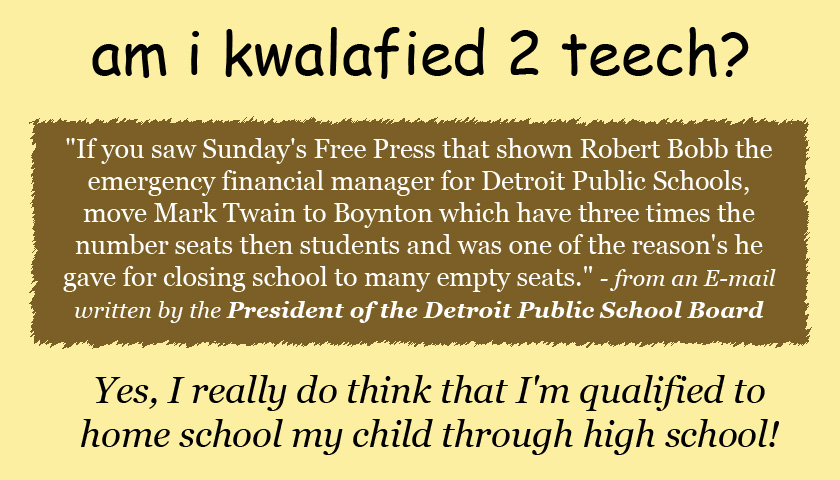
Are you a home school parent? Have you come up against criticism such as, “How can you be qualified to teach high school to your child”? If so, then simply hand out the following am i kwalafied 2 teech? card, which highlights an incoherent E-mail written [sic] by the President of the Detroit Public School Board.

Printing instructions: Click on the image above to open up the full-size version. Print the image, size to 3.5″ wide by 2″ tall.

Ninth Circuit Court of Appeals Rules "Under God" Constitutional

Yes, that 9th Circuit.  The same one that ruled it unconstitutional before.

A federal appeals court upheld the use of the words "under God" in the Pledge of Allegiance and "In God We Trust" on U.S. currency, rejecting arguments Thursday that the phrases violate the separation of church and state.

The San Francisco-based 9th U.S. Circuit Court of Appeals panel rejected two legal challenges by Sacramento atheist Michael Newdow, who said the references to God are unconstitutional and infringe on his religious beliefs.

The same appeals court caused a national uproar and prompted accusations of judicial activism when it decided in Newdow’s favor in 2002, ruling that the pledge violated the First Amendment prohibition against government endorsement of religion.

But here’s the thing.  The last time he tried this, it went to the Supreme Court which simply said he had no standing.  So they never really dealt with the salient issue.

Now, the 9th Circuit takes up the exact same issue, and, lacking some SCOTS precedent to fall back on, rules in the opposite direction. 

Apparently, it’s all due to the luck of the (judicial) draw; it depends on which 3 judges you get.  Although…

In a separate 3-0 ruling Thursday, the appeals court upheld the inscription of the national motto "In God We Trust" on U.S. coins and currency, citing an earlier 9th Circuit panel that ruled the phrase is ceremonial and patriotic and "has nothing whatsover to do with the establishment of religion."

I’d say, neither does "under God" in the pledge; it’s a statement of historical fact.  Still, "In God We Trust" gets a 3-0 unanimous decision while "under God" goes 2-1.  The 9th Circuit Court of Appeals richly deserves it’s position as the most overruled appeals court in the country.

Hat Tip: Stop the ACLU

Why I Oppose the HCR Bill: The Perfect is the Enemy Of the Good

It is better to empower the people to be more charitable by letting them keep their money in order to give it than to get the government in the health care business.  It is both cheaper and more moral. 

Will people fall through the cracks if this is left up to the people?  Yes.  And it will be the same for a government program.  Don’t let the "perfect" be the enemy of the "good", especially if the "perfect" is clearly known to be unobtainable. 

Trying to obtain that perfection via government will do 2 things.  First, it will not happen.  Second, it will give more power and money to a government already awash in both.  For those that already despise dealing with a more local insurance company, multiply that for dealing with the government.  (Including, yes, "death panels", just like they have in Canada, in behavior if not title.)

But will government involvement, if not perfect, be at least better than we have now?  Perhaps we could ask that cancer patient in Alberta (follow that link up there) who came to Minnesota to get lifesaving surgery.  Or you could read the article in the London Times about how the liberal Labour party hid the truth about patient neglect in their National Health Service.  If your measure of "success" is how many people have health insurance, then sure, it would be "better".  But if you factor in the quality of care, not so much.

Because our system isn’t perfect, don’t make a deal with the devil.  Our founding fathers felt government to be a necessary evil.  They were students of history that saw the natural tendency of government and tried to avoid those problems when they wrote the Constitution so that government’s power was limited.  We are "unwriting" those limits if we do this.

Things Heard: e109v4

Good morning.

  1. Bonhoeffer on technology.
  2. The Democrats getting press, more here.
  3. Undermining public education by the Admin, a feature not a bug?
  4. Candidates and boxes.
  5. Wind bottles and power.
  6. Of metric, model, and stimulus.
  7. Church and culture.
  8. Trust and reputation.
  9. The medieval warm period … and a correlation (which is not causation … but that doesn’t mean it isn’t either).
  10. A long conversation on morals and war.
  11. Freedom of speech and the word ‘nigger’.

When Pro-Choice = Pro-Abortion

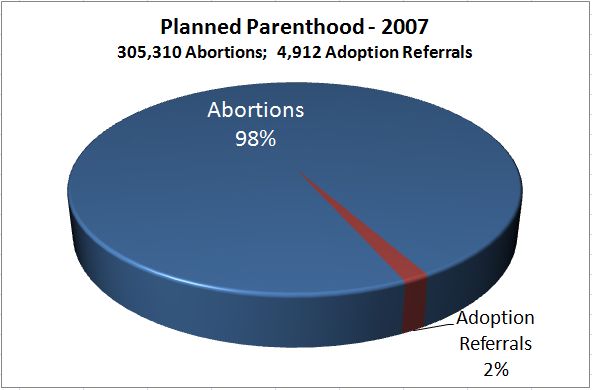
Per Planned Parenthood’s annual report, they performed 305,310 abortions in 2007, compared to 4,912 adoption referrals. HT: Mere Comments.

It would seem that, in terms of being Pro-Choice, their act of choice is… abortion.

Things Heard: e109v3

Good morning.

  1. Wrecked ships.
  2. The Chicago machine and what it means w.r.t. our current President.
  3. Data and the CBO.
  4. A modest suggestion.
  5. Jokes in the Chavez regime.
  6. Go left.
  7. Laptops in lectures.
  8. On the Toyota recall.
  9. A sign you might be wrong.
  10. Free market and correction.
  11. On Greece.
  12. Google maps and the bike route.
  13. Heh.
  14. On fear and terrorism.

Warming up to cooler climate changes over colder times of warmer weather

Colder means warmer when global warming becomes climate change except when more hurricanes result in less hurricanes before a dip in temperature preceded by a warm few years and less snow on an Olympic downhill run sixty years after record heat waves.

Oh bother!

Fumento tells us all about climate vs. weather regardless of who happens to be doing the claiming (and he links to an interesting page which tracks EVERYTHING that global warming is affecting).

 Page 127 of 245  « First  ... « 125  126  127  128  129 » ...  Last »