Baroness Pelosi Reverses Reform

Nancy Pelosi has approved new rules for the House that will keep the old boy (or girl) network firmly in place.  In 1995, when the Contract With America propelled Republicans into Congress, one of the points of the contract was to limit the terms of committee chairs so that you remove the ability of one Representative to rule the roost until they retired or died.  This reduces the opportunity for corruption to build up over time or last for decades. It brings in new blood to bring new eyes to the issues. 

Pelosi will have none of this.  Let’s see how the rest of her party feels when the rules package is voted on.

Things Heard: e49v4

Consider Hatred

I have to admit, I don’t grok the whole “hate-of-group” thing that so many people to seem get infected with.

But during National Brotherhood Week
National Brotherhood Week
New Yorkers love the Puerto Ricans
‘Cause it’s very chic
Step up and shake the hand
Of someone you can’t stand
You can tolerate him if you try

Oh, the Protestants hate the Catholics
And the Catholics hate the Protestants
And the Hindus hate the Moslems
And everybody hates the Jews

But during National Brotherhood Week
National Brotherhood Week
It’s National Everyone-Smile-At-
One-Another-hood Week
Be nice to people who
Are inferior to you
It’s only for a week, so have no fear
Be grateful that it doesn’t last all year!

Does anybody out there understand it? I don’t think the I have any conscious awareness of hatred for any particular group, except perhaps a particular peccadillo I observe (in others) which bugs me. That is I get unreasonably irked when I see able bodied people using handicapped spots. But that’s not the same as the prejudices and hatreds which seem to abound.

If you hate someone, why do you do it? If you hate or despise a particular group of people, why? How do you justify that?

Things Heard: e49v3

Considering Consequentialism and Torture

One of the dominant meta-ethical methodologies today is consequentialism. The consequences of your choice determine for you the right choice. Roughly speaking if your choice would lead to harm, then it is wrong. Then, consider the following, is it torture from a consequentialist perspective, and if so why? And if it is not, why is it wrong … or is it wrong at all.

  • We propose first a drug exists which prevents the formation of long term memory. If this drug is taken, no long term memories will be formed effectively and permanently erasing all subsequent memory of the events from the last, say, 12 hours.
  • A torture technique, much like the infamous waterboarding is applied which causes great mental distress, “cracking” the subject but causing no organic damage, i.e., no physical harm which will be detectable the next day by the subject.
  • Therefore the use of the techniques like the above coupled with the absence of memory mean that for the subject there is no way of determining that anything occurred.
  • After questioning is performed and the results reported , both the subject and the administrator(s) of the questioning (the “torturer”)  are given the drug noted above. Thus neither the questioned nor the questioner have any memory of the event. For them, this never occurred.
  • Furthermore, names and data regarding the subject and administrators are not kept. No video record is kept of the interrogation, just conclusions remain with all source information excised. This is to insuring that there will remain no possible (direct) data remaining of the specifics of the interrogation. This prevents the subject (or interrogator) from later viewing and discovering later that they took part this event.

So the question is, where is the harm? It is said that the act of torture degrades the torturer as well as obviously harms the tortured subject. This is in fact why the interrogator as well as subject are given the drug. Therefore with no physical or mental memory of the event, how do we locate harm to the subject? Without memory, is there harm? There is no consequence to subject (or interrogator) on which a harmful consequence can be attached. Where then is the harm located?

The only possible harm is the memory gap that remains. But memory gaps are common. About a decade and a half ago, I had appendicitis. Demoral was administered as a pain killer after the surgery. Intravenous demoral had the effect on me of preventing me from forming reliable memory of the event. Memory of small inconsequential routine days as little as a month or half a year ago fade. Human memory is not so precise that one can realistically locate as harm to an individual the loss of a half of a day in the eight to ten decades of average human lifespan. Couple that with national imperatives to solve crime, stop terror, or save lives by performing the interrogation and one has a consequentialist argument that leads one inescapably to the conclusion that this sort of interrogation is not only not harm, but an ethical good.

My suggestion is that this sort of thing is indeed actually unethical and wrong and that that there is no consequential argument that can be made against it. Therefore this can be posed as is an argument underlining a fundamental deficiencies of the consequentialism as a meta-ethical methodology.

Is this just logical nonsense? Perhaps, but I suspect the technology to implement such a program is not just a hypothetical suppostion, but that it could be implemented today, if a government so chose. That consequentialism is perhaps the dominant meta-ethic should therefore give us pause.

Comments?

Global Warming Update

With a hat tip to NewsBusters, a report on polar ice from this past June:

It seems unthinkable, but for the first time in human history, ice is on course to disappear entirely from the North Pole this year.

The disappearance of the Arctic sea ice, making it possible to reach the Pole sailing in a boat through open water, would be one of the most dramatic – and worrying – examples of the impact of global warming on the planet. Scientists say the ice at 90 degrees north may well have melted away by the summer.

"From the viewpoint of science, the North Pole is just another point on the globe, but symbolically it is hugely important. There is supposed to be ice at the North Pole, not open water," said Mark Serreze of the US National Snow and Ice Data Centre in Colorado.

That was then.  This is now.

Thanks to a rapid rebound in recent months, global sea ice levels now equal those seen 29 years ago, when the year 1979 also drew to a close.

Ice levels had been tracking lower throughout much of 2008, but rapidly recovered in the last quarter. In fact, the rate of increase from September onward is the fastest rate of change on record, either upwards or downwards.

(That rapid recovery in the last quarter is what we in the northern hemisphere call "winter".)

So all the experts and nifty computer models were absolutely wrong.  We’re not sailing ships through Santa’s workshop; instead we’re seeing ice levels we haven’t seen for 30 years.  Why were predictions so wrong?  The article explains:

Researchers had expected the newer sea ice, which is thinner, to be less resilient and melt easier. Instead, the thinner ice had less snow cover to insulate it from the bitterly cold air, and therefore grew much faster than expected, according to the National Snow and Ice Data Center.

Maybe, just maybe, the earth has cycles and this icing is just one of them.  Cycles like this are one of the reasons that the Huffington Post — no member of the Vast Right-Wing Conspiracy they — are now preemptively accepting Al Gore’s apology for the lies he’s been telling us.

Read the rest of this entry

Things Heard: e48v2

The Gaza War and the "Anti-War" Left

"There have been approximately 7,200 rockets (Grads, Qassams) and mortars launched at Israel since 2005", according to IDFSpokesperson.com.  There are more stats at the link, but let that one sink in for a moment (especially after reading this headline).

Now consider that when Israel finally defends itself, and launches a counter-attack, with the goal, not of revenge, not of tit-for-tat, but to stop the attacks aimed at it’s civilians by targeting Hamas’ military, then and only then does the "anti-war" Left spring into action.  I really must put "anti-war" in scare quotes because, as much as their rhetoric is anti-all-war, they only get their dander up when their particular political ox is being gored.  They dredge up their celebrities, who have been chirping with the crickets for years regarding Hamas’ continual barrage, and get them to feign outrage for the media.

Israel made the extremely difficult decision to evict its own people out of their homes to make Gaza available to the Palestinians.  But with respect to international relations, the only thing that did was give Hamas a closer base of operations to fire rockets into southern Israel.  And as this short video production notes, distance is only a matter of time.  Unless Hamas’ ability to launch is severely curtailed or stopped, major population centers are on their list. 

But nary a word from the "anti-war" Left, hardly a bare nod to what Hamas terrorists have been inflicting on Israel for years.  There’s a word for this: Disingenuous. 

I’d like to re-link something that Mark O. noted before.  This post at Chicago Boyz notes that terrorism, historically, cannot be negotiated with.  Any concessions simply bolster their cause for more terrorism.  Israel, after decades of pressure, gave up land for peace.  They did the former, but they never got the latter.  And if all they do is make concessions, they never will.  (Remember this when discussing "root causes" of 9/11, by the way.)

I’ll leave you with this post from Yourish.com; 15 New Commandments for gradual self-destruction.  See what the liberal mindset hath wrought.  (And bookmark "yourish.com".  Their analysis of the media coverage of the Gaza war has been fantastic.)

Things Heard: e48v1

A Question

With regarding the current financial crises has the following connection been made anywhere?

  • Many American’s operate close to the edge of their liquidity, spending money on “things” at about the same rate it comes in.
  • Gas prices doubled in a short period of time, coming to a maximum shortly before the crises.
  • Our economy is called rightly petroleum based.
  • Our behavior didn’t markedly change quickly when prices doubled.
  • Then the credit markets collapsed.

It is hard to adjust habits, spending and activities rapidly to match rapidly fluctuating commodity prices. When that commodity is oil, which is so fundemental to every one of our activities. That could spell trouble.

Is it too simplistic to account for the current market problems to the inability of that same market to adjust quickly to fluctuations in cost of its fundamental commodity? If not, why isn’t this being noted? Or more to the point, what’s wrong with my logic above? And if it isn’t wrong, who else is suggesting it.

Using the George Bailey method of facing the New Year

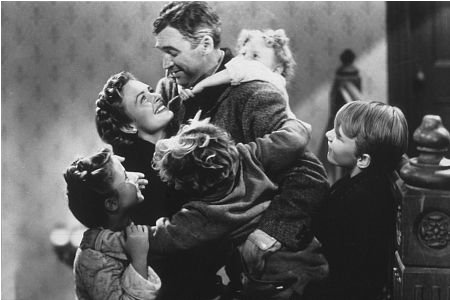
Tucked somewhere inbetween making tamales and lighting each of the 5 candles of Advent, watching the movie It’s a Wonderful Life has become sort of a family tradition for us. Call me sentimental, but I firmly believe the film to be a masterpiece of cinematic story-telling.

Greg Koukl, at Stand to Reason, recently pointed out an op-ed by Andrew Klavan, written in 2003, in which Klavan extolls the virtues of both Scrooge (1951) and It’s a Wonderful Life. He writes,

In “Scrooge,” a man grown rich because of heart-shriveling greed is forced by spirits to view the consequences of his existence.

In “It’s a Wonderful Life,” George Bailey, a man in financial trouble because of his large-souled generosity, is forced by an angel to view the consequences of his non-existence: what would’ve happened if he’d never been born.

On both sides of the mirror, the results are the same: a revolutionary personal transformation, what the New Testament calls “metanoia,” which is often translated as “repentance” but which means literally “a change of mind.”

After the metanoia, there’s a lot of Christmas caroling and happiness and that sort of thing. Thus movie critics – who frequently confuse darkness with depth – sometimes belittle these films as sentimental.

They’re wrong. Watched carefully, the films are disturbingly realistic. Because, for each protagonist, the change in outlook has absolutely nothing to do with a change in circumstance. They aren’t singing carols and so forth because they’ve won the girl or beaten the villain or made millions or righted wrongs. Scrooge can never bring justice to the people he’s ruined, and Bailey will never become the world-traveling architect he wanted to be.

As we enter the new year, we would do well to consider whether or not our outlook for the future is driven by our circumstances or by our will.

Happy New Year.
Things Heard: e47v3

A Modest Proposal for Palestine

The world has long awaited and long needed, a final realistic solution to the Palestinian/Israeli Middle East problem. And at long last, I’ll offer it to y’all for free. Just because … I’m that kind of guy.

The problem itself goes back some years, generations in fact. To the creation of Israel. The UN in either its folly or its evil intent, depending on your point of view on that matter, created this whole disaster by its intentional act. In the movement of Israel to a free Jewish state they moved the Palestinians out. Where? Into “permanent refugee camps”. Now in the rest of the world, and in saner moments of reflection, it will occur to any rational observer that the words “permanent” and “refugee camp” should not be connected in any way shape or form. Refugee camps, well suck just a little less than the terror of war, famine, or other disaster from which the refugee is fleeing. The slogan might be, “refugee camps, where life sucks just a little less than being dead.” The purpose of such camps is to either wait the short time until the disaster has passed to return home, or in case of civil war and the possibilities of return are not realistic … a place to survive until one can make oneself a way to find a home elsewhere.

Well, guess what. The time for waiting for Israel to be returned to the Palestinian people has passed its time. It’s well overripe. The refugees need to find a home … outside of that refugee camp. The time for the Palestinian diaspora is now. These people need to be integrated into society. Those people need to be bussed out of those camps, split up, separated and integrated into legal stable societies all over the world. They need jobs, they need a quiet surrounding filled with law abiding people to raise their children in, they a fresh start.

Decades ago if not sooner.

(one final remark, note the title, “A Modest Proposal” … you all know what that means right?)

Business Ethics

I hear there are courses offered at B-school on this topic. This is odd, or a unfortunate sign of the times at best.

Business ethics are trivial. Two rules only.

  1. Don’t lie.
  2. Don’t steal.

Uhm, what isn’t covered in those two simple rules in the world of commerce? Why are there courses to teach how to do that?

Things Heard: e47v2

 Page 189 of 245  « First  ... « 187  188  189  190  191 » ...  Last »