Archive for May, 2010

A Clear Look Into the Soviet Union. >yawn<

Betsy Newmark notes the collective disinterest in new documents that give us a much better look into the waning day of the former Soviet Union.

This is amazing stuff: Claire Berlinski reports on documents smuggled out of Russia about the last years of the Cold War. These are documents from Gorbachev’s own files and are an amazing treasure trove of notes from his meetings with foreign dignitaries and from the Central Committee of the Communist Party. Simply fascinating stuff. But no western publisher seems to be interested in publishing any of this.

Why wouldn’t western researchers and publishers be interested in documents containing such tidbits as Gorbachev’s response to the Chinese killing dissidents in Tiananmen Square? Maybe they don’t like the real story of how he just shrugged it off. Or his laughter at the news of the Soviets shooting down a Korean jetliner.

The press and the Left in this country were apologists for the Soviet Union, very nearly lionizing Gorbachev.  So it’s no wonder that this is not getting more notice in the network news.  Again, it’s all about the narrative (and not wanting to be shown to be horribly wrong about them).  And not only the US press but the European press as well which, again, were all too ready to seek the USSR’s approval rather than take the hard positions on what was right.

(This is the same press/Left/Europe that freaked out when Reagan stood up to the Communists and set in motion their downfall soon after.)

Betsy has more, and Clair Berlinski has lots more.  And you gotta’ wonder if "USSR" was replaced by "Nazis", whether this would be equally as ignored.

Things Heard: e119v1

Good morning.

  1. Well, now that he’s done finger pointing everybody else should now stop too.
  2. Freedom of speech in the UK, exhibits one and two.
  3. Not unrelated to the above.
  4. Go girl!
  5. Art.
  6. A book dismissed.
  7. Setting aside the American Trinity.
  8. Not the cowardly lion.
  9. Nixon and China.
  10. The hood.
  11. Pacifism and war.

The Many Worlds as Adiaphora

Two well known strands of Protestant theology are the Calvinist and Arminian. There are a number of differences between these two schools but one of them keys on soteriology (salvation). Calvinists would hold that once a person is saved, he is always saved. Arminians dispute this idea. Consider the following thought experiment:

  1. A person, we’ll call him John, is born and arrives in his twenties. He is a devoted and sincere Christian.
  2. Then, in his twenties a series of circumstances arise and he loses his faith. Through his mid-thirties he is a not-Christian.
  3. Finally late in life and to his death he returns to the faith of his birth and is again a devout and sincere Christian.

We add to this mix “device X.” Device X is trained on John and makes him into an human Schrödinger‘s Cat. If a particular nuclei is seen to decay … he dies. The state of this nuclei is tested at points 1 and 2 during his life. So we now consider if he dies at points 1,2, and 3 in his life and the soteriological implications of this.

My (limited and likely flawed) understanding of the Calvin/Arminius dispute is that an Arminian would say he was saved at points 1&3 and a Calvinist would say at point 2 that even though John was not a believer that he (John) is still one of those saved that He (God) would still call him saved because He (being omniscient) knows that John will live through to point 3 and will return to the fold.

This is where the Many-Worlds theory comes in. An Arminian could argue that each of points 1,2, and 3 the universe splits. In one universe he lives. In the other he dies. Therefore the Calvinist argument that God can know the result is impossible. Just before point 1, there is one universe. After point 3 there are three and in two of them John goes on to be saved and one in which he is not.  Therefore if Many Worlds is true God cannot say which John He is judging at point 1 … which is the Arminian statement on this question. Thus the Arminian view is compatible with Many Worlds while the Calvinist view is not.

If one take (the seemingly obvious and innocuous) view that belief or non-belief in the quantum theory known as the “many worlds hypothesis” is adiaphora. It is not essential to salvation whether you give the theory credence or not … and that given the dependence of this particular dispute between these two schools on this point … that therefore this point is thus also adiaphora and not dogma.

I think I’m going to start calling myself a progressive. If one labels place on the axis regarding social or cultural change … progressives want to move away from the status quo toward something new, conservatives are cautious about movement along that axis, and reactionaries also want cultural change … but back toward a past relationship. Conservatives in that light are at the zero point, the origin of a generic “social movement” metric. This is (in the light of prior discussion) not a “retconning” of the definition of progressive, reactionary, and conservative but indeed the standard ones. However it might be noted that in popular parlance, progressive and conservative have come to mean ill-defined but definite political party affiliations … and this is not the usage of these words I am applying here. The other meaning however is also well known and common and I don’t think there are really any alternatives words to use in their place.

Sometime past the topic of Honor/Shame cultures came up in a more sympathetic setting than I had experienced before. I think the so-called ‘conventional wisdom’ regarding H/S cultures is a confused message from the liberal academic establishment. The conventional wisdom is that their treatment of woman (and gays) is appalling and that life in these societies is horrible. Our news services flood us with messages giving us a feeling of superiority regarding our culture, with stories of older men marrying or abusing pre-teen and young women. Yet as was pointed out what is missing in those stories are numbers and any sense of comparison of different flaws which appear in our own society. That is to say, that yes, while women suffer some problems in those societies that is not necessarily the norm but that these are outliers or abuses that appear at the edges. On the other hand, in our society rape, murder, suicide and mental illnesses like depression which are apparently far rarer in those societies and serve the similar role of outliers and breakdowns at the edges of our society. The upshot is that if one sets aside these two sets of outliers people in the Western individualistic society are wealthier people in H/S/non-individualistic cultures are happier. Read the rest of this entry

The Gulf of Mexico Oil Spill Tragedy: How Your Church Can Help!

What can we do as Christians and what can our churches do to help address the damage from the Gulf of Mexico oil spill. Here’s a thorough guide from Flourish, with clear information, how to pray, ideas for fundraising, and tips for action.

One tip:

Although it is not appropriate to fly down to the Gulf Coast, pick up an oil-slicked bird, and start scrubbing on your own, there are lots of opportunities to assist established organizations with oil spill clean up efforts at ground zero.

50 leaders of the evangelical generation: #19 Bill Hybels. Church changer

[I am working on a project that may become a book on the most influential evangelicals leaders of our generation, since 1976, and the impact they’ve had on the church and their times. I will introduce them briefly on this blog from time to time. Who should be on this list?]

#19 Bill Hybels. Church changer b.1951
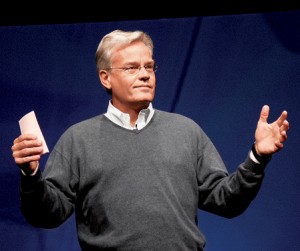
Walk into most evangelicals churches in America today, large and small, and you are likely to see the influences in worship style and service components of Bill Hybels and the Willow Creek church and association. It is particularly true in the megachurches, regardless of their evangelical flavor–from reformed to Wesleyan, charismatic or Baptist. Early, he was criticized for using marketing language to sell church and accused of smoothing the sharp corners off the Gospel to make it more “seeker-sensitive.” In recent years the Willowcreek team has been its own strongest critic, faulting its failure to adequately develop spiritual maturity while creating an enormous, active congregation.

Hybels’ South Barrington, Illinois, church is the third most attended in the country, with an average weekly attendance exceeding 23,000, and the nation’s most influential church for the last several years in a national poll of pastors. He is also the founder of the Willow Creek Association and creator of the Global Leadership Summit.

In 1971, as youth pastor at Park Ridge’s South Park Church, Hybels started a youth group with friend Dave Holmbo. With modern music, dramatic skits and multimedia combined with Bible studies in relevant language, the group grow from 25 to 1,200 in just three years.

After 300 youth waited in line to be led to Christ in a service in May 1974, Hybels and other leaders began dreaming of forming a new church. They surveyed the community to find out why people weren’t coming to church. Common answers included: “church is boring”, “they’re always asking for money”, or “I don’t like being preached down to.” These answers shaped the group’s approach to creating a new church, Willow Creek.

In October 1975 the group held their first service at Palatine’s Willow Creek Theater. 125 people attended the service. The rent and other costs were paid for with 1,200 baskets of tomatoes, sold door-to-door by 100 teenagers. Within two years the church had grown to 2,000 and in 1981 it moved to its current suburban location.
Willow Creek is the prototypical megachurch, with modern worship, drama and messages focused on the unchurched. Through its association, Willow has promoted a vision of church that is big, programmatic, and comprehensive.

Not long ago Willow released its findings from a multiple year qualitative study of its ministry. Willow Creek leadership wanted to know what programs and activities of the church were actually helping people mature spiritually and which were not.
The research revealed that “increasing levels of participation in these sets of activities does not predict whether someone’s becoming more of a disciple of Christ. It does not predict whether they love God more or they love people more.”

Speaking at his Leadership Summit, Hybels summarized the findings:

“Some of the stuff that we have put millions of dollars into thinking it would really help our people grow and develop spiritually, when the data actually came back, it wasn’t helping people that much. Other things that we didn’t put that much money into and didn’t put much staff against is stuff our people are crying out for.

We made a mistake. What we should have done when people crossed the line of faith and become Christians, we should have started telling people and teaching people that they have to take responsibility to become ‘self feeders.’ We should have gotten people, taught people, how to read their Bible between services, how to do the spiritual practices much more aggressively on their own.

Now, our dream is to fundamentally change the way we do church. That we take out a clean sheet of paper and we rethink all of our old assumptions. Replace it with new insights that are informed by research and rooted in Scripture. Our dream is really to discover what God is doing and how he’s asking us to transform this planet.”.

More than any other person of his generation, Bill Hybels developed a church ministry plan, found the blend of stability and innovation, and built a team that figured out how to involve modern, message-saturated Americans in church programs and services—in very large numbers for many years. But perhaps even more important, Hybels found an effective way to share that information with other church leaders, and then after painstaking measurement publicly admit mistakes—not in church building or evangelism, but in not more successfully leading believers to deeper levels of Christian maturity—and commit to correcting them.

If You Were Paying Attention, This Isn’t News.

CBO says ObamaCare will cost $115 billion more than thought.  That is to say, if you already had a healthy skepticism of government estimates.  And those same people won’t be surprised if when this figure climbs higher.

Pity the poor folks who have been snookered by the Democrats.

The AZ anti-illegal alien law profiles… criminals

Cities across the United States are officially boycotting the state of Arizona. Presumably because of its recently enacted state law, which enforces Federal law regarding alien status in our country. In Berkeley, a group of UC Berkeley students engaged in a hunger strike, ostensibly to force university administration to sanction illegal activity with the confines of the campus. It is, indeed, interesting to note this excerpt from the post,

Their initial protest target was Arizona’s new immigration law, which requires police to stop and question anyone they suspect of being in the country illegally.

No, the AZ law does not require police to stop anyone they suspect is here illegally. Consider this audio clip of an Arizona sheriff, regarding high speed pursuits during the past month.

The new AZ law is widely supported throughout the country, so one has to wonder why so many city governments are shoving their liberal views down the throats of their constituents?

Rest assured, politics is at play here. Is it no wonder, then, that we have Nancy Pelosi instructing clergy what to tell their congregants?

Things Heard: e118v5

Good morning.

  1. Of public transportation and markets.
  2. Again on Ms Kagan … and blind justice.
  3. On the Soviet gulag system.
  4. Global warming strikes again.
  5. On the Middle East.
  6. Mr Cuomo.
  7. Banking and profit.
  8. Diversity studies.
  9. For President?
  10. For discussion.
  11. The intentionally (?) dense Mr Holder.
  12. Firearms and airports.
  13. Supporting genocide?
  14. Schools.

Ms Kagan

So. Ms Kagan. Anybody find any links to online articles authored by her? It is said by her defenders that she’s a brilliant academic, whatever that means. Publish or perish means there should be scads of articles and books by her if she was as claimed a brilliant academic. No book at Amazon, except a $45 tribute essay contribution in honor of some Harvard dude. And I’m guessing this book isn’t hers. Finally there is this at Amazon as well … out of print and no reviews. But that doesn’t mean she doesn’t publish in journals not available on-line. So … anything?

Do legal professors not publish? What is the point of being in the Academy if you don’t publish? I don’t get it.

Look to be a brilliant academic you have to make a mark. To make a mark you have to publish important works which make a visible impact on our profession. I see no evidence that is the case for Ms Kagan. Perchance this is more of this retconning thing in which brilliant academic is recast to mean something entirely different. Perhaps it now is to mean an academic liked by Mr Obama who just happens to be another ‘brilliant academic’ who lacks any actual substantive academic record.

A Southern Baptist Leader’s View of the Oil Spill and Christian Responsbility

There is no shortage of articles and broadcast reports on the Gulf oil spill–who is to blame, what’s being done to stem the flow of oil, what the impact will be on the Gulf coast and its people, flora and fauna.

The Flourish Blog has an important view of things, The Gulf of Mexico Oil Spill and Creation Care, from Southern Baptist Seminary’s Russell Moore.

Moore writes:

Some conservatives, and some conservative evangelicals, act as though “environmentalism” is by definition “liberal” or even just downright silly. Witness a lot of the evangelical rhetoric across social media on Earth Day a while back: mostly Al Gore jokes and wisecracks about cutting down trees or eating endangered species as a means of celebration.

Do some environmentalists reject the dignity of humanity? Yes. Do some replace the reverence for creation with that due the Creator? Of course. This happens in the same way some do the same thing with reverence for economic profit or any other finite thing.

There’s nothing conservative though, and nothing “evangelical,” about dismissing the conservation of the natural environment. And the accelerating Gulf crisis reminds us something of what’s at stake.

This is an important read for those of us who are conservative evangelicals from one of our community’s articulate leaders.

Political Cartoon: Your Papers, Please.

From Chuck Asay (click for a larger version):

Chuck Asay

Just a bit of perspective before tossing around the "racist" or "Nazi" labels.

Things Heard: e118v4

Good morning.

  1. Logic and the greening of cars.
  2. Medieval icons uncovered.
  3. One of the unspoken unexamined axioms of the left.
  4. Spending binge … do you think it will stop?
  5. Climate not weather … heh.
  6. Mr Wilson.
  7. A quote regarding the UK PM exchange.
  8. A discussion of church and same sex relations.
  9. Paradigm shifts in thinking about the universe.
  10. Chutzpah and an interesting recasting of what swiftboating means that perhaps aligns better with history (although perhaps “politically motivated” should be added as an adjective to the term opponents).
  11. Examining Mr Gates.

Things Heard: e118v3

Good morning.

  1. One of the Gentlemen on Kagan.
  2. More here from a Volokh conspirator.
  3. Lithium dead? That has to be a translation glitch. Oh, wait … reading more carefully it is presented as such.
  4. Jews as WASPS?
  5. EU crises examined.
  6. I failed to mention this yesterday. Actually the WSJ Monday had a hole section on energy which is worth a look.
  7. Apropos of my “failure to communicate” essay last night … here’s another example.
  8. A solution from the Soviet era?
  9. Well, I don’t always take all my vacation days … but I wouldn’t ascribe the reason as guilt.
  10. I suspect that “increase” is the first of many admissions of cost increases.
  11. A novel.

Our Unhappy Political and Religious Discourse

From a comment:

In Mark’s post-modern relativistic world it appears almost impossible for anyone on the right to say anything untrue. Likewise there’s almost nothing Obama can say that can’t be ret-conned into a lie.

In the above, the accusation leveled at myself is likely a charge made reflexively whenever Mr Boonton (or likely any number of interlocutors from the left) sees someone on the right suggesting that a phrase or word can be taken in more than one way. This is noted in the wake of the particular history of post-modernism/quasi-Derridan theories of language and as a result of the rejection of the same by conservatives. The ironic thing here is that the accusation of this sort attempts to at the same time defend relativism, i.e., multiple meanings while at the same time force a particular meaning to be established.

Foucault and Derrida, as is my understanding, suggest that fixing and setting the meaning of words and phrases, fixing the primary hermenuetic if you will, is an act of power and that furthermore there is no intrinsic meanings for things beyond being an expression of power. While this is undoubtedly a simplification at the same time has the problem of getting the matter exactly wrong.

Meanings are fixed … but their particular assignment to particular words is not. When one says something the intention, the meaning is the one thing which is fixed and not a thing captured or expressed fundamentally in and via particular words. The act of speaking and then of hearing is a distortion on the original meaning (or web of meanings) which is being expressed. Conversation is one aid to the exercise of transmitting this which allows one to correct and refine the transmission. This is of course an exercise made more complicated by the fact that the idea reflected back is itself distorted by the act of expression by the receiver. If speaking is a lossy transmission of one’s thought to another. When you converse and try to get your meaning across, discussion is the act of trying to correct the image of your idea into another’s mind through the quadruple layers of distortion (thought -> spoken words then perceived words -> thoughts with a reflection).

What perchance does this have to do with the title selected for this particular essay? Well, in our political discourse peculiar (particular?) assumptions are made about what phrases mean which are normally misinterpreted by the other side and which make our discourse more contentious than it would normally be. One of the common irritants between parties then aligns along the continual frustration which this engenders. One says a thing to express one idea and by the other’s reaction and comments it is clearly misunderstood. Furthermore as one clarifies and attempts to more clearly state and restate the original point one either gets nowhere or the act of restatement is interpreted as an attempt at “changing” what one originally said.

 Page 3 of 5 « 1  2  3  4  5 »