50 leaders of the evangelical generation: #15 D. James Kennedy. Evangelism exponent

 [I am working on a project that may become a book on the most influential evangelicals leaders of our generation, since 1976, and the impact they’ve had on the church and their times. I will introduce them briefly on this blog from time to time. Who should be on this list?]

#15. D. James Kennedy. Evangelism Exponent  1930-2007 
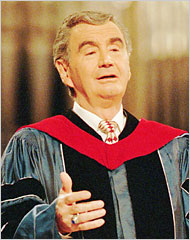
 A young D. James Kennedy arrived at Coral Ridge Presbyterian Church in Ft. Lauderdale, Florida, in 1959, and after just three years brought change to the congregation of 45: attendance declined to 17!

Recalling those difficult times, Kennedy said, “Extrapolation made it clear that I had two-and-a-half months of ministry left before I was preaching to only my wife—and she was threatening to go to the Baptist Church down the street!”

 It was then that a pastor friend, Kennedy Smartt, invited Kennedy to assist him in–of all things–a series of evangelistic services in Scottdale, Georgia. “I who had decimated one church was being asked to ship my technique across state lines. Have plague will travel!” quipped Kennedy.

During those 10 days of meetings, Kennedy watched Smartt—future president of the Presbyterian Church in America—engage people spiritually. By the end of the meetings, 54 people made professions of faith in Christ. Kennedy returned to Fort Lauderdale with the seeds that built a thriving church. Coral Ridge began to grow, and after 12-years church membership increased to 2,000.

 More broadly, Kennedy made witness-training the bedrock of his ministry, and launched what the evangelistic program called Evangelism Explosion. By 1996 Evangelism Explosion was planted in all nations of the world. Materials have been translated into more than 70 different languages and clinics have been held in many nations.

 Kennedy, who died in 2007, became one of the best known Christian ministers in the world by way of his television, radio, and the Internet broadcasts. A televangelist of a different stripe, Kennedy’s formal—almost arrogant to some–Presbyterian bearing, preaching in robes and traditional language, set him apart from the histrionics of some of the TV preachers and from the informality of a new generation of talkers.

 Kennedy served for 47 years as Senior Minister of Coral Ridge Presbyterian Church. A modest mission church when Kennedy arrived in 1959, the rocketing growth of the church made it, for 15 years, the fastest growing Presbyterian church in America. Decision magazine named the church one of the “Five Great Churches of North America.” In 2005, Dr. Kennedy was inducted into the National Religious Broadcasters Hall of Fame.

 Well regarded for his evangelism program and his television preaching, Kennedy was drawn like others of his generation to divert time and resources to political and cultural renewal. He did this through personal involvement, but through the development of the Center for Christian Statesmanship in Washington, D.C., and the Center for Reclaiming America. 

 Both efforts were shuttered as his health declined and preceded Kennedy in death.

 When both were closed in early 2007 a Coral Ridge spokesperson explained: “We’re getting back to our core competency, the production of media. Our heart and soul is the teaching of Dr. Kennedy, and getting it to more people than those who come to church.”

 Conservative commentator Cal Thomas wrote: “One hopes that will be preaching the unadulterated Gospel of Jesus Christ, unencumbered by the allures of the political kingdoms of this world, because that is where the greatest power lies to transform lives and ultimately nations. It does not lie in the Republican Party, with which Kennedy’s organization was almost exclusively associated.”

 Kennedy was not able to resume his preaching after December 2006 heart attack and died in September 2007. 

In addition to the church and Evangelism Explosion, Kennedy leaves two educational legacies: Westminster Academy, a Pre-K to 12th grade private school in Ft. Lauderdale, and Knox Theological Seminary, a reformed seminary begun in 1989 to prepare and equip Christians for ministry.

 “When all is said and done and my life is finished,” Kennedy said late in life, “I believe that the most significant thing God will have done through me will be Evangelism Explosion.”

 It is likely that EE was his unique and most significant accomplishment and his enduring legacy from a life lived large.  For this had great influence on the church’s evangelistic priorities, while his other ventures produced, to be charitable, mixed results.

The Flotilla Incident: Not About the Aid

If it was simply about getting aid to the folks in Gaza, first of all there are plenty of ways to do that, and Gaza has been getting it.  About 15,000 tons of aid per week enter Gaza through means that assure there are no weapons in it.  (By the way, the flotillas total cargo was 10,000 tons, less than a week’s worth.)

And secondly, if it was all about the aid, this wouldn’t be happening.

Israel has attempted to deliver humanitarian aid from an international flotilla to Gaza, but Hamas — which controls the territory — has refused to accept the cargo, the Israel Defense Forces said Wednesday.

Palestinian sources confirmed that trucks that arrived from Israel at the Rafah terminal at the Israel-Gaza border were barred from delivering the aid.

Ra’ed Fatooh, in charge of the crossings, and Jamal Khudari, head of a committee against the Gaza blockade, said Israel must release all flotilla detainees and that it will be accepted in the territory only by the Free Gaza Movement people who organized the flotilla.

So Hamas is holding up aid to its own people for a PR move.  This is not about the aid.  It’s about opening up a means of transporting more and larger weapons, via ships, than via the means that are currently available to Hamas.  And these "peace" activists are, at least, simply the "useful idiots" being duped or, at worst, complicit in the charade.

Things Heard: e121v4

Good morning.

  1. Regarding the prospects of one Ms Pelosi.
  2. Mr Obama and his ‘blackness’, here and here. My remark to the second is that this is not indicative of WASP-ness but just being a jerk, which comes in any color.
  3. Holodomor
  4. Something to remember when talking heads talk about job recovery.
  5. Regarding my short morning post.
  6. Heh.
  7. Remember this for the next time Mr Obama is touted as post-partisan.
  8. Child mortality.
  9. Not just for warding off Vampires.
  10. Crucifix ban.
  11. And God said, “heh“.
  12. The addendum to the memo.

Mr Obama and a Good Idea … Not Mixing

Mr Obama is in a pickle. He “says” he is thinking morning, noon, and night and obsessing about the what to do about the oil leak in the Gulf. And there’s a little problem here. A subterranean tactical (20-40 kiloton) nuclear device activated in the vicinity of the leak would stop the leakage with almost no danger of any excess nuclear material being released to the environment. I’m betting this won’t be done. Why?

  • Mr Obama is religiously anti-nuclear. He holds to an unstated (unexamined?) ivory tower plan toward a nuclear free world. Using a nuclear device to stop one of the larger modern ecological disasters has no part in that plan. The notion that a nuclear device might do anything but harm would be a fatal flaw for his dream.
  • If it works then it would have worked it two months ago. Which means the longer we wait to do that … the more obvious that doing it earlier would have been better is all the more compelling. Which is why, now two months down the road this won’t be done. Every day, every hour makes the chance of acting decisively less easy.

So remember, as you look at pictures of ecological impacts of the oil spill in the upcoming months. Mr Obama could have fixed this and even prevented it but didn’t because it would hurt his case for non-proliferation and because it would make him look a little stupid.

So when you gaze on the gulf disaster you’re looking at the results of Mr Obama’s pride and folly.

Learn From Canada!

In the superb movie "Awakenings", Leonard Lowe (Robert DeNiro) is woken up from his catatonic state by a drug administered by Dr. Malcolm Sayer (Robin Williams).  All goes well until Leonard starts to exhibit some side effects.  While this is happening, he insists that Dr. Sayer continue to film him, which Sayer is doing as part of the research.  We see Leonard from the perspective of the movie camera, almost yelling at it, "Learn from me!  Learn from me!"

It’s hard to watch this experiment demonstrating, in the body of Leonard, what could be a huge flaw in what otherwise appears to be a promising treatment for his illness.  It is a turning point in the story.

We are at such a turning point in another medical story, but I wonder if we’ll notice it and learn from it.

Pressured by an aging population and the need to rein in budget deficits, Canada’s provinces are taking tough measures to curb healthcare costs, a trend that could erode the principles of the popular state-funded system.

Ontario, Canada’s most populous province, kicked off a fierce battle with drug companies and pharmacies when it said earlier this year it would halve generic drug prices and eliminate "incentive fees" to generic drug manufacturers.

British Columbia is replacing block grants to hospitals with fee-for-procedure payments and Quebec has a new flat health tax and a proposal for payments on each medical visit — an idea that critics say is an illegal user fee.

And a few provinces are also experimenting with private funding for procedures such as hip, knee and cataract surgery.

It’s likely just a start as the provinces, responsible for delivering healthcare, cope with the demands of a retiring baby-boom generation. Official figures show that senior citizens will make up 25 percent of the population by 2036.

"There’s got to be some change to the status quo whether it happens in three years or 10 years," said Derek Burleton, senior economist at Toronto-Dominion Bank.

"We can’t continually see health spending growing above and beyond the growth rate in the economy because, at some point, it means crowding out of all the other government services.

"At some stage we’re going to hit a breaking point."

A government handout (or, really, a redistribution of wealth)  running way over budget?  (See "Stop the ACLU" for a discussion of costs in the Canadian system that the Democrats pretend they can keep at half.)  Why do we keep hearing this tune and yet be surprised when it ends exactly the same way?  Why do politicians say that this kind of system will reduce costs when…

Ontario says healthcare could eat up 70 percent of its budget in 12 years, if all these costs are left unchecked.

The answer for Canada is cut back on benefits, which they’re seriously considering.  But that is fraught with trouble.

Scotia Capital’s Webb said one cost-saving idea may be to make patients aware of how much it costs each time they visit a healthcare professional. "(The public) will use the services more wisely if they know how much it’s costing," she said.

"If it’s absolutely free with no information on the cost and the information of an alternative that would be have been more practical, then how can we expect the public to wisely use the service?"

That’s the problem with separating the payment from the service.  It’s not absolutely free; it’s paid for with huge national taxes.  But thinking it’s free, or even just using it more knowing that you won’t be charged more, creates additional demand that the system can’t handle.

But once you’ve made that mistake, there’s no going back.

But change may come slowly. Universal healthcare is central to Canada’s national identity, and decisions are made as much on politics as economics.

"It’s an area that Canadians don’t want to see touched," said TD’s Burleton. "Essentially it boils down the wishes of the population. But I think, from an economist’s standpoint, we point to the fact that sometimes Canadians in the short term may not realize the cost."

These economic decisions are now even more political than they ever were, but the thought of damaging something so much identified with Canada is just unthinkable.  So Canada must either go bankrupt, reduce services, or raise taxes.  And all this from a program that was supposed to reduce costs. 

This, folks, is the future of ObamaCare(tm) if it gets implemented or, worse, if the removed provisions get implemented piecemeal later on.  Canada is suffering from the experiment.  Learn from it.

Wrestling With the NSS

Well, I read the NSS this weekend … and I haven’t yet written that thorny post that I promised to write as yet. This post will not reach that lofty goal I held for myself but it may do as a weak substitute. As mentioned on Friday what I was going to try to do is take this middling sized document (about 60 pages) produced by Mr Obama which comprised the new National Security Strategy which his administration is allegedly following and this document comprises a submittal to the Senate explaining the overall features of that strategy. Read the rest of this entry

Things Heard: e121v3

Good morning.

  1. Comparing the outrage.
  2. More on the Israeli/blockade kerfuffle here and here. Some questions asked.
  3. St. Justin Martyr, here and here.
  4. SCOTUS, Tuesday.
  5. Frogs.
  6. Meth and memory.
  7. Looking at “yes, but” as strategy.
  8. Zooom.
  9. PC fixin’s
  10. Freedom of speech.
  11. and religion.
  12. Range time.
  13. Social security. Phase it out wasn’t an option. Darn.

Political Cartoon: "Peaceful" Flotilla

From Michael Ramirez (click for a larger version):

Michael Ramirez Cartoon

This pretty much sums up the whole flotilla situation.  There are videos going out about how the captain and other members of the ship, before leaving, chanted about times when Muslims wiped out Jews.  Yeah, "peace" activists indeed.  This was a set-up, plain and simple.

Things Heard: e121v1-2

Good morning.

  1. Credibility and Mr Clinton share much in common.
  2. When cops over-reach … those who are quick to criticise forget this sort of thing.
  3. Mr Sestak and the scandal, here and here. I’ve seen nothing at all on this from the left blogs. Odd that.
  4. Memorial day.
  5. Another memory.
  6. Give it a nifty name, its still a really really bad idea.
  7. The spill and some statistics.
  8. I got a 14.
  9. Empathy measured and found wanting. A suggestion as to why.
  10. Where to start.
  11. Mr Boyd and the Israeli/blockade kerfuffle.

Logical Inconsistancy and the NSS

A question regarding promotion of Democracy. During the Iraq reconstruction, the Iraqi people came together and wrote their own Constitution. Critics in this country soundly criticised that document because it didn’t establish freedom of religion, that is Islamic religious principles and separation of Church and State was not firmly established. In the recent National Security Strategy document released by the Administration the same curious thing occurred. In adjacent sections Mr Obama states that two primary objectives with regard to promoting human rights abroad include supporting democracy and women’s rights. These two ideas are in conflict.

The document states the importance of:

Recognizing the Legitimacy of All Peaceful Democratic Movements: America respects the right of all peaceful, law-abiding, and nonviolent voices to be heard around the world, even if we disagree with them.

and

Supporting the Rights of Women and Girls: Women should have access to the same opportunities and be able to make the same choices as men.

It seems to me quite clear that one of the notions held throughout much of the world is that women should not have the same access to the same opportunities as men. And this is an idea expressed by peaceful, law-abiding, and non-violent voices in places around the world, one with which however we disagree. This is just the same as the criticisms rendered after a democratic government forms a Constitution which does not separate Church and State.

Here’s the thing, you can support the idea that people should be free and able to set up their communities and the laws and customs by which they are run. You can want people to have certain ways of governing themselves and modes of setting up those communities. You can’t have both.

50 leaders of the evangelical generation: #17 Jack Hayford. Pentecostal standard.

[I am working on a project that may become a book on the most influential evangelicals leaders of our generation, since 1976, and the impact they’ve had on the church and their times. I will introduce them briefly on this blog from time to time. Who should be on this list?]

#17 Jack Hayford. Pentecostal standard b.1934


Most Pentecostal leaders are known as firebrands because of their high-octane presentation and spiritual zealotry. But the dean of the Pentecostal and charismatic movement, Jack Hayford, is often described as gentle, careful, and diplomatic. He served for more than 30 years as pastor of Church on the Way near Los Angeles and recently completed a term as president of the International Church of the Foursquare Gospel. Hayford is also widely known for his involvement in Promise Keepers and his role as founder of The King’s College. He has written nearly 50 books and 600 hymns and choruses. In 1978, he wrote the popular praise chorus “Majesty.”

Hayford has emerged as “Pentecostals’ and charismatics’ gold standard,” according to Steve Strang, publisher of the leading charismatic magazines Charisma and Ministries Today. “Pastor Jack would fall into a category of statesman almost without peer,” Strang told Christianity Today.

He is the founding pastor of the Church on the Way, a congregation of 12,000 in Van Nuys, California, a one-time Anglo suburb of Los Angeles that has become gritty Latino turf. But the church has not moved. Hayford believes that the Church on the Way was called to that very location. Spanish-language services have become the leading edge of the church, averaging 6,000 in weekly attendance.

Hayford stepped in as head of the Foursquare denomination after its leadership had lost $15 million in a pyramid scheme. He also was part of the team that was chosen to mentor and restore the disgraced president of the National Association of Evangelicals, who resigned amid a gay sex and drugs scandal.

“He is viewed as a voice of reason and calm at a time of scandal and crisis. They look to him as a source of balance,” says Thomson Mathew, dean of the graduate school of theology at Oral Roberts University.

Co-chairman of the Israel Christian Nexus, Hayford has made 34 trips to Israel. “I don’t think of myself as a Zionist,” Hayford says. “I believe in God’s sovereign providence and purpose with his ancient people.”

Hayford brings Pentecostals together with other evangelicals. He has done this by patient outreach, one person at a time. In his public speaking he makes frequent, appreciative references to non-Pentecostal influences, from C. S. Lewis to Richard Foster. He reaches out to other L.A.-area pastors. John MacArthur counts him as a friend despite their many theological differences. Presbyterian pastor and former Senate chaplain Lloyd Ogilvie considers him one of his oldest and dearest prayer partners.

“His integrity and theological depth are so well known that he can draw together all kinds of factions,” Strang says.

In keeping with that role, Hayford is frequently involved as a leader in interdenominational activities, from prayer breakfasts to Billy Graham crusades. As a prominent speaker at Promise Keepers events, he has been heavily involved in efforts at racial reconciliation.

“He is known throughout the world as one of the great ecumenical leaders,” says Ogilvie.

He reaches across theological divides, Tim Stafford writes in Christianity Today:

“without toning down his Pentecostalism one decibel. He is, in fact, aggressive about his beliefs, though he presents them graciously, in a way that explains and persuades. Leadership editor Marshall Shelley recalls hearing Hayford at a prayer summit at Multnomah Bible College. Most of the gathered pastors were conservative non-Pentecostals. ‘”By the time he was done, he had most of those pastors lifting their hands in praise,” Shelley says. “He did it by explaining why it was biblical and why it mattered. He made sense. He brought rationality to spiritual expressiveness.’”

In 1969, Hayford was asked to pastor a small congregation, the first Foursquare Church of Van Nuys, California. The congregation was an “old struggling” congregation (the average age of the church members was over 65). First Foursquare was one of the first churches to be planted after the denomination’s founding in 1923. But with 18 members and the massive First Baptist two blocks away, it didn’t seem the kind of place for a young minister to achieve international renown. Hayford quickly began preparing for his next move.Hayford had initially agreed to only temporarily pastor the church for a period of six months. A few weeks from giving a decision to a prestigious Foursquare church that wanted to hire him, Hayford decided to stay at the Van Nuys church. By the early 1980s, The Church on the Way became a pioneer of the megachurch movement.

In 1999, Jack Hayford passed the mantle as senior pastor of the Church on the Way to his son in law, Scott Bauer; but in 2003 Bauer suffered a brain aneurysm and died. Hayford served again as the church’s pastor for a year, then named Jim and Alice Tolle as the senior pastors of the church. Six months later, Hayford was elected president of the International Foursquare Gospel.

Within the charismatic subset of evangelical Christianity, Jack Hayford has brought rationality to spiritual expressiveness, offered a wise spirit and steady hand in dealing with crises, and provided a unifying force and welcoming hand from the charismatic camp to the whole of the church.

On Memorial Day

It’s Memorial Day. Keep in mind that, while we certainly should honor our veterans, Memorial Day is the day we remember those who have died in service to our country.

Whatever your choice of activities for today, whether it be picnic, barbecue, parade, beach, lake, or all of the above, take the time to remember those who, by virtue of their sacrifice, are unable to partake in today’s festivities. And… take the time to teach your children to respect the freedoms we remember today.

Enjoy!

Images: National Cemetery, Springfield, MO; American Flag, Cambria, CA © A. R. Lopez

Remembering a Soldier of the Greatest Generation

Memorial Day 2010
 
When I think of men and women of the armed forces who paid the ultimate price to fight for freedom and justice, I think of their peers and how they honor those who didn’t make it.   Those who remember soldiers who fought and died on the battlefields of  the last century are now bowed men in their seventies and eighties speaking hesitantly about their colleagues and their service a lifetime ago in the killing fields of Europe and Asia. We owe our nation to them, because of their moral strength, their youthful sacrifices, and their country-building ethic.
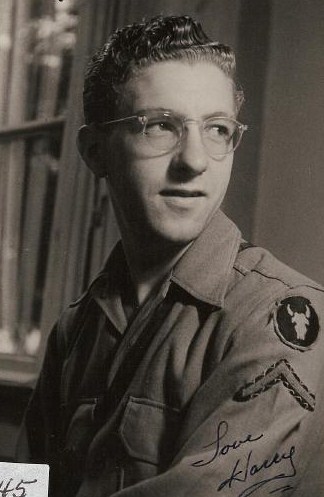
Harry Jewell, 1945 (5th Army, 34th Division, 135th Infantry)

Harry Jewell, 1945 (5th Army, 34th Division, 135th Infantry)

There has been much courage and dreadful sacrifice by veterans in the intervening years, but on Memorial Day and all days when we honor veterans, I think of  my favorite veteran, my father, who left us to be with the Lord he loved in January 2004 at the age of 79.

“They were better than we are,” said Tom Brokaw about the generation that saved the world from the last century’s Axis of Evil. The stark statement is true, we know. My father, Harry Jewell, was better than I am, I know.

Dad was a member of what they’ve called The Greatest Generation. He served his country mostly in Italy during World War II, and he was a hero of the American variety—putting his life on the line to save the world, and spending his life to serve his family, assuring their well-being in so many ways.

Dad told very few stories of the War, like most of his comrades in arms who saw their service as opportunities for duty, not celebrity; and didn’t relish the ugly memories. But from time to time we’d pull out a remarkable tale. Such as the time he was racing his jeep across an open field, with German artillery following him, but missing by just a few paces each time. Or the time he and others stepped inside a building, and their friend was obliterated by a shell on the front step they had just left. Death was always so close.

A sense of purpose prevailed and soldiers like Dad never asked why. Evil is evil, and men like Dad didn’t have any trouble recognizing it, as many seem to today.

A man of deep faith, my Dad demonstrated his peace with God in his final days and his homegoing. In life and at death he was an example to all of us.

Thanks to all who have served, then and now. And thanks Dad. I miss you.

Friday Link Wrap-Up

My blogging was rather light this week, but that doesn’t mean I wasn’t collecting links.

Sarah Palin got skewered for suggesting that ObamaCare(tm) would bring about what she called “Death Panels”.  Well, turns out that Obama’s pick for the guy to oversee government health care programs is all in favor of them.

Jobs saved and created … and created and created and created.  “Last week, one of the millions of workers hired by Census 2010 to parade around the country counting Americans blew the whistle on some statistical tricks. The worker, Naomi Cohn, told The Post that she was hired and fired a number of times by Census. Each time she was hired back, it seems, Census was able to report the creation of a new job to the Labor Department.”

“Unexpected” is the term the MSM uses to describe Obama’s economic failures.  We were promised it would work, and they’re shocked when it didn’t.  But’s that’s so last week.  Now the phrase is “little-noticed”, as in “a little-noticed provision of the health care bill is unexpectedly discovered.”  (Well, little-notice by the MSM.  Opponents mostly knew it already.)

And finally, some “smart” diplomacy, courtesy of Michael Ramirez (click for a larger image):

Michael Ramirez

Things Heard: e120v5

Good morning.

  1. Girls and fins.
  2. A missing point … that it is dangerous to be an illegal resident anywhere. This is not an argument for legalising aliens it is an argument not to be an illegal.
  3. Why ideological blinders matter. Everyone abuses history.
  4. North Korea and China.
  5. One report on the handling of the Gulf cleanup/reponse.
  6. The administration pulls a queue from two-bit dictatorships.
  7. Will the AZ outrage over immigration now move to MA? Or not so much cause it’s a Democratic stronghold?
  8. Heh heh.
  9. On anger.
  10. Obama’s version of “Its my responsibilty” … fire and forget. Just like his pleas of bipartisanship in the wake and during his own particular partisan attacks the buck stops here comes in in the wake of and during his own assignment of blame. His supporters somehow remain blind to this.
  11. A musical tribute to the Doctor.
 Page 116 of 245  « First  ... « 114  115  116  117  118 » ...  Last »