
When feelings take the place of thinking, God becomes our puppet

I’ve written previously on the false notion, in my opinion, of “felt-led” theology (see here and here). Felt-led theology, as coined by Greg Koukl at Stand to Reason, is a mindset among Christians, in which life decisions are based on whether or not one feels led – presumably of the Spirit – towards said decision. This experiential approach is heavily dependent on interpreting inner feelings and urges as potential messages from God. In a broad sense, such an approach is also used as a measure of one’s “connectedness” with God. In other words, your walk with God is determined by how well you decipher those inner nudges; the better you decipher, the more closely aligned you are with His Will.

Unfortunately, though pervasive within contemporary evangelical culture, felt-led theology has no scriptural foundation and, in my opinion, is tantamount to Christian superstition.

How many times have you encountered a fellow Christian who has made an important commitment decision or, worse, has left a previous commitment, mainly because they felt that God was leading them in such and such a direction? How many times have you encountered a fellow Christian, while contemplating a decision, state that they are “praying for direction”? It seems to me that the Bible makes it clear that we should pray for wisdom (and then use our own minds to make the decision).

Maybe it’s the introvert in me, as I deal with a decidedly extroverted Christian culture, but I tend to find the notion of relying on inner nudges and feelings, while we have access to God’s Word, to be a bit counter intuitive. Recently, I saw a discussion pertaining to how one should expect an answer from God, after prayerfully asking, especially when no answer seemed (felt) to be forthcoming. Some comments were (with my emphasis),

Yes, the waiting time can be very difficult. However, sometimes we have to ask ourselves if we are really listening or if we are really waiting for an answer.

Sometimes we’re so afraid of what the answer might or might not be that we’re not ready to listen to what he has to say.

He’ll only answer if you want him to.

While it’s sad to see such lame theology coming from other Christians, it’s even sadder to realize that such notions are commonly held beliefs within the evangelical community. One has to wonder if those who hold such beliefs have ever considered that God not only has the ability to deliver a message to us in any manner he chooses, regardless of whether or not we’re “listening” or whether or not we’re afraid of the answer, but that scripture does not support the notion that we have control over whether or not God speaks to us. Indeed, when one looks at scripture, one finds that God has no problem at all getting His message to whomever He chooses (ref. Saul on the road to Damascus); and that those who happen to feel that God is not answering them do not conclude that they aren’t listening hard enough, but understand the distinction of who they are and who God is (ref. David calling out to God).

Unfortunately, the message behind the idea that we can control whether or not answers from God get through is that we can conjure up God. That makes God our puppet – and that’s sending the wrong message to our fellow Christians.

For additional reference:
Just Do Something – Kevin DeYoung
Decision Making & the Will of God – Greg Koukl
Perhaps It’s a Double Standard Based On Science?

Steven Hawking is one of the most brilliant scientists of our time, and we’re lucky to have him.  In earlier days, his disability might have relegated him to being homebound, and he probably wouldn’t have lived nearly this long, robbing humanity of his intelligence.

However, he’s apparently branching out into a new area that he is not as well versed in; religion.

In his latest book, The Grand Design, an extract of which is published in Eureka magazine in The Times, Hawking said: “Because there is a law such as gravity, the Universe can and will create itself from nothing. Spontaneous creation is the reason there is something rather than nothing, why the Universe exists, why we exist.”

He added: “It is not necessary to invoke God to light the blue touch paper and set the Universe going.”

In A Brief History of Time, Prof Hawking’s most famous work, he did not dismiss the possibility that God had a hand in the creation of the world.

He wrote in the 1988 book: "If we discover a complete theory, it would be the ultimate triumph of human reason — for then we should know the mind of God.”

In his new book he rejects Sir Isaac Newton’s theory that the Universe did not spontaneously begin to form but was set in motion by God.

Scientists have a conniption when theologians delve into the scientific realm.  But apparently, that doesn’t work both ways in Prof. Hawking’s estimation.

Frankly, I think there can be spill over to each other.  The God of creation made us to be curious and made the order of the universe understandable to us.  I just would like scientists, who frown when a religious person appears to infringe on territory they claim exclusive rights to, would judge themselves by their own standards when moving the other direction. 

Things Heard: e136v4

Good morning. Well, I’m a little rushed this morning … shorter list than usual … work intrudes on life.

  1. Satan and cinema.
  2. Another view of the POTUS speech. I think the right was not his intended audience. I’m not sure who was.
  3. Thoughts on marriage, mostly from the left. I’d offer that if you’re considering marriage and want to pretend to live the self-examined life, this resource is indispensable (Wing to Wing, Oar to Oar).
  4. Ahhhhh
  5. Occupied territory.
  6. Why is this even a question
  7. Thought and sin.
  8. Liberal caricature.
  9. Comments of note.
  10. Of rest and restlessness.
  11. Noetic processes.

Passing the evangelical torch: Returning to virtue

Evangelical leaders of previous generations are in the process of passing the torch to younger leaders, for whom there are at least 10 fresh challenges. We’ve considered the challenge of Navigating Newfound AuthorityWaging a New Bloodless Revolution, Overcoming Spiritual Superficiality; Creating Culture; and now a fifth challenge:

Returning to Virtue. 

The new generation must deal with the crisis of basic character that overwhelms the nation and has also inflicted the church–with temptations of self-interest, immediate gratification, and moral laziness sapping the strength of its leaders and the witness of its people. All of us who are honest with ourselves will grieve our own failures to consistently demonstrate Christian character and to rise above our self-interest and harmful attitudes. There is less and less encouragement from our culture to demonstrate the basic virtues called for in not only the Christian tradition but in most traditions of Western civilization. Our Christian leaders must be known not primarily for their power, their persuasiveness, or their cultural conformity, but by their virtue.

These are not new concepts; they are ancient. Effective Christian witness will be seen from believers who can consistently demonstrate virtue.  Here’s one list of virtues:

 Purity

Abstaining from sexual conduct inappropriate for one’s state in life; the ability to refrain from being distracted and influenced by hostility, temptation,  or corruption.

 Restraint

Practicing self-control, moderation, and deferred gratification. Prudence to judge between actions with regard to appropriate actions at a given time. Proper moderation between self-interest, versus public-interest, and against the rights and needs of others.

Generosity 

Charity and self-sacrifice. Spending time, money, or labour, for others, without being rewarded in return.

Diligence

Decisive work ethic. Fortitude and the capability of not giving up. Budgeting one’s time; monitoring one’s own activities to guard against laziness. Upholding one’s convictions at all times, especially when no one else is watching; integrity.

 Patience   

Forbearance and endurance. Resolving conflicts and injustice peacefully, as opposed to resorting to violence. The ability to forgive; to show mercy to others. Creating a sense of peaceful stability and community, rather than engendering suffering, hostility,  and antagonism.

 Kindness  

Compassion and friendship for its own sake. Empathy and trust without prejudice or resentment. Unconditional love and voluntary kindness without bias or spite. Having positive outlook and cheerful demeanor; to inspire kindness in others.

 Humility    

Modest behavior, selflessness, and the giving of respect. The courage of the heart necessary to undertake tasks which are difficult, tedious or unglamorous, and to graciously accept the sacrifices involved. Reverence for those who have wisdom. Giving credit where credit is due; not unfairly glorifying one’s own self

That’s a good list for all of us. 

Bishop and New Testament scholar N.T. Wright makes a good case for believers to take seriously the formation of Christian character and the daily practice of virtues in his book After You Believe: Why Christian Character Matters.

This is an excerpt from the book:

“It is thus more or less impossible to speak of God with any conviction or effect if those who profess to follow Jesus are not exemplifying humility, charity, patience, and chastity. These are not optional extras for the especially keen, but the very clothes which the royal priesthood must ‘put on’ day by day. If the vocation of the royal priesthood is to reflect God to the world and the world back to God (the world, that is, as it was made to be and as, by God’s grace, it will be one day), that vocation must be sustained, and can only be sustained, by serious attention to ‘putting on’ these virtues, not for the sake of a self-centered holiness or pride in one’s own moral achievement, but for the sake of revealing to the world who its true God really is. The church has been divided between those who cultivate their own personal holiness but do nothing about working for justice in the world and those who are passionate for justice but regard personal holiness as an unnecessary distraction from that task. This division has been solidified by the church’s unfortunate habit of adopting from our surrounding culture the unhelpful packages of ‘left-wing’ and ‘right-wing’ prejudices, the former speaking of ‘justice’ and meaning ‘libertarianism’ and the latter speaking of ‘holiness’ and meaning ‘dualism.’ All this must be firmly pushed to one side. What we need is integration.

Wednesday Highlights

Good morning.

  1. Son of a great man.
  2. On the POTUS address.
  3. Verse.
  4. Huh, the average male has a GPS these days.
  5. France and the Roma.
  6. Hmm, in a search for a less substantial less vapid political post … this might be in the list. My wife lists here occupation on our 10-40 as “domestic goddess.” 
  7. Male midlife crisis … a temporary one.
  8. Mr Assange.
  9. About those free riders.
  10. I think that assessment is right, although I doubt my own ability to judge the motives of liberal/progressives.

When You Joust …

Don’t aim for the straw man, go for the flesh and blood one aiming a lance at you. Read the rest of this entry

Passing the evangelical torch: Creating culture

Evangelical leaders of previous generations are in the process of passing the torch to younger leaders, for whom there are at least 10 fresh challenges. We’ve considered the challenge of Navigating Newfound AuthorityWaging a New Bloodless Revolution, Overcoming Spiritual Superficiality; and now a fourth challenge:

Creating Culture. 

New leaders will be faced with the challenge of combating what has become transcendent societal secularism. The culture gives no one– young believers, newlyweds, young parents, mid-lifers, or the aging–help in dealing withthe hard work and hard choices that are necessary to live godly lives in a secularized environment. 

 Who teaches us values? Who leads the celebration for what is right and good? Who establishes the boundaries of decency? Who paints the living portraits of beauty?

Today, the answer to all of those questions is usually someone who is not guided by the biblical view of life or the Creator’s definitions of goodness and human flourishing. A rising generation of Christians seems to be attuned to cultural trends, but will the leaders among them influence the cultural waves or be carried along by them to an unknown destination?

 Chuck Colson writes:

“We bear children, plant crops, build cities, form governments, and create works of art. While sin introduced a destructive power into God’s created order, it did not obliterate that order. And when we are redeemed, we are both freed from sin and restored to do what God designed us to do: create culture.”

 In How Now Shall we Live, Colson and Nancy Pearcey called this the cultural commission:

 “God cares not only about redeeming souls but also about restoring his creation. He calls us to be agents not only of his saving grace, but also of his common grace. Our job is not only to build up the church but also to build a society to the glory of God. As agents of God’s common grace, we are called to help sustain and renew his creation, to uphold the created institutions of family and society, to pursue science and scholarship, to create works of art and beauty, and to heal and help those suffering from the results of the Fall.”

 Os Guinness pins the blame not on the culture, but on the church: 

Much of the opposition to Christians has been brought down on our own heads through our sub-Christian behavior, as in the failure of Christians demonstrating love for their enemies in obedience to the call of Jesus,” Guinness writes in The Last Christian on Earth. “We’ve lost a tough-minded understanding of ‘worldliness.’ Though we’re getting better at recognizing and resisting philosophies and ideologies –secularism, humanism, postmodernism– we are often naïve about the shaping power of culture. But the real menace of the modern world comes in its philosophies – in things such as ‘consumerism’ and ‘secularization.’”

Andy Crouch, author of Culture Making, writes on his blog:

 “Cultural transformation is something that a lot of Christians talk about and aspire to. We want to be a part of transforming the culture. The question is, how is culture transformed? Does it happen just because we think more about culture, or because we pay more attention to culture? As I was thinking about cultural transformation I became convinced that culture changes when people actually make more and better culture. If we want to transform culture, what we actually have to do is to get into the midst of the human cultural project and create some new cultural goods that reshape the way people imagine and experience their world. So culture-making answers the “how” question rather than just “what” we are about. We seek the transformation of every culture but how we do it is by actually making culture.”

In an interview, sociologist Peter Berger observed that in the U.S. evangelicals are shifting from being largely a blue-collar constituency to becoming a college educated population. His question is, will Christians going into the arts, business, government, the media, and film

  • assimilate to the existing baseline cultural narratives so they become in their views and values the same as other secular professionals and elites?
  • seal off and privatize their faith from their work so that, effectively, they do not do their work in any distinctive way?
  • or will they do enough new Christian ‘culture-making’ in their fields to change things?

That’s a primary question for the next generation of evangelical leaders.

All Done At No Taxpayer Expense!

The Oval Office got a makeover.

While President Obama was on vacation, his West Wing office got a bit of a face lift, complete with a new rug, fresh wallpaper and paint, and new furniture — all done at no taxpayer expense, the White House says.

I would think, of all things, a makeover of the President’s office should be done at taxpayer expense.  It’s all this unconstitutional, required purchases that I think ought not be.

Tell ya’ what, I’ll trade a coat of paint and new carpeting for another unfunded mandate to be named later.

"Stop Tinkering" Exhibit A

David Brooks:

During the first half of this year, German and American political leaders engaged in an epic debate. American leaders argued that the economic crisis was so bad, governments should borrow billions to stimulate growth. German leaders argued that a little short-term stimulus was sensible, but anything more was near-sighted. What was needed was not more debt, but measures to balance budgets and restore confidence.

The debate got pointed. American economists accused German policy makers of risking a long depression. The German finance minister, Wolfgang Schäuble, countered, "Governments should not become addicted to borrowing as a quick fix to stimulate demand."

The two countries followed different policy paths. According to Gary Becker of the University of Chicago, the Americans borrowed an amount equal to 6 percent of G.D.P. in an attempt to stimulate growth. The Germans spent about 1.5 percent of G.D.P. on their stimulus.

This divergence created a natural experiment. Who was right?

The early returns suggest the Germans were.

Indeed, Germany’s economy is growing at an amazing 9% annual rate and unemployment is back to what it was before the crisis.  Back home, Obama and company are considering a second stimulus.

Because the first one worked so well?

Perfectly Legal, But a Bad Idea

No, I’m not talking about the "Ground Zero Mosque".  I’m talking about the Dove World Outreach Center’s plan to burn Korans on September 11th.

There’s nothing unconstitutional about doing with your own property what you wish.  Insofar as there are any relevant ordinances, it’s a local issue.  But also, people are free to exercise their right to protest and express their displeasure at such a thing, and try to convince those who are doing it to reconsider their plans, as I am trying to do.

OK, now I’m talking about the "Ground Zero Mosque".  Or both.

Are liberal websites who criticize the Dove Center’s burning of Korans and mock them anti-Christian bigots?  Certainly this criticism, in and of itself, is not proof of any such bigotry.  They just feel it’s wrong and are expressing their opinion.  I would be building a straw man to suggest that they are motivated by hate of Christians.  Equally, appealing to the constitutionality of this would be ignoring the other, more substantive, points of their protest.

And yet when the tables are turned, out come their straw men and their baseless accusations.  Liberal talking heads speak of constitutionality of building the Mosque on private property and accuse opponents of Islamophobia.  A nutty and drunk cab passenger killing his Muslim cabbie is pointed to as an example of the alleged overall fear, even though the perp was for the Mosque and the Muslim victim against it. 

Why can’t we have a civil discussion about race, religion or any sort of sensitive subject in this country?  This is a big reason why. 

Things Heard: e136v2

Good morning.

  1. Of Beck and Obama.
  2. A man shot and consequence.
  3. Two Gulf disasters, two Presidents, and a cricket race.
  4. One post which clearly shows Mr Krugman and his ilk are non-serious about economy and politics.
  5. And lo and behold, he shows the origins of his fantasy.
  6. A big bubble?
  7. The continuation of the lying to Congress charge … one wonders how actual real-live you-can-tell-they’re-lying-because-their-lips-are-moving Congress-critters make such charges with straight faces.
  8. Appeasement.
  9. A challenge.
  10. Just get on your bike and ride, dude.
  11. Shotgun tracts.
  12. Contra smut.

On Park51 or the Cordoba House

I have not offered any opinion of mine own on the proposed Mosque site. I think a lot of odd things have been said about it, not the least of which was the GOP reaction to his expressing the mainstream conservative opinion on the matter, that they do in fact posses a Constitutional right to build but that it is a very bad idea. One has to remember an idea you support, when spoken by one on the other side of the aisle, remains a good idea (and recall that even a broken clock is right twice a day). Another silly thing touted is that this building is “two whole blocks away” and nowhere near the ‘Ground Zero’ location. The reason that notion is silly is that the Park51/Cordoba people have chosen this location is its proximity to the former World Trade site. It seems to me that the those who protest that this is too far away miss a crucial point. Neither the sponsors nor the objectors see that is correct. Doubtless one can point at countless other ideas fronted on this topic which are incoherent or silly. Read the rest of this entry

Church Services in the US Capitol

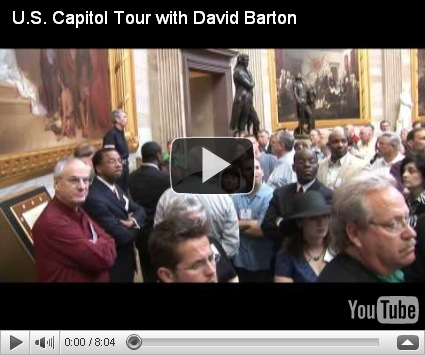
If you think the ACLU would have a conniption over that, imagine how they would have reacted had they been around for some of these other events in the video.  The "separation of church and state" doesn’t mean what they, and liberal judges, think it means.

US Capitol Tour with David Barton

Seven of the most interesting stories on Mon. morning: climate collapse, Moore on Beck, Jim Wallis apologizes, and more

1.    Crisis in the Environmental Community: The climate lobby has declined dramatically from its days of high confidence after the 2008 election and it is scrambling to determine the next steps:  

A year ago, these groups seemed to be at the peak of their influence, needing only the Senate’s approval for a landmark climate-change bill. But they lost that fight, done in by the sluggish economy and opposition from business and fossil-fuel interests.

2.    God, the Gospel, and Glenn Beck:  Southern Seminary’s Russ Moore writes about relying on populist God-and-country sloganeering and outrage-generating talking heads.

It’s taken us a long time to get here, in this plummet from Francis Schaeffer to Glenn Beck. In order to be this gullible, American Christians have had to endure years of vacuous talk about undefined “revival” and “turning America back to God” that was less about anything uniquely Christian than about, at best, a generically theistic civil religion and, at worst, some partisan political movement.

3.    Advertising Parasites: Ads that follow you from site to site.

“For days or weeks, every site I went to seemed to be showing me ads for those shoes,” said Ms. Matlin, a mother of two from Montreal. “It is a pretty clever marketing tool. But it’s a little creepy, especially if you don’t know what’s going on.”

4.    Jim Wallis Apologizes: Sojourners’ Jim Wallis apologizes to World’s Marvin Olasky.

“I was wrong, out of anger at the insinuation about the dependence on these foundations, I was wrong to imply that like Beck, Marvin lies for a living,” Wallis said. “Glenn Beck does lie for a living. Marvin Olasky doesn’t lie for a living; that’s not something I should say about a brother in Christ.”


5.    Crooked Afghan Partner?: Another Diem? Karazi fires his corruption fighter.

“What he was doing was very important,” State Department spokesman P.J. Crowley said of Mr. Faqiryar. “Those charged with pursuing corruption need to continue their work without political interference. It’s something we are watching to make sure the Afghan government lives up to the pledges it has made in battling corruption.”

6.    America’s Creativity Crisis?:  For the first time, research shows American creativity declining.

What’s driving the drop? According to Newsweek, technology and education are particularly nefarious culprits. At home, kids are spending more time watching television and playing video games; at school, our educational system is evaporating the creative juices. Neither of these criticisms is particularly new, but they are informative within the context of the creativity discussion.

7.    Baseball Replay Confirms Walk-off Homer:  For the first time, the limited replay rule is used on a play that ends game.

McCann capped a stunning comeback with a replay-assisted homer that gave Atlanta a 7-6 victory over the Marlins on Sunday – the first time a game ended on a call using video. Without it, McCann might have only gotten credit for a double and the game would have continued on. Instead, he was jumping into the arms of his teammates after the umps took a second look, taking advantage of a limited replay rule that went into effect two years earlier almost to the day – Aug. 28, 2008 – to make sure they got these sort of calls right.

Things Heard: e136v1

Good morning.

  1. Some with Nixie tubes
  2. The VP and those pesky details.
  3. Going up?
  4. Setting aside the (excessive) sarcasm, I think the question of how to treat differently talented kids in school to optimize goals is a valid question. And “making things equal” is not necessarily the best answer.
  5. Stupid liberal tricks … now bullets.
  6. That’s what we need more, bigger deficits.
  7. Extreme airport.
  8. Friendship.
  9. Mr Obama goes on the offensive against misinformation, with hyperbole and misinformation.
  10. Great photo anyhow.
  11. Reading on the Mosque
  12. 2-d time.
  13. Iraq.
  14. A photo.
  15. Norman and virtue.
 Page 103 of 245  « First  ... « 101  102  103  104  105 » ...  Last »