Things Heard: e56v4

Lent.

  1. Memories of Lent past.
  2. As Sacramental memory.
  3. Cinema.
  4. Some suggestions.
  5. Verse.

And elsewhere.

  1. Fuel cells and the cell phone.
  2. An empty room.
  3. 10 statements on evolution by Kim Fabricus.
  4. Paintball arms race … top of the food chain.
  5. Some history of science, gauge theory.
  6. Afghan and supply chains.
  7. What does he mean when he said, “I don’t believe in big government?”
  8. That recent speech, between the lines.
  9. Incomprehension mapped.
  10. UFO.
  11. A libertarian looks at Jindal.
  12. Science and politics … last century.
  13. Evil and self.
  14. Carnival.
  15. Japan and anthropomorphic origin of climate change. I also saw, I didn’t keep the link (sorry), that another group was trumpeting polar ice retreat. Why, I wonder, is that significant when (record?) polar ice advance is not? If weather is not climate … sorry but that’s not significant.
  16. A speechwriter defends Jindal’s response.
  17. Swim.
  18. Ducking debate.

Greening the Hood

Leroy Barber, a new friend who is president of the innovative Mission Year program that facilitates the placement of suburban Christians to live and minister in urban comunities, has an interesting take on the importance of healthier environments in urban settings.  See his post on “greening the hood.

Four Books and Lent

Last year for Lent, I had an (inspired?) somewhat strange idea for Lent. There is a age-old wedding tradition in the form of a little ditty aimed at guiding the bride when she prepares her garment for the feast. That tradition goes in the manner of a ditty, she is to wear,

Something old,
Something new,
Something borrowed, and
Something blue.

I read. If I had time and less concerns I’d read a lot more, but I really enjoy study and reading. As a result, my Lenten tradition, now all of two years old, is to read 4 from books during the Lenten journey. And … the strange part is, I select these books based for good reason on that marriage ditty. I don’t have my borrowed book as yet, but the other three are the following:

  1. The old book is a book I’ve read and am going to re-read. For this book, I’m going to re-read The Brothers Karamazov. I finished this about a year ago but just before completing it I read in this little book on theodicy The Doors of the Sea: Where Was God in the Tsunami? by David Bentley Hart that a important theme in the Brothers K is the posing and the Christian answer to the theodicy problem.
  2. The new book is a book newly acquired. Two books have vied for this as both seem really good. But I’ve selected God, Man and the Church by Vladamir Solovyev. Mr Solovyev was a late 19th century religious philosopher who influenced both Tolstoy and Dostoevsky, judging by his wiki page and the introduction which I’ve glanced through, this will be an interesting read.
  3. And the blue book, is likely going to recur as the blue book for quite some time to come, Saint Silouan, the Athonite by the Archimandrite Sophrony has a blue cover … and is full of the teaching and example of an exemplary saint. Mount Athos is the holy mountain in Greece, a treasured and holy place for the Eastern Orthodox churches. Twenty monasteries dot the hillside and many, if not most, have been there for more than a millenia.

In God We Trust, everyone else. . .

In an online poll, even visitors to the MSNBC site want In God We Trust to stay on U.S. currency.  See if the poll is still there.   In these times, who else shall we trust?

ChangeWatch

It’s been a few weeks since we had one of these, and boy are things changing…or not.

"Extraordinary Rendition"?  Keeping the Bush administration policy.

Holding "enemy combatants" without trial?  Obama’s nominee for Solicitor General, Harvard Law Dean Elena Kagan, says yes we can!  (And Obama & Holder second that motion.)

Make Guantanamo Geneva-Convention-compliant?  It already is.

Wiretapping international calls related to terrorists?  The Obama administration continues to protect it.

Continuity we can believe in!

And Nicholas Guariglia says that we should have seen this coming.

Things Heard: e56v3

Lent

  1. Lent with the Dominicans.
  2. Denial.
  3. Fasting as feasting.

Other

  1. The Christian and the pagan.
  2. Approaching the end.
  3. 900 days.
  4. The mythical moderate.
  5. Science and belief.
  6. Against the stimulus.
  7. Symbol and Trinity.
  8. Construction and 2009, a prediction.
  9. Accepting the Taliban?
  10. Epistemic modesty.

As Lent Nears

Soccer and ashes. Fat or Shrove Tuesday is celebrated by liturgical Western Christians tonight. Tomorrow with less sackcloth but still with ashes they begin their Lenten journey. The Eastern half of Christianity begins Lent at sundown (or after Vespers) Sunday night this weekend as the Julian calendrical calculation this year puts Lent a week later than the Gregorian.

For those who do partake of the Lent tradition, I’d like to offer an invitation from the East. This Monday through Thursday many of the Eastern churches will be offering the The Great Canon: The Work of Saint Andrew of Crete as an evening Lenten meditation and prayer. I’d invite any who are interested in a meditative liturgical very repentant service to search out and find an Orthodox parish near them (for Americans this may serve as one place to look but other ethnic Orthodox churches may be closer, their web site should give a time when the Canon is being offered and directions.) and this coming Monday to partake of the Canon. For those Western visitors, please be aware the Orthodox perform prostrations during this service. It serves to heighten the sense of repentance for those taking part. As a note to visitors, there is no stigma in not taking part. If you do not feel this movement is part of your worship vocabulary … that is perfectly fine. Depending on where you go, the music (a capella voice) might be a little, uhm, shaky. But the Canon is primarily not a musical experience, listen to the words and think on their meaning and connection to you. This is an extended walk through Scripture connecting events through repentance to your life. A microcosm of Lent in four days. A jumping off point for the rest of the journey to Pascha (Easter).

Failing that invitation, two books might be of interest. Orthodox liturgist Alexander Schmeman’s Great Lent: Journey to Pascha and Khouria Frederica Matthews Green’s First Fruits of Prayer: A Forty-Day Journey Through the Canon of St. Andrew both are books which can provide background and perhaps a gentler introduction to the Great Canon and are both well recommended reading for the season.

Redefining "Thrift"

Frugality.  Thriftiness.  These terms are being redefined by the NY Times as "dead weight"

As recession-wary Americans adapt to a new frugality, Japan offers a peek at how thrift can take lasting hold of a consumer society, to disastrous effect.

The economic malaise that plagued Japan from the 1990s until the early 2000s brought stunted wages and depressed stock prices, turning free-spending consumers into misers and making them dead weight on Japan’s economy.

Today, years after the recovery, even well-off Japanese households use old bath water to do laundry, a popular way to save on utility bills. Sales of whiskey, the favorite drink among moneyed Tokyoites in the booming ’80s, have fallen to a fifth of their peak. And the nation is losing interest in cars; sales have fallen by half since 1990.

Never mind those government types that encouraged banks to give loans to those who couldn’t afford them.  Never mind the investors who spend too much money on too much risk.  No, you, dear person living within your means, you are the reason we’re in this mess. 

I’m sorry, but this reasoning is utterly upside down.  Instead of trash-talking responsible living, perhaps a recession is what we need to pare back some of the overspending we’ve been doing, personally and federally. 

(In fact, some economists say that we would normally have mini-recessions now and then that would serve to do these corrections little by little if the federal government didn’t manipulate monetary policy to keep them away.  Now, after other poor government decisions have come to a head, they’re all hitting at once.)

One of these excesses is arguably federal pensions.  The world is finding out (again) that a one-size-fits-all social security program means when we fail, we all fail since all our eggs are forced to be in fewer baskets (sometimes just one).  Japan is seeing this.

Japan’s aging population is not helping consumption. Businesses had hoped that baby boomers — the generation that reaped the benefits of Japan’s postwar breakneck economic growth — would splurge their lifetime savings upon retirement, which began en masse in 2007. But that has not happened at the scale that companies had hoped.

Economists blame this slow spending on widespread distrust of Japan’s pension system, which is buckling under the weight of one of the world’s most rapidly aging societies. That could serve as a warning for the United States, where workers’ 401(k)’s have been ravaged by declining stocks, pensions are disappearing, and the long-term solvency of the Social Security system is in question.

Other countries, like France and Germany, have had to come to terms with this in the past, and now it’s our turn. 

Spending our way out of overspending is not the answer.  Letting the market roll, with its ups and down, would hurt far, far less than the climbs and crashes we’re having to get used to.
Things Heard: e56v2

  1. Race advice which is transferable to other avenues of life.
  2. Except, due to cholesterol, my dietitian informs me cheese is not a food … it’s a garnish.
  3. Iran slumping?
  4. Crime pays?
  5. Water and Spirit.
  6. Verse.
  7. Violation of law.
  8. In five short (long?) months … ta-daaa.
  9. On that scientific authority thing.
  10. Getting parenting very very wrong.
  11. F-22. Stimulus?
  12. A gigabyte now and then.
  13. Sssspiiin.
  14. We need some gridlock in the beltway faaast. Huh?
  15. On theodicy.
  16. Links … I thought the Krugman criticism cogent.
  17. Mornings.
  18. Loony ranting wackjobs haters. Whatever.
  19. Very cool art.
  20. Abduction.

Man, Society, and Science

Carl Olson of the Insight Scoop notes an article noting a term which he predicts will be in our future, scientific authoritarianism. The cited article notes:

Scientific authoritarianism, as I am using it here, holds that political decisions should be compelled by the political preferences of scientists. It is a very strong form of the ‘linear model’ of science and decision-making that I discuss in my book, The Honest Broker. Hansen believes that the advice of experts, and specifically his advice alone, should compel certain political outcomes.

There are just a few matters that need to take into account in this matter.

  • First off, it is my experience that there are two features found in many of the first rank scientists in our midst. First off, the best and brightest scientists in various fields don’t have the slightest interest in giving advice to politicians and in fact when they do offer political advice they offer very bad advice. I might add that theologians and religious leaders as well, for the most part, also are very horrible when they enter into the political world. There are some good reasons for this. Skills are involved in politics. The ability to read people, judge motivations and to have an estimate of the possible and so on are political skills. To become talented and to rise to the top of a scientific discipline requires three things: talent or genius, a love for inquiry, and a concentration on that field virtually to the exclusion of all else in life. Those people who are at the first rank usually have no talent, or frankly, desire to spend any time with exercising any authority. For them, their life is wholly given to the chase for the truths hidden by and in nature. To make an analogy with popular culture from cinema, while we might hope for our scientific authority to rise from the Mozarts in our midst, we’re going to get the Salieri’s who are the ones who will sully themselves with such matters.
  • Second, those scientists who are not blinded by the possibility of exercise of political authority, i.e., those who are honest with themselves, are aware of the vast gulf between what we know and what is out there to be known. To put it baldly, any scientist who assures you that we “know” the best policy is a liar or a fool. We “know” so very little about ourselves, our universe, and how it is put together.
  • Michael Polanyi in Personal Knowledge offers for us a glimpse at how much we deceive ourselves regarding about the epistemological certainties in science. I cannot recommend this book enough (although I’ll ruefully admit I really do need carve out the time to finish it).

A joke which is part of the culture of Physics and the pursuit of knowledge in that discipline.

A policeman encounters a drunk one night, who is on his hands and knees searching for something in the night beneath a street light. The policeman asks him, “What are you looking for?”
The drunk replies, “My keys.”
“Where did you drop them?” asks the bobby.
“Over there,” the drunk points down the block.
“Why are you looking here then?”
“I can’t see over there, because the light is here,” replies the drunk.

Our search for the mysteries of the universe and ourselves are a lot like that. We search under the light. Our keys … our understanding is to be found, so often, elsewhere down the road … in the dark.

So much of physics and our physical understanding of the universe assumes linearity. The mathematical behaviour and our understanding of linear PDEs and non-linear ones are much like comparing oranges to not-oranges. We look at and search for understanding under the light of just a few lamps. Gradually we uncover and begin to use a few more. But, we are just beginning. To pretend otherwise is foolishness. My advice would be to spurn those offering to give us scientific authority are who are assured in their results and their knowledge and don’t first show evidence of humility and uncertainty and demonstrate they posses a firm grasp of the magnitude of our ignorance.

Religious Environmentalism & Idolatry

Don Sensing has noted in the past how the environmental movement morphed from a Teddy Roosevelt conservation into Earth worship, to the detriment, in this case, of highly unemployed Latinos.  Rev. Sensing also observes that the increase in this idolatry seems to coincide with its economic decline.

God is not mocked. 

Things Heard: e56v1

  1. Penicillin and Lent.
  2. Induction and inference.
  3. That nasty brutish and short thing.
  4. Prayer request.
  5. Power and efficiency.
  6. Brand name and prestige.
  7. Winter.
  8. Offensive prayer.
  9. Ms Pelosi is perhaps the tip of the non-catholic catholic iceberg.
  10. 1st Corinthians in the modern world.
  11. damned lied … and statistics.
  12. That right to privacy.
  13. Is that a thing which is needed?
  14. Beowulfs.
  15. And a pony for everyone too?
  16. Putting his cards on the table.

A New Wind is Blowing

And it’s blowing away the rage that Democrats would have had if Bush had done this.

The economic stimulus signed by President Barack Obama will spread billions of dollars across the country to spruce up aging roads and bridges. But there’s not a dime specifically dedicated to fixing leftover damage from Hurricane Katrina.

And there’s no outrage about it.

Democrats who routinely criticized President George W. Bush for not sending more money to the Gulf Coast appear to be giving Obama the benefit of the doubt in his first major spending initiative. Even the Gulf’s fiercest advocates say they’re happy with the stimulus package, and their states have enough money for now to address their needs.

What a difference an administration makes.

It’s a significant change in tone from the Bush years, when any perceived slight of Katrina victims was met with charges that the Republican president who bungled the initial response to the disaster continued to callously ignore the Gulf’s needs years later.

Just last summer, Democrats accused Bush of putting Iraq before New Orleans when he sought to block Gulf Coast reconstruction money from a $162 billion war spending bill. Bush was pilloried for not mentioning the disaster in back-to-back State of the Union addresses.

Bush couldn’t miss mentioning Katrina let alone sending more money there.  But Obama doesn’t spend a dime in a 3/4 of a trillion dollar spending spree and cue the crickets.

What, does Obama hate black people?  That’s preposterous now, and it was preposterous then.

Obama’s Mortgage Plan: More Harm Than Good?

The Wall Street Journal takes a look at President Obama’s proposed mortgage rescue plan and finds that it could create far more problems than it solves:

President Obama yesterday announced his plan to prevent home foreclosures, saying he wanted to be “very clear about what this plan will not do: It will not rescue the unscrupulous or irresponsible by throwing good taxpayer money after bad loans . . . And it will not reward folks who bought homes they knew from the beginning they would never be able to afford.”

We really do wish he were right. In fact, the details released yesterday suggest the President’s plan will do all of the above. The plan will help some struggling homeowners. But by investing in failure, the Administration will also prolong the housing downturn and make financing a home purchase more difficult for future borrowers. Meanwhile, the plan isn’t likely to slow the continuing decline in housing prices.

The President’s plan is predicated on the false belief that everyone deserves to own a home. The fact is that not everyone can afford to own a home. The efforts of Fannie Mae and Freddie Mac to make it easier for people to buy homes they could not afford are at the heart of the current financial crisis. Unfortunately, the President’s plan does nothing to address this fundamental issue and instead just prolongs the crisis and leaving taxpayers on the hook.

As CNBC’s Rick Santelli correctly points out in this clip, this is an example of government rewarding bad behavior. Unfortunately it’s the 92% of honest, hardworking Americans he refers to that will pay the price.

Sometimes a Chimp is Just a Chimp

John Hinderaker on PowerLine:

If the President is a Republican, it’s fine to call him a "chimp." In fact, it’s morally superior. But if the President is a Democrat, you can’t call a chimpanzee a chimp lest someone think you might have been referring to the President.

It all makes perfect sense.

Indeed, for 8 years calling the President a chimp was so prevalent that there are hundreds if not thousands of images of him specifically morphed into or compared to a chimpanzee

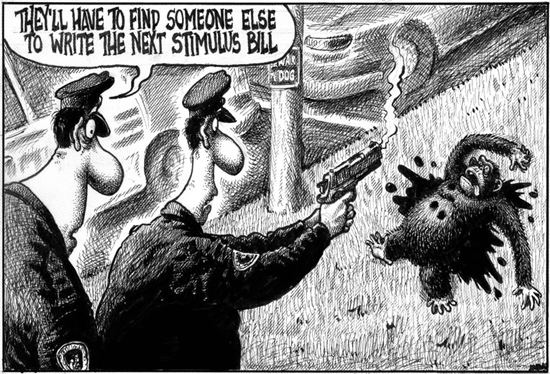
But today, here is the controversial chimp in question:

They'll have to find someone else to write the next stimulus bill.

This was referring to, not just the awful "stimulus" bill (written by Congressmen, not the President), but the chimpanzee that went on a rampage in Stamford, CT that was shot and killed by police.  Just like in the cartoon. 

But Al Sharpton and all manner of bloggers have now confirmed what many of us thought might happen when Obama was elected.  Any criticism of the President (or in this case, the Congress) that can be linked to racism, will. 

Paging Mr. Holder.  Maybe your observation that we’re "essentially a nation of cowards" on racism is because of this sort of reaction from the Left whenever race comes up.  Or, as in this case, even when it doesn’t come up.

 Page 180 of 245  « First  ... « 178  179  180  181  182 » ...  Last »