The Accountability Factor

A growing list of "honest mistakes" by Democrats is leading this op-ed author to ask, "What does it take to disqualify Democrats from public service?"  If tax evasion, suborning forgery and using campaign funds for personal expenses ain’t enough, what is?  As commenter "socrates" writes:

Failure to pay $150K in taxes normally gets one in front of a Tax Court judge with the IRS burning your house down.

If you’re a Democrat it gets you a Cabinet position.

Both sides have corruption in their ranks, make no mistake about it.  But as I’ve said multiple times in the past, it’s not about corruption; it’s about accountability.  On the whole, Republicans tend to remove those involved with corruption, while Democrats, when they do anything, pass a motion and continue with the business of the day.  Read those links for a number of examples.

Nominating them for cabinet positions, right "socrates"?

Man is sinful; that’s just the way it is.  But if he’s not held accountable for his actions when he breaks the law, do we expect that we’ll have less law-breaking?

Indvidual Choice and the Church

Pro-choice, the Madison avenue euphemization for by the pro-abortion crowd is on some reflection an odd choice of terminology. The word “heresy” comes from the Greek hairesis (haireomai, “choose”), and means either a choice of beliefs or a faction of dissident believers. Pro-heresy might be an interesting alternative phrasing. Relabeling is in vogue these days, where it is common for those with the bully pulpit to recast the opponents and terms to favor their cause, which perhaps is why Mr Obama is trying to identify Mr Limbaugh as a conservative leader. If turnabout is fair play, perhaps recasting pro-choice as pro-heresy might help the pro-life cause within the liberal Christian community.

When making arguments one must consider one’s audience. When convincing a secular audience that one should rely on secular arguments, which is the primary place in which these arguments are taking place these days. If on the other hand, one is speaking to a Christian community, then Christian argument and theology should be used. Rarely however it seems to me does the pro-heresy community attempt to cast their arguments for abortion in the light of Christian tradition and theology. And for good reason … because Christian tradition and theology has stood against abortion for almost 2 millenia. Read the rest of this entry

The Beginning of Empathy

David Henson at the blog Unorthodoxology posted a terse thought last Friday, “Sin is the beginning of empathy.”  I’ve been reading a bit of Dave’s blog ever since, I believe, Mark linked to something of his.  Dave, and the commenters that frequent there, are of the “many paths lead to truth” school of thought, and are not very much in agreement with my ideas about the exclusivity of Jesus as “the Way, the Truth, the Life”.  (See the comments to this post for examples.)

So this “empathy” post showed up, and I could see what Dave was getting at, and I made short comment about it myself, that perhaps this could also be said of pain.  Pain, whether caused by sin or not, can make us empathetic to others in the same situation as well.  But that thought, too, didn’t seem complete.  After 24 hours of having that roll around in my head, here’s what I came up with.

If sin causes no pain, then it does not bring empathy. If cheating old ladies out of their social security makes me “happy” (or at least doesn’t hurt in the short term), no empathy comes with it. It’s not until the pain that there’s a chance that empathy will develop. And even then, sometimes the consequences don’t quite get things rolling, but without the pain, it won’t happen.

So perhaps “sin is the beginning of pain which is the beginning of empathy.”

Well, ‘cept that you can have pain that leads to empathy but that did not originate with sin. I could say “Getting laid off from your job is the beginning of empathy” and it would be just as true, yet you don’t have to do anything wrong to feel it. But then what if you hated the job and are happy that you got laid off, because you have a back-up plan (or some similar situation)? No pain, and thus you probably can’t empathize with a co-worker who desperately needed that job and has nowhere else to go. So getting laid off, for you, isn’t the beginning of pain.

There are so many things that may or may not lead to pain for you, but until you feel that pain you can’t empathize with someone who has. So perhaps the phrase should be, “Pain is the beginning of empathy.”

Or is even that right? Can we really not empathize with a drug addict until we get high ourselves? Can we really not empathize with a murderer unless we kill someone ourselves? Sympathize, perhaps, but maybe not empathize. Still, is that such a bad thing; not being able to empathize? Granted, a drug addict might be more inclined to accept help from former addict, but many times this happens without dealing with someone who is a peer at that level. Someone who never took one drink can be merciful and helpful and caring to the alcoholic. Sympathy is just as potent.

Additionally, one can have the pain, but refuse to be empathetic to anyone in a similar situation. It isn’t always a given.

So what is beyond pain that would lead to empathy? If you don’t care about your fellow man, you’ll never empathize with him, no matter how much sin you commit or pain you experience or whatever bad circumstances come your way. You can only truly have empathy when you love your neighbor as yourself.

So sin might lead to pain, or it might not. And pain might lead to empathy, or it might not. But neither is necessary for love, and love is the beginning of empathy.

Things Head: e53v1

  1. Ben Myers lists 10 virtues for theology students, although looking at his list of virtues I’m not sure why students needs qualification.
  2. Not impressed with TIME.
  3. Dan asks why?
  4. Wei Hsien on St. Ephrem on Jonah.
  5. He didn’t just do it once but it looked like after every play … and if you watched his lips I think he was saying “Lord have mercy” … a phrase used more than once in Orthodox liturgy.
  6. Consumer reports … little (motor) bikes.
  7. An early look at USB 3.0.
  8. A mythic conversation.
  9. Huh?
  10. Right left and … youth?
  11. Witness and the hand grenade.
  12. Imperial clothing … or Mr Daschle and the promise of “no lobbyists.”
  13. Will it catch on?
  14. Girls. Bikes. What’s not to like? (HT: Jussi)

Rendition is Still an Option

Ed Morrissey notes that…

For the last seven years, the Left has screeched hysterically over the CIA practice of rendition, in which agents turn detainees over to authorities in their home country for interrogation.  Never mind that the practice started in the Clinton administration, and never mind that the other options were Guantanamo Bay, release, or two caps in the back of the head; they pilloried Bush over renditions as if he’d thought them up himself.  Hollywood even made a movie about how awful the process is, apparently matched in awfulness only by the film’s box office.

Obama has signed an executive order to remedy some things he finds wrong with the Bush administration policy, but some things remain as they are.

The CIA’s secret prisons are being shuttered. Harsh interrogation techniques are off-limits. And Guantanamo Bay will eventually go back to being a wind-swept naval base on the southeastern corner of Cuba.

But even while dismantling these programs, President Obama left intact an equally controversial counter-terrorism tool.

Under executive orders issued by Obama recently, the CIA still has authority to carry out what are known as renditions, secret abductions and transfers of prisoners to countries that cooperate with the United States.

Current and former U.S. intelligence officials said that the rendition program might be poised to play an expanded role going forward because it was the main remaining mechanism — aside from Predator missile strikes — for taking suspected terrorists off the street.

The anti-war Left is surprisingly silent.

The decision to preserve the program did not draw major protests, even among human rights groups. Leaders of such organizations attribute that to a sense that nations need certain tools to combat terrorism.

"Under limited circumstances, there is a legitimate place" for renditions, said Tom Malinowski, the Washington advocacy director for Human Rights Watch. "What I heard loud and clear from the president’s order was that they want to design a system that doesn’t result in people being sent to foreign dungeons to be tortured — but that designing that system is going to take some time."

But as Moe Lane notes, Human Rights Watch was playing quite a different tune up until a Democrat made it to the Oval Office.  Their web site says, in an article from April 7, 2008:

The US government should:

·Repudiate the use of rendition to torture as a counterterrorism tactic and permanently discontinue the CIA’s rendition program;

That was then.  This is now.  Now, it has "a legitimate place".  Funny how some Bush policies look oh-so-different through the Obama prism.

The New Deal Didn’t Work (And Won’t Work Again)

President Barack Obama has made no secret of the fact that he considers Franklin D. Roosevelt as one of his role models. President Obama’s economic plans are very similar to those of FDR: increased government spending and intervention in markets to try to spur economic growth. Amity Shales, author of the excellent book The Forgotten Man, offers a terrific summary of why the New Deal didn’t work. (hat tip: Nota Bennett)

The fundamental problem with President Obama’s economic policies is the underlying assumption that government action can solve problems that can be more effectively and efficiently dealt with by market forces. The only guarantee with the President’s proposals is that the economy will be no better off and in fact probably be in much worse shape no matter how much new spending is dressed up as “stimulus”.

If the President’s program actually helps the economy recover it will be the first time that increased government spending has spurred economic growth. History (and particularly the New Deal) suggest that the President’s stimulus is doomed to fail.

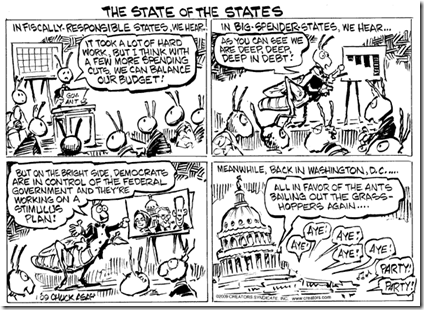
Political Cartoon: Bailing Out the States

From Chuck Asay.  (Click for a larger version.)

image

We punish the fiscally responsible by making them pay for the irresponsible.  Do you think this will bring about more responsibility or less?  Hmmm.

Things Heard: e53v1

  1. Quantum computer as reality … a problem.
  2. I don’t think his hermeneuticalness is a word … but perhaps it should be.
  3. Prison and Islam.
  4. Parody or not?
  5. The Hybrid-Starfish and church. Huh?
  6. A homily.
  7. A power “behind the throne?”
  8. Metropolitan Jonah addresses the crowd.
  9. Homophobe … the weasel word for the day.
  10. St. Maximus and hospitality via ontology.
  11. That Brazilian hasn’t been to Chicago yet.
  12. Obama and the tyrant.
  13. Netflix’s next move?
  14. Computer nerds through the ages.
  15. CAIR.
  16. A film reviewed: Taken.
  17. The revolving door and the Democratic party.
  18. Of course not.
  19. Libs against Dashle, one and two. And a view from the right.
  20. Hair, puns and nationality.
  21. Why is Obama singling out Rush? One view.

Public Service Announcement on Stem Cell Research

No, Bush did not ban embryonic stem cell research.  Never mind what left-wing talk radio host Ed Schultz keeps saying.  Like the House Republicans, perhaps you, too, should listen to Rush Limbaugh.  Perhaps Ed should, as well, to get his demagoguery straight.

We now return you to your regularly scheduled blog.

Stimulus Bill Not All That Stimulating

Ben Stein is not impressed.

I love this. The new kind of politics of hope. Eight hours of debate in the HR to pass a bill spending $820 billion, or roughly $102 billion per hour of debate.

Only ten per cent of the "stimulus" to be spent on 2009.

Close to half goes to entities that sponsor or employ or both members of the Service Employees International Union, federal, state, and municipal employee unions, or other Democrat-controlled unions.

This bill is sent to Congress after Obama has been in office for seven days. It is 680 pages long. According to my calculations, not one member of Congress read the entire bill before this vote. Obviously, it would have been impossible, given his schedule, for President Obama to have read the entire bill.

For the amount spent we could have given every unemployed person in the United States roughly $75,000.

We could give every person who had lost a job and is now passing through long-term unemployment of six months or longer roughly $300,000.

There has been pork barrel politics since there has been politics. The scale of this pork is beyond what had ever been imagined before — and no one can be sure it will actually do much stimulation.

Especially considering Stein’s note that only 10% of this even gets spent in 2009, and that most recessions don’t last more than a year, this is simply a way to push the pork and pretend to "do something".  And then, when the recession ends you can take credit and garner votes for you and your party.

All the House Republicans voted against this.  If you’re a fiscal conservative, you should be glad they listen to Rush Limbaugh.  And if you’re not a fiscal conservative, then perhaps the Senate version of the "economic stimulus" bill might make you one.  What’s in it?  Here’s a sampling:

•    $20 million “for the removal of small- to medium-sized fish passage barriers.” (Pg. 45 of Senate Appropriations Committee report: “20,000,000 for the removal of small- to medium-sized fish passage barriers)

•    $400 million for STD prevention (Pg. 60 of Senate Appropriations Committee report: “CDC estimates that a proximately 19 million new STD infections occur annually in the United States …The Committee has included $400,000,000 for testing and prevention of these conditions.”)

•    $25 million to rehabilitate off-roading (ATV) trails (Pg. 45 of Senate Appropriations Committee report: “$25,000,000 is for recreation maintenance, especially for rehabilitation of off-road vehicle routes, and $20,000,000 is for trail maintenance and restoration”)

•    $34 million to remodel the Department of Commerce HQ (Pg. 15 of Senate Appropriations Committee report:  $34,000,000 for the Department of Commerce renovation and modernization”)

•    $70 million to “Support Supercomputing Activities” for climate research (Pgs. 14-15 of Senate Appropriations Committee Report: $70,000,000 is directed to specifically support supercomputing activities, especially as they relate to climate research)

•    $150 million for honey bee insurance (Pg. 102 of Senate Appropriations Committee report: “The Secretary shall use up to $ 50,000,000 per year, and $150,000,000 in the case of 2009, from the Trust Fund to provide emergency relief to eligible producers of livestock, honey bees, and farm-raised fish to aid in the reduction of losses due to disease, adverse weather, or other conditions, such as blizzards and wildfires, as determined by the Secretary”)

The critical infrastructure spending is well within the purview of the federal government, and frankly is long overdue.  But there’s a huge amount of pork coming out of this that the Democrats seek to sweep under the rug hoping you won’t notice.  It’s apparently too imminent a problem to bother, y’know, debating the bill for too much longer.  This pork, er, stimulus must be passed now.

Things Heard: e52v5

  1. An economist looks at the numbers for Q4, here and here.
  2. A thought experiment, the pork bill, and the election.
  3. Large scale math, a social experiment.
  4. RAM expands.
  5. Carbon and economic expansion … not what you’d expect. Also examine this goofy statement by a Berkeley commission … are they insane?
  6. From the “hate filled” religious right … or “If you do not love your enemies then you do not know God.”
  7. Brrr … horse’s ass version.
  8. It might not be just corruption … the economic downturn might have a big part too.
  9. Consequences of not turning to the desert.
  10. Italian Job a solution.
  11. Islam in Brussels.
  12. Popular cinema, the Old Testament God, and a question.
  13. Mr Obama’s thermostat problem, or yet another carbon hypocrite.
  14. Meaning and text.
  15. Let your “yes be yes”.
  16. From Sirach.
  17. Big, bad and beautiful.
  18. Euthenasia and Montana.
  19. Modern “lovers of wisdom” … are not exactly lovers of wisdom.
  20. Grrrrrr.
  21. A book recommended. Another.
  22. Life after fame.

Things Heard: e52v4

  1. David’s cancer events/story continues to unfold.
  2. Geek games.
  3. If the progressives want to claim credit, blame must also follow.
  4. A film noted.
  5. A discussion of Islam and conversation.
  6. In name at least.
  7. What “hoping he fails” looks like.
  8. Brrrrr.
  9. Cosmos.
  10. Stimulus, billions for ACORN, hmm.
  11. Netflix reminisces.
  12. Candid camera.
  13. Comparison … possible media bias?
  14. Party lines.
  15. Le Tour … of Missouri.
  16. Moving of goalposts. I wonder why we aren’t coining the influx of new troops into Afghanistan as a surge?
  17. Forgetting innocent until proven guilty.
  18. The more I hear about it, the more I think the “stimulus” package should be called the porkulous stuffsack.
  19. Jails … worse for women … because of the other women.

For the Feast-Day of St. Ephrem the Syrian

Why St. Ephraim. Today is his feast day. Today, centuries ago, St. Ephrem fell asleep with the Lord. For me, just under two years ago, on the Saturday before Pascha I was chrismated and became an Orthodox Christian. Part of the process also entailed choosing a patron Saint, who for native Orthodox persons was chosen at your birth and that is normally also your given name. I had spent some months considering and reading about various Saints. Some of whom I had read somewhat extensively prior even witnessing an Orthodox liturgy. The choice of which Saint I might select was difficult. St. Mark was one choice, gospel author and witness to the Coptic peoples … and my first name is Mark (the patron Saint is sometimes called your “name” Saint as that is the name by which you are referred to at Eucharist).

Some of those I considered were:

  • St. John Cassian’s writings powerful and thought provoking.
  • St. John Chysostom’s homilies are also were accessible to modern sensibilities.
  • Metropolitan John Zizioulas wrote powerfully about the cosmic ontological theology of St. Maximus the Confessor echoed many centuries later by secular philosopher Sartre.
  • and St. Theophan the Recluse a Russian monastic and Bishop of the 19th century.

But … throughout Lent, through the poetic piercing stanzas of the Great Canon of St. Andrew of Crete and in the presanctified liturgies and Vespers services always ending every service was the Lenten prayer of St. Ephrem the Syrian:

O Lord and Master of my life!

Take from me the spirit of sloth,
faint-heartedness, lust of power, and idle talk.

But give rather the spirit of chastity,
humility, patience, and love to Thy servant.

Yea, Lord and King! Grant me to see my own errors
and not to judge my brother,
for Thou art blessed unto ages of ages. Amen.

Many have talked and written about this prayer. Fr Schmeman wrote a little book, Great Lent, which talks about it at some length. But remembering that prayer, I looked at St. Ephrem’s body of work and found it extensive … and almost all of it Psalmody. St. Ephrem is referred to by some as the Psalmodist of the New Testament, where King David was the Psalmist of the Old Covenant. And psalm and psalmody connects with me through music. I am not a poet. But music, harmony and polyphony, chant and song connect. My harmony teacher in college often remarked that those in math and physics often did the best in music because of connections between music and mathematics. Between the prayer above, the music connection, and St. Ephrem’s life of asceticism, prayer, and example … my choice was made.

This book, Spiritual Psalter or Reflections on God, has a collection of prayers penned by St. Ephrem, translated and collated after the manner of the Psalms of David by St. Theophan the Recluse. This latter book is something of an scandal in my opinion. It is virtually unknown in the West … but should be in every Christian home and in every pew or prayer corner. The crime is that it is not a Christian best-seller only superseded by the Bible. Those prayers in that book, some of which you can find excerpted and remarked upon by me here … read like they were written about me, to me, for me by St. Ephrem. And I found this book months after having chosen St. Ephrem (or perhaps being chosen by St. Ephrem).

Who Tried to Nip It In the Bud, and Who Let it Bloom?

Here’s a video giving us a timeline of what happened when in the story of the Fannie Mae and Freddie Mac collapse.  Take special note of who was for regulation and who was against it. 

Read the rest of this entry

ChangeWatch

Some more of "change" in the Obama administration that I’ve been saving up for a few weeks.

"Capturing or killing Osama bin Laden" used to be "a critical aspect of stamping out al Qaeda".  Now he just needs to be "pinned down" or just kept "on the run".  Some of this "change" Obama speaks of apparently means change from his campaign rhetoric.  (H/T Don Sensing.)

Two years ago, Obama called the expansion of coal-fired electricity his "worst nightmare".  Two weeks ago, Obama’s choices for both the EPA and the Energy Department described the industry as "vital" and coal as a "great natural resource".  The environmentalists are not happy at this "change".

In spite of Obama’s promise to severely reduce or eliminate the influence of lobbyists in Washington, Harry Reid said that Obama would be meeting with lobbyists and him, where the president would be doing business with them.  Reid said, "And there’s nothing wrong with that."  I happen to agree with Reid (petitioning the government is a right, though it can, like anything, be misused), but Obama’s promises like this keep falling by the wayside.  (H/T Q & O.)

Hmm, wonder if I should rename this feature "StillTheSameWatch"…

 Page 184 of 245  « First  ... « 182  183  184  185  186 » ...  Last »