By Contributor Archives

Friday Link Wrap-Up

They check immigration status at traffic stops.  This can only be referring to those racists in … Rhode Island.  Do you think we’re likely to see a lawsuit from the Justice Department there?  Yea, me neither.  In fact, it’s already been upheld by the First Circuit Court of Appeals when a private citizen sued.  Yet the government is going after Arizona for this.  Can’t have anything to do with who each state voted for in the last election, right?

A federal district court judge in Boston today struck down the 1996 federal law that defines marriage as a union exclusively between a man and a woman.”  I’ve read portions of the ruling, and I can actually see the judge’s point.  However, I think the 10th Amendment’s “equal protection” clause is being misused a bit to now refer to things like health benefits, which doesn’t really strike me as “protection” from a government’s viewpoint.  And Jack Balkin, a supporter of same-sex marriage incidentally, wonders (among other things) if liberals really want to go down this path with the 10th Amendment.  “As much as liberals might applaud the result, they should be aware that the logic of his arguments, taken seriously, would undermine the constitutionality of wide swaths of federal regulatory programs and seriously constrict federal regulatory power.”

The “biggest revolution in the NHS [Britain’s National Health System] for 60 years” is … giving doctors responsibility for overseeing patient care!  Yes folks, it took 60 years of socialized medicine for them to realize that.  Do you want to lose those 60 years of common sense here?

Much of the media is saying that the report that was commissioned by the Climate Research Unit of the University of East Anglia to investigate the ClimateGate document dump exonerated the Climate Research Unit of the University of East Anglia.  Except there’s the issue of the biggest thing critics have been harping on; the “hide the decline” suggestion that inconvenient data has been reworked to be consistent with the conclusion already drawn.  Buried in the report is this gem:

On the allegation that the references in a specific e-mail to a “trick” and to “hide the decline” in respect of a 1999 WMO report figure show evidence of intent to paint a misleading picture, we find that, given its subsequent iconic significance (not least the use of a similar figure in the IPCC Third Assessment Report), the figure supplied for the WMO Report was Misleading.

Terry Miller explains:

The researchers were not trying to hide evidence of a decline in global temperatures over the last decade—we have plenty of actual thermometer readings to show temperatures in recent years. What they were trying to hide was the discrepancy between actual temperature readings and the temperatures suggested by tree ring data. They have relied on tree ring data to show that the earth was cooler in the past. If the tree ring data is not reliable (as the discrepancy in recent years would suggest), then maybe the earth was actually hotter in the past than these researchers would have us believe—and perhaps the hot temperatures of recent years do not represent unprecedented global warming but just natural variation in climate.

So the big issue that critics latched on to is, indeed, still a big issue.
Things Heard: e128v5

Good morning.

  1. Divorce and the pack instinct.
  2. Mr Obama, AZ, and RI.
  3. Liberal/Progressives turning around.
  4. Predating Wilberforce by just, oh, 1200+ years.
  5. Methane by any other name. (would be odorless?)
  6. Summer in Russia.
  7. Of monks and marriage.
  8. Freedom and film.
  9. A simple puzzle.
  10. The future of Obamacare.
  11. A song.
  12. An app.
  13. A film.

A Silver Lining to Katrina

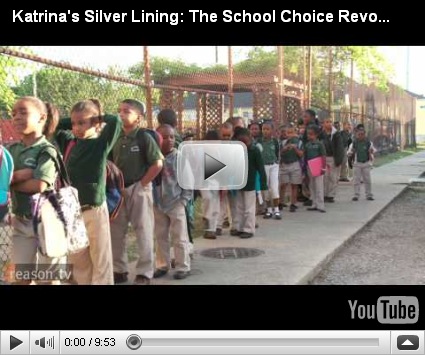
Four years after Hurricane Katrina hit New Orleans, the schools there have made an impressive turnaround.  How this was done was with rebuilding the system with school choice and competition.  It’s working.

Rusty Nails (SCO v. 7)

Is there a turn in the tide regarding gun rights? As a result of the recent Supreme Court ruling on 2nd Amendment rights, a DA in Wisconsin will not prosecute certain state laws restricting the use or carrying of firearms. Some of the laws he will not prosecute include:

prohibiting uncased or loaded firearms in vehicles;  prohibiting the carrying of concealed weapons, including firearms;  prohibiting the possession of firearms in public buildings;  and prohibiting the possession of firearms in establishments where alcohol may be sold or served.

###

Besides not letting them learn to read, black slaves couldn’t own guns either. Justice Clarence Thomas likens restrictions to the 2nd Amendment to tactics used by racists. From his opinion on the McDonald v. Chicago suit,

Militias such as the Ku Klux Klan, the Knights of the White Camellia, the White Brotherhood, the Pale Faces and the ’76 Association spread terror among blacks. . . . The use of firearms for self-defense was often the only way black citizens could protect themselves from mob violence.

By the way, Otis McDonald, of McDonald v. Chicago, is black.

###

And lastly, regarding the 2nd Amendment, a cogent and well thought out argument. Excerpt,

In no other country, at no other time, has such a right existed. It is not the right to hunt. It is not the right to shoot at soda cans in an empty field. It is not even the right to shoot at a home invader in the middle of the night.

It is the right of revolution.

Written not by a Tea Partier or Right-wing Gun Nut, but by a very liberal author at Daily Kos.

###

Well, if we can’t ban gunsmoke, then how about… smoke?

Under the new law, smoking is prohibited in indoor and outdoor areas frequented by the public, including sidewalks, parking garages, bars, restaurants, stores, stadiums, playgrounds and transit centers. Lighting up outside is also banned in places that are within 20 feet of indoor areas.

###

There won’t be any smoke around our family meal, though. In Family Meal as Therapy, we read,

…there is something about a shared meal–not some holiday blowout, not once in a while but regularly, reliably–that anchors a family even on nights when the food is fast and the talk cheap and everyone has someplace else they’d rather be. And on those evenings when the mood is right and the family lingers, caught up in an idea or an argument explored in a shared safe place where no one is stupid or shy or ashamed, you get a glimpse of the power of this habit and why social scientists say such communion acts as a kind of vaccine, protecting kids from all manner of harm.

At risk to my standing at my place of employment, I make it a point to have dinner with my family. It matters.

###

What about Jeremiah 29:10? Never read a Bible verse; especially Jeremiah 29:11.

Things Heard: e128v4

Good morning.

  1. So, how do you think the nomination will look after mid-terms when he gets ousted in 6 months.
  2. Hmm, Riefenstahl-in-a-fat-suit?
  3. Of logic and stimulus and another response to the same here as well.
  4. In a hole, keep digging.
  5. Verse on oppression.

  6. Stupidity abounds.
  7. Now I don’t think that helps at all.
  8. By the lights of Mr Obama’s argument for voting against Mssrs Alito and Roberts, this has no rejoinder.
  9. An interesting word, that.
  10. So, for the last 3 months, it’s been doing … what?
  11. An insufficient reason for art noted.
  12. Blogs and activism … in Serbia.
  13. One famous mutiny and one Bible.

Only Israel

Which country is not allowed to defend itself?

An Ecumenical Question

Throughout Church history, theological controversy has been one of the enduring features. Name any communion or denomination and you will find one which has struggled with this matter. St. Maximus the Confessor was imprisoned, exiled and lost his tongue and compared to many he got off easy. For that matter, I’d be willing to guess that among those reading this very essay, if they are Christian, have themselves had discussions, often perhaps heated, of this sort. As the title indicates, I’m leading towards a question but to start I’m going to preface that with a few remarks.

Two fragments from Scripture are perhaps relevant. (1 Corinthians 13:12) “For now we see through a glass, darkly; but then face to face: now I know in part; but then shall I know even as also I am known.”  For the second passage, Romans 2 offers that Jesus not men will be the final judge. 

We may argue about our view of the theology, Christology, soteriology, or whatever topic, but we all must admit we only see dimly the truths to which we attest. Who is right in these argument? From the second it might be said that these arguments will only be settled at the eschaton.

My question then is why then might we argue? What is the core reason for which we dispute. What is at stake? I’d be very curious to hear a variety of responses to this.

For myself, my answer might be as follows. Trinitarian theology and Christology, the parables and teachings of Jesus, Paul, James and so on are beautiful. They possess symmetry and a poetry have no little impact. Teachings that obscure this beauty … that is what is problematic. Why? Because it hinders others from seeing it. The core problem is not that you will be judged adversely if you’re a Calvinist and if at the eschaton Calvin’s teaching was fraught with error (and no, please don’t take this as a generic attack on Calvinism, the “if” is important there). The problem might be with Calvinism is whether his teachings obscures or conceals some important part of the Gospel. 

Stem Cells From Blood Coming Soon?

It could happen.

Blood drawn with a simple needle stick can be coaxed into producing stem cells that may have the ability to form any type of tissue in the body, three independent papers report in the July 2 Cell Stem Cell. The new technique will allow scientists to tap a large, readily available source of personalized stem cells.

Because taking blood is safe, fast and efficient compared to current stem cell harvesting methods, some of which include biopsies and pretreatments with drugs, researchers hope that blood-derived stem cells could one day be used to study and treat diseases — though major safety hurdles remain.

The findings “represent a huge and important progression in the field,” stem cell biologist Shinya Yamanaka of Kyoto University in Japan and the Gladstone Institute of Cardiovascular Disease in San Francisco, Calif., writes in a commentary appearing in the same issue of the journal.

All this without the need to destroy embryos.  This just keep looking better and better for getting stem cells from adults rather than the more riskier and ethically challenged embryonic stem cells.

Things Heard: e126v3

Good morning.

  1. NASA’s “new” mission.
  2. Black panthers in the news.
  3. Mr Obama’s popularity, one measure.
  4. Not unrelated to my post on mortgages … the why they (the government that is) did it.
  5. Coming of age.
  6. Confusion about who.
  7. A lexicon on the inner life: Attention.
  8. Gender and the gaol.
  9. A girl in the wide world.
  10. Orange.
  11. Micro-economics of banks.
  12. Hope and change.

Things Heard: e126v2

Good morning.

  1. Guns and scholarship.
  2. Social cooperation and competition.
  3. The Steele kerfuffle.
  4. Mark Twain and his admiration for a Saint.
  5. Photoshopping and news.
  6. The expected (?) reaction.
  7. Spain?
  8. Ya think?

Us And Credit: A Little History

From Rajan’s book Fault Lines, I summarize the latter part of the first chapter (sub-titled “A Short History of Housing Credit”). From Rajan, before we embark on this little history:

Easy credit has large, positive, immediate, and widely distributed benefits, whereas the costs all lie in the future. It has a payoff structure that is precisely the one desired by politicians, which is why so many countries have succumbed to its lure. Rich countries have, over time, built institutions such as financial sector regulators and supervisors, which can stand up to politicians and deflect such short term myopia. The problem in the United States this time was that the politicians found a way around these regulatory structures, and eventually public support for housing credit was so widespread that few regulators, if any, dared oppose it.

Prior to the Great Depression (also a time of great credit expansion and by golly also a period of great income inequality) mortgages were different. At that time mortgages where offered only by banks and credit unions and were short term, 5 years with a single capital repayment when the loan came due. These loans were variable rate, so the borrower bore the credit risk. In the 30s at the height of the Depression, loans were drying up and foreclosures a looming threat (10% of loans were threatened by foreclosure). So the government stepped in, creating HOLC and the FHA. HOLC was to buy defaulting loans and restructure them to 20 year amortizing mortgages with a fixed rate. The government held these loans for a short time but moved these into the private sector when it could … but the private sector at the time did not trust long term loans. So … the FHA guaranteed them, financing this by requiring insurance. HOLC disbanded in 1936 and was restructured as FNMA (Fannie Mae). FNMA bought FHA insured mortgages and financed them by issuing long term bonds sold to insurance and pension funds. 
In the 1960s short term interest rates went up and the system broke. To fix it, FNMA was split in two, FNMA and GNMA (Ginnie Mae). GNMA continued as FNMA had before, but now FNMA sold its repackaged loans directly to the public. When Lyndon Johnson had budget fights at hand, FNMA balance sheets were removed as a government liability. FHLM (Freddie Mae) was also created at this time to repackage loans made by the thrifts (credit unions) … and for the same reason it too was privatized. In the 1970s and early 80s. Fed chairman Paul Volcker increased short term interest rates to “hitherto unimagined levels” to tame inflation. This was lethal for the savings and loan industry and it would have gone bankrupt. But … housing was too important politically and the industry too well connected. So it was deregulated. The sizeable loss for the thrifts was converted neatly into an enormous loss for the taxpayers. This meant that Fannie and Freddie came to play in increasingly important role in mortgage financing. 
Fan and Fred are curious beasts, known to the industry (apparently) as GSEs or government sponsered enterprises. They have private shareholders to whom their profits are due. They are however not public. They have political perks and duties. They are exempt from federal and state taxes, government appointees on their boards, and a line of credit from the US Treasury. The “full faith and credit” of the US backs these organizations. These perks come with a mandate to — support housing finance. To do this they do two things, they buy mortgages which conform to certain size limits and credit standards. They also package these loans together and issue mortgage backed securties after insuring them against default. They also started borrowing directly from the market and investing mortgages backed securities. 

But much of the profit stemmed from their low cost of financing, deriving from the implicit government guarantee, and this was a critical political vulnerability.

Here is where the politicians stepped in. In 1992 Congress passed the “Federal Housing Enterprise, Safety, and Soundness Act.” The act instructed HUD to develop affordable housing goals for the agencies and monitor progress towards these goals. Rajan notes that when Congress writes an act with “Safety and Soundness” in the title, you must realize that Congress means that ironically. Even though Fan/Fred couldn’t head off this bill, they did manage to restructure it to their advantage. They insured that the legislation required that they hold less capital than other regulated financial institutions and that this new regulator (within HUD) was subject to Congressional appropriations. This meant that if it really started, you know, regulating Fan/Fred the friends of Fan/Fred in Congress could cut their purse strings. 

The combination of an activist Congress, government supported private firms hungry for profit, and a weak and pliant regulator proved disastrous.

Under the Clinton admin, HUD steadily increased the amount of funding it required the agencies to allocate to low income housing. The administration set ever higher mandates for the percentage of these loans, from 42% in 1995 to 50% in 2000. In 1977 the CRA (community reinvestment act) had required banks to lend in their local markets, but set no explicit goals, which was left to the regulators. The Clinton admin put pressure on the regulators to apply threats and fines on banks to increase loans … and so they did. In 2000, the Clinton admin ramatically cut the minimum down payment required to qualify for an FHA (federally insured loan) to 3%,  increased the maximum size of the mortgage, and halved the premiums it charged for the insurance. Mr Bush’s administration doubled down on these practices. The pushed the mandate to 56%. 
How much lending went this way? Well, in Rajan’s words

On average, these entities accounted for 54% of the market across the years, with a high of 70% in 2007. He (Pinto) estimates that in June 2008 the mortgage giants, the FHA, and various other government programs were exposed to about $2.7 trillion in sub-prime and Alt-A loans, approximately 59% of the total loans in those categories. It is very difficult to reach any other conclusion than that this was a market driven largely by government, or government influence money.

Things Heard: e126v1

A belated Happy Birthday Mr America.

  1. Books, celebrated.
  2. Some links for the 4th: on the founders, freedom, sacrifice, and chains.
  3. Where theology starts … and what it needs to remember, namely hew to what is true not new or topical.
  4. Rain, not in Spain.
  5. Anaphalaxis.
  6. If he was a fan, he’d be calling him pragmatic.
  7. Heh.
  8. Evidence that Mr Obama isn’t so smart, e.g., his admission that he “doesn’t get it.”
  9. Fingers.
  10. Cinema, here and here.
  11. Looking at the zeitgeist.
  12. 30 years of draconian regulations.

Fireworks, 206 years ago

Wednesday July 4th 1804, we Set out Eairly & passed the mouth of the outlet of a large lake which comes in on the north Side. this pond or lake is large & their has been a Great many bever found in it, high land on the South Side & praries, we Delayed a Short time at noon to dine. a Snake bit Jo. Fields on the out Side of his foot, this was under the hills near the praries on the South Side, we passed a Creek on the South Side about 15 yards wide. comes out of the large prarie, and as it has no name & as it is the 4 of July, Capts. name it Independence Creek we fired our Bow piece this morning & one in the evening for Independance of the U. S.

– Sgt. John Ordway, Lewis & Clark Expedition, 4 July 1804

Happy Independence Day!

America, bless God.

Friday Link Wrap Up

Two weeks of links to catch up!

Closing Guantanamo; big priority during the campaign, not so much now.  (Well, especially since even Democrats don’t even want to do it.)

The Obama administration turned down using Dutch oil skimmers because they couldn’t meet our stringent government environmental regulations on how pure the decontaminated water was that they dumped back into the Gulf of Mexico, right on-sight of the spill.  Instead, we transport the oily water to facilities and decontaminate it there.  Huge efficiency drop during a major catastrophe because, ironically, of environmental regulationsRead the whole article for more things we turned down that could have averted a lot of this problem.

Our own Treasury Secretary is ignorant of economic history.  Timothy Geithner said this at the latest G-20 summit:  “One of the mistakes made in the 1930s was that countries pulled back their recovery efforts too soon, prolonging the Great Depression.”  However, precisely the opposite happened.  Recovery efforts failed, lasted too long, and that’s what prolonged the Great Depression.  NewsBusters has the charts.

School vouchers improve graduation rates. Now we have a government study to prove what common sense already told us.

Sharia Law in the UK:  Dogs barred from buses so as not to offend Muslims.

Democrats have decided that there will be no budget this year.  Hey, at least (this time) they’re being honest about it.  I guess they’ll just spend until it doesn’t feel good anymore.  Or until they’re voted out.  Whichever comes first.

In Venezuela’s socialist paradise, the government’s Food Ministry rounds up 120 tons of rice because it might be sold above regulated prices.  At the same time, 80,000 tons of food was found rotting in government warehouses.  Government efficiency at its finest.

Another example of bait-and-switch in the passage of ObamaCare.  Obama rejected the idea that the individual mandate was a tax increase, but in defending it from state lawsuits, the administration does classify it as a tax increase.  This way, the mandate falls under a law that forbids the states from interfering in tax collections.  In addition, “an early draft of an administration regulation estimates … a majority of workers—51 percent—will be in plans subject to new federal requirements….”

If your 11-year-old asks a particular Massachusetts school for a condom, they’ll get it, no questions asked.  Also, parents objections will not be taken into consideration.  Actually, there’s no real age limit on the policy; any kid can get one.  Only in Massachusetts.  For now.

And finally, all that hard work pays off, but not the way you thought it would.  (From Chuck Asay.  Click for a larger version.)

 Page 109 of 241  « First  ... « 107  108  109  110  111 » ...  Last »