
Archive for September, 2008

Abortion and Community

I’ve got a few loose threads running around. I’m going to pick a smaller one tonight. Last night I quoted Wendell Barry on the public and private nature of sex and the consequent dialog in our society which has lost its sense of community. And I think we should take seriously the notion of moving our discourse out of the conservative/liberal divide and center it around community. With that in mind (and another loose thread to nip) in this comment trail, commenter Boonton suggests that there is not good “pro-life” answer to:

A good question that ended up getting EO to ban a commentator was based on a hypothetical fire. You rush into a IV Fertilization clinic that is on fire. There happens to be a live baby in a crib crying. There is also a heavy 60 pound mini-freezer whose label says it contains 150 frozen fertilized eggs. There are only moments to spare and you can only carry one out. Which is it?

The initial response, which you can follow (but I’ll summarize) is that there is at least one problematic feature to this, that the IVF is problematic for many who hold pro-life positions, e.g., the Catholics. I suggested that one might make a problematic moral question in the context of an extermination/concentration camp, but that the different arguments might ignore a “Gordian solution” (in the case of saving IVF blastocysts its that IVF is problematic in the case of the camp … it is the mere existence of the camp). Mr Boonton leaped at an mistaken notion of what such a “camp moral quandary might be”, so before going further I’ll offer that as an aside before going on to the real point. In the context of a camp, a analogous moral question might be, you are in position to save either one child imprisoned in the camp or 5 (pick a number greater than 1) children of the guards … you know that tomorrow everyone in the camp will die. Whom do you save, the one child or the five? The one has had a recent life filled with horror, the others benefited from luxury not of their making but as a result of their parents choices (crimes) and (abuse of their) positions of power.

So the matter at hand with the asides finally set, err, aside, is that we want to discuss abortion in not in a “cold-blooded mechanical” fashion, but instead in the language of “respect, responsibility, sexual discipline, fidelity, or the practice of love.” Now we live in a culture which has been dominated by a particular (Christian-Greco-Roman) culture. What this means is that our narratives describing what comprises healthy community all involve a healthy helping of ethics which include a disavowal of abortion, and for now what that means for those of us in our culture is that abortion is a symptom of a breakdown of community. So, I’ll turn the tables back on the pro-choice crowd, how does abortion fit into your notion of healthy community? And if it doesn’t why is the question of pro-choice/pro-life on the table? For the question at hand isn’t one structuring law right, its recovering community.

Postcard From the Inside

Mr. Instapundit noted yesterday:

A READER AT A MAJOR NEWSROOM EMAILS: “Off the record, every suspicion you have about MSM being in the tank for O is true. We have a team of 4 people going thru dumpsters in Alaska and 4 in arizona. Not a single one looking into Acorn, Ayers or Freddiemae. Editor refuses to publish anything that would jeopardize election for O, and betting you dollars to donuts same is true at NYT, others. People cheer when CNN or NBC run another Palin-mocking but raising any reasonable inquiry into obama is derided or flat out ignored. The fix is in, and its working.” I asked permission to reprint without attribution and it was granted.

UPDATE: The Anchoress hears similar things.

Water must be warm in the tank.

Abuse Not Worthy of News Coverage

When sexual abuse in the Catholic church was uncovered, the national mainstream media was all over the story, as it should have been.  But when it’s a public school system that is involved in the same thing — including sending known offenders back in to work with kids, and trying to minimized the issue — their silence betrays their bias.  Then, there was outrage and daily reports on the evening news.  Now, local reporting but not much else.

Dave Pierre of NewsBusters chronicles the issue here (back in May) and here (last week).  The national media ignores a government program but wallops Christians over the same issue.  Yeah, no bias there, right?

Panicking? Don’t.

As my wife and I talked about the bailout failure, she wondered if there would be the catastrophe that pundits were predicting would come about.  I mean, some were giving the impression that the next day we’d be in The Great Depression 2.0.  The Dow Jones drop yesterday was a large absolute number, but it was just a little over 6%; less than a third of the percentage drop in ’86.  And over the past week the market has taken wide swings as emotion rather than reason has put it on the roller coaster.

But as the Hitchhiker’s Guide to the Galaxy reminds  us; don’t panic.

There are two reasons not to panic.  The first is that God is still in control, He knows what’s coming, and if we’re trusting in Him we don’t have to worry.  “And we know that in all things God works for the good of those who love him, who have been called according to his purpose.” (Romans 8:28)  Those “all things” may not all be pleasant and cheerful, but they’ll all work for good.  Likewise, this doesn’t mean we don’t have plans if disaster strikes — I have a savings account, a retirement account, and I backup my computer; this verse doesn’t tell us not to be careful — but whatever events come our way we need to trust Him to get us through it.  Panic, as human and as understandable as it may be, is a lack of trust.  A good article, “Fearing the Future”, is here at Crown Financial Ministries’ web site.  Don’t panic.

The second is that panic makes us do foolish things that calm consideration may warn against.  We react instead of respond to the events of the day.  Take the fuel shortage hitting my neck of the woods.  If every car in metro Atlanta were to top off their tank on the same day, we’d have a fuel shortage even if all the stations had gas to begin with.  But, true to (human) form, when we heard that hurricane Ike slowed the flow of gas into the southeast, and the governor said not to panic, Atlanta did anyway.  Worried about gas lines and higher prices, Atlantans created and implemented a self-fulfilling prophesy.  If folks with 7/8th of a tank all hadn’t decided to top off during the same few days, we may have been able to ease through it.  There would have been some disruption, no doubt, but not to the point where some folks trail gas tankers to their delivery locations. 

The stock market lost 6% yesterday?  Then today’s the day to jump in.  Other people panicked and bailed out of the market, creating bargains.  Some folks have dumped stock of companies that aren’t going to be affected, or affected little, by this situation, so their stocks are now artificially low.  This podcast episode from Crown Financial Ministries deals with this specific issue.  (And I recommend picking up the feed in your podcatcher of choice.  Good advice all the time.)  Don’t panic.

But could we actually wind up in The Great Depression 2.0?  Only God knows, and that’s not a cliche.  Whether we experience some pain now or if we kick the can down the road, it’s still all known to God.  Trust Him, and don’t panic. 

Things Heard: e35v2

Do you think the market will rebound to day, as investors grab deals … or will it continue to plunge? Why is the bailout bill noted as “the GOP killed it” with 95 Dems voting against it?

Community and Babylon

In the book (and eponymous essay) Sex, Economy, Freedom & Community: Eight Essays Wendell Barry writes an final impassioned essay pushing the importance of community. Mr Barry notes the inability of public discourse to deal with sex and other issues is due to the failure of community. Writing:

Once it [a society or culture] has shrugged off the interests and claims of the community, the public language of sexuality comes directly under the influence of private lust, ambition, and greed and becomes inadequate to deal with the real issues and problems of sexuality. The public dialogue degenerates into a stupefying and useless contest between so-called liberation and so-called morality. The real issues and problems, as they are experienced and suffered in people’s lives, cannot be talked about. The public language can deal, however awkwardly and perhaps uselessly, with pornography, sexual harassment, rape, and so on. But it cannot talk about respect, responsibility, sexual discipline, fidelity, or the practice of love. “Sexual education” carried on in this public language, is and can only be, a dispirited description of the working of a sort of anatomical machinery — and this is a sexuality that is neither erotic nor social nor sacramental but rather a cold-blooded, abstract procedure which is finally not even imaginable.

[…]

The public discussion of sexual issues has thus degenerated into a poor attempt to equivocate between private lusts and public emergencies. Nowhere in public life (that is, in the public life that counts: the discussions of political and corporate leaders) is there an attempt to respond to community needs in the language of community interest.

Bertrand de Jouvenel as summarized in Mahoney’s little book Bertrand De Jouvenel: Conservative Liberal & Illusions Of Modernity (Library of Modern Thinkers) also notes that the discourse between liberal and conservative is an intramural struggle between two parties which share a largely common set of (erroneous) assumptions. Modern political discussion is straight-jacketed by the Hobbesian/Lockean assumptions which are largely fraught with error, yet remain dominant. For example, Locke proposes notions of natural rights to protect from the obvious dictatorship of Hobbes social contracts ability to subsume any and all parts of the private into the public realm. Rousseau, critiqued this by noting that the notion of rights does not in any way hinder the government from taking. Observe the last weeks dialogs on the banking crises. Nowhere in the discussions do we find asked if it is the “right” of government to decide whether the proposed takings (the $700 billion) was right. So often there is talk about the barriers between politics and religion. Barriers between the partisan political and the financial seem, if anything, more important. But no fundamentals needed discussion here. The assumption is, that whatever is needed, can be extracted by fiat by those in the beltway.
I have on a number of occasions argued for pushing our political members to assign powers and responsibilities to the local level. There are many good reasons for this. Above, Mr Berry notes eloquently yet another of them. Community in this country is dying. In part this is due to the very low price of energy in our petroleum driven economy. High mobility and ease of travel makes anonymity and disconnect from our neighbor easy and in part natural. This may be a temporary adjustment as it may be likely that in a half-century the petroleum engine driving the modern 20th and 21st century economy may in fact wind down. Mr Berry points as well to other structural elements in our society that keep our alienation from community intact. Mr Jouvenel also isolates and notes the peculiar yearnings that citizen of Babylon (as he terms our multifarious multicultural society) possess. For the citizen of Babylon is a repellent and attractive nature to the smaller more unified societies of old. The unity that a small society could have is at the same time exciting in that it is a thing one can strongly believe in, can join, and participate fully … but at the same time that giving up of self to one particular thing is repellent.

My suggestion to this is strengthening of the small community by giving it responsibility and authority. Babylon might perhaps co-exist with a multiplicity of small cohesive micro-societies joining together in a larger whole.

New Poll: To Bail or Not To Bail

We have a new poll question today.  Do you approve of having some sort of bailout bill from Congress to deal with the subprime mortage crisis.  If so, what form would you like the bailout to take; buy the debt, insure the debt but don’t buy it, or some other option?  If you have a different idea, let us know in the comment section.  Or would you prefer to just let the chips fall where they may?

The proposed & amended bailout bill failed today, so the question is, what (if anything) now?  This is an open thread (aka “You Cry Out”) on what you think the next step should be.

Polls are opened until Friday night at midnight.

The Dynamics of Virginia

During this election cycle, much has been made of the possibility that Virginia could turn blue in November. But Senator Obama’s success in the state will likely depend on how well he can do in Southwest Virginia. A fascinating piece in The New Yorker examines the challenges he’ll face in this part of the state.
 
Although the New Yorker piece suggests Obama might have a pretty solid chance at winning here Jim Geraghty’s analysis seems to be far more realistic. Senator Obama is farther to the left philisophically than Mark Warner or Jim Webb and is going to have a harder time making significant inroads here.
 
One other thing to note here: although polls show Obama ahead here (Rassmussen has him up by 3 points today), the state is politically diverse and support for each of the candidates runs stronger in different parts of the state. Most internals to polls will talk about party affiiliation, gender, race, and other demographic factors. But to really determine whether a poll here is accurate you need to know where the respondents live.
 
When election day rolls around, don’t be surprised if Virginia becomes the state that ultimately determines the outcome of the election. It may go either way but it’s not as much of a lock for Democrats as they would like to make it out to be.

The Law of Nature

With a tip of the hat to Bruce McQuain at Q&O, the country of Ecuador is about to take a step into environmental extremism that is (so far) unparalleled.

The South American republic of Ecuador will next week consider what many countries in the world would say is unthinkable. People will be asked to vote on Sunday on a new constitution that would give Ecuador’s tropical forests, islands, rivers and air similar legal rights to those normally granted to humans. If they vote yes – and polls show that 56% are for and only 23% are against – then an already approved bill of rights for nature will be introduced, and new laws will change the legal status of nature from being simply property to being a right-bearing entity.

This is a complete rewrite of the definition of the concept of a “right”. 

And where did they get this idea?  American leftists.

Thomas Linzey, a US lawyer who has helped to develop the new legal framework for nature, says: “The dominant form of environmental protection in industrialised countries is based on the regulatory system. Governments permit and legalise the discharge of certain amounts of toxics into the environment. As a form of environmental protection, it’s not working.

“In the same way, compensation is measured in terms of that injury to a person or people. Under the new system, it will be measured according to damage to the ecosystem. The new system is, in essence, an attempt to codify sustainable development. The new laws would grant people the right to sue on behalf of an ecosystem, even if not actually injured themselves.”

Linzey is a member of the Community Environmental Legal Defense Fund.  This is their liberalism and environmental policies running out of control, and is a peek into what they really want in our country.

Linzey admits that Ecuador may be taking a step into the legal unknown. “No one knows what will happen [if the referendum goes in favour of new rights for nature] because there are no examples of how this works in the real world,” he says. “A lot of people will be watching what happens.”

Yeah, good luck with that guinea pig thing.  Just waiting for the Plant’s Suffrage movement.

Republicans Wanted to Regulate Freddie & Fannie, Democrats Didn’t See a Problem

In the first Presidential debate, Barack Obama used the line more than once that this credit crisis we’re in stems from policies that “shredded” regulations, and that assumed that regulation is “always bad”.  But that characterization is simply not true, and in the cases of Freddie and Fannie, which are government sponsored enterprises (GSE), government oversight is especially required.

First of all, GSEs are a non-free-market concept, contrary to Rep. Barney Frank’s assertion that this credit crunch is a failure of the free market.  It is a government program to target certain sectors with cheap loans.  Overall, it has been fairly successful, but it is not a free market issue.  This is government stepping in to deal with a situation it wants to see changed.

The second issue is that when Democrats pushed Freddie and Fannie to create what became known as the subprime mortgage market.  That was the subject of the previous video I posted on this subject.  It became the late-20th-century version of “a chicken in every pot” promise.  Everyone gets a home!  Well, not really.  Everyone gets a mortgage, including some who couldn’t afford it.  But Freddie and Fannie took this mandate and went wild.  It was essentially a big-government solution being administered by a big-government program; again, not a failure of the free market. 

During this time, Republicans realized that more regulation of these types of loans and the securities backed by them was required, but Democrats did not believe there was a problem.  Those were their words; not a problem.

Roll the tape, and listen to their words.

So Obama’s sweeping contention that Republican consider regulation “always bad” is demonstrably false.  Less regulation is a hallmark of conservatism, true, but where it’s required, especially in a government program, it should be done.  But Democrats, when faced with tightening the purse strings on a constituency that they claim for themselves, will see no evil.  Being for the little guy does not mean setting them up for failure.  It’s partisan politics, pure and simple.

And by the way, where’s the MSM on this?  Quiet as a mouse.  FactCheck.org’s checking of debate facts is silent on this issue.  The objectivity on this issue is pointing out some glaring blind spots.

Update: Roger Kimball gives the roots of this crisis a closer look, with suitable linkage.  Short and sweet, but informative.

Things Heard: e35v1

Global warming, the complexity explained

From NASA warming scientist: ‘This is the last chance’ to Hot Climate could Shut Down Plate Tectonics, what is one to think about our impending doom from Global Warming?

In the web-radio interview Toward a Sensible Approach to Global Warming, the scholars at Reasons to Believe interviewed environmental scientist Kevin Birdwell.

The interview was well done, with no rash statements made on either side of the issue. Birdwell presented the current state of knowledge, on environmental science, noting that global warming does occur. He also noted that, due to the incredibly complex nature of the topic, we are not yet able to determine to what extent human induced warming affects the environment. Birdwell also stated that simply reducing carbon emissions will not necessarily impact global warming since all particulants emitted, natural and man-made, play a role in “global warming.”

It was good to see Reasons to Believe finally address this issue, which has polarized many within the evangelical community.

The First Debate

Now that the first presidential debate is over, the question that everyone is asking is who won?
Each side will, of course, claim victory. But pundits (and probably voters, too) go into these things looking for a clear victor.
 
One of the cardinal rules of debates is to not say anything that will come back as a sound bite that can be used against you later. While there weren’t any major verbal gaffes, the McCain campaign didn’t waste any time making an ad from one of Senator Obama’s minor gaffes. The speed with which that ad appeared is just further testimony of how media saavy McCain’s campaign really is.
 
My impression is that Senator Obama started strong when the questions were more focused on the economy and gradually got weaker as the shift moved to foreign affairs. Senaor McCain, on the other hand, started out weaker and got better as the night wore on.
 
Although the pre-debate coverage indicated that Senator Obama would try to get under Senator McCain’s skin it seemed to me (especially when they went to split screen – I was watching it on Fox News) that Obama seemed more irritated, interrupted Senator McCain frequently, and would often try to get the last word in. These are all minor issues overall but seemed to make Senator Obama seem smaller and consequently less presidential.
 
There’s no question these two candidates are extremely intelligent and both performed well under pressure. No major mistakes were made. But at the end of the day I think Senator McCain still has an edge in terms of having the character and experience necessary to be President. It remains to be seen whether voters will draw the same conclusion.

Obama, what was that about politics as usual?

From Glenn Reynolds, a link to a story about Obama threatening the licenses of TV stations that run an NRA ad.

Change… we can believe in.

Here’s the ad:

Interview: Kevin McCullough, Author of The Kind of Man Every Man Should Be

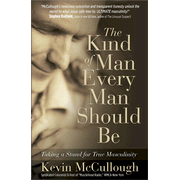
920407: The Kind of Man Every Man Should Be: Taking a Stand for True Masculinity The Kind of Man Every Man Should Be: Taking a Stand for True MasculinityBy Kevin McCullough / Harvest House Publishers* From radio commentator, syndicated columnist, and MuscleHead Revolution author comes a bold message for 21st-century men! McCullough probes the undermining of manhood over recent decades and speculates why both sexes are reluctant to address the problem. Citing God’s blueprint in Scripture, he challenges Christian men to behave with dignity, act with clarity, and lead with conviction! 224 pages, softcover from Harvest.

This morning I had the opportunity to chat with Kevin McCullough. His book is a wake up call to men (and women) everywhere that it’s time for men to start living the way that God has designed them. It’s both a very personal and immensely practical book and one that I heartily recommend to everyone. I’ll have a more complete review here soon.

Click on this link to hear the interview.

UPDATE: Thanks to Kevin McCullough for the link!

 Page 1 of 8  1  2  3  4  5 » ...  Last »