Things Heard: e29v5
- Ammunition for the (faulty) recession meme.
- Better (big) battery?
- On anti-semitism and America.
- Mr Obama (and liberals) on race.
- Power, extra-crispy, or KFC in Fallujah.
- Single payer.
- Biology question. (Answer at the link)
I’m currently on vacation in Ithaca, NY. My dad’s father, my dad, his 2 brothers, and a whole host of family in-laws and friends have purchases homes here and retired to the beautiful central New York region. Ithaca is home to Cornell University and Ithaca College, and over the years students from those schools essentially paid for the homes while they rented them during the school year. We would take our 3 weeks vacation here every year to mow the lawn (5 feet high by summer; students don’t typically mow lawns) and see our cousins. Because the brothers and their sister tried to coordinate vacations, we got to know our first cousins very well, as well as some second cousins and others of various once-removed or twice-removed situations.
Ithaca lives up to the stereotype of a very liberal college town, politically speaking. Obama will carry this town with greater than 95% of the vote. For a very long time, large, “big box” stores — Wal-Mart, Kohl’s, Home Depot, for examples — were kept out of town so as not to ruin the local town charm. The problem was, suburbs just outside the town were quite accepting of these stores, and they saw their tax revenues jump as the stores came in, while Ithaca found itself in a bit of a crisis. Money came in to the town, but it flowed out to the mall just on the other side of the town line or in burgs 20-30 minutes away. In the end, the “CAVE” people (liberal folks who were labeled “Citizens Against Virtually Everything”) had to relent to the fiscal realities. Ithaca now has a thriving shopping area for those that want the big stores, and after 5 or so years it still has The Commons where you can stroll around to find that corner bookstore.
What the CAVE people were worried about didn’t really happen, or at least not nearly to the extent that they predicted. The Meadow Court and the Grayhaven motels, longtime residents of Ithaca, have survived the introduction of the Hampton Inn chain. The Grayhaven caters to dog owners, one of the ways they stay competitive; defining their market. The local Wicks Lumber, which has a small hardware store attached, is still in business, even with Home Depot less than 2 miles away. The “mom & pop” establishments are essentially still here. The free market didn’t kill them off, and the CAVE people have grudgingly accepted it. (Well, some were simply out-voted. Acceptance isn’t always a given.)
In the end, capitalism worked. People got more choices, and the existing businesses survived, either by defining their markets, trading on their nostalgic or hometown quality, or enjoying customer loyalty going back decades. In Ithaca, both kinds of consumers — for the large and small businesses — exist, and businesses of both types can exist, side-by-side, in a capitalist society.
A long long time ago, when I had more free time in my life, I read copious quantities of science fiction (and other pulp fiction). Donald Kingsbury in The Moon Goddess and the Son had a crucial insight on democracy, which I suggest that many of us have forgotten. One of the primary threads in the book was a peaceful means to bring about (and bringing about) the fall of the iron curtain and the possible rise of a democratic in the place of the former Soviet empire (in part this was helped by a viral board/video/war game in the book). It should be noted that this book was written in 1986 some years before the actual fall of that regime.

One insight which might as well be drawn in part from our own revolutionary process is that, to embark on democracy is to fundamentally lose control. Centralization of power is satisfying and tempting in the larger part because of the control. The (wise) leaders of a revolution (or democratic government) must, in order to remain a democracy, yield control to the (unwise) individuals. I’ll give a few examples:
The question then, is how can we protect our individual freedoms and rights and at the same time prevent abuses that in a large measure give rise to the paternalism impulse that drives centralization?
Sharia law in the Middle East from a rights perspective is seen by the west as, well plainly said, horrible. The uneven freedoms granted differentially to men and woman (and infidel) within their society is shocking to the Westerner. It is my view of government that a state is acting within its bounds if it only takes the authority granted to it by its people. If they grant that women should be treated unevenly, then it is right for the state to reflect that. A Muslim community anywhere (including the US) might very well be within its bounds of authority, in my view is righteous.
How does one put this in practice however? What does it even then mean for such communities to overstep their bounds? Well, one might suggest that if I put you in jail unjustly it is one thing. It is another if you complain about being placed unjustly in jail but that the door is open and you can leave at any time. And that might be the key. If we allow great freedoms in the ordering of individual small communities and at the same time insist that information about the “outside” and other communities makeup and practices be available and that that “door be left open and unlocked”, that might be enough to insure your civil liberties be protected.
It might also, go a lot further to establish the sorts of civil progressive changes that the left wishes would occur. I would suggest that asking many more of us to get involved in the crafting of just law would go a lot further to internalize civil behavior than anything that might be attempted from “on high” within the beltway or the vaunted halls of the ivory tower.
I’m in a bit of a time-bind so … today y’all get all the links again.
I’ve got more, but I’m out of time. Maybe later in the day or tonight.
If you knew beyond a shadow of a doubt that a vote for the surge in Iraq and its strategy changes would dramatically reduce the amount of violence and deaths, giving the Iraqi government breathing room to get 15 of 18 benchmarks completed, would you vote for it? If it was a certainty?
Obama wouldn’t have. The man of Hope and Change(tm) would have kept the status quo.
That, ladies and gentlemen, is playing politics with the war and the lives of our soldiers. Bailing out at all costs — big costs, to Iraq if not to us — is irresponsibility at its highest. That’s not the kind of man I want as President.
[tags]Barack Obama,Iraq surge[/tags]
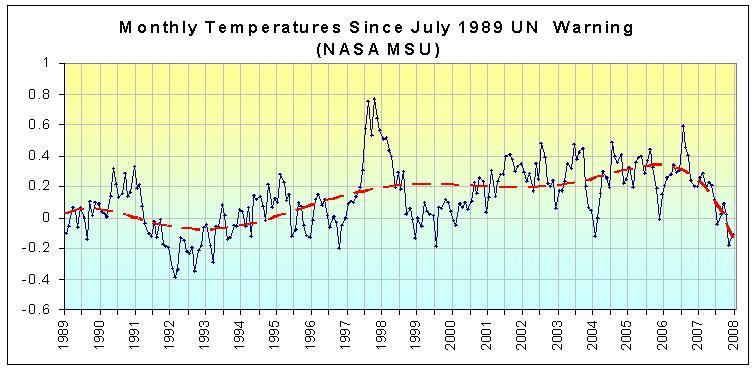
Click image for a larger version. Rev. Don Sensing queries, "Wasn’t it in July 1989 that the UN said we only had 10 years left to save the planet?" Guess we did it. Can we move on now?
Oh, well maybe not. Sensing also points to this report (PDF) which starts:
Addressing the Washington Policymakers in Seattle, WA, Dr. Don Easterbrook said that shifting of the Pacific Decadal Oscillation (PDO) from its warm mode to its cool mode virtually assures global cooling for the next 25-30 years and means that the global warming of the past 30 years is over.
That dive starting in 2006 may be just the beginning. Expect environmentalists to have something to say about it. Al Gore will probably not be the spokesman for it; too closely associated with that other natural phenomenon.
[tags]global warming,environment,Dr. Don Easterbrook,Pacific Decadal Oscillation[/tags]
If, one were to take seriously (which is admittedly hard), the left’s seriousness about reducing abortion as in Mr Clinton’s (in)famous: safe, legal, and rare … there is the problem of adoption. [note: in the following I’m going to ignore the clear conundrum raised by the question unasked or unanswered by those to whom that phrase has meaning, which is if abortion is not problematic, then why is rare valued.]
Adoption is held as an mythological sign for the pro-choice crowd. Both asking, well if you pro-lifers are so serious about saving babies why aren’t y’all adopting. But, examining the adoption procedures in this country a little more carefully the answer becomes clear. Because the largely pro-choice crowd has raised immense barriers to adopting. Getting qualified for an adoption costs close to $20k for legal fees, home studies and the like. The question is … Why?
Well, one reason one might suggest is that because the parents of the child are giving up their moral and legal responsibilities toward the child, they cannot be depended upon to insure the quality and home for the child so the state must do that instead. But, at what cost? A great number of well qualified caring parents are excluded from the process because they lack the disposable income in order to jump through the states required adoption hoops.There is another conclusion to be drawn from the existence to high barriers to adoption. That is, that orphans and children needing adoption (in this country) are in fact rare. If the problem of excess orphans was actually acute, essential moral market forces would bring the barriers down. That they haven’t and that adoption agencies and their lawyers successfully continue to charge high prices for their services is
Actually another highly likely reason is that legislators setting guidelines for abortion (often) forget TANSTAAFL when they make their laws. What cost adding one more check, after all it might just save one kid from misery? Well, there is a cost. But it’s not apparent.
There is another conundrum present. The pro-choice crowd consistently paints abortion as easy, pregnancy as difficult, adoption as freely available (and a choice rarely chosen by the pro-life side). However, that begs a question. If the reason that the high barriers to adoption exist are in fact that in giving up their responsibilities toward the child mean that the state do due dilligence in vetting the parent then that begs the question: Why does that at the same time exclude the state from exercising due diligence when a pregnant mom wants to terminate her child. Is she not as well, yeilding her moral and legal responsibilities toward her offspring as well?
Help Build Houses and Hope with Habitat for Humanity