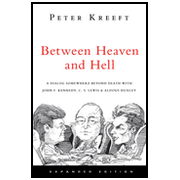
A Conversation with Peter Kreeft

834800: Between Heaven and Hell: A Dialog Somewhere Beyond Death with John F. Kennedy, C.S. Lewis & Aldous Huxley Between Heaven and Hell: A Dialog Somewhere Beyond Death with John F. Kennedy, C.S. Lewis & Aldous Huxley
By Peter Kreeft / Inter-varsity Press

Back when I was in college, Peter Kreeft’s book Between Heaven and Hell was essential reading for anyone interested in apologetics. Now the book has been reissued in an expanded format. National Review’s John J. Miller has a fascinating conversation with the author on his book, how it was written, and why it’s just as revelevant today as when he first wrote it. Check it out.

Things Heard: e41v5

Aliens: Maths and Gods

In this recent post arguing for the converse of cogito ergo sum, two comments were elicited for which the response I felt was better promoted to a new post. Plus, of course, the ever present problem for the regular blogger is solved … that is on what to write? Two responses, not entirely unrelated by frequent commenter, the Jewish Atheist who first remarks:

Intelligent space aliens would discover i2=j2=k2=ijk=-1 but would likely have a completely different theology. Math equations are universal. Theological angel-pin-dancing calculations?

There are two problematic features of this response. The first is the (especially the first) Star Trek alien problem, that is all too often aliens are portrayed as humans in rubber suits. Their concerns, appearance, and their communications are all to often human with a small twist. JA elaborates:

People from different cultures on Earth come to the same conclusions about math. They differ on theology. This is because math is a formal system learned by humans and theology is just made up.Are you really denying that given an intelligent civilization elsewhere that they would almost certainly discover i2=j2=k2=ijk=-1? And that they would almost certainly have created thousands of their own theologies that bear only superficial resemblances to Earth’s theologies? If they had theologies at all?

This follows much the same vein. So there are really two questions at hand here. The first is how fundamentally immutable are mathematical truths and how much of our mathematical construction is human, or to coin it more poetically what parts of math are divine and what parts mortal? The second issue offered here is on the theological side. To put it bluntly, our interlocutor insists that theological ideas are “just made up” and specifically made up in a way that math (such as the Brougham bridge example noted earlier) is not. Read the rest of this entry

Unwanted Advances at School

In Florida, evidence of a growing problem with the public schools.

At least 150 Florida teachers have been disciplined in the past three years after being accused of sexual misconduct with students, an Orlando Sentinel review has found.

Some of the most severe cases resulted in arrests and criminal convictions for offenses such as secretly watching a boy change and shower, tricking elementary-school girls into touching a man’s genitals and having sex with minor students. But the Sentinel’s case-by-case review of teacher discipline records from the Florida Department of Education found that a lot of the alleged misconduct did not rise to the criminal level.

Still, parents would be alarmed.

[…]

Those 150 cases don’t include the dozens of educators who have been suspended or lost their teaching certificates since 2006 for molesting non-students, downloading porn at school, having sex in public and trying to pick up prostitutes.

There is no research to show whether this is indeed an actual trend or a case of students reporting it more often.  However, there is research, cited later in the article, that shows that students now are very reluctant to report it.

Researchers, however, say far more children are affected by sexual misconduct at school than many people may realize.

The most in-depth study to date, commissioned by the U.S. Department of Education in 2004, showed that nearly 10 percent of the country’s public-school students — 4.5 million children — had received unwanted sexual attention from school employees, including teachers.

Only 11 percent of students who are sexually abused by teachers report it, said Charol Shakeshaft, an education professor at Virginia Commonwealth University who authored the 2004 study and is one of the nation’s top experts on the issue.

If only 11 percent reported it in 2004, we’d have to believe it was in the low-to-mid-single-digits in the decades prior to that.  That’s stretching things rather thin, in my opinion. 

And if only 11 percent are reporting it now, what we’re seeing, in Florida and elsewhere, could be 9 or 10 times worse that it looks. 

Homeschooling keeps looking better all the time.

Things Heard: e41v4

An Old Connection Made

Tom Daschle is back in the news today. Oddly enough Mr Daschle’s name is linked in my noggin with a quote probably bugged me as the most wrong thing I’ve every heard a politician utter. There was some scandal he was defending another Democratic from and he said something like,

What X did was unethical and immoral, but it was not illegal.

This to me seems to get it exactly backwards and should not be used to defend anyone’s actions. Your actions should be moral and ethical … and its always a good thing if they are also legal. But if the two are at odds, i.e., the ethical/moral and the legal are not the same, we should always choose the ethical and let the cards fall where they may regarding the legal.

Things Heard: e41v3

“Never Allow A Crisis To Go To Waste”

The top issue on President-Elect Barack Obama’s agenda on January 20 will no doubt be the economy. Over the weekend, Mr. Obama gave a hint of who he was looking for as a role model in an interview with CBS’ 60 Minutes:
 

(CBS) Kroft: Have you been reading anything about the Depression? Anything about FDR?
 
Mr. Obama: You know, I have actually. There’s a new book out about FDR’s first 100 days and what you see in FDR that I hope my team can–emulate, is not always getting it right, but projecting a sense of confidence, and a willingness to try things. And experiment in order to get people working again.

The problem is that such experimenting that Mr. Obama is referring to could very well be rehashing old liberal ideas. Ironically, FDR did the same thing according to Amity Shlaes:
 

The trouble with new financial crises is that they provide pretexts for implementing old social agendas. As the president-elect’s new chief of staff, Rahm Emanuel, said recently, “never allow a crisis to go to waste.”

Consider President Franklin Roosevelt’s New Deal, which President-elect Barack Obama invokes when he talks of “a defining moment.” Like Obama today, FDR was inaugurated into trouble. He wisely addressed the financial crisis through the steps that we learned about in school. He signed deposit insurance into law, reassuring savers. He created the Securities and Exchange Commission, making the stock market more transparent and consistent. He soothed our grandparents via his radio Fireside Chats. This was the FDR we love.

But FDR also used the crisis mood to push through an unprecedented program of reforms that progressives had been hoping to put in place for years. Sen. George Norris of Nebraska, for example, had for decades argued that utilities should be in the public, not the private, sector. As far back as the early ’20s, Norris wanted to build a big power project on Tennessee River. He wanted the government – and not the Ford Motor Company, which was drawing up such plans – to be in charge. FDR made Norris’ progressive dream a reality by creating the publicly owned Tennessee Valley Authority. Washington won out, but it wasn’t clear its power served the South down the decades.

Miss Shlaes goes on in the column to document other spectacular failures of experimentation in the New Deal including the NRA. The entire column is, of course, worth reading.
 
I’ve just started reading Miss Shlaes’ book The Forgotten Man: A New History of The Great Depression. Perhaps Mr. Obama would be well served to also read it before he takes office. While some of FDR’s experiments were huge successes, many were not. President-Elect Obama should be careful to not experiment with solutions simply for the sake of experimentation. Yes, voters asked for change but more importantly they want governmeent to deliver solutions and not create more problems. FDR’s legacy was one of creating as many economic problems as he did solutions. Perhaps Obama can avoid repeating that legacy.

Thought and the Thinker

Cogito Ergo Sum, the famous observation of Descartes is today in modern circles thought nonsense. Centers of consciousness and awareness are increasingly found to be fuzzy. And even beyond that modern Physics has fuzzy notions of reality as well. What is real is not particles, waves, or quanta/wavicles but wave functions, complex probability amplitudes whose collapse is some magical, ahem, not-well-understood “measurement” process. So that which I perceive as “I” may be in fact something quite different. As Descartes considered, everything I perceive about my exterior world might be fiction and not trusted. But, consider for a moment that those modern researchers on mind and conscsiousness are right. That consciousness which I perceive as “I” is a fiction. That is, that the reality of that which I perceive is not to be trusted and even the focus point of consciousness that I think of as “I” is a likely fiction.

Yet what remains, as the ancient Greeks considered more solid, is the thought about which I, err, thunk. For example, that which William Hamilton famously carved with a non-real knife on a non-real Brougham Bridge, namely

i2 = j = k2 = ijk = -1

That! That is real. Those ideas, those notions can be transmitted, transmuted, and touched (by mind). The quaternionic algebra is a “thing.” It is real and unlike consciousness, electrons, or my perceptions is by its ontological nature … not subject to the same sorts of questions as one puts to notions of self or the world of my perceptions.

The Christian faith is based on ideas, ideas like Trinity (the relational nature of God), Sacraments, and Theosis. These ideas are in some sense, likely, more real than we are (and as well as real as the quaternion algebra above) and as Jesus demonstrated on the third day … those ideas are real in the sense that my lunch is as well.

Now They Tell Us

In what’s sure to be a common theme in the mainstream media in the coming months, the LA Times is just now really investigating Barack Obama’s background.  In this article, it notices that his resume is quite thin.

In his books, speeches and campaign commercials, Sen. Barack Obama has harked back to his days as a civil-rights attorney.

It is fundamental to his autobiography and was displayed on his campaign Web site and woven into his appeals for votes. In one of his television ads leading up to the South Carolina primary, Obama recalled "working as a civil-rights attorney to make sure that everybody’s vote counted."

Senior attorneys at the small firm where he worked say he was a strong writer and researcher, but was involved in relatively few cases before entering politics.

Hat tip: NewsBusters.

Of course, this information was available for the past 2 years, and yet only today does it get reported.  How…interesting.

How Obama Got Elected (.com)

This web site hosts a poll of Obama voters who were asked questions about the US government and the presidential candidates in particular.  The level of non- or mis-information is truly amazing.  There is an accompanying video of 12 of those respondents showing how little they knew about Obama or Biden, but how much they did know about negative reports on Sarah Palin (or mistook what Tina Fey said as a Palin quote). 

While the general lack of knowledge about who Barney Frank is, or who controls the US Congress, may indeed cross political boundaries, what I found interesting is that, of the Obama voters asked, 86% did know that the RNC paid $150,000 for Sarah Palin’s clothes, 93.8% knew she had a pregnant teenage daughter, but only 43.9% knew in who’s home Obama kicked off his political career.  Only 1 of the 12 highlighted in the video even knew the name Bill Ayers.  And yet we were told that the public had heard the Ayers/Weather Underground connection and, based on the continued Obama advantage in the polls, must have considered it uninteresting.

Well perhaps they never heard the information in the first place.  Watch the video and find out where these folks gets their news, and that’ll go a long way to answering that question.

Things Heard: e41v2

Two Texts, A Book, and an all too brief review

Recently I’ve drifted through Jaroslav Pelikan’s odd little book, Interpreting the Bible and the Constitution (mostly reading this material while on airplanes in the last week). I say odd, because while Mr Pelikan makes a lot of interesting connections between the hermeneutical traditions behind the extraction of meaning by the Church from the Bible and the legal community from the Constitution it is hard to see what to do with the connections thus made.

One such striking observation made by Mr Pelikan are in some of the parallels between their traditions. One such interesting parallel is that today academic theology and academic legal thinking no longer actively orders its study to serve the practice of its attendant organs (as it once did). Specifically, academic legal writing and thought is not directed at aiding and influencing the practice of practical law and theology is not aimed at producing insights for pastoral application.

Another thought which struck me concerned the divisions in the modern church on the other hand … and the Civil War and other political organs of power which prevent similar divisions from occurring in the Union. Modern evangelicals and protestants deride and dismiss the hierarchical structure of the Eastern and Roman churches and particularly point to efforts to keep ecclesiastic and theological unity within those churches. However, those same people applaud the civil war and stand firmly against separatist movements within the nation.

Mr Pelikan does occasionally amuse himself (and the reader) by tweaking the reader’s expectations. Allusions to liturgical trappings … are found to allude not to Church at times but to the rite and rituals (and dress) of the law courts.

And Her Army of Flying Monkeys

This video sequence is making the rounds. You know, prior to seeing this I opposed prop 8 on the principles of government I’ve espoused on this blog. However, seeing this gives me pause. If that is the opposition to prop 8, I might have voted for it just to oppose that sort of behavior.

An interesting combination of cultural icons are coming together to make chowder out of the world’s religions.

A website launched Friday with the backing of technology industry and Hollywood elite urges people worldwide to help craft a framework for harmony between all religions.

The Charter for Compassion project on the Internet at www.charterforcompassion.org springs from a "wish" granted this year to religious scholar Karen Armstrong at a premier Technology, Entertainment and Design (TED) conference in California.

"Tedizens" include Google founders Larry Page and Sergey Brin along with other Internet icons as well as celebrities such as Forest Whittaker and Cameron Diaz.

Wishes granted at TED envision ways to better the world and come with a promise that Tedizens will lend their clout and capabilities to making them come true.

Indeed, this group of intellectual heavyweights wants to reconcile all world religions into one, bland, least common denominator.  And here’s where they’re starting from.

Armstrong’s wish is to combine universal principles of respect and compassion into a charter based on a "golden rule" she believes is at the core of every major religion.

The Golden Rule essentially calls on people to do unto others as they would have done unto them.

Except that, if I may speak for Christianity, that’s not "at the core" of my religion.  From the Old Testament, the 10 Commandments might be closer to the core.  And from the New Testament, you’d have this from Mark chapter 12:

One of the teachers of the law came and heard them debating. Noticing that Jesus had given them a good answer, he asked him, "Of all the commandments, which is the most important?"

"The most important one," answered Jesus, "is this: ‘Hear, O Israel, the Lord our God, the Lord is one.  Love the Lord your God with all your heart and with all your soul and with all your mind and with all your strength.’  The second is this: ‘Love your neighbor as yourself.’ There is no commandment greater than these."

While that second commandment sounds like the Golden Rule, one must remember that it is predicated on the first commandment.  Thus, it’s not just a case of simple actions, but one of attitude.  It requires that how to love your neighbor be a shared value between you and God, and that who God is is also a shared value. 

Thus, simply doing unto others is of no eternal consequence or value if the attitude behind it is not there.  It’s pretty clear who Jesus was referring to by "God"; Israel’s God.  And when Jesus said later that the only way to God the Father was through Himself, He left no options open for this chowder-izing of major world religions. 

Much like other new-age-type religions that seek to do the same thing, this effort is simply a way to water it all down.  Christianity is, at its core, a relationship, not a religion.  As much as others may contend that it’s nothing but a bunch of rules, I’d note that this effort is more deserving of that type of scorn; turning a relationship with a loving God into just a set of do’s and don’ts. 

 Page 194 of 245  « First  ... « 192  193  194  195  196 » ...  Last »