Things Heard: e41v1

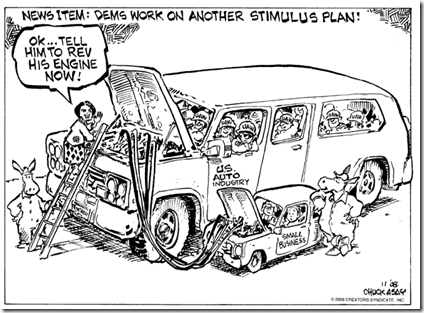
Political Cartoon: Jumpstarting the Economy

From Chuck Asay:

Chuck Asay cartoon

Karamazov and the Squinch

For the “throwaway book” I read on my recent business trip, for entertainment value I selected Walter Jon Williams Implied Spaces. This book is a relatively straightforward science fiction far future book in the modern vein. The name of the book, “implied spaces” is in away all about squinches. The residents of this far future world live in and construct for their entertainment pocket universes designed to order. However, in designing your perfect fjords and vistas … between them what appears is not to design … and those pockets end up being, like squinches or being “spaces who’s construction is implied” and not designed by intent. At the beginning, we find our somewhat implausible hero entertaining himself by personally exploring “implied spaces” finding mostly deserts and spiders.  (Note: spoilers ahead), but I’d like to comment on some of implied spaces in Mr Williams story arc itself. Read the rest of this entry

Quote of the… uh… century?

From CNN, Poll finds great expectations for Obama,

“My fervent prayer is that there will be peace on Earth in all nations, and let all countries unite together to make this dream come true,” said iReporter Shari Atukorala of Kandy, Sri Lanka. “To the President-elect Barack Obama: Sir, you can do this for all of us.”

Utterly amazing.

Is this perception of Obama common? Maybe so. Also from the CNN article,

The public thinks it’s likely that Obama will improve race relations, improve economic conditions, bring stability to the financial markets, make the U.S. safer from terrorism, reduce the country’s dependence on foreign oil, reduce global warming, win the war in Afghanistan and remove U.S. troops from Iraq without causing a major upheaval in that country.

How much of this adoration, do you think, has gone (and will go) to Obama’s head? At what point does admiration for one’s leader turn into adoration, albeit worship, of one’s leader?

On the one hand, reality may rear its ugly head and simply educate the many ignorant, but sincere, idealists who have put their faith in Obama; on the other hand, the cult of worship, is an enticing temptation, which strokes at the very essence of the narcissist’s ego.

Christians: pray for Obama

Keeping a Promise In Spite Of Himself

Barack Obama may be able to get the troops out of Iraq in 16 months mostly because George W. Bush’s surge did so well.  Via Instapundit:

"THE WAR IS OVER AND WE WON:" Michael Yon just phoned from Baghdad, and reports that things are much better than he had expected, and he had expected things to be good. "There’s nothing going on. I’m with the 10th Mountain Division, and about half of the guys I’m with haven’t fired their weapons on this tour and they’ve been here eight months. And the place we’re at, South Baghdad, used to be one of the worst places in Iraq. And now there’s nothing going on. I’ve been walking my feet off and haven’t seen anything. I’ve been asking Iraqis, ‘do you think the violence will kick up again,’ but even the Iraqi journalists are sounding optimistic now and they’re usually dour." There’s a little bit of violence here and there, but nothing that’s a threat to the general situation. Plus, not only the Iraqi Army, but even the National Police are well thought of by the populace. Training from U.S. toops [sic] has paid off, he says, in building a rapport.

If Obama had had his way, this wouldn’t have happened.  But if & when he has the troops home on or before April 2010, it will be because Dubya laid the foundation for it.

The Basics

For this who may need a refresher, a tip from LaShawn Barber.

Reading this Newsweek story for a Pajamas Media TV segment I’m taping in an hour tomorrow, one paragraph stopped me cold (emphasis added):

“If this week’s exit polls tell us anything about religion, they remind us that there are tens of millions of voters in this country who believe in God, read their Scripture, pray, regularly attend a house of worship—and do not consider themselves born-again Christians.”

OK. For the record, there is no such thing as a Christian who has not been born again. To say you believe in God, go to church every Sunday, etc., doesn’t mean you’re a Christian. People worship all kind of gods and go to church for various reasons. The questions is, is Christ your Lord and Savior? If someone has been forgiven, he has been born again, no matter what cultural or social connotations the term born again (white fundamentalist Bible-thumpers?) has been burdened with. Those saved by grace through faith in Christ understand what the term means biblically.

Born again or rebirth in Christ refers to the process that takes place when Christ saves/forgives someone. Here’s the imagery: the former man was crucified with Christ, and the new man was resurrected with Christ when he rose from the dead. The new man is renewed, regenerated…re-born. Day by day, God guides us, chastises us, and loves us, molding and shaping us into the image of his Son.

If you believe the Lord Jesus Christ suffered and died for your sins, and you trust in this sacrifice alone for the forgiveness of your sins, born again applies to you, whether you’re white, black, blue, Baptist, Presbyterian, Lutheran, Roman Catholic, or whatever else they’ve got.

I’m not quite sure what Newsweek writers think the term means.  Perhaps this usage of it shows how many people in church go through all the motions, but don’t see themselves as born-again.  (Although the usual case is that it’s the other way around; they go through the motions, never have a relationship with Jesus, and do consider themselves born-again.)  Perhaps this is the media adding its own connotations to the term.

Whatever the case, LaShawn gets it right.

Things Heard: e40v5

Prop 8 and a Scapegoat

Recently in a conversation on prop 8, it was suggested the religion of the Blacks which was why Black vote perhaps tipped prop 8 pass.

This seems an odd charge to make. Yes, time and time again we’ve heard how religion is the basis and foundation for so much anti-homosexual bigotry … but I don’t think that holds so much water. Yes, the “high atheists” do not hold fervent anti-gay positions. But … that’s not the whole of the matter. Look at two counter examples:

  1. Where did the big atheist 20th century Marxist horrors which were adamantly and ideologically atheist, such as China and the Soviet Union fall on the gay rights issues?
  2. Yes, the high atheists are not so anti-gay, but then again neither are the “high theists.” How about the six-pack or “low” atheists. What evidence do you have that they are more OK about gay rights than the bible belt/Wednesday night bingo crowd?

Try to compare apples and apples not apples and frogs.

Things Heard: e40v4

Logic and Race

From my “links” page, a response to the claim that “sore losers” are at work regarding claims of racism:

From sore winners:

People have to complain about the states that did go for McCain, claiming that all the white Southerners who voted for McCain were doing so merely because of racism rather than because they think Obama’s policies would be awful.

Nobody would argue that everybody who voted against Obama did so out of racism. However, when the old confederacy is pretty much the only place in the entire country that voted more Republican than last time, it makes you wonder. Unless you’re completely blind (willingly or not) to history.

One of the confusing things for me is the claim that voting against Mr Obama on the basis of race is racism and at the same time voting for him on the basis of race is not. It seems to me either both are or none is. If race is a valid basis to make a decision for a candidate … then that necessarily cuts both ways and that it is also is a valid reason for making a decision against a candidate. One claim on the Southern voting numbers is that a lot of those white Southern voters are Scots/Irish … and they voted more than some other regions for Mr McCain on account of ethnic heritage. But that is a little off topic. The salient point is if a decision by one person based on membership in group “A” is just (or unjust), then the particulars of membership in which group is not important.

The only argument that I’ve heard suggested that this claim that the logic works “both ways” is that one group is disadvantaged. That is is only moral to prefer one group over another if the group you prefer is disadvantaged. This apparently is very Rawlsian wiki cites the “2nd principle of justice” as:

Social and economic inequalities are to be arranged so that (Rawls, 1971, p.303):
a) they are to be of the greatest benefit to the least-advantaged members of society (the difference principle).
b) offices and positions must be open to everyone under conditions of fair equality of opportunity

This is a statement which I’ve been mulling over somewhat recently. I can’t make heads of tails of it … especially the first part. This is described as a “principle of justice”. This connects with the above in proposing that the notion that one decision based on group membership is just if it is of benefit to the “least-advantaged” members of that society (which is read as connecting specifically with that group). That is specifically, Blacks in America have had a long history of suffering injustice and therefore on account of that they are entitled in this case to be located as “least-advantaged”. That being the case, according to this “rule” then it the logic is not reversible via the “difference principle.”

Earlier forms of justice don’t take the economic or status of an individual into account, hence statues of “blind justice” and so on. The idea there is that justice is meted out not according to your membership in group or your personal status (or lack thereof) but based only on circumstance, deed, and perhaps motive. I’m unclear on why abandoning this is a good idea or how Mr Rawl’s notion of justice connects with and can be demonstrated to be “superior” to a the the standard blind one.

How the Media Fared in the Campaign

Short answer:  Not very well, and it doesn’t appear they care.

Long answer:

The adulation given to Barack Obama was far more than can be accounted for by his historic run for the Presidency.  It got so bad before the election that Michael S. Malone, a tech journalist for ABC News, got to the point he was "deeply ashamed to be called a ‘journalist’".  Michael explained, back in late October:

For many years, spotting bias in reporting was a little parlor game of mine, watching TV news or reading a newspaper article and spotting how the reporter had inserted, often unconsciously, his or her own preconceptions.  But I always wrote it off as bad judgment, and lack of professionalism, rather than bad faith and conscious advocacy.  Sure, being a child of the ‘60s I saw a lot of subjective “New” Journalism, and did a fair amount of it myself, but that kind of writing, like columns and editorials, was supposed to be segregated from ‘real’ reporting, and at least in mainstream media, usually was.  The same was true for the emerging blogosphere, which by its very nature was opinionated and biased.

But my complacent faith in my peers first began to be shaken when some of the most admired journalists in the country were exposed as plagiarists, or worse, accused of making up stories from whole cloth.  I’d spent my entire professional career scrupulously pounding out endless dreary footnotes and double-checking sources to make sure that I never got accused of lying or stealing someone else’s work – not out any native honesty, but out of fear: I’d always been told to fake or steal a story was a firing offense . . .indeed, it meant being blackballed out of the profession.

[…]

But nothing, nothing I’ve seen has matched the media bias on display in the current Presidential campaign.  Republicans are justifiably foaming at the mouth over the sheer one-sidedness of the press coverage of the two candidates and their running mates.  But in the last few days, even Democrats, who have been gloating over the pass – no, make that shameless support – they’ve gotten from the press, are starting to get uncomfortable as they realize that no one wins in the long run when we don’t have a free and fair press.  I was one of the first people in the traditional media to call for the firing of Dan Rather – not because of his phony story, but because he refused to admit his mistake – but, bless him, even Gunga Dan thinks the media is one-sided in this election.

[…]

The absolute nadir (though I hate to commit to that, as we still have two weeks before the election) came with Joe the Plumber.  Middle America, even when they didn’t agree with Joe, looked on in horror as the press took apart the private life of an average person who had the temerity to ask a tough question of a Presidential candidate.  So much for the Standing Up for the Little Man, so much for Speaking Truth to Power, so much for Comforting the Afflicted and Afflicting the Comfortable, and all of those other catchphrases we journalists used to believe we lived by.

Read the whole thing(tm).  Malone is more certainly not against reporters digging for the dirt (he supported the "reportorial SWAT teams" sent to Alaska to see what they could find about Gov. Palin).  What he is aghast at, however, was how utterly unbalanced this hardball treatment was. 

Aside from the viciousness given mostly to Republicans and their supporters, the Pew Research Center found that McCain’s news coverage was incredibly lopsided.

Slightly fewer than a third of the stories about Obama were negative, whereas more than a third were positive and about the same number were neutral or mixed. More than half of the stories about McCain cast him in a negative light, whereas fewer than 2 in 10 were positive, according to Pew Research Center’s Project for Excellence in Journalism.

The study suggests that advancement in the polls does translate into more positive coverage, but with the polls so tight this season, bouncing around in the high 40s & low 50s for so long, that explanation doesn’t really fit.

The Washington Post ombudsman, Deborah Howell, also says that her paper tilted towards Obama and didn’t really cover the issues well.  The big question is, will this translate into better coverage?  With the media still in the tank for Democrats after decades of being that way, it doesn’t seem likely.

Just ask Chris Matthews:

CHRIS MATTHEWS: Yeah, well, you know what? I want to do everything I can to make this thing work, this new presidency work, and I think that —

JOE SCARBOROUGH: Is that your job? You just talked about being a journalist!

MATTHEWS: Yeah, it is my job. My job is to help this country.

The phrase "speaking the truth to power" is about to drop quickly out of fashion in national media circles.

Things Heard: e40v3

The Electoral College

[This is a repost of an entry I wrote 4 years ago, in response to a question posed to a blogging group I belonged to.  The question was, "Is it time for the U.S. to end the Electoral College? If so, in favor of what alternative system? If not, why is it still relevant and beneficial to the nation?"  With support for efforts like the National Popular Vote rising, I thought it was a good time for a repost of this.]

I’ve actually talked a little bit abut this issue as far back as the 2000 election. Back then, I found a document on the web site of the Federal Elections Commission called “A Brief History of the Electoral College”. It hasn’t been updated to note the popular vs. electoral vote situation in the 2000 election itself, but it is a fascinating and educational look into the issues surrounding the creation of the Electoral College. Read that first before making up your mind.

This paper identifies two main requirements that the Electoral College imposes on candidates for the presidency:

  • The victor must obtain a sufficient popular vote to enable him to govern, even if it’s not an absolute majority, and
  • The popular vote must be sufficiently distributed across the country to enable him to govern.

What this means is that the winner has balanced regional support, even if that balance is tipped in favor of distribution rather than absolute numbers (as it was in 1888 and again in 2000).

The paper presents a number of pros and cons of the Electoral College and is a fairly balanced look at it, although it does come out in favor of it ultimately. I’d like to highlight just one of its points and add one of my own.

Minorities: With the Electoral College, the voice of minorities in this country is enhanced so that they cannot be so easily dismissed by candidates. Small minorities in a State can (and have) been able to be the difference between winning all of a State’s electoral votes or none. Without this clout, blacks, Hispanics, farmers, Iowans, or whatever other group you can come up with can have a larger voice in the matter, and this speaks to one of the ideas of America.

If the President was selected solely on the basis of popular vote, a candidate could simply ignore minorities who’s votes wouldn’t matter in the big picture. Getting a bare majority of the big city vote can be enough to get the electoral votes of California or New York, but then the candidate needs to appeal elsewhere in other states and among other groups of people to win the Presidency. If popular vote was all that mattered, the candidate could just continue to appeal to the wants & needs of those in highly concentrated population areas. This would not be in the best interest of a country that wants the President to be the President for everyone. Thus the Electoral College forces the issue of minority views into the national debate, which is good for all of us.

Voter Fraud: Under the current system, a candidate gets the same number of electoral votes for a state, whether he takes 50%+1 of the popular vote for that state or 100% of it. Thus any attempts to rig an election in a state are pointless after a majority is reached. Therefore, in order to have an impact nationally, the fraud must be widespread, in multiple states, rather than allowing it to work with only a few “friendly” areas involved. This makes voter fraud less of a viable tactic, and diminishes its impact when used.

Again, the paper linked above has quite a bit more, but these two issues are the ones that are one the top of my list. The paper ends this way:

The fact that the Electoral College was originally designed to solve one set of problems but today serves to solve an entirely different set of problems is a tribute to the genius of the Founding Fathers and to the durability of the American federal system.

I’d have to agree.

Things Heard: e40v2

Waves and Swans: Black Marks (on Swans)

Mr Taleb in The Black Swan: The Impact of the Highly Improbable makes an essentially clean distinction between “Mediocristan” and “Extremistan” (I’ll attempt to summarize those in a bit). This distinction however is strained. He cites, for example, the extreme income disparities in Extremistan occupations, for example the high wages pulled in by celebrities. Now, there are fundamental differences in some high wage situations. It may be argued, perhaps successfully, that hundreds, if not thousands, could step into the shoes of say any given news broadcast anchor and pick up with not a big hitch. However, consider another big category of very visible salary discrepancies … sports. It might be interesting to say that Tom Warner(for example who is playing on MNF right now), any given baseball pitcher, or to pick on my favorite sport cycling do not deserve their wage. The problem is … people pay and are interested in that sport and their place is not replaceable. Their status and position is very much meritocratic. The reason that I, a once and future (ahem) amateur cyclist, am not a “highly compensated” star of the international peloton is not a factor of luck. Not luck but the meritocratic factors talent, abililty, and training tell more. Or consider for a moment your fate on a professional football field. Read the rest of this entry

 Page 195 of 245  « First  ... « 193  194  195  196  197 » ...  Last »