Yelling "Racism" in a Crowded Country

That interesting turn of the phrase goes to Andrew Breibart as he documents how desperate the Left has become in trying to paint the Tea Partiers with the broad, and very overused, brush of racism charges.  The latest example; as the Congressional Black Caucus paraded to the Capitol for the health care reform vote, they claim racial epithets were yelled at them.  However, with as many cameras, smart phones and video recorders as there were on the scene, not a single second of proof has emerged.  Click the link for the videos and other examples of this desperation.

Breibart says, regarding this political theater:

There is no reason in 21st century America on an issue that is not a black or white or a civil rights issue to have a bloc of black people walk slowly through a mostly white crowd to make a racial point. The walk in and of itself — with two of the participants holding their handheld cameras above their heads hoping to document “proof” — was an act of racism meant to create a contrast between the tea party crowd and themselves.

And it failed. 

50 Leaders of the Evangelical Generation: #29 Ron Sider. The Liberal

[I am working on a project that may become a book on the most influential evangelicals leaders of our generation, since 1976, and the impact they’ve had on the church and their times. I will introduce them briefly on this blog from time to time. Who should be on this list?]

Ron Sider. b. 1939

Since Ron Sider published Rich Christians in an Age of Hunger in 1977, he has provided direction and support for evangelicals focusing on poverty, social justice, pacifism, and the environment. Sider, both personally and through the small and lightly funded organizations he founded, has represented the northstar of the small group of evangelical liberals that from time to time prod the right-leaning community with a necessary nudge to include the last, least, and lost in the outreach of the church. One thing Sider has never done is deviate from both the core doctrines and the central cultural issues of the movement; he demonstrated this by signing the Manhattan Declaration in 2009. This was consistent with his lifelong pro-life stance. In fact, Sider’s Completely Pro-Life, published in the mid-1980s, calls on Christians to take a consistent stand opposing abortion, capital punishment, nuclear weapons, hunger, and other conditions that Sider sees as anti-life.

As Tim Stafford wrote in Christianity Today:

Ron Sider doesn’t seem the type to upset people. A short, balding seminary professor with a quick smile and thick glasses, he talks in a relaxed, low-voltage way. Professionally he is a hybrid, a historian who teaches theology and talks and writes about politics and economics. His academic credentials are exemplary: a Ph.D. in Reformation history Yale; articles published in prestigious journals. Theologically he is a heartland evangelical, deeply committed to an inspired Bible, to a passionate communication of the gospel and to a transforming personal faith. Politically he is mainstream Democratic party except for conservative stances on homosexuality and abortion. In short, Sider is no flaming radical. Yet it would be hard to think of another evangelical who has been more ardently criticized for being “radical.” In reality, Sider takes flak from both the Left and the Right, particularly when he upholds evangelical positions at ecumenical meetings. “I’ve been picketed twice,” he says, “by theonomists [who believe in applying Old Testament law today] in Australia, and in Minnesota by gay-rights [advocates].”

Sider has published over 22 books and has written over 100 articles in both religious and secular magazines on a variety of topics including the importance of caring for creation as part of biblical discipleship. Sider’s Rich Christians in an Age of Hunger was published In 1977. Hailed by Christianity Today as one of the one hundred most influential books in religion in the twentieth century, it went on to sell 350,000 copies. He is often identified by others with the Christian left, though he personally disclaims any political inclination. He is the founder of Evangelicals for Social Action, a think-tank which seeks to develop biblical solutions to social and economic problems.. He is also the Professor of Theology, Holistic Ministry and Public Policy at Palmer Theological Seminary in Wynnewood, Pennsylvania.

Things Heard: e111v3

Good morning.

  1. I think you might need to be a subscriber to read this … but it is quite good.
  2. Following my predilection for sidestepping the main point of a piece … the phrase “deeply patronizing” jumped out at me. I think the adjective “deeply” here is meaningless and inaccurate. Besides that, the attitude is more than likely “shallowly” patronizing at best, i.e., just based on surface assumptions and casual expectations.
  3. Huh? So … who is the guy on the left? Lenin? Freud?
  4. Inflation and a debate, a missing piece possibly in this list.
  5. This is not unrelated to the above.
  6. Remarks on the CBO estimates of the healthcare bill
  7. Economics and legislation.
  8. New? A “New” nuclear option? Huh!? This is what nuclear proponents (mostly oddly enough on the right) have been advocating for two decades.
  9. Speaking of healthcare.
  10. From pro-choice to pro-life in a pro-choice community.
  11. Bill of attainder?
  12. Obama keeping his word … not.
  13. It will be interesting to see if those who support the stimulus object to this … which is due to the stimulus bill.
  14. A motor.

Things Heard: e111v2

Good morning.

  1. Pessimism (here and here) and Optimism (here) in the wake of the healthcare passing.
  2. Loneliness and humility.
  3. Climate or weather news.
  4. Testable predictions … what are your predictions (testable).
  5. One here.
  6. On planet liberal … apparently selling crap to the government is free markets. Geesh.
  7. This would be a story to dig into … in my copious free time.
  8. Shame, a quality entirely lacking in the beltway set.
  9. On abortion and the healthcare bill.
  10. An abhorrent trend.
  11. And the big lie in the healthcare mix.
  12. Why the legislative victory will likely be Pyrrhic.

New Poll: The Health Care Reform Bill

We haven’t done one of these in quite some time, so here’s a chance for you to weigh in on the bill that just passed Congress.  Let us know what you think about the bill in the poll, and then toss a comment here about why you voted the way you did. 

And hey, if you’re not concerned, let’s hear that, too.

10+ Books with Significan Influence (on me)

Career.

Religion

Politics

A Brave New (Political) World

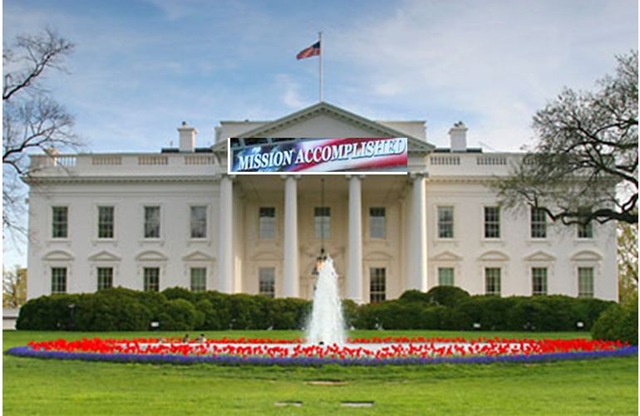
whiteHouse_missionAccomplished

(Fake photo credit:  Chris Jamison)

So the health care "reform" bill passed last night, complete with payoffs, abortion funding and fake projections of "savings" required to try to pass it via reconciliation.  And in an entirely "unipartisan" manner.  (Even the New Deal had bipartisan support.)

So what does this mean for American politics?  Glad you asked.

  • There is now a precedent for requiring Americans to buy something simply because they live here.  Automobile insurance is required in most states if you own a car.  Health insurance, however, is required, period.  Nice work if you can get it. 
  • The phrase "pro-life Democrat", at least (but not limited to) as it described Washington politicians, is now known to be an oxymoron.  The executive order Obama promised the Stupak group isn’t worth the paper it’s printed on.  (See here, here and here, please.)  An EO only applies to the executive branch, can be rescinded on a whim, and legislation always trumps it.  And in spite of whatever pro-life record they may have had in the past, the entire Stupak group sold its collective souls, principles and the lives of future generations for something they must know is less a fig leaf and more tissue paper.  (More on this from Betsy Newmark.  This is just unfathomable.)
  • Democrats can no longer legitimately complain about polarization or the lack of bipartisanship in Washington.  No doubt they will, mind you, but they’ve completely lost the moral authority on the issue.
  • Gaming the CBO system for political gain, though I’m sure it’s been done before, has, by virtue of this massive bill, been raised to a new level of legitimacy.  A former CBO head wrote on Saturday that the numbers were so manipulated that what is claimed will be a reduction in the deficit of $138 billion is really more like an increase in the neighborhood of $562 billion.  The foundation for using the reconciliation process to pass this bill was that it reduced the deficit.  So the method used to pass the bill was based on a lie.  And this is not even including a $371 billion dollar Medicare bill that’s coming down the pike. 

Everything about this legislation — above and beyond the usual sausage-making that is the political process — is absolutely awful, regardless of its actual contents.  And its actual contents, once we have it, no matter how awful it turns out to be, is now with us for good.  (Barring a repeal, which is very hard to get the political will to do in Washington.)  If it’s an abject failure, or even it if just keeps the status quo at the cost of billions every year to run in place, it will not go away.  We’re stuck with this ball and chain.

And a parting "shot", if you will, from Michael Ramirez.  (Click for a larger version.)


Bullet points

Things Heard: e111v1

Good morning.

  1. Civility and trade.
  2. Friday’s prediction. “worst aspects of market and socialism” Words … we will apparently now be living by.
  3. Adultery.
  4. Clinton in Russia regarding Iran.
  5. The coming healthcare battles … will only get worse.
  6. On hell.
  7. Of milk and meat and Christian education.
  8. Considering the Prayer of St. Ephrem.
  9. A forest and a highway.
  10. Yet another scientific study noted which discovers the obvious.
  11. Sarcasm in the wake of the healthcare passage. Or is it irony, I can never figure out what the difference between those two.
  12. Maybe that healthcare bill will lose its teeth.
  13. And it has to stand up in court as well.
  14. Imagine that, dishonesty from the President
  15. Darwin and teleology.

“Deem and Pass” Doesn’t

Word is the House is not going for the “Deem and Pass” option in spite of saying they would. My guess is that it didn’t pass the PR test.

At least we’ll get an honest vote out of this. Too bad the Democrats didn’t choose the honorable way first.

[I am working on a project that may become a book on the most influential evangelical leaders of our generation, since 1976, and the impact they’ve had on the church and their times. I will introduce them briefly on this blog from time to time. Who should be on this list?]

Frank Wolf. Gentle Congressman b.1939

When the topic of Christian politicians comes up in conversation, almost no one mentions Representative Frank Wolf of northern Virginia. That is not because his actions or words run contrary to Christian principles. It may be for just the opposite reason: Wolf is a humble 15-term Congressman who has worked unflaggingly but quietly on some of the most difficult issues for people of faith around the world. Wolf is a restrained and effective Christian statesman.

An unassuming champion of international human rights and religious liberty, Wolf won the first William Wilberforce Award in 1992, presented to Christians in public service by Chuck Colson and Prison Fellowship. Wilberforce is the driving force behind a group of congressmen from both sides of the aisle, including Wolf, who meet periodically to make their faith part of their politics. The most recent recipient of the award is former Democratic congressman Tony Hall of Ohio.

Wolf said: “There are only 435 members of the House of Representatives and only 100 members of the Senate. If we can get the word out about Wilberforce’s life and legacy, we can change this country.”

Wolf is not much at glad-handing, he shies away from the limelight, and he’s a bland public speaker. For his serene optimism, critics have labeled him naive. His travels are not the typical junkets to posh resorts or embassy parties but risky excursions to outposts ravaged by war and famine—especially to places where fellow Christians are persecuted for their faith.

On one journey took him to Tibet, where he posed as a tourist, eluded the tour guide by pretending to be ill, and then sneaked out to talk to Tibetans on the street for the real story of Chinese repression. Another expedition took him to Sudan, a nation that was waging a self-described religious war against its own citizens who are Christians or other non-Muslims through a campaign of torture, starvation, and murder. Sudanese soldiers were literally snatching children from their mothers’ arms and selling them into slavery for the price of a few head of cattle. Girls were sold as concubines.

He has dodged bombs in Nagorno Karabakh. He has investigated conditions in El Salvador, Bosnia, and Ethiopia. Instead of enjoying the plush accommodations he could command as a government official, Wolf toughs it out with ordinary people for a first-hand sense of their plight.

Before the fall of the Iron Curtain, Wolf tramped throughout Eastern Europe championing for freedom. He was the first American official to bulldog his way into the notorious Perm Camp 35 in the Siberian gulag, where leading dissidents were imprisoned. Upon returning, he publicized the religious and political abuses they reported and arranged for me to join a second group visiting the camp. Due to Wolf’s tenacity, the Soviets released many prisoners even before the USSR collapsed.

After the trial of the leadership of the Bahá’í community of Iran was announced in February 2009, Wolf was deeply disturbed over the “systematic persecution” of the Bahá’ís. He offered a resolution on the subject of the trial of the Iranian Bahá’í leadership co-sponsored by seven others–“Condemning the Government of Iran for its state-sponsored persecution of its Baha’i minority and its continued violation of the International Covenants on Human Rights.”

For his indefatigable efforts, Wolf has won respect even from people on the opposite side of his conservative politics. Former Washington Post columnist Mary McGrory called him “a watchman on the rampart of world freedom.” Former Democratic congressman Lionel Van Deerlin described Wolf as one of “a special breed,” who “seem attracted to public office to fulfill more than personal or political ends.” Men like Wolf, he added, “sustain a flicker of hope in the elective process.”

When Chuck Colson presented the first Wilberforce Award to Wolf, we prepared large red, white and blue vertical banners with Wilberforce’s picture to decorate the outdoor proceedings. Wolf asked if he could have one of the banners and we complied. The next time I visited Wolf’s congressional office, he had it hanging on the inside of the door to his personal office. The banner took up the entire door; a Wilberforce-like legacy seems to have consumed his entire life.

More Gaming the System for Health Care Reform

The CBO numbers for the final final health care reform bill may look good (depending on your definition of "good"), but, as I’ve noted before, the numbers are gamed.  And now, here’s more sleight of hand going on.

Democrats are planning to introduce legislation later this spring that would permanently repeal annual Medicare cuts to doctors, but are warning lawmakers not to talk about it for fear that it will complicate their push to pass comprehensive health reform. The plans undercut the party’s message that reform lowers the deficit, according to a memo obtained by POLITICO.

Democrats removed the so-called doc fix from the reform legislation last year because its $371-billion price tag would have made it impossible for Democrats to claim that their bill reduces the deficit. Republicans have argued for months that by stripping the doc fix from the bill, Democrats were playing a shell game.

Remember, the CBO estimate is, for all intents and purposes, a minimum price.  As with all other big government programs, it will increase dramatically.

Things Heard: e110v5

Good morning.

  1. That FOIA thing, with some numbers.
  2. Change … or not.
  3. St. Cyril on the Lord’s prayer.
  4. Climate.
  5. Flight.
  6. Art.
  7. Healthcare and the Jedi younglings.
  8. Budget and the latest version of the bill … and a big lie.
  9. Abandoned churches in Russia, a photo-montage. (HT: Paul Gregory Alms)
  10. Campaign finance.
  11. Attitudes in academia? Counter-intuitive?
  12. An Aussie judge strikes out.

Things Heard: e110v4

Good morning.

  1. Career choices in the UK.
  2. Genocides.
  3. No. Charity does not imply a power hierarchy.
  4. Enforced charity however, does incur disgruntlement.
  5. Three more for St. Patrick’s day, here (a defence) and here (some history) and here (Irish jokes).
  6. Eucharist and confession.
  7. Some economic indicators … including “attractive wait staff.”
  8. When you start off by misreading … going from there means straw men are afoot.
  9. HUD for the rest of us.
  10. Russian elections.
  11. Hitler and Pakistan.a
  12. Gooder English.
  13. Fer the kiddies … or not.
  14. Next comes Evagrius, then Cassian … then swim in the Bosphorus? 😉

Why I Oppose the HCR Bill: We’re Broke

Remember that “lock box” that Social Security money was in?  Well government, as government is wont to do, has already raided it over the years, treating Social Security funds as its own private slush fund and left IOUs in there.

This year, for the first time since the 1980s, when Congress last overhauled Social Security, the retirement program is projected to pay out more in benefits than it collects in taxes — nearly $29 billion more.

Sounds like a good time to start tapping the nest egg. Too bad the federal government already spent that money over the years on other programs, preferring to borrow from Social Security rather than foreign creditors. In return, the Treasury Department issued a stack of IOUs — in the form of Treasury bonds — which are kept in a nondescript office building just down the street from Parkersburg’s municipal offices.

Now the government will have to borrow even more money, much of it abroad, to start paying back the IOUs, and the timing couldn’t be worse. The government is projected to post a record $1.5 trillion budget deficit this year, followed by trillion dollar deficits for years to come.

The BigGovernment website, noting this, says there are 2 choices on how to raise this money; taxes and borrowing.  Those are the one mandated by law, but there is another option; change the law and renege on the promise.  (I didn’t say it was a good option.)  No one wants to do any of that, but the combination of a promise made, irresponsible spending on all sorts of “good” programs, and a down economy have combined to create this mess.  And now we’re broke, and our children are going to have to pay the price for our excesses.

All this is foreseeable with health care reform as well.  The creeping socialism of Europe has led it to insolvency as well.  Will somebody please learn from history.  Recent history?

And if you weren’t already realizing that the Democrats were gaming the numbers to make the costs look good, this report should (hopefully) jolt you into reality.

A new congressional report released Friday says the United States’ long-term fiscal woes are even worse than predicted by President Barack Obama’s grim budget submission last month.

The nonpartisan Congressional Budget Office predicts that Obama’s budget plans would generate deficits over the upcoming decade that would total $9.8 trillion. That’s $1.2 trillion more than predicted by the administration.

We’re broke, folks, and we’re issuing a credit card to our kids, and using it to fund our own out-of-control spending.  The money’s not there.  It’s gone.  It’s long past time to wake up to this fact before we follow Europe into the black hole.

Wednesday Highlights

Good morning.

  1. For a site that depends on logical arguments … failing to think logically is a big problem. The statement “slavery was/is not evil because of cruelty” does not depend or imply the statement “cruelty is not evil.” The statement means slavery is evil without cruelty (more accurately does not depend on the evil of cruelty to be evil), but does not imply that cruelty is not also evil.
  2. Oh … Hell
  3. Comparisons of comfort.
  4. Truth to power.
  5. Weather implies climate change? Only when it fits the rhetoric I guess.
  6. What if? Hmmph. That shouldn’t be a question. It isn’t.
  7. Ride a bike.
  8. Heh. Snort.
  9. Yes they do. I don’t think there should be any question about that, although I don’t think “during a recession” is a necessary qualifier.
  10. I hate those “compelling life story” rhetorical techniques … so when they backfire … people should notice.
  11. For St. Patrick’s day.
  12. More transparent administration, is measurably much less transparent. Color me unsurprised.
 Page 126 of 245  « First  ... « 124  125  126  127  128 » ...  Last »