By Contributor Archives

Another Perspective on the Sequester

The President has been treating the cuts from the sequester as some sort of budget Armageddon; blaming Republicans and talking up how much they’ll hurt. Here’s another perspective on these cuts from people who look more closely at our financial situation.

Credit rating agencies are shrugging off sequestration, saying the U.S. government will need to do more to reduce the deficit if it wants to prevent a downgrade of the nation’s credit rating.

While the agencies say the $85 billion in automatic spending cuts represent at least a step towards deficit reduction, they argue much more is needed to prevent the United States from losing its “AAA” rating.

“It’s not the most ideal outcome,” said David Riley, Fitch Rating’s global managing director for sovereign ratings, on CNBC Europe. “You’d rather have intelligent cuts and some revenue measures as well … but we don’t live in an ideal world, and it’s better to have some deficit reduction than none at all.”

The agencies view it as a positive sign that Congress did not simply scrap the unpopular sequester. Erasing the cuts without coming up with an alternative, something pushed by some liberal lawmakers, would have added to the deficit and debt and further pressured agencies to downgrade the nation’s credit rating.

They are glad Congress didn’t scrap it, but the year’s still young. In any event, when you hear Democrats freak out about these cuts, just remember that the credit agencies are yawning.

Things Heard: e250v4

Good, well, whatever.

  1. Mr Stewart notes the filibuster.
  2. So does Mr Barnett, in the context of Lochner.
  3. A question not answered … but what we got
  4. took a month and a half and a root canal.”
  5. Somebody doesn’t understand the phrase “no relation.” You could make a game of that. What relationships can you find. For starters, both are speeches, made of words, both in English, both by people in the Western hemisphere, … apparently “no” has no meaning anymore.
  6. So, where would you pick?
  7. Freshwater zooloogy.
  8. Don’t worry your President has a non-disclosed fantasy (?) of a path to a non-nuclear world. If you believe that is real you believe in the tooth fairy … and are a Democrat. Funny how those go together, no?
  9. Government sponsored trafficking. But hey, it’s all illegal, so why talk about it.
  10. Little aloof, kinda like when she got a little pregnant.
  11. Three books.
  12. Poetry by google.
  13. Hmm. Adoption by another name … perhaps because adoption and the regulatory burdens round that have priced stranger methods onto the landscape.
  14. Of bugs and features.
  15. Links abound, 2nd one of particular interest.

Things Heard: e250v3

Good talk talk talk day, eh?

  1. Apparently there is a filibuster going on … approval here.
  2. Droney lawers discuss as well.
  3. More grist for the drone conversationsWoops.
  4. So, why do liberals trust Obama with the power to kill whomever for whatever reason. Trust. Why trust? Beats me. Ask a lib.
  5. In a discussion on phone regulations … this was firmly denied. Alas, data seems to indicate otherwise.
  6. A book to lead you back to the garden.
  7. So, why oh, why did Obama cut what he did for the sequester? He cut aid to babies … and here’s why. His goal is government growth, nothing more, nothing less.
  8. Wait wait, what day is it tomorrow? Oh, my.
  9. Statistics and bunnies.
  10. Talking Turkey, not turkey.
  11. Think about this too hard out loud and you’ll be accused of racism.
  12. The first word is the most important. Happy is good. Remember that.
  13. Snort. Don’t click through with anything in your mouth. You were warned.
  14. Grist for talking about evil, ethics, and such. Did Josef think he was acting unethically or not? Or did he follow an ethical code with which you happen to disagree strongly?

Things Heard: e250v2

And so it goes, another world leader steps off the stage.

  1. Not that way however. Yikes.
  2. climate question.
  3. A book noted.
  4. Liturgy.
  5. If you don’t laugh, your having a really really bad week.
  6. Someday we’ll find out what the Obamacare supporters were smoking when they supposed longer hours, more uncertainty, less pay would attract more the field.
  7. They will, however, insist it wasn’t this.
  8. question is posed. Woops, that was a follow-up. Start here.
  9. merica.
  10. Won’t be sold here.
  11. Matrix and cellular automata have some challenges.
  12. Thoughts on nuclear Iran. And … why you really really need to read that last linked post.
  13. Our un-serious President. Alas. Don’t look at me, I didn’t vote for him.
  14. And to finish off, what hard riding man puts on his shelf. Wow.

Categorical Errors Considered

Note: I started writing this with the notion that the category error alluded to below was a mistake and a sidelight hiding behind the issues being argued. As I continued in writing I have come to believe that the category error is both the primary reason for the arguments and further is a fundamental problem which is well known.

Much wroth, fury, words, and accusations of ignorance, bigotry, and perversion have crossed from both sides in the recent decades long struggle by various factions in the debates about marriage and who might be married rightly. A few observations

  1. Defenders of SSM remark that this sort of marriage is private and affects none outside of the marriage. Yet, if this were so, then why would not civil unions suffice? The logical answers is because this reply is a lie. It does in fact affect others and in this lies a category error to which I alluded in this essay’s title.
  2. To read the papers and hear the debates this is an important issue. Yet, why is that? Why is that more important than other issues. As that famous statistician Bjorn Lomberg  pointed out that getting vitamin supplements to the third world would saves tens if not hundreds of millions of lives (and would be cheaper and more effective than most of the aid we send to the third world), world-wide millions are affected by human trafficking indeed the numbers trafficked within the states is comparable to those affected by SSM … and those affected are mostly well educated affluent couples. Yet what debates are heard?

How are these issues a sidelight issue and the other a hot button issue? I suspect my  I offer it is because those entrenched against SSM are also committing that same category error. What is the error of category to which I allude? Simply the following, laws and lawmakers are not our spiritual guides. Note, the use of the term “spiritual” is not the normal one, but one which I will continue in this essay and perhaps in further essays.

So let me digress for a moment. Spiritual? What is that? In the introduction to Dimitru Staniloae’s book (Orthodox Spirituality), it is pointed out that in the Eastern Christian doctrine, your spiritual life and its tending is perhaps better translated as your ethical life and its care. Spiritual health and ethical well being are synonyms.

What is legal or not and what is righteous (in good spirit or a good moral/ethical decision) are independent. This is a founding principle of American jurisprudence. (Or is it?) It certainly is the assumption now. Mr Daschle defended a Senatorial philandering colleague by pointing while he while he was dishonest he didn’t break any laws. The correct reaction to this is that the colleague got his priorities exactly backwards, i.e., it is more important to be ethical than stay on the right side of the law.

Laws are not ethics. Laws and what lawmakers conspire to create has very little to do with ethics and instead its primary purpose is to provide a framework. This framework provides so that peoples may live harmoniously alongside each other in an ordered way.  So that, when conflicts between people arise, there is an orderly way of handling those same conflicts. Personal ethics overrides and sits over the law. For the most part, there is no conflict, most of our choices, our ethical decisions do not lead us toward choices which are illegal. Where they do, it is right, it is correct to choose the ethical over the legal. On the other hand, there are things you may do legally which however are not ethical. Even where there is no conflict, normally ethics binds our actions tighter than the law.

Solzhenitsyn warns that this separation that is part of modern Western democracies (and was part of the former Soviet state) is an error. That itself is an interesting counter point. So it seems likely that this why this debate is important is not what it is about, but sort of the issue is the ground on which it is being made. What is at stake is perhaps not about the particulars of whether certain young dinks (dual income no kids) can have their relationship legalized or not but really what is being debated here and in other forums is whether law should be neutral or be admitted to have spiritual (ethical) content or should it not. Kant (and our founders) explored law devoid of ethics, can a safe lawful republic of demons (not angels) be constructed or not. Perhaps it can. Perhaps it can’t. The question at hand is should it? Recall the Ratzinger/Habermas debate, debating whether a democratic society can be constructed and sustain itself independent of religion, i.e., “does it need things outside itself to sustain itself.” Ratzinger and Solzhenitsyn think not. Bertrand de Jouvenal pointed out in his meta-political science musings about what he termed Babylon (the large multicultural state) envies the unity of the small state. My reading of Solzhenitsyn (and Jouvenal) is that a solution exists. If the larger federal state limit itself to promoting commerce and unity between smaller entities within itself, while foster their ability to form strong local identity, laws and praxis then you could have the best of both worlds. You can find local loyalties and ties and bonds within the framework a larger multicultural state.

Both sides of the cultural debate miss this point. Both sides wish to apply the same laws and sensibilities in artists boroughs of San Francisco, in Amish villages in Ohio, in rural Lutheran Wisconsin, and so on. Why? Why try? It seems wrong to insist that behavioral norms universal.

Locally laws can be tied to spirit. Federally, the are not, but there they run to the Habermas separation of Spirit and law. It seems to me laws about birth, death, marriage are those which the federal level should keep its hands away, to set aside for local regions to coin their own practices, to tie their own view of ethics and spirit what is allowed, to what is righteous in their region.

Instead of insisting that laws be spiritual or devoid of spiritual considerations is wrong. Federal laws laws which bind us all, might be best be light and aim only to promote commerce, unity, and ease frictions. Local laws … let them tangle and wind the ways the local choose. That is, after all, nothing more than freedom.

Things Heard: e250v1

As I noted, I’m switching to evening links, ’cause I’ve got to hit the road before 5am every morning.

  1. Job applications.
  2. Applications with merit or not?
  3. Doodles applied. Some hit, some miss.
  4. Ah, history. If only Western Christians hadn’t put their stock in this guy instead of Augustine (they were contemporaries and left approx the same quantity of writings).
  5. The strange fruits of googling oneself.
  6. Sequester and our Presidents (most) recent attempts to re-write history.
  7. Energy bar, paleo style.
  8. Snerk. Jedi mind meld indeed.
  9. So, packing for the archipelago yet?
  10. Putting Genghis in context. Wow.
  11. Holding doors.
  12. Science fiction author looks ahead.
  13. The tribal left. And yes, you’d likely be able to find evidence o the tribal right, that that’s the assumption isn’t it? That tribalism is all on one side of the aisle.
  14. million mile goober.
  15. Still not a fan of cats.
  16. We’re watching and waiting.
  17. Duck and Cover.

The Science Was Settled

That is, during the 1970s, what they were saying about global cooling sounds quite a lot like what they’re saying today about global warming. Anthony Watts has compiled 65 stories from that era that talked up the dangers of a new Ice Age, including remedies like outlawing the internal combustion engine, population control, and the loss of democracy to save us from the coming disaster.  And these were just those available online from a time 20 years before the Internet.

This includes findings from the National Center for Atmospheric Research, so it’s not just a bunch of journalists getting themselves in a tizzy. So this is something for a little perspective.

Things Heard: e250v3

Good morning.

  1. So what are the Supremes up to?
  2. Massachusetts lawmakers have no clue. If you can’t imagine how teenage kids might abuse that law … your ignorance is historic.
  3. On the Pontiff’s retirement.
  4. Heroism noted.
  5. A critic of statistics not noticing that many of the new gun laws proposed also call out rifles so the statistics is apter than he pretends, cf “assault” rifle bans which don’t actually ban assault rifles which are already illegal but just ordinary semi-automatic rifles. Reminder to Mr Darrel, an actual assault rifle as defined is an automatic (not semi-automatic) carbine.
  6. Playing with automatic translator fixed points.
  7. Absolute legal immunity? Sounds like a recipe for abuse, kind of like giving free reign to young teenagers in showers and bathrooms.
  8. History and the “Great White Fleet.”
  9. More details on the kill list mechanicsSimilarities to this are of course accidental.
  10. Sequestration and the TSA … whose “cuts” amount to a 11% increase in budget. Wow. Radical deep horrible cuts. Not.
  11. Remember the promises the President made about lobbying and money? One wonders about the silence of the lambs on the left?
  12. Crises and Church considered.
  13. A view from the sidelines on the GOP sequester thinking. I would add to #1 that “massively wasteful” is missing the point, it’s massive spending on things outside of what the government’s purview that is the problem. Healthcare for example, is not a thing the federal government has a call to address at all.

Things Heard: e250v1n2

Good morning, and sorry about not posting links yesterday.

  1. To be or not to be.
  2. Hear hear.
  3. The dangers of spell check on an unfettered US budget.
  4. Debt and out of control spending. Money supply and created value are unconnected, who knew?
  5. Gosh, cut 1-2% out of the budget and what sorts of screaming do we get. You’d think that the Administration would realize they have control over what spending gets cut and what doesn’t so that actual critical things wouldn’t have to be cut. Apparently air traffic control and defense are not critical. And look at how savage those cuts are. Another view.
  6. In a word, no.
  7. Golly, why just kill the unborn and the elderly. Let’s move on the inconvenient as well.
  8. The fate of Cassandra.
  9. From the Oscars.

That Was Then, This Is Now: Sequester Edition

The President is distancing himself from the sequester bill that will trigger automatic budget cuts. He’s trying to push the blame on Republicans for not coming up with a way to avoid it.

But this is now. Here’s what he was saying then:

"Already some in Congress are trying to undo these automatic spending cuts. My message to them is simple: No," Mr. Obama said from the White House briefing room Monday evening. "I will veto any effort to get rid of those automatic spending cuts to domestic and defense spending."

Click on the link for the video. Then, he signed the bill and would now allow anyone to tinker with it. Now, he’s blaming Republicans for not tinkering with it.

Dishonest.

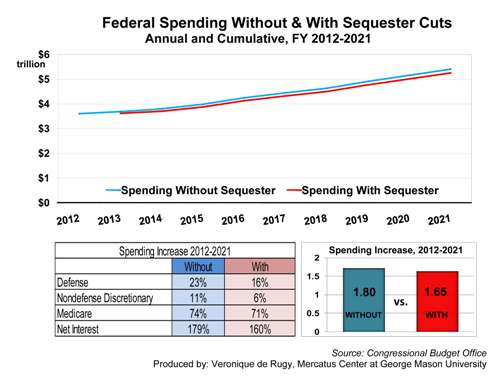
Oh, and those "cuts"? Yeah, they’re "Washington Cuts"; just a reduction in the rate of growth. And not much at that.

Click on the picture for the accompanying article from George Mason University. This is much ado about very little.

Things Heard: e249v5

Good morning.

  1. Drone tactics.
  2. On going into that sweet night.
  3. Speaking of which.
  4. Fiber filled diet advice.
  5. Gun discussion advice.
  6. To power your electric car?
  7. To be honest, for myself, I never understood paying more than nominal “speaker fees” and why you would ever want to pay anything more than a reasonable hourly wage to anyone, much less the person suggested in this link.
  8. The way to counter the “imagination fallacy”, which is a more common rhetorical method than one might suggest.
  9. A flashlight with a little more.
  10. Coming soon to your phone.
  11. Ooooh. That’s really really not going to be in my price range. Rats.

Things Heard: e249v4

Rrrrr. Top of the morning to all!

  1. Possibly my wife’s future runabout, you know for us non-anthro global warming activists.
  2. Pretty as a picture, come to think of it … it is actually a picture.
  3. Siris, err Brandon, talks guns.
  4. Interesting new product for ya.
  5. Why is the US 2nd world regarding phone tech? Oh, wait … dy’a think it might be regulatory strangulation? Gosh.
  6. Conservative views on racism.
  7. I wonder (historically speaking) what “court” meant. Court as a thing to me doesn’t sound like great fun.
  8. Never give up hope.
  9. An economist talks about Obamacare.
  10. Privacy and file deletion.
  11. Budget cuts and numbers noted.
  12. Mr Biden’s ill considered advice.
  13. Those large ammo purchases by the government … just graft … never mind. See, always the Chicago way.
  14. Is this about the relationship to the left with the arts?
  15. Somebody needs to remind this author that the great majority of scouts are 11-14  … and kids that age are not exactly “already are” anything in particular regarding sex.

Things Heard: e249v3

Hello all.

  1. How to reign in the Norks. China?
  2. Polycarp.
  3. Is this another response the “to bad I’m not Emperor” meme?
  4. This seems to be a straw man argument … I mean, who is arguing otherwise?
  5. This link was down earlier, but will hopefully be back … why women at the frontlines might not be wise.
  6. 10 billion insuring 10 trillion … innumeracy at large in finance.
  7. A better “it’s for the children” thing. OK OK. I don’t like the word “thing” there. What might be better?
  8. Ice.
  9. Cheese is a problem there … but there are two kinds of people out there, those who eat anchovies and those who don’t. Most people, unlike myself, are in the second category.
  10. Liberals don’t want people with training. Apparently.
  11. Mental exercise for today, recast that short essay as minimum productivity limits not as a wage limit.
  12. What evidence? Seriously. Evidence? Where?
  13. Obama’s personal view on guns.
  14. Yikes.

Things Heard: e249v2

Good morning ty’all.

  1. Dating, faith, and global warming.
  2. For you cuda users … (with spare cash).
  3. Gun talk.
  4. More here.
  5. B&P talk about raising the minimum productivity floor here and here.
  6. More here.
  7. How many takes was that dya think?
  8. Pining for ARexx without knowing it (wiki here).
  9. Act now … before the gig is up.
  10. What’s your explanation?
  11. Raising taxes … leads to moving on out.
  12. Evolution and EDAR.

The Science is … Settled?

If it is, it may not be in the way  you’ve been told.

Don’t look now, but maybe a scientific consensus exists concerning global warming after all. Only 36 percent of geoscientists and engineers believe that humans are creating a global warming crisis, according to a survey reported in the peer-reviewed Organization Studies. By contrast, a strong majority of the 1,077 respondents believe that nature is the primary cause of recent global warming and/or that future global warming will not be a very serious problem.

Is this some sort of sea change? Again, not necessarily.

Another interesting aspect of this new survey is that it reports on the beliefs of scientists themselves rather than bureaucrats who often publish alarmist statements without polling their member scientists. We now have meteorologists, geoscientists and engineers all reporting that they are skeptics of an asserted global warming crisis, yet the bureaucrats of these organizations frequently suck up to the media and suck up to government grant providers by trying to tell us the opposite of what their scientist members actually believe.

An inconvenient truth, to be sure.

 Page 27 of 241  « First  ... « 25  26  27  28  29 » ...  Last »