Things Heard: e67v3

  1. The Pope in the Holy Land brought more than $40 worth of CDs as gifts.
  2. Kids and faith … our family did this too, we brought our kids to church in the absence of my belief for almost a decade.
  3. Maps and China.
  4. Speaking of maps … what goes perfectly with cartography, uhm, shoes?
  5. Color me unsurprised.
  6. Another nail in the old journalism coffin.
  7. A paschal flower.
  8. Reading Wright(ly).
  9. Health care and cost confusion.
  10. Is bio-hacking a bigger threat than the flu?
  11. Central planning, it worked so well for the Soviet economy that our “bright boys” in the Administration think they want to give it a go. Well, at the same time … a look at government belt tightening (or the reverse).
  12. On the Mid-Pentecostal feast.
  13. Hmmm. I didn’t see it once too … over there.
  14. If the narrative that the “tide of democracy” is going to overtake the world is still alive … I’ve a question. Do you think the common person has more or less influence in the government and expressed authority today or 100 years ago? Less free or more free today than in 1809?
  15. The conservative liberal entitlement debate, 2009 edition.
  16. Tests.
  17. Martyrs counted.
  18. A plea that Mr Obama mature a little.
  19. A Christian praises the neo-atheists.

Our Innumerate President

Via the Corner, Ed Whelan notes two instances in which President Obama previously said,

[W]hile adherence to legal precedent and rules of statutory or constitutional construction will dispose of 95 percent of the cases that come before a court, so that both a Scalia and a Ginsburg will arrive at the same place most of the time on those 95 percent of the cases — what matters on the Supreme Court is those 5 percent of cases that are truly difficult.

OK. What is that man talking about? A quick look at some, you know, actual statistics shows that the agreement is just a little less. Ms Ginsberg agreed with Mr Scalia less than 15% of the time and Mr Thomas less than 10%. A far cry from 95%.

So, remind me why is this man touted for his “high intelligence?” He’s either bright … and a bald faced liar … or he’s innumerate. Pick one.

How Effective Is the Stimulus?

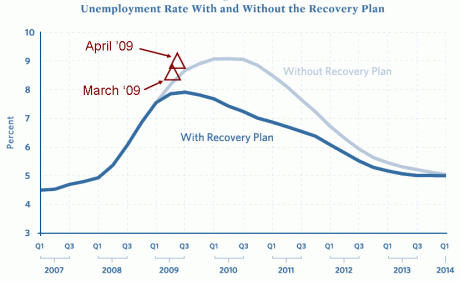
Back in January, the Obama administration put out a prediction of what would happen if the stimulus bill was passed and if it wasn’t.  It was called "The Job Impact of the American Recovery and Reinvestment Plan".  In it, they predicted that, while unemployment figures would ultimately recover from this recession, the stimulus bill would flatten out the peak they would otherwise reach.  They even put in a graph to demonstrate their prediction.

Geoff, one of the many writers at the Innocent Bystanders blog, noted in April, and again last week when the April numbers were official, that the unemployment figures are precisely following the Obama administration’s graph of what would happen … without the recovery plan.

Stimulus-vs-unemployment-april

So we’re spending 3/4ths of a trillion dollars, and according to Obama’s own economic experts, the job impact of the American Recovery and Reinvestment Plan was nothing.  But this is government, and no matter how poor the results, they’ll keep on doing the same thing; printing money, spending unlike any other time in history, and telling us that they know what they’re doing. 

Oh yeah, and they’ll tell us to live within our means.  We need an irony graph.

Things Heard: e67v2

  1. Some problems with debt … and notice the borrowing market for state and bank is not independent.
  2. Secret. Safe … and hackers (not Frodo & Gandalf).
  3. Looking forward in Iraq.
  4. A monumental issue.
  5. Church State separation issues.
  6. If they’re not tracking it … there is going to be rampant crime and fraud.
  7. A question for the atheist.
  8. In which the left praises an explicitly unconstitutional law.
  9. For myself I have no clue how to judge “intelligence” in the public forum or legal arena for that matter.
  10. Commuter designs.
  11. Toys for the military.
  12. Of Tolkien and Wagner.
  13. American police, tools techniques and liberty?
  14. Part two of a lecture on church and science from quite some time ago.
  15. Are philosophers hoping for something magical to occur in their field?
  16. On nomination hearings.

Atheist. Christian. Push and Pull

One of the arguments that atheists often bring forth is that the Christian notion of God is logically inconsistent. 1+1+1=1 they will point out doesn’t logically make sense. Well, on the other hand a fundamental particle being simultaneously a mathematical point and and extended object is logically inconsistent as well. Yet the latter is presently our best understanding of how nature presents itself, quantum objects, leptons and quarks that is to say matter is in fact point-like and extended at the same time. The atheists failing is that they, when confronted with the first logical inconsistency insist is it fundamental and when confronted with the second, insist that the human mind and our learning will encompass and explain the paradox more fully. I would suggest that the latter confidence can equally be applied to the former and that if they cannot yet understand it, that is because they are not engaging their imagination and optimism in the same way for reasons which have little to do with the problem posed.

Yet at the same time, there is an accusation of lack of imagination which might be returned to the court of the Christian believer. Modern physics has deepened our understanding concerning space and time. Applying the Minkowoski metrics to a four dimensional Riemann manifold describing space time as governed by a dynamical equation by Einstein in his proposal of General Relativity is a powerful way of envisioning our Universe. Similarly, Yang-Mills gauge theories, either classical or quantized provide a beautiful geometrically motivated understanding of the forces and small scale structure of space time. Ernst Mach a physicist and philosopher, prior to Einstein considered abstract ideas regarding motion and inertia, with the idea suggested that a single object in space (in the absence of any other “things”) has no inertia. In fact motion can only be described as a relation between two things. Christian conceptions place God, or at least his essence if not His energies following St. Gregory Palamas, outside of time. Certainly God prior to creation and the eschaton are placed by theologian to be outside of time. Christians have, as far as I know, not connected either large-scale or small scale (Minkowski-Riemann space-time or Yang-Mills quantization of U(1)xSU(2)xSU(3) gauge theory) to the notion of what “out of time” means. For myself, while I’ve thought a little about this and have nothing useful to report as yet, this book by John Pokinghorne might spur some ideas, The God of Hope and the End of the World. it should be noted that Mr Polkinghorne was an accomplished theoretical physicist before he became a Anglican priest and theologian.

Humans endow the world with meaning. Semantic content flows from our every thought and our conversation finds expression and meaning in semantic intercourse with others. Yet, in a purely material world semanatic content is meaningless. A pattern of electro-chemical discharges invoking vibrational patterns in the air is devoid of meaning. Yet humans call that speech and embue it with semantic import in a way which can be translated to word, text, and image. Michael Polanyi in Personal Knowledge recounts that when reading his morning correspondence which arrives from friends and peers the world over is unaware during the act of reading the language in which the text he reads is transmitted (obviously he is very fluent in a number of different languages). When he wishes to share something, for example, with his son, who only knows English, he has to check to see if the letter or passage of interest is in English or not. He is not, in the act of reading, consciously aware of the langauge which he is reading. On this matter theists and atheists point the “lack of imagination” finger at the other, the latter insisting that the semantic boostrap from the material to the semantic is lacking in the imagination of the former and the former insisting that the latter cannot imagine how the semantic boostrap itself might be the essence of the soul.

Things Heard: e67v1

  1. Tracking.
  2. Art. England. 10th century.
  3. Also England. Car repair.
  4. Think, thank, thunk.
  5. Prime matters.
  6. The Pope speaks from the Holy land.
  7. Taking the people out.
  8. Parliament has lost its moral authority. Well, heck, those in our government don’t even know what moral authority might even mean.
  9. Souter and conservatism considered.
  10. Going home and some related reflections.
  11. A new book.
  12. Pakistan … some thoughts.
  13. VE day.
  14. Considering a (malign?) stereotype.
  15. Ways to strangle that which would strangle us.
  16. A long and interesting essay on Dollhouse.

Being and Such

In a fundamental way the church fathers and tradition has rejected the traditional attribute driven ontology. Long ago I read a presentation describing the difference between Platonic and Aristotelian ontological methods by comparing how they attached, manipulated, and viewed attribute attachments to ontological categories. The Nicene fathers and the theological/philosophical aftermath of that 4th century upheaval rejected that and arrived at a new conception. Their notion was that ontological objects and categories are not defined by their attributes but defined instead by the qualities and aspects of their relationships with other objects and categories. Existence of a thing depends crucially not on its substance of qualities (attributes) but on the aspects of its relationships with others things. A chair is not a chair because it has chair-like attributes but because people (or I for example) have a relationship with it that categorizes it as chair.

I’d like to examine a few consequences of how that works especially in a Christian context.

  • A primary example of this is that the ontology of God, the Trinity is to be understand relationally. We arrive at our understanding of God not by understanding God as such, or as Father, Son, and Spirit by examing their attributes, but instead by understanding the relationship between the three. Put more radically, God’s existence depends on its relational nature between the hypostasis.
  • Consider the radical science fiction notion of transference of person from one body to either a machine or another body. There is difficulty in deciding where and when “transference” is valid especially in the case of information or ability loss. But if existence and identity is defined relationally does that work? It seems to me likely that it does and perhaps avoids some of the ambiguities and difficulties that arise in the attribute model.
  • In the context of abortion a lot of the arguments I’ve seen center on attributes of being. Specifically what attributes the fetus must obtain in order to qualify as person. This is often state in terms of intellectual or brain development or an attribute of “independent” living or existence, i.e., viability. However that existence of the fetus might just as well be defined relationally. In the relational model it is a little more difficult to distinguish infanticide from abortion. However, another aspect of relational ontological thinking arises … that of the disordered relationship. Abortion (or miscarriage) can perhaps be viewed as a disorder in the relationship between mother and fetus.
  • Consider as well, the marriage/homosexuality discussion in the context of existence and a ontology based on connection and relationships. That is perhaps a fruitful avenue for later discussion. I think it’s clear that both sides of the question can be presented in this methodology and unlike abortion the resolution is not so clearly biased (as in the case of abortion there is a clear bias against abortion in my view with this ontological method). The real question is by framing the question in this way, can some of the heat be abstracted from the discussion? For that might be a very useful thing to do at the very least.

An Informal Poll

I value gas mileage highly in my choice of automobile. In fact, one of the implicit criteria I had in obtaining new cars lately is that my “new” car should get better mileage than the one it replaces. My current car I drive is a 2000 manual transmission Honda Insight. It gets “officially” 61/71 mpg city/highway. My experience is that in temperate weather on dry pavement I get about 65/80 … but any drop in conditions or the thermometer drops the milage as low as 52/62 respectively.

Anyhow, here’s the question. How many years will I have to wait until a replacement vehicle costing under $25k that gets better mileage will be available. The only other criteria I have is that it at least seat two with some luggage and when I’m alone can fit me with my bike (wheels removed). The Insight can do this handily. 2012? 2015? Or never?

So, what’s your guess? When will there be an alternative out there which meets those criteria?

Things Heard: e66v5

  1. I think it’s the press who has a “thing” about gays. I’d bet dollars to donuts that same Christian college would suspend a student for participation in porn without the ever popular “gay” tag … and the linked article supports that contention.
  2. Mr Obama and his Guantanamo bay problem, “what details?”
  3. Culture wars continue.
  4. Isn’t that supposed to be an egg … or a butterfly?
  5. Some inspiration.
  6. One poverty myth.
  7. Government, worse than you imagine.
  8. How will the left defend this?
  9. A question on defense spending … when you want to have comparable defense budgets to other countries … do you want to also have comparable attitudes about casualty rates?
  10. The foreclosure matter.
  11. Of Job and Kansas.
  12. The journey there and back again about a former atheist.
  13. For when it doesn’t work … war?
  14. Abortion and a Obama effect?
  15. Spring is sproinging.
  16. ZoooomBaam.
  17. A squeeze.
  18. That recent $300k NYC flyover … payback for campaign contributions, a quid pro quo with taxpayer dollars?
  19. Econometrics then and now.

Do They Love Us For Our Diplomacy?

First off, Robert Gates says that the extended hand of friendship is being rebuffed by the Iranians.

He said Tuesday that so far, Iranian President Mahmoud Ahmadinejad’s response to the US outreach has been "not very encouraging."

"We’re not willing to pull the hand back yet because we think there’s still some opportunity," Gates said. "But I think concerns out there of some kind of a grand bargain developed in secret are completely unrealistic."

He was referring to speculation in the Middle East that the Obama administration was trying to forge a grand Middle East peace settlement with Iran whereby the US would press Israel to make concessions to the Palestinians, perhaps a Palestinian state, in exchange for Teheran rolling back its nuclear program.

"Not encouraging."  Who’d have thought?  (Well, lots of people, actually.)  We attempt to give them what we think they want, and they turn it down.  Perhaps what we think they want isn’t what they really want.  Maybe wiping Israel "off the map" really is part of their foreign policy. 

OK, but we’re trying, aren’t we?  I mean, that must count for something in the Middle East, where Obama is trying to repair our standing among the Arabs, right?

Washington’s efforts to start a dialogue with Iran have sent ripples of alarm through the capitals of America’s closest Arab allies, who accuse Teheran of playing a destabilizing role in the Middle East.

The concerns being raised by Arab leaders sound strikingly like those coming from the mouths of Israeli officials.

"We hope that any dialogue between countries will not come at our expense," said a statement Tuesday by the six oil-rich nations of the Gulf Cooperation Council, who have long relied on US protection in the region.

Oh, well, so much for that.  Extend a hand to an enemy, alarm our allies.  Perhaps they just need to get used to the idea that making Iran a friend is in their best interest.

Or perhaps they know something we don’t know about Iranian foreign policy.

Two Days To Go!

Saturday begins the Giro d’Italia, the first of the years three Grand Tours on the pro cycling calendar. This is a three week, sort of, stage race which begins on a Saturday and ends on a Sunday just over three weeks later with two rest days in the second and third week. Now, given that most of my readership is in the US and most US residents are not up to speed on bike racing as a sport, here’s a little primer (below the fold). Read the rest of this entry

"Trimming" the Fat

For a very modest definition of the word "trim".  This administration has said it would be more fiscally responsible than the last, and then proceeded to put us into debt in a way never before seen.  Well then, it made a promise about cutting the budget.  So how’s that going?

President Obama has said for weeks that his staff is scouring the federal budget, "line by line," for savings. Today, they will release the results: a plan to trim 121 programs by $17 billion, a tiny fraction of next year’s $3.4 trillion budget.

About 1/2 of 1%.  Well, one might say, that’s probably better than what Bush did.  And one might be wrong.

The plan is less ambitious than the hit list former president George W. Bush produced last year, targeting 151 programs for $34 billion in savings. And like most of the cuts Bush sought, congressional sources and independent budget analysts yesterday predicted that Obama’s, too, would be a tough sell.

With a much smaller budget, Dubya found double the cuts he wanted. 

But just because the President wants a cut, no matter his party, that isn’t the end of the story.

"Even if you got all of those things, it would be saving pennies, not dollars. And you’re not going to begin to get all of them," said Isabel Sawhill, a Brookings Institution economist who waged her own battles with Congress as a senior official in the Clinton White House budget office. "This is a good government exercise without much prospect of putting a significant dent in spending."

The problem is that our federal government is simply too big.  So much responsibility has been given up voluntarily by, or taken by force from, states and the private sector, and once it goes to Washington, it virtually always stays there, where it grows and costs more money while becoming less and less efficient and nimble.  Whatever the good intention, the more Washington does for us, the more it costs and the less anybody wants their piece of the pie slimmed.  Consolidation of this power means lobbyists only have to convince a few Washington Senators and Representatives to keep their money flowing rather than legislatures in 50 states. 

This is the result; a budget where only the most microscopic pieces can ever hope to be trimmed. 

Things Heard: e66v4

  1. Well, here’s Obama’s big “budget balancing” act. Numerically speaking, I think if his recent cut $500m had been $17b and today $17b had been in excess of an order of magnitude larger.
  2. The ordinary as more influential.
  3. Some images from an interesting photo site, Orthophoto. A few more here.
  4. Kreminology as a hermeneutic for predicting Obama’s moves regarding Israel.
  5. Gosh, how about wearing little yellow stars?
  6. Is the torture narrative winding down?
  7. Math and more math.
  8. Ask the trees?!?
  9. YA reading list.
  10. Babies … albeit not of the human variety.
  11. So … Mr Obama looks for a white church filled with black people? Is that it?
  12. Chesterton.
  13. Not exactly chic.
  14. Forgiveness.
  15. God and Star Trek.
  16. Democrats, the party of the intellectually arrogant, proof here. I don’t think he grasps what “free inquiry” actually means.
  17. Unions.

On Prayer

Well, that makes it all simple … I guess I can toss that book(Wickedness) by Ms Midgley. Mr Niven offers that:

The problem of evil, for instance, has often been reduced to one and only one issue, that of unanswered prayers (see e.g. here)

Well, one can come up with a few notions, which may not be “new” but it’s unclear on why that is per se problematic.

  1. From Scripture, John 9 offers As he passed by, he saw a man blind from birth. And his disciples asked him, “Rabbi, who sinned, this man or his parents, that he was born blind?” Jesus answered, “It was not that this man sinned, or his parents, but that the works of God might be displayed in him.
  2. There is a story of a Papal representative referring to Acts 3:6 who when referring to the rich appointments in the Vatican city noted that “no longer can we say, we “have no silver and gold” … the retort as it goes is that no longer either can the representative say, “In the name of Jesus Christ of Nazareth, rise up and walk!”
  3. When the disciples failed to cast out an unclean spirit, (Mark 9) Jesus replied, “This kind can come out only by prayer and fasting.”
  4. Genesis 1 as discussed by Kass in The Beginning of Wisdom: Reading Genesis points out that one of the lessons of this first story is that God’s universe as created is intelligible.
  5. Consider the following. A group of people in a room are trying to determine if they can communicate with a person outside of room. Some individuals think they can communicate with that outside individual. One faction in the room devises a well constructed double blind experiment to see if the communication works. The experiment “fails.” That however proves nothing meaningful, in that it assumes that the exterior entity is unaware of the experiment. Or more plainly, what does a double blind experiment mean that must needs “blind” God?
  6. Finally, examine the action of a parent. Parents do not fulfill every request of a child. Every stumble, every fall. If a parent was to catch and hand hold every matter a child faced, that child would not grow up. Augustine coined the phrase (I think), that “happy fall”.

What is the point of these items?

  1. God’s view is larger in scope than one man’s view. A person may endure hardship to bring out the good in those around him. There may be other reasons.
  2. It is often said that works of prayer are rare these days because the work of prayer matches the faith. This is not an age of faith and prayer. Likewise ascetic struggle is not common likewise the fruits of prayer are less clear.
  3. Consider a nerfed world in which every prayer is answered and no harm can be done to another. What moral development might we expect in men? What need would a man have to be good.
  4. Some offer a “scientific” study (based on unusual assumptions regarding God) proving that prayer doesn’t work. Another has a large number of individuals who witness to the benefit of a lifetime of ascetic struggle which includes numerous personal encounters with God.
  5. Finally, this notion of prayer as a mechanism to “fix things in your life which are wrong or are painful” is flawed. Prayer is fundamentally a reach for communion with the Creator, a striving for theosis … not a magical incantation to make your life materially better.

[Update: Missing link to the first quoted excerpt which was missing is now present]

Things Heard: e66v3

  1. Eating habits and the modern world … a graph.
  2. Banned, but the real question might be is this newsworthy?
  3. Questioning the Trek fanaticism (Star not bike).
  4. Spy vs Spy, a book.
  5. Pseudonym a narrative.
  6. Another book, volume 4 of a Marginal Jew noted.
  7. Contra the Shack.
  8. From the Desert Fathers a quote. Deer eat reptiles?
  9. Reality trumps data? Huh?
  10. How long will it take?
  11. A price of non-repentance.
  12. Revision … which prompted me to consider the non-revisional aspects of blogging.
  13. Whom do you follow?
  14. Insight on faction in a 100 day reflection.
  15. A hidden cost to biofuel.
  16. Human rights as a weapon.
  17. Some reflections on humility.
  18. More dreck for the left to attempt  (vainly?) to spin in a positive light.
  19. Tales of a father.
  20. From the (real) depression.
 Page 170 of 245  « First  ... « 168  169  170  171  172 » ...  Last »