50 leaders of the evangelical generation: #13 J. I. Packer. Wise counselor.

[I am working on a project that may become a book on the most influential evangelicals leaders of our generation, since 1976, and the impact they’ve had on the church and their times. I will introduce them briefly on this blog from time to time. Who should be on this list?]

#13. J.I. Packer, Wise Counselor b. 1926
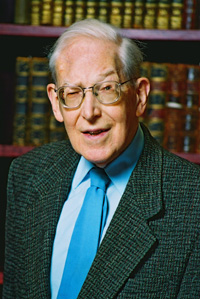
It is surprising to first meet J.I. Packer in his academic setting, an unassuming room at Regent College in awe-inspiring Vancouver. My first impression was “Mr. Rogers Goes to College.” But then, of course, Packer speaks and you begin sense the wisdom of the ages in one of Christendom’s wise and courageous thinkers.

The son of a clerk for Britain’s Great Western Railway, Packer won a scholarship to Oxford University, where as a student he first met C.S. Lewis, whose teachings would become a major influence in his life. In a meeting of the Oxford Inter-Collegiate Christian Union, Packer committed his life to Christ. Throughout the years Packer, like Lewis, taught and demonstrated that orthodoxy is the friend not the enemy of cross-cultural and cross-denominational engagement.

The Anglican scholar is one the most significant evangelical theologians of the last one hundred years and hHe has had a strong influence through his many book and lectures on many Christian renewal movements in the U.S. and worldwide. He has helped Christians in their pursuit of Knowing God, the title of his influential 1973 best seller, which taught the simple, deep truth that to know God is to love His Word..

A 2009 essay collection edited by Beeson professor Timothy George concludes that he “should be seen fundamentally as a “theologizer,” a “latter-day catechist,” a Reformed prophet standing in the tradition of Irenaeus, Augustine, Calvin, Baxter, and Owen.”

Packer has said “the numeric growth of evangelicals, which has been such a striking thing in our time, is likely never to become a real power, morally and spiritually, in the community that it ought to be if it does not embrace a God-centered way of thinking, an appreciation of his sovereignty, an appreciation of how radical the damage of sin is to the human condition and community, and with that, an appreciation of just how radical and transforming is the power of the Lord Jesus Christ in his saving grace.”

His collegial manner can mask what would otherwise be seen his conservative, even “right wing” beliefs. After being ordained in the Anglican church, Packer soon became recognized as a leader in the evangelical movement in the Church of England. In 1978, he signed the Chicago Statement on Biblical Inerrancy, which affirmed the conservative position on inerrancy.

In a 2009 discussion Mars Hill pastor Mark Driscoll found Packer to be “clear minded at age 82 and he remains incredibly conversant, insightful, and witty. Impressively, his words are impeccably precise.” During that visit, Packer explained his strong opposition to homosexuality on biblical grounds, and he said the teaching that Christians can remain practicing homosexuals is heresy because it denied the basic tenet of repentance.

Packer has also been engaged in some of the most important statements of evangelical engagement, including his decision to sign the Evangelicals and Catholics Together document in 1994. He is perhaps the most influential evangelical theologian to call for stronger ties between evangelicals and Roman Catholics, but he believes that unity should not come at the expense of orthodox doctrine. Nonetheless, his advocacy of this ecumenism has brought sharp criticism from some conservatives.

Packer served as general editor for the English Standard Version of the Bible (2001), an Evangelical revision of the Revised Standard Version of 1971. He is a frequent contributor to and an executive editor of Christianity Today.

Things Heard: e116v2

Good morning.

  1. Math and sport.
  2. Gang warfare.
  3. 5000 baptized.
  4. Mikhailovich Bakhtin.
  5. I wonder how many “sex-scandals” in the US are the result of planned actions by the opposition.
  6. I think he means “start using something like a strategy” not “revamp.” 
  7. How to shake the trees and let the rotten fruit fall.
  8. No. No. No. Silly. It’s the climate deniers
  9. A taxonomy, which doesn’t fit my view of self very well at all, seeing as the first and perhaps last axis don’t mesh well with my views.
  10. On the unconstitutionality of the health care bill.
  11. On Confession.
  12. Our Government really really really needs to spend less.

Law abiding citizens given same rights as criminals

In Arizona, if you are a law abiding citizen, you will soon have the same rights as criminals. Governor Jan Brewer recently signed into law a bill which will allow people without a permit to carry a concealed weapon (i.e., a gun). The law, which should take effect in July or August, allows people to forgo the background checks and classes currently required for a concealed carry weapon permit. Arizona now joins Alaska and Vermont as the only states to allow concealed carry without a permit.

In other words, law abiding citizens, concerned with their own self defense, can now do what criminals ALREADY do! – namely – walk around armed.

3 1/2″ Diskettes – Lights Out

Remember way back in the 1980s when the 3 1/2″ diskette came out? Those little babies could hold a whopping 1.44 mb! Wow! I recall saving up so I could get a 3 1/2″ disk drive on my PC.

Sony has announced that they will cease production of the 3 1/2″ diskette – It’s 15 minutes of fame is up. Even so, 12 million units were sold last year. However,

To put the floppy market in perspective, consider those 12 million disks sold in Japan last year. Together they can hold about 17GB of data, which isn’t even enough to fill a single-sided Blu-ray Disc.

A Brief History of Israel Concessions

Meryl Yourish hears that there’s a possibility of Israel conceding to the Obama administration on the subject of Jewish settlements in East Jerusalem.  With that in mind, she gives us a brief history of how well said concessions have worked out for Israel.

Israel made peace with Egypt in 1979. As a result, Israelis can look forward to regular warnings of terrorist attacks and kidnappings when they visit Sinai resorts. The Egyptian foreign minister calls Israel “the enemy.” Egypt boycotted the annual Mediterranean student conference because it was held in Israel. The Sinai is used to regularly smuggle arms to Hamas. A second Israeli was arrested and held by Egypt for accidentally crossing the border. Egypt restored the Maimonides synagogue and then declared that no Jew will ever pray in it (this was the same guy who said he’d burn any Israeli books he found). That’s just a short list of the benefits of peace with Egypt. Of course, Israel hasn’t fought a war with Egypt since 1973. But Egyptians are arming Israel’s enemies.

Israel left Gaza in 2005. In return, Israel got rockets, mortars, and terror attacks, and a war in 2008. Hamas is in control of the Strip and has been for several years. Hamas has thousands of rockets and missiles stored in bunkers, ready for another attack on Israel when they feel strong enough (or when their Iranian masters give the go-ahead). This was one of the Palestinian demands—the eviction of all Jews from Gaza. They got what they wanted. And yet, there is still not peace between the residents of Gaza and Israel.

Israel left Lebanon in 2000. The United Nations certified that Israel left every square inch of Lebanese territory. Hizballah stockpiled tens of thousands of rockets and mortars, crossed into Israeli territory to kill and capture Israeli soldiers, which started a war in 2006. Now, the UN says that the Shebaa Farms is Lebanese—not Syrian—territory, giving Hizballah the excuse they have wanted for years to say that Israel is still holding Lebanese territory and “resistance” must be used. Hizballah has a stockpile of tens of thousand of rockets, and now Syria is supplying them with Scud missiles.

The last place Obama need to be putting pressure on is Israel.  These other issues should be dealt with before asking Israel to give up anything else. 

Things Heard: e116v1

Good morning.

  1. Can they? They did in the former Soviet Union … and didn’t need given new roles to do it either.
  2. This piece is no longer “obscure” news.
  3. Network fail.
  4. Knifely advice. And yes, I know ‘knifely’ is not a word.
  5. G-S and the left.
  6. Sin has color
  7. I’m stuck on “less trendy more stylish,” doesn’t trendy=stylish (asks the very much not trendy nor stylish guy).
  8. A meta-comment on the new $100 bill.
  9. Two drunks in a warehouse of booze.
  10. Lies and the administration. One of the bigger ones.
  11. Real or fiction … a quiz.
  12. Defending the late Senator McCarthy.
  13. Freedom of association.

Small riot breaks out after Tea Partiers attack man of color

No, they didn’t.

Actually, the headline reads, Small Riot Breaks Out at Immigration Protest.

The protest was directed towards the signing of SB1070, in Arizona. The controversial Arizona bill clamps down on illegal “immigration” by requiring local police officers to question people about their immigration status if they suspect the person is in this country illegally. Illegal “immigration” advocates fear such a law will result in racial profiling. From the article,

Witnesses say a group protesting against SB1070 began to fight with a man who was for the controversial immigration bill.

Police tried escorting that man away from the scene, fearing for his safety, when they too came under attack by people throwing items, including water bottles.

It appears that the first racial profiling to occur, upon the bill’s signing into law, would be on the part of the protester who, yelling at the man police escorted from the scene, shouted, “F*** you! F***ing racist!” (see video here).

Things Heard: e115v5

Good morning.

  1. I normally don’t. Do you?
  2. Election blues.
  3. Robotic butlers with guns.
  4. Earth day … and I had trouble making sense of the first sentence. What does it mean to be a “denlalist” of a new-fangled faux holiday.
  5. Heavy presence in the room.
  6. Not getting the cloning thing, here and here. I suppose this would make more sense if I had any notion of who Mr Caplan might be, but sorry I’ve never heard of him and therefore the import of some dude you’ve never heard of says something silly is just a tad weak.
  7. Private association.
  8. Free speech.
  9. A question for the libertarians against the draft … if a lack of draft meant losing the Civil war and WWII would you still be against the draft?
  10. Violence, tea party, and liberal stupidity.
  11. A life not wasted, and one metric.

Real Racism vs Liberal Violence

From James Taranto’s column in the Wall St. Journal Online:

Ho Hum, a White Supremacist Rally
"A rally of about 40 white supremacists Saturday on the lawn of Los Angeles City Hall drew hundreds of counter-protesters, sparked brawls in which two people were severely beaten and ended with crowds of demonstrators hurling rocks and bottles at police and departing supremacists," the Los Angeles Times reported Sunday. The violence came from those who had come to counter the hate:

A bare-chested middle-aged man with Nazi insignias tattooed on his chest and back walked into a crowd of hundreds of counter-protesters gathered near 1st and Spring streets.

Surrounded, the man mockingly bobbed his head to the rhythm of demonstrators chanting "Nazi scum." About a dozen protesters suddenly began pelting the man with punches and kicks. He fell and was struck on the back with the wooden handle of a protester’s sign, which snapped in two. Police eventually reached the man and pulled him from the melee, as blood poured from the back of his neck.

Another man was rushed by a mob on Spring Street. He was punched in the face and kicked for about 20 seconds before police made it to the scene. After that beating was broken up, the man began running south on Spring Street, only to be chased down by a protester and slugged in the face. He collapsed and his face slammed to the curb as protesters began pummeling him again.

The bloodied man was then escorted away by police. Both victims were treated and released, police said.

His sign, unclear in its intended meaning, read "Christianity=Paganism=Heathen$" with an arrow pointing at a swastika.

"Gosh, I think he just didn’t have a clear message. I don’t even think he was a Nazi," said one man, looking at the broken pieces of the sign left behind.

The Left insists that these sorts of folks come from the Right, and thus it would be safe to assume, then, that those counter-protesters were mostly from the Left.  For those who say that all this sort of physical violence comes solely from the Right (I’m looking at you, Dan) may need to rethink your premise.  I think violence from both sides, fringe (relative to both sides) though it may be, is a reality.  Many suggest that Limbaugh and Beck are to blame for violence.  How about Olberman and Schultz now?

Anyone?  Hello?  Crickets?

Taranto goes on to make a very salient point about this actual racism vs. the accused racism of Tea Partiers.

If you haven’t heard about this until now, you’re not alone. Blogger William Jacobson points out that the media hardly noticed:

Outside of the local media and a handful of blogs, the event received scarce attention. None of the usual suspects bothered to cover or comment on it. Firedoglake and Huffington Post covered it, but we saw none of the hyperventilated commentary and lecturing that is directed at Tea Parties.

How curious. Tea Party events which are not white supremacist events are met with derision and abuse, while a real white supremacist rally is met mostly with silence.

There is a lesson here. The attacks on the Tea Parties have nothing to do with stamping out white supremacy and everything to do with shaping the political dialogue to stamp out legitimate opposition to Obama administration policies.

[…]

But Saturday’s tumult is a timely reminder that in 2010, as in 1999 [the date of a Klan rally in LA]–and, for that matter, in 1977, when the U.S. Supreme Court held that neo-Nazis had a right to march in Skokie, Ill.–white supremacy is a fringe ideology that appeals only to a minuscule number of weirdos.

The people who claim to be alarmed by the "racism" of the tea-party movement know this as well as we do–which is why they respond to a display of actual racism as nonchalantly as we do. They desperately attack the tea-party movement for the same reason we cheer it: because it is made up of ordinary Americans anxious and unhappy about the ever-expanding power of government over their lives.

A mass movement of Americans concerned about preserving their freedom is a threat to the political agenda of the left. A gathering of a few dozen actual white supremacists is a threat only to whatever shred of dignity the supremacists may retain.

Sorry for the long quotes, but this is a point that Taranto has been making for some time (which is why I highly suggest getting the daily e-mail of his column), and this particular incident highlights precisely the the disingenuousness of it’s being used as a political football by the Left.  It’s the race card they play; a game to stifle dissent (such dissent formerly being the highest form of patriotism). 

We are post-racial only to the point that charges of racism aren’t used as some political ploy.  Actual racism is very much on the decline, as President Obama’s election highlighted brightly.  It shows that the Tea Party’s detractors have very little in their corner.  They’re reduced to name-calling. 

Earth Day. . .

and the Christian life.

A balanced and wise piece on the Flourish blog, which concludes:

Instead of being optimistic, we–as Christians–are hopeful. And our hope is foundational to every day of our lives, not just Earth Day. So let us celebrate this day in recognition for what it means in the history of our relationship with God’s earth. But let us also celebrate Thanksgiving in gratitude for the bounty of God’s creation and the love that can occur between strangers. Let us celebrate Christmas in acknowledgment that not only is Christ our brother, savior, and redeemer, but he is also the One through whom all things were made. Let us celebrate–on each nameless day of our lives, on our birthdays, at family get-togethers, and at church–the goodness of God’s creation with hope, joy, and hard work.

We are hopeful because the earth is the Lord’s–a fact that remains unconstrained by holidays or public awareness or sin–and that is why we care for his creation every day.

“The earth is the Lord’s and all that is in it, the world, and those who live in it …”

– Psalm 24:1

Front Porch Virtues

Do you have a front porch? I mean a real front porch, where you can greet neighbors and sit with a friend who stops by for a visit. No, neither do I.

We need more porches to restore a more American and even biblical way of life, says architect Bill Randall writing at the Flourish Blog. He writes:

Porches also are a wonderful way to interact with our neighbors. To sit on the front porch in a chair or a swing, sipping iced tea or lemonade in our present “cool of the day” still holds an amazing appeal to us. To be able to greet our neighbors and have a short chat fosters that very spiritual concept called community.

While our connection to nature could be part of the first great commandment of loving God, our connection to those in our immediate community could be part of that second commandment to love our neighbor. Do we really love our neighbor? Do we even KNOW our neighbor? We’ve fallen out of touch with those around us as the “place” of our front porch has waned and one of our primary means of connecting with our neighbors has faded.

Three inventions in the mid 20th century had an almost fatal effect on the front porch and our connection to our neighbors: the automobile, the air conditioner, and the television.


Things Heard: e115v4

Good morning.

  1. I recommend this article from today’s WSJ about the causes of the crisis, which of course would have consequences for what to do to prevent a repeat. Another article here.
  2. Of risk and the past.
  3. START.
  4. Risk and behavior.
  5. Art.
  6. Gaming two party politics.
  7. My #1 daughter, when she was about 1 or so, was absolutely terrified of men with beards and yes that meant Santa was very scary.
  8. GS as smokescreen.
  9. I was going to tag this as gender and driving, but it looks like to me she hit the accelerator when she meant to brake. Driving off however, was inexcusable.
  10. Reset relations?
  11. Cuteness, here and here, but not so much here.
  12. A really really long winded way of saying, none (which isn’t to day the arguments given were not bad … but the question was sidestepped).
  13. Modernity … stealing your Yoga when you’re not looking.

[I am working on a project that may become a book on the most influential evangelicals leaders of our generation, since 1976, and the impact they’ve had on the church and their times. I will introduce them briefly on this blog from time to time. Who should be on this list?]


#39 Andy Miller. Happy Salvationist b.1923

Until a deck collapsed at a suburban Atlanta outing in 1995–injuring a number of Salvation Army leaders, including the man they still call Commissioner–Andrew S. Miller bounced with the exuberance and optimism of young man, belying his 80 plus years. Andy Miller is a renowned former leader of The Salvation Army in the U.S., a denomination best known for its quaint Christmastime bells and kettles, the sum of which—-together with other fundraising—-makes the “Army” among the nation’s largest and wealthiest charities. Its ubiquitous social services are highly respected in America and around the world and, while its tightly organized personnel live modestly and its use of funds is above board, the group raises more than $3 billion annually and has U.S. assets worth more than $10 billion, buoyed by its church buildings, community centers, and alcohol and drug rehabilitation centers.

Few people know that the Army is primarily and at its core an evangelical church in the holiness tradition, with 1,200 congregations (called corps) in the U.S. It is a deeply conservative expression of Methodism, begun by disaffected Methodist minister William Booth and his wife Catherine in 1865 as an evangelistic outreach to the down and out in English cities. Its uniformed leaders rarely rise to the level of public recognition because at every level, from most junior officer (minister) to the international general, its leaders are rotated every few years. It’s a discipline introduced by Booth to guard against complacency. U.S. leaders (called national commanders) are no different, but in the modern era one national commander, Miller, stands above others because of his effervescent personality and his uncanny ability to connect “Sallies” to the outside world.

Andy Miller’s two strongest contributions to the evangelical movement: He is part of the leadership that has pursued a seamless connection of the church’s evangelistic and social service heritage. And he bucked the separatist impulse of the most conservative churches and reached out to secular leaders–at the same time he stroked the hair and provided food and shelter for the poorest of the poor.

Miller, who held many positions during his 47-year career and served as the national commander from 1986-89, made it a priority to maintain the church’s historic connection of evangelism and social service. He resisted bifurcation of the church and insisted that its social ministry must be evangelistic and its evangelism must include a social service delivery system. “When we do it right,” Miller said, “you can’t tell the difference.”

This breadth was captured in The Salvation Army’s longtime slogan: “Soup, Soap, and Salvation. There is ongoing concern that the social will eclipse the spiritual, and today some in the church are concerned that the national command’s recent approval of the more secular slogan “Doing the Most Good,” may signal that slide. That worry is magnified because the social service effort is so large and the church body that meets in worship each week is relatively small in the U.S.

Although the The Salvation Army’s work can be found in nearly every region of the country and in communities large and small, its people—particularly its staff and clergy–are relatively insulated from both secular culture and the larger evangelical church. Salvationists have traditionally found their worship, social interaction, church conferences, even summer camping and recreation within the denomination, and adherents have traditionally found their marriage partners within the group. These trends have shifted in recent years and the U.S. membership is stagnant, even as giving has increased—bucking national trends.

In the midst of this insular subculture, Miller had an expansive tenure that introduced the church to the powerful and influential of his time. He had a commitment to bear witness about Christ with at least one person every day. After telling President Reagan about this in a meeting, Miller was called back to the White House several weeks later. The President wanted to tell the Salvationist leader that he had taken the opportunity to witness to Soviet President Mikhail Gorbachev in a face-to-face meeting. In private, Gorbachev told Reagan that his grandmother had him baptized as a young boy and that she had told him about Jesus.

Miller found ways to befriend powerful men as easily as others. He was an usher at Robert Kennedy’s funeral because he met and formed a friendship with the former U.S. Attorney General while jogging on the streets of New York City.

“He is a Salvation Army original,” his biography reads,” and at the same time a symbol of the Army, keeping the Army true to the Army, to its birthright and mission. His life story is the miracle of a bush that burned with fire and yet was not consumed.”

Things Heard: e115v3

Good morning. Short list.

  1. Dogs and the court.
  2. I’m pretty sure the first sentence is hyperbole, but for now I’m drawing a blank for more egregious examples. 
  3. A strange state.
  4. TARP.
  5. Credit crunching.
  6. More pictures of that unpronounceable volcano
  7. Reading suggestions.
  8. An economic question.
  9. I’m thinking that’s an oversimplification.

Things Heard: e115v2

Good, err, day.

  1. A cycling chick. Cycling? How?
  2. UK NHS.
  3. Prince Charles … and the Holy Mountain?
  4. April 18 some years back.
  5. A suggestion. Duh. Yet, that notion will take decades to sink in at the beltway.
  6. Of India and Maoists.
  7. A reading list. Suggestions … or what would you read?
  8. Public finance.
  9. Somebody misses obvious use of irony … and calls it “dumber”. Yes it’s dumb to not notice irony when its being used.
  10. Ride a bike, ride a bike, ride a bike … and racing with handicap.
  11. A book suggested.
  12. Integration.
  13. Eruption, pictures here and here and here.
  14. I’m missing the “weather is not reminder” standard caveat. Oh, its missing because its a warming event. Gotcha. 
  15. Mr Clinton on tea parties, here and here and here.
  16. The next step in the entitlement feeding-trough development.
 Page 122 of 245  « First  ... « 120  121  122  123  124 » ...  Last »