Things Heard: e132v2

Good morning.

  1. A very cool photo-essay.
  2. Fun with toys.
  3. It sounds like the strategy is the same-as-it-ever-was, that is talk is cheap (and cheap is all you’ll get).
  4. Obesity and cause.
  5. A narrow view of plagarism.
  6. In which the European/US “,” vs “.” transposition threw me for a loop momentarily.
  7. Maintaining civilization.
  8. Abortion and slavery, continued.
  9. Transit tech
  10. Given that climate claims rest on difficult statistical analysis … this might ring alarm bells. Unless of course, AGW advocates are up in arms rejecting those claims.
  11. One the rule of law.

I’ve come out in favor of the Electoral College before (see here).  Among other things, the EC ensures that Presidents get broad support as opposed to simply the most support, it gives minorities a bigger voice, and it makes vote fraud much more difficult.  See here for an FEC paper on the origins of the EC, and it makes for very informative reading, especially on the reason that the Founders decided not to go with a direct popular vote for the President.  (The paper was last updated in 1992, but the history is what’s important.)

In Wednesday’s "Best of the Web Today" column, James Taranto takes on the National Popular Vote Interstate Coalition.  What they’re trying to do is get enough states, accounting for at least the 270 electoral votes needed to win, to agree to direct their electors to vote for whoever wins the national popular vote, regardless of how the vote in their particular state went. 

Taranto notes that the states currently supporting it, or who’s legislatures have at least passed a bill on to their governor, all voted Democratic in at least the last 5 elections, usually by double-digit margins.  Taranto surmises (though, not really having to make a big logical leap):

It’s no mystery why this idea appeals to Democrats. They are still bitter over the disputed 2000 presidential election, in which Al Gore "won" the popular vote but George W. Bush won the actual election. Changing the rules wouldn’t necessarily benefit Democrats, but you can see why trying to do so might make them feel good.

After all, it was after the 2000 election that the NPVIC got it’s start.  Again, not much of a leap.

But there are problems with this, not even related to the question of popular vote vs electoral vote.  While the measure would be indeed constitutional, Taranto contends it would be unenforceable.

Think about that old Philosophy 101 question: If God is omnipotent, can he make a rock so big that he can’t lift it? It seems like a puzzle, but the answer is clearly no. The premise that God is omnipotent leads to the conclusion that he can both make and lift a rock of any size. "A rock so big that he can’t lift it" is a logically incoherent construct, not a limitation on God’s power.

The NPVIC is based on the similarly illogical premise that lawmakers with plenary powers can enact a law so strong that they can’t repeal it. In truth, because a state legislature’s power in this matter is plenary, it would be an entirely legitimate exercise of its authority to drop out of the compact anytime before the deadline for selecting electors–be it July 21 of an election year or Nov. 9.

Call it the problem of faithless lawmakers–somewhat akin to the question of faithless electors. Legal scholars differ on whether state laws requiring electors to vote for the candidate to whom they are pledged are constitutional. But because the power of legislatures to choose the method of selecting electors is plenary, there is no question that the Constitution would permit faithless lawmakers to exit the NPVIC.

If one or more states did so, and it affected the outcome of the election, the result would be a political crisis that would make 2000 look tame. Unlike in that case, the Supreme Court would be unable to review the matter because it would be an exercise in plenary lawmaking authority. Challenges in Congress to the electoral vote count would be almost inevitable. Whatever the outcome, it would result from an assertion of raw political power that the losing side would have good reason to see as illegitimate.

The problem here is that we’d be giving the election of our President over to what amounts to a gentleman’s agreement; an agreement that not even the Supreme Court would be able to work out, since they wouldn’t have jurisdiction. 

I’m still entirely behind the Electoral College system, and please read the link for the details (and especially the FEC paper; history is important).  But Taranto winds up with something to think about, should this gentleman’s agreement get put in place.

Since the NPVIC would be legally unenforceable, only political pressure could be brought to bear to ensure that state legislatures stand by their commitments to it. Would this be enough? Let’s put the question in starkly partisan terms: If you’re a Republican, do you trust Massachusetts lawmakers to keep their word, and to defy the will of the voters who elected them, if by doing so they would make Sarah Palin president?

Consider this.

Things Heard: e132v1

Good morning.

  1. Democrats and anti-semitism.
  2. Politics trumps truth in the Democratic world.
  3. Freedom and the press.
  4. That secular/religion debate.
  5. Why I am not … 
  6. Fairyland.
  7. Immigration.
  8. Not grokking Mr Obama.
  9. Mr Obama visits GM.
  10. Equity.
  11. Tenure.

The Anchoress on Anne Rice

The Anchoress, posting at First Things, has a wonderful post on the issues raised by Anne Rice in her "quitting" of Christianity.  There is plenty of blame to go around, and in this portion of the post I’m quoting, The Anchoress covers them in part, but the whole post is well worth the read.

Anne Rice wants to do the Life-in-Christ on her own, while saying “Yes” to the worldly world and its values. She seems not to realize that far from being an Institution of No, the church is a giant and eternal urging toward “Yes,”, that being a “yes” toward God–whose ways are not our ways, and who draws all to Himself, in the fullness of time–rather than a “yes” to ourselves.

Unfortunately, we Christians teach this poorly and generally make too many excuses for our failings. Too many of us go out into the world seeking to confront and “fix” others, when the key to the Christian life begins with confronting and “fixing” the self. This can only be done through grace, which enters upon the Yes, and moves and grows on the intentional breeze of Willingness, because that is the only thing that counts, our intentions and our willingness; “worthiness” does not enter in.

But willingness only comes with humility. It comes when we can say “Thy will be done,” and then actually surrender, instead of preparing a treaty.

The world, because it is worldly, cannot understand Christianity or the churches; the world will never love either, and it is foolishness to think otherwise. But the church is not here to be loved by the world; it is here to serve the Bread. The Living Bread did not come for the love of the world, but for its life.

Dogs and Cats Living Together

When TIME magazine is defending Rush Limbaugh, you gotta’ wonder if the Apocalypse can be close behind.  Regarding the BP oil spill, and the potentially exaggerated predictions of what was to come, TIME’s Michael Grunwald writes:

The obnoxious anti-environmentalist Rush Limbaugh has been a rare voice arguing that the spill — he calls it "the leak" — is anything less than an ecological calamity, scoffing at the avalanche of end-is-nigh eco-hype.

Well, Limbaugh has a point. The Deepwater Horizon explosion was an awful tragedy for the 11 workers who died on the rig, and it’s no leak; it’s the biggest oil spill in U.S. history. It’s also inflicting serious economic and psychological damage on coastal communities that depend on tourism, fishing and drilling. But so far — while it’s important to acknowledge that the long-term potential danger is simply unknowable for an underwater event that took place just three months ago — it does not seem to be inflicting severe environmental damage. "The impacts have been much, much less than everyone feared," says geochemist Jacqueline Michel, a federal contractor who is coordinating shoreline assessments in Louisiana.

Yes, the spill killed birds — but so far, less than 1% of the number killed by the Exxon Valdez spill in Alaska 21 years ago. Yes, we’ve heard horror stories about oiled dolphins — but so far, wildlife-response teams have collected only three visibly oiled carcasses of mammals. Yes, the spill prompted harsh restrictions on fishing and shrimping, but so far, the region’s fish and shrimp have tested clean, and the restrictions are gradually being lifted. And yes, scientists have warned that the oil could accelerate the destruction of Louisiana’s disintegrating coastal marshes — a real slow-motion ecological calamity — but so far, assessment teams have found only about 350 acres of oiled marshes, when Louisiana was already losing about 15,000 acres of wetlands every year.

There’s a bunch more; it’s quite an interesting read. 

Obligatory disclaimer:  This is not to say that the ecological problems that did occur weren’t bad, nor that more should be done to prevent spills.  I’m just pointing out that the "Cry Wolf" type of ecological disaster pronouncements get a lot of play in the press up front.  Even though when it’s over we finally get a tiny bit more sober, what’s I’m betting will be remembered in future years are the initial claims, and not so much the reality. 

50 leaders of the evangelical generation: #35 Michael Gerson. The Scribe

[I am working on a project that may become a book on the most influential evangelicals leaders of our generation, since 1976, and the impact they’ve had on the church and their times. I will introduce them briefly on this blog from time to time. Who should be on this list?]

 #35. Michael Gerson. The Scribe  b.1964
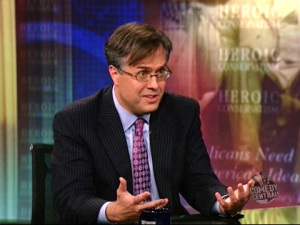
 In modern American culture, where the language of politics influences the thinking and actions of not just its public officials but also its people and its institutions, speechwriter and columnist Michael Gerson is certainly the most influential evangelical rhetorician of the last generation and a powerful literary craftsman at the nexus Christian faith and public life.

 Today a columnist for The Washington Post, Gerson emerged professionally as a sure bet to make a mark in the public square. We were colleagues in the late 1980s on Chuck Colson’s personal staff at Prison Fellowship, Gerson drafting speeches and columns soon after graduating from Wheaton College. I was Colson’s chief of staff, so technically Mike worked for me, but only in the same way that press secretary Robert Gibbs works for White House chief of staff Rahm Emanuel. In reality, Gerson dealt with Colson almost entirely, and he served him with great skill.

The first major speech in which he had a significant hand was Colson’s 1993 acceptance speech at Rockefeller Chapel, University of Chicago, when Colson received the Templeton Prize. That speech, The Enduring Revolution, demonstrated the powerful use of language, spiritual images, and rich content that would have a much larger megaphone when Gerson served as the chief speech writer for President George W. Bush.

 In The Enduring Revolution, Gerson/Colson penned these words:

 “Christian conviction inspires public virtue, the moral impulse to do good. It has sent legions into battle against disease, oppression, and bigotry. It ended the slave trade, built hospitals and orphanages, tamed the brutality of mental wards and prisons. In every age it has given divine mercy a human face in the lives of those who follow Christ — from Francis of Assisi to the great social reformers Wilberforce and Shaftesbury to Mother Teresa to the tens of thousands of Prison Fellowship volunteers who take hope to the captives — and who are the true recipients of this award. Christian conviction also shapes personal virtue, the moral imperative to be good. It subdues an obstinate will. It ties a tether to self-interest and violence.”[1]

After writing for Colson, Gerson went on to write for Senator Dan Coats, for Bob Dole’s and Jack Kemp’s presidential campaigns, and at U.S. News and World Report—before joining the Bush team and eventually serving in the White House.

Gerson has said one of his favorite speeches was given at the National Cathedral on September 14, 2001, a few days after the September 11, 2001 attacks, which included the following passage: “Grief and tragedy and hatred are only for a time. Goodness, remembrance, and love have no end. And the Lord of life holds all who die, and all who mourn.”

Gerson also coined “the soft bigotry of low expectations” and “the armies of compassion.”

Gerson was criticized during his time as “The Scribe,” as President Bush called him, for his Christian influence on Bush and on the content of his speeches and policies. This criticism came from political opponents and others who object to religious content in government discourse and indeed to any suggestion that there are spiritual aspects to personal convictions and decision-making. 

Gerson addressed the topic of religious content in political life in a talk to journalists at a forum sponsored by the Ethics and Public Policy Center in 2004.  He outlined the five aspects of religious rhetoric in public addresses:

1. Comfort in grief and mourning, and we’ve had too many of those opportunities: in the space shuttle disaster, 9/11, other things where people are faced with completely unfair suffering. And in that circumstance, a president generally can’t say that death is final, and separation is endless, and the universe is an echoing, empty void.  A president offers hope – the hope of reunions and a love stronger than death, and justice beyond our understanding.     

2. Historic influence of faith on our country. We argue that it has contributed to the justice of America, that people of faith have been a voice of conscience.

3. When we talk about our faith-based welfare reform . This is rooted in the president’s belief that government, in some cases, should encourage the provision of social services without providing those services. And some of the most effective providers, especially in fighting addiction and providing mentoring, are faith-based community groups.

4. Literary allusions to hymns and scripture . In our first inaugural, we had “when we see that wounded traveler on the road to Jericho, we will not pass to the other side;” or “there is power, wonder-working power in the goodness and idealism and faith of the American people” in the State of the Union. I’ve actually had, in the past, reporters call me up on a variety of speeches and ask me where are the code words. I try to explain that they’re not code words; they’re literary references understood by millions of Americans. They’re not code words; they’re our culture. It’s not a code word when I put a reference to T.S. Eliot’s Choruses From the Rock in our Whitehall speech; it’s a literary reference. And just because some don’t get it doesn’t mean it’s a plot or a secret.

5. Reference to providence, which some of the other examples have touched on. This is actually a longstanding tenet of American civil religion. It is one of the central themes of Lincoln’s second inaugural. It’s a recurring theme of Martin Luther King – “the arc of the moral universe is long, but it bends toward justice;” “we do not know what the future holds, but we know Who holds the future.” The important theological principle here, I believe, is to avoid identifying the purposes of an individual or a nation with the purposes of God. That seems presumption to me, and we’ve done our best to avoid the temptation. [2]

Since leaving the White House, Gerson has often criticized fellow conservatives in his columns (and they have returned the favor). One of Gerson’s first Washington Post columns was entitled “Letting Fear Rule”, in which he compared skeptics of President Bush’s immigration reform bill to nativist bigots of the 1880s. He has also been critical of some elements of the Tea Party movement and libertarians.  His book “Heroic Conservatism,” published by HarperOne in 2007, established Gerson as a continuing voice for compassionate conservatism, which is often seen in his twice-weekly columns, and which has pitted him from time to time against the most conservative elements of the Republican Party.


[1] http://www.ifapray.org/downloads/The%20Enduring%20Revolution%20-%20Charles%20Colson.pdf 

[2] http://www.beliefnet.com/News/Politics/2005/01/The-Danger-For-America-Is-Not-Theocracy.aspx

Things Heard: e131v5

Good morning.

  1. Talking Arizona and the lawsuit.
  2. Summer couture and consequence, here and here.
  3. Screening potential employees.
  4. A birthday of sorts … and this is apropos.
  5. Mr Limbaugh and the spill.
  6. Stadium crowds.
  7. Advice and context.
  8. Advice for Ms Sherrod.
  9. What’s doing while doing time in Lithuania.
  10. Democrats and the tea party.
  11. Two essays on complex systems and contemporary politics, here and here.

I quit

Notice (for those who care):

Today I’m still a Christian. I’m still in with this bunch of quarrelsome and hostile humans. I refuse to be arrogant enough to believe that my Western-bred, self-concerned, and individualistic mindset can circumvent the very humanity which leaves Christianity imperfect in practice.

Also, in the name of Christ, I refuse to condone sexual behavior, whether it be hetero or homo, that is outside the boundaries God has set; I refuse to agree with liberal feminists who degrade women; I refuse to believe being Democrat or Republican is related to “Jesus is God, he died, and was resurrected”; I refuse to think secular humanism is valid (or new); I refuse to succumb to the self defeating views of methodological naturalism, yet continue to support research of the natural realm God created; and I refuse to be anti-life, specifically, the life of unborn images of God.

This just in…

This just in:  Shirley Sherrod is planning to sue Andrew Breitbart, whose blog ran with a story accusing her of being racist. There has been no confirmation to the rumor that the basis of Sherrod’s lawsuit is that Breitbart’s actions brought to light the ineptitude of both the Obama Administration and the NAACP, as well as causing Howard Dean to stick his foot in his mouth.

Damaging Our Intelligence Efforts: NY Times and Wikileaks

If you had information about local organized crime activities, and were contemplating giving this information to the police, would you be more or less willing to be an informant if you knew your name might be associated with that information?  Would you be willing to take that chance?

Yeah, me neither.

NewsBusters, in a post regarding all the classified information dumped to the public via the NY Times and, more recently, by Wikileaks, noted Jim Miklaszewski discussing this on MSNBC.

Not only are those named put at risk, but those who might potentially cooperate with the Americans are probably not going to do it now. You know, often allies, U.S. allies, have told the Pentagon, State Department, why should we cooperate with you, because whatever we tell you is going to end up on the front pages of the New York Times.

That’s one of the complaints, actually, specifically from Pakistan.  Every time U.S. officials travel to Islamabad to sit down and try to gain increased cooperation from Pakistan, inevitably, we are told, they complain about press leaks that jeopardize anything they’re going to do in conjunction with the U.S.

(Emphasis supplied by NB.) 

While Pfc. Bradley Manning may have had a legitimate beef with how portions of the Afghanistan War have been run, his implication in this massive document dump to Wikileaks far overshadows his initial charges.  If he’d kept the dump relevant to his whistleblowing, I’d think much better of him (aside from the fact that he didn’t go through the normal channels the military has set up for whistleblowers). 

But this dump, purporting to merely foster transparency, has damaged our credibility with potential sources, and given our enemies a boatload of late summer reading.  Just as there were other, proper ways for Pfc. Manning to get his point across, there are better ways to foster transparency than giving aid to our enemies and discomfort to those who might help us defend ourselves.

Things Heard: e131v4

Good morning.

  1. A commercial hack?
  2. The technology behind carbon fiber, not exactly explained.
  3. Steward on the Sherrod kerfuffle.
  4. Those leaks and a likely consequence.
  5. NaCl and soteriology.
  6. More NaCl here too.
  7. Gallantry … a old fashioned notion, for which the revival of same would not be a bad thing.
  8. Mr Kerry and his taxes.
  9. Like a poll tax?
  10. Kind or clever … and a question begged.
  11. An argument for irresponsibility examined. I reject proposition (b).
  12. Diversity training in action.

Things Heard: e131v3

Good morning.

  1. Lithuania and demographics (linked from here).
  2. Attention span problems? Advice here.
  3. A book suggestion.
  4. In the Obamacare bill.
  5. Spanking.
  6. Technically speaking Islam is a cult … Cult as defined means: followers of an exclusive system of religious beliefs and practices.
  7. Elections in the land of the not very free at all.
  8. I’ve seen liberals asking in numerous occasion, “How would the right react if there was a Black Tea Party movement.” How about, with strong affirmation?
  9. Mixed signals in high school.
  10. Savings … well, to be honest the current environment is sending a strong message not to save. Ever heard of low interest rates?
  11. Obama lied? Say it ain’t so.
  12. Discussing Academia.

ObamaCare Paying For Abortions

Obama’s executive order forbidding the use of ObamaCare money for abortions has been rendered useless by … the Obama administration.  Did anyone, other than hyper-partisan liberals, really believe him when he signed it?  I certainly didn’t.

The Obama administration has officially approved the first instance of taxpayer funded abortions under the new national government-run health care program. This is the kind of abortion funding the pro-life movement warned about when Congress considered the bill.

The Obama Administration will give Pennsylvania $160 million to set up a new "high-risk" insurance program under a provision of the federal health care legislation enacted in March.

It has quietly approved a plan submitted by an appointee of pro-abortion Governor Edward Rendell under which the new program will cover any abortion that is legal in Pennsylvania.

Tabitha Hale writing at RedState explains that the so-called "high risk" qualifier is just another fig leaf.

The loophole comes in the wording:

The section on abortion (see page 14) asserts that “elective abortions are not covered,” though it does not define elective — which Johnson calls a “red herring.”

Therein lies the problem. Anything that is not hard worded is a gray area that will be manipulated by the most pro-abortion administration we’ve ever seen. What, then, determines an “elective” abortion? Is the mother who chooses to terminate her baby with Down’s Syndrome “electing” to have an abortion, or is she forced by circumstances?

The National Right to Life Committee has determined that the only abortion that will not be covered under the plan is gender selection. It’s dangerous territory, which is why there should be no Federal funding for abortions, period. Everyone has a different definition of what is “elective.” We know all too well what happens when Washington has room to maneuver within the wording of the law.

Bart Stupak caved, and I agree with Tabitha that the term "pro-life Democrat" is an oxymoron.  The Democrats flat-out lied to get their agenda through, both (at least) in that this would be a a cost saver (whereas now they’re defending it in court as a tax increase) and what it would pay for.  This is big government.  It’s what it does.  The more power you give it, the more it’ll lie to you (and bribe you) to get more.

We’ve not seen the end of the surprises.

Black against White <> Msicar

It’s been interesting to see the continued liberal ranting regarding the Sherrod incident – that of USDA offical Shirley Sherrod being forced to resign due to the publication of a partial video of her allegedly espousing racist views. Over the weekend, Howard Dean ignorantly attributed the whole mess to the “absolutely racist” FoxNews, despite the fact that Sherrod resigned before FoxNews had aired the video footage. Even Sherrod herself is cashing in on her Warhol minutes, claiming that Andrew Breibart (whose website the original video was posted) wants to take us back to the days of slavery.

Now, I thought that Obama’s election had elevated us beyond the racial divide of our past? I thought that Obama and, presumably, his administration, would usher in the era when persons were judged not by the color of their skin?

In Owning up to jumping the gun, my previous post on the Sherrod incident, the author of the piece at the New Mexico Independent refers to certain conservatives (originally) claiming that Sherrod was guilty of “reverse racism”. Well let’s be clear – racism is racism – any belief that one race is superior to another. There is no such thing as “reverse racism”, regardless of whether the views expressed are from blacks against whites. That blacks, or people of color, may suffer from racism more often than whites does not change the definition of the word racism.

Things Heard: e131v2

Good morning.

  1. Words on racism, with which I basically agree. Aff. action and other policies on racism support ontological racial distinctions … which is why they tend to support and reinforce that which they are trying to remove.
  2. Where blogging is really political.
  3. Flailing against “deeper than objective reason” and forgetting that most of life is like that. Your love for, well anything, but take your love for your beloved and/or your children. This is not a thing established by “objective reason.” Perhaps you don’t like the term “deeper” but that is something of shorthand for “more profound and basic.” This also connects with the piece on the Jewish discussion in which objective discussion disproved God, yet they prayed (calmly) on the way to immolation.
  4. Weather without climate change hyperbole.
  5. A film noted.
  6. Ladies, I’m sorry but in real life it’s just not all that complicated.
  7. Propane.
  8. A girl and a map.
  9. Ms Sherrod’s case reviewed.
  10. Discussing Colonel Lynch’s solution to a vexing problem (which by the by had nothing at all to do with race relations).
  11. Our new healthcare working for (or against) us.
  12. Memory Eternal.
  13. I’m not sure that would work for me … how about you?
 Page 108 of 245  « First  ... « 106  107  108  109  110 » ...  Last »