Things Heard: e90v1

  1. A cricket race to discuss (for those coming “late to the party”, cricket race is my word for a poll).
  2. Corruption in high places, one approach and the last bit with St. Basil might serve as an object lesson (HT: Ocholophobist, the).
  3. Forgiveness and a not-completely-unrelated prayer.
  4. Money talk.
  5. On the senior handout.
  6. Ms Palin on healthcare (HT: Politico).
  7. More on healthcare here.
  8. The apostolic physician.
  9. “Because it has a perspective” … just like all the rest. Speaking of which
  10. The Maoist in the White House kerfuffle.
  11. Considering recessions and recoveries.
  12. Are these the “new rules?”
  13. Ms Clinton in Moscow.
  14. Working with a beatitude.

Dawkins, Creationists, and books

I don’t think they [creationists] read books anyway, except for one book. It’s aimed at the intelligent layperson who does read books and who vaguely knows a little bit about evolution…

So says Richard Dawkins, author of The Greatest Show on Earth, in a Salon interview.

Hmmm. Let’s see.

I’m a creationist (of the Old Earth variety) and, while I don’t consider myself well read, I have read The Origin of Species, Finding Darwin’s God, Tower of Babel, Night Comes to the Cretaceous, Rare Earth, The Elegant Universe, The Fabric of the Cosmos, and A Brief History of Time, just to name a few books from the non-creationist book bin.

It can’t be this easy.

Regarding Fundamentalism

This post by the pseudonymous Larry Niven at Rust Belt Philosophy, which is largely against a traditional morality, in part as defined by Scripture (especially the Old Testament). I think this attitude about traditional morality in part is the result of a common fundamentalist tendency common on the non-Christian left, the “new atheists” like Mr Niven follow that methodology. That same group of people would of course bristle at being termed fundamentalist, yet this is in fact a good term to describe them, their approach to traditional (mostly Biblical) traditions is fundamentalists which makes it in turn far easier to reject. Personally I consider myself a fundamentalist … but use the word ‘fundamentalist’ in a different meaning when I do so. Read the rest of this entry

Most Influential Evangelicals?

I’m working on a project that explores what I’m calling “the evangelical generation” from 1976 through the present.  As part of the research, I’m considering the question: “Who have been the 35-40 most influential evangelicals of our generation?”


Who would you list, and why?

Feel-Good Diplomacy

How’s that working out for President Obama?  Charles Krauthammer takes a look back at the past nine months and ticks off this administration’s biggest foreign policy initiatives.

What’s come from Obama holding his tongue while Iranian demonstrators were being shot and from his recognizing the legitimacy of a thug regime illegitimately returned to power in a fraudulent election? Iran cracks down even more mercilessly on the opposition and races ahead with its nuclear program.

What’s come from Secretary of State Hillary Clinton taking human rights off the table on a visit to China and from Obama’s shameful refusal to see the Dalai Lama (a postponement, we are told)? China hasn’t moved an inch on North Korea, Iran or human rights. Indeed, it’s pushing with Russia to dethrone the dollar as the world’s reserve currency.

What’s come from the new-respect-for-Muslims Cairo speech and the unprecedented pressure on Israel for a total settlement freeze? "The settlement push backfired," reports The Post, and Arab-Israeli peace prospects have "arguably regressed."

And what’s come from Obama’s single most dramatic foreign policy stroke — the sudden abrogation of missile defense arrangements with Poland and the Czech Republic that Russia had virulently opposed? For the East Europeans it was a crushing blow, a gratuitous restoration of Russian influence over a region that thought it had regained independence under American protection.

But maybe not gratuitous. Surely we got something in return for selling out our friends. Some brilliant secret trade-off to get strong Russian support for stopping Iran from going nuclear before it’s too late? Just wait and see, said administration officials, who then gleefully played up an oblique statement by President Dmitry Medvedev a week later as vindication of the missile defense betrayal.

The Russian statement was so equivocal that such a claim seemed a ridiculous stretch at the time. Well, Clinton went to Moscow this week to nail down the deal. What did she get?

"Russia Not Budging on Iran Sanctions; Clinton Unable to Sway Counterpart." Such was The Post headline’s succinct summary of the debacle.

Note how thoroughly Clinton was rebuffed. Russian Foreign Minister Sergei Lavrov declared that "threats, sanctions and threats of pressure" are "counterproductive." Note: It’s not just sanctions that are worse than useless, but even the threat of mere pressure.

There’s more; read the whole thing(tm).  Now granted, nine months is not time enough to make great strides.  Heck, it’s barely enough time to win a "peace" prize.  But if the world has a collective thrill up its leg over the election of He Who Is Not Bush, it’s having a difficult time showing it. 

As I noted 3 years ago, the facade is just that; a false front.  Goodwill was not squandered because little of it was there in the first place.  The world is just as difficult to work with now as it has ever been, especially for those European leftists who keep trying to remake American in their image, those radical Islamists who hatched a massive terrorist attack plan while we had a Democrat in the White House, and a Russian government deeply paranoid of America, no matter who is in power.

Fine oratory, promises, and a medal given because of them, will not change the world.  There are too many enemies out there that will be placated only by a credible threat of force.  The more credible the threat, the less likely it is that it need be used. 

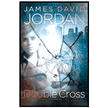
Book Review: Double Cross by James David Jordan

Taylor Pasbury has had a tough life. Her mother ran out on her when she was just nine years old. Her father was murdered when she was seventeen while trying to protect her from a brutal rape. She had a successful career as a Secret Service agent before being dismissed for extracurricular activities. To top it off, her last client, Simon Mason, a noted televangelist, was murdered.

But things are about to get even more complicated. First, Mason’s assistant turns up dead in an apparent suicide as allegations of embezzlement swirl around her. Then her mother suddenly decides to reappear in her life. As she begins to sort through the clues someone starts shooting at her. And a simple case of suicide quickly becomes a complicated case of murder.

This is the premise behind James David Jordan’s new thriller Double Cross, the sequel to his best-selling suspense novel Forsaken. Once again Mr. Jordan, a corporate attorney by day, shows his ability to weave an intriguing story of suspense.

Jordan has already shown an ability to tell a good story without preaching at the same time. There are themes within each of his books that will give the reader plenty to think about. Taylor is a flawed woman who is struggling to figure out not only what she wants out of life but also what God wants and expects from her. The reappearance of her mother also is a source of tension for Taylor because she was abandoned at an early age but also because her role is integral to the overall story and causes her to think long and hard about who she can trust.

Once again, Mr. Jordan has spun a terrific yarn. In Taylor Pasbury, he has an intriguing heroine: a woman with a very tough exterior who at the same time is extremely vunerable and lonely. She’s also deeply flawed which makes her incredibly fascinating.

Double Cross is another fine novel from Mr. Jordan. As I said when I reviewed Forsaken, I could enjoy reading about Taylor Pasbury for quite some time. Here’s hoping that there she’s got more adventures ahead of her.

447545: Double Cross Double Cross
By James David Jordan / B & H Publishing Group

Things Heard: e89v5

  1. Dark thoughts (HT: Ochlophobist, the)
  2. Of ethanol and petroleum.
  3. Analyzing violence.
  4. Atheism and political ethics.
  5. Looking at an one of Mr Obama’s aids.
  6. A suggestion re the gender wage discrepancy.
  7. An answer for a question Mr Sullivan asked.
  8. Kept quiet … or not.
  9. Is he just trying to buy votes?
  10. Of weather (not climate) and economics.
  11. The point of the tattoo … missed by the media.
  12. V. Havel criticises Mr Obama’s litte compromises.
  13. “The meltdown” over Mr Limbaugh’s failed NFL bid … missing only any sort of actual meltdown. 
  14. A paper on libertarianism.
  15. The mortgage crises was so much fun … let’s line up another. And not unrelated … more bailout problems noted. Here too.
  16. Of science and the media. In the conclusion, I think this thought can be more generally applied to the media’s topical response to just about anything, “I want to know what’s going on at the frontier of research elsewhere. I don’t want to know what the crazy outliers do, I want to know what the central problems are. Give me the big picture, give me a basis. If I want to know more details, I’ll look for them.” Replace research, with politics, economics, current events, whatever.
  17. A worthwhile celebrity quote.
  18. Consider the beard (and ex-beard).

Debunking Global Warming Myths

A brand new film from the Cornwall Alliance for Stewardship of Creation entitled Not Evil Just Wrong takes a critical look at the claims made by global warming fearmongers and attempts to separate the facts from fiction. Which is worse: the (alleged) problem or the proposed solutions? Click the video below to see the trailer.

Hat tip: Chuck Colson

Moving in the Opposite Direction

As the US government takes steps like government controls of major industries and attempting to hijack 1/5th of the economy via health care reform, another country is moving in quite the opposite direction during this global recession.

Cuba’s workplace cafeterias are closing, President Raúl Castro keeps saying the well-off shouldn’t get the same subsidies as the poor, and now there are rumblings that one of the stalwart vestiges of the revolution — the ration booklet — has outlived its usefulness.

As the Cuban government struggles through a deep recession, its leaders have begun picking away at socialism in order to save it. But experts say the latest buzz by the Cuban government is simply another desperate fix to stem the slide of a failed economy that buckled long ago.

[…]

Since he took office early last year, Raúl Castro has been saying that the country’s severely battered economy needs fixing. In a widely quoted August speech, Castro said Cuba was spending more than it made.

“Nobody, no individual nor country, can indefinitely spend more than she or he earns. Two plus two always adds up to four, never five,” he said. “Within the conditions of our imperfect socialism, due to our own shortcomings, two plus two often adds up to three.”

In the 18 months since he took office, Castro restructured the nation’s agricultural system to give idle land to farmers, hoping they would revive a deeply troubled state-run agricultural industry plagued by inefficiency. He also allowed taxi drivers to have private licenses; many were working illegally anyway.

How do you get farmers to do more farming?  Create an incentive to do so, like a profit motive, long reviled by liberals and one of the reasons they believe health insurance needs reform.  Socialism costs more than the benefits to society.

Hugo Chavez was, no doubt, convinced that the oil profits he absconded with would pay for his socialist paradise, but that very socialism chases away the people he soaks off of.  Combined with the global recession, food shortages continue in Venezuela’s “paradise”.

The profit motive gives people an incentive to put their own time & money at risk to provide a service to those who need it.  If not enough folks need it, it’s not subsidized by the government (or shouldn’t be); it folds.  If it is useful to enough people, it prospers, and, rightfully, so does the owner who bore the risk.  Wealth is created in this system, not simply “spread around”, as Obama infamously said to Joe the Plumber.

Wealth was spread around in Venezuela, Cuba, and even Sweden, and now the piper must be paid.  In the latter two, changes are being made in a more capitalist direction.  Let’s hope Venezuelans learn that lesson.

Heck, let’s hope American Democrats learn it.

Things Heard: e89v4

Good morning.

  1. On evening prayers.
  2. Orthodox ecumenism.
  3. Southeast asia considers the Kerry/Luger bill (even as Americans for the most part ignore it).
  4. Human rights and US/Russian relations.
  5. For myself, I’m a sucker for little gadgets.
  6. Liftoff.
  7. Asking history to just stop for a bit.
  8. Mr Niven suggests some reading why national exceptionalism is, uhm, crap. In turn, here’s some suggested reading as to why it is not, Defending Identity: Its Indispensable Role in Protecting Democracy.
  9. Some lighter verse … and its application to modern situations.
  10. Robo … robo … (wait for it) … Pumpkin!
  11. An item list for good discussions.

Hasty Pudding Thoughts

Well, I had an long day (12 hours is long for me) and am fighting off a bug hanging in the wings. So, for tonight … a few hasty thoughts and we’ll see where that gets us:

Perhaps if we accept the ontological aspect of human dignity as a starting point in a discussion on abortion that might help make the argument more useful. For discussion based on human dignity can serve as on both sides. The dignity of the mother and father as well as the child. One side can point to the necessity of insuring that the parents dignity, specifically the recognition of their personal ethical choices need to be respected. The other to the fact that human life, any human life, needs to be treated exceptionally. Forming policies and arguments that respect both sides of this matter is the essential element. One which the radicals on both sides fail to accomplish.

A few Econ Nobel prizes ago (Stigler I think) taught me one lesson on investing by which I live … and which lead to my portfolio being dominated by index funds. Whether or not it really does beat playing the market or some other complicated (or simple) strategy (which Mr Stigler argues it indeed also does) … there is one thing it does really well, which might be more important. It take the time wasted on the whole investment aspect of life out of the equation. This years prize will be grist for plenty of later blog posts (after I get some reading on the matter behind me). But commenter JA, might need to re-orient his thinking some ultimately … as he has used the tragedy of the commons numerous times in discussions to amplify on why government intervention is necessary … but alas, when you study the matter … perhaps that assumption is wrong.

And getting wrong reminds me that a quote from Paul Collier’s book on Democracy keeps springing back. In which he notes that spreading democracy in the third world as a good thing to do … is an assumption both Mr Bush and Mr Soros agree. To bad it’s wrong.

White House Goes To War Against Fox News

Frankly I can’t understand why any White House would declare war on a single media outlet but that’s exactly what the Obama Administration has decided to do with Fox News. Fox’s own Brit Hume succinctly points out what a huge losing strategy this is:

Hat tip: Don Surber

Sometimes, You Need a Cowboy

So how’s all that "capitulate to their demands and get them on our side" plan going?  Not so well, apparently.

Denting President Obama’s hopes for a powerful ally in his campaign to press Iran on its nuclear program, Russia’s foreign minister said Tuesday that threatening Tehran now with harsh new sanctions would be “counterproductive.”

The minister, Sergey V. Lavrov, said after meeting with Secretary of State Hillary Rodham Clinton here that diplomacy should be given a chance to work, particularly after a meeting in Geneva this month in which the Iranian government said it would allow United Nations inspectors to visit its clandestine nuclear enrichment site near the holy city of Qum.

“At the current stage, all forces should be thrown at supporting the negotiating process,” he said. “Threats, sanctions and threats of pressure in the current situation, we are convinced, would be counterproductive.”

Mr. Lavrov’s resistance was striking given that, just three weeks before, President Dmitri A. Medvedev said that “in some cases, sanctions are inevitable.” American officials had hailed that statement as a sign that Russia was finally coming around to the Obama administration’s view that Iran is best handled with diplomacy backed by a credible threat of sanctions.

It also came after the Obama administration announced that it would retool a European missile defense system fiercely opposed by Russia. That move was thought to have paid dividends for the White House when Mr. Medvedev appeared to throw his support behind Mr. Obama on Iran, though American officials say the Russian president was also likely to have been reacting to the disclosure of the secret nuclear site near Qum.

See, if Iran gets a nuke, it’s highly unlikely that Russia will ever be a target, given how close these two have worked in the past.  So Obama, instead of proving his Jedi diplomacy skills, got played instead.  Apparently, Medvedev is immune to those Jedi mind tricks.

Even Obama’s supporter in the punditocracy are complaining about this administration’s efforts.

And, no, Obama hasn’t reset the American relationship with Russia. He was taken for a ride. Maybe his vanity won’t let him admit it. But, believe me, the Russians know they have taken him (and us) for a big ride, indeed.

Here are the facts:

After Obama agreed to cancel the missile defense program for Poland and the Czech Republic, the president got Moscow to give him an inch. Maybe, they said, we’d have to move on tougher measures against Iran if Tehran doesn’t satisfy us on its nukes. “Hallelujah!” said the president and his entourage.

All of this good cheer is now over. Lavrov greeted Clinton in Moscow with the bad news: “At the current stage, all forces should be thrown at supporting the negotiating process. … Threats, sanctions and threats of pressure in the current situation, we are convinced, would be counterproductive.”

Just before Hillary arrived in Moscow, she warned that America was impatient. With whom? With the Iranians, of course. But her impatience with Tehran will be useless unless we get impatient with Russia.

“We did not ask for anything today,” she said. “We reviewed the situation and where it stood, which I think was the appropriate timing for what this process entails.”

Of course, if you don’t ask, you don’t get. In fact, with the Russians, if you don’t demand and threaten a little, you get zero.

As history has shown us.  No, not everybody can be trusted, reasoned with or impressed upon.  Sometimes you just gotta’ be the cowboy.  They may complain about it and say they don’t like us, but being liked by the rest of the world shouldn’t really be a main goal of US diplomacy. 

That’s what Nobel "Peace" Prizes are for.

Things Heard: e89v2

  1. It’s not just “about the kids”, in the post-modern political climate regulation attempts to replace judgement
  2. Consequentialism continues here.
  3. The Book.
  4. The church in Ethiopia.
  5. More on Ms Ostrom and the tragedy of the commons. Here too.
  6. LDS, a painting and Mr Skousen.
  7. The OCA a church designed to disappear.
  8. Nobel humor.
  9. Don’t hate Wal-Mart, it’s just a consequence of Equality by Default … Just a natural outworking of the liberal project.
  10. Rights talk.
  11. It has been claimed that the left has dropped communism … which might be a premature statement.
  12. A new poster/voice at the Agora.
  13. So … whadya think? Are the Democrats going to commit political suicide or not? Or in the words of the link, “I’m skeptical.  I think it is more likely is that this thing passes, and fails spectacularly.  There are too many moving parts, and if any of them breaks, the whole thing rapidly starts to spin out of control and eat a gigantic hole in the deficit.” … and subsequently doom them politically.
  14. That Zeigeist thing, see the last few sentences.
  15. Mr Obama emulating the worst tendencies of the Nixon admin. Hmm.
  16. Of maths and economics.

What Happened to Global Warming?

So asks the BBC:

This headline may come as a bit of a surprise, so too might that fact that the warmest year recorded globally was not in 2008 or 2007, but in 1998.

But it is true. For the last 11 years we have not observed any increase in global temperatures.

And our climate models did not forecast it, even though man-made carbon dioxide, the gas thought to be responsible for warming our planet, has continued to rise.

So what on Earth is going on?

The article continues on, referring to to Sun output and ocean cycles, and how the climate models didn’t predict this, even though the guys who program the models say they took all this into consideration.

My point is not to debate what is or isn’t heating or cooling the planet, but rather to point out that there is so much that governments around the world want to legislate based on these climate models, while these models are failing in their near-term predictions.  But that doesn’t stop Al Gore from his itinerant preaching, nor the climate scientists from insisting that, never mind the past decade, now it’s going to get warmer, nor governments from trying to save us with new taxes based on models that aren’t predicting properly.

No, instead we’re pushing all our chips in based on buggy climate software. 

 Page 147 of 245  « First  ... « 145  146  147  148  149 » ...  Last »